Athena
First Appearance
Athena first appears not by ordinary birth but through the swallowing of her mother. Zeus took Metis, wisest of gods and mortals, as his first wife; warned that she would bear first a daughter and then a son fated to seize the kingship of heaven, he swallowed her whole while she was pregnant, taking her wisdom into himself. In time the child came to term within him, and from his own head sprang Athena — full-grown, armoured, and terrible — the grey-eyed goddess called Tritogeneia.
— Hesiod, Theogony 886–900, 924–926
Who They Are
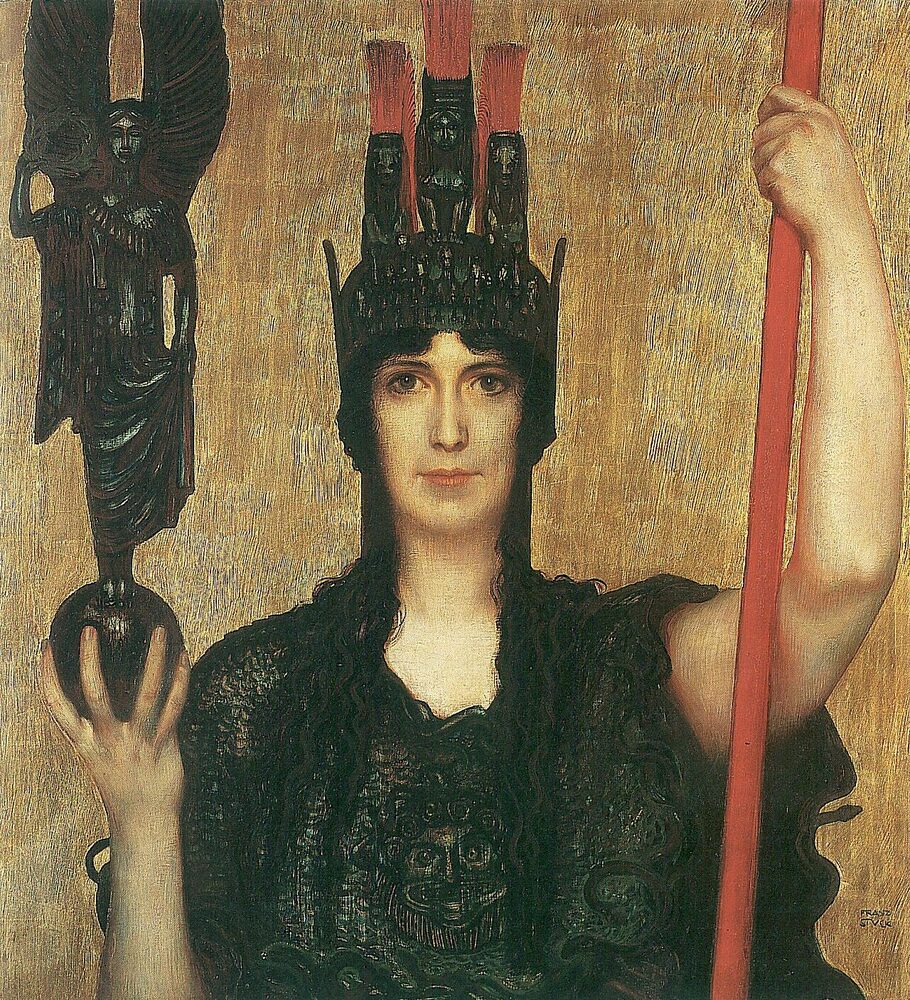
Athena (uh-THEE-nuh) is the grey-eyed goddess of wisdom, of skilled war-craft, of the loom and the workshop, and above all of the city — the divine mind that plans, makes, and defends. Where Ares embodies the blind fury of battle, Athena is war governed by intelligence: the general's forethought, the discipline of the phalanx, the victory won by cunning rather than slaughter. And where that same clear intelligence turns to peace, she is Ergane, the Worker, presiding over the weaver at her loom and the potter at his wheel. She is at once the most warlike and the most civilising of the Olympians.
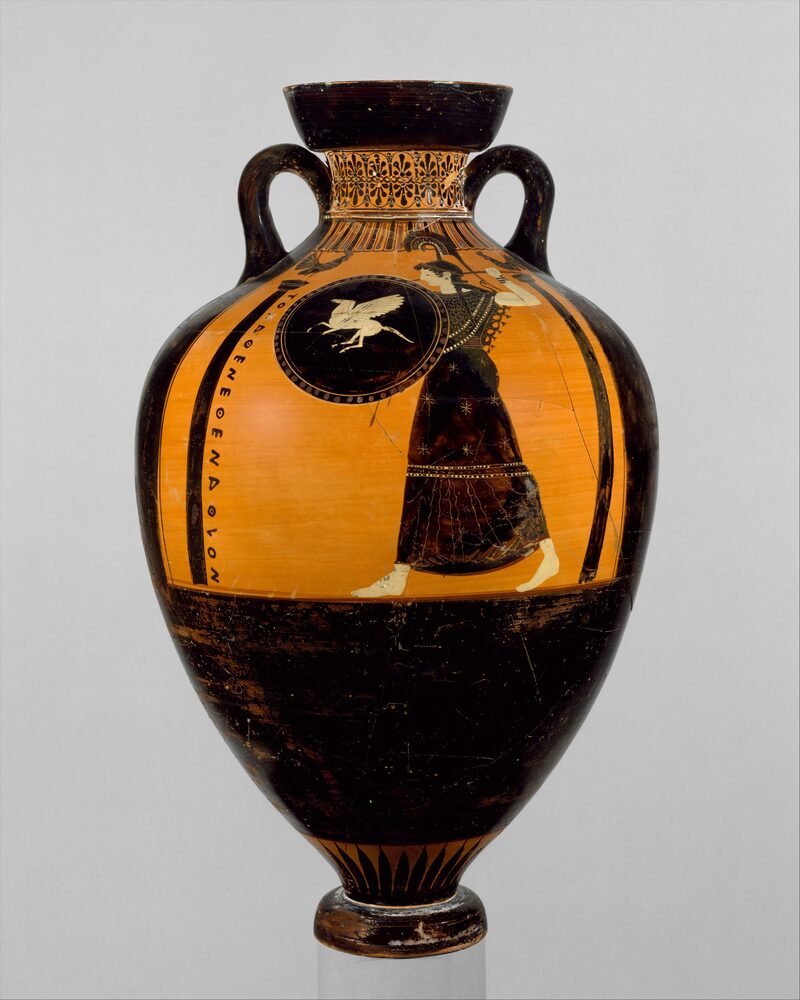
She is Parthenos, the eternal Maiden, who takes no husband and bears no child of her own body, and this untouchable self-possession is central to her power. Her constant companions are the owl, whose unblinking eyes match her own epithet glaukopis, and the olive, the tree of peace and prosperity she gave to Athens. On her breast she wears the aegis, the fringed goatskin set with the severed head of the Gorgon Medusa, whose gaze turns her enemies to stone; in her hand the long spear; on her head the crested helmet. She springs from myth already grown and already armed.
Above all she is the patron of Athens, so fused with her city that the two share a name. From the Acropolis she was worshipped as Polias, guardian of the citadel, and as Nike, the giver of victory; her temples crowned the sacred rock and her festivals ordered the Athenian year. Yet her care reached far beyond one city: she was the standing helper of Greece's greatest heroes — Perseus, Heracles, Odysseus, and the sailors of the Argo — the goddess who steadies the brave and rewards the clever, present at every moment where courage needs a guiding intelligence to make it count.
Mythology
Born from the head of Zeus
Athena's birth is the strangest of any Olympian. Zeus's first wife was Metis, "Cunning Intelligence," wisest of all beings. When she conceived, Gaia and Uranus warned Zeus of a fate that echoed his own rise against Cronus: Metis was destined to bear a daughter, and then a son who would overthrow his father and take the kingship of heaven. To break the chain of usurpers at its root, Zeus coaxed Metis with soft words and swallowed her whole, absorbing her wisdom into himself so that she might counsel him from within (Hesiod, Theogony 886–900). But the daughter already conceived came to term inside him. When her time came his head was split open — by the axe of Hephaestus, later tellers say — and out leapt Athena, full-grown and clad in gleaming armour, brandishing a sharp spear with a war-cry that made Olympus reel and the sea heave (Homeric Hymn 28). Because wisdom itself now lived inside the king of the gods, no son was ever born to Metis, and Zeus's rule was made secure forever.
Hesiod calls the newborn goddess Tritogeneia, "Trito-born" — a title so old that the Greeks themselves no longer knew its meaning. Some connected it to a body of water called Trito or Tritonis; others read it as "head-born." The page follows the archaic Olympian account: she is the child of Zeus's own head, and Tritogeneia is best left as an ancient, unexplained name of honour rather than tied to any one late story.
Pallas, the companion she mourned
Athena's most familiar name, Pallas Athena, carried for the Greeks the memory of grief. In the account preserved by Apollodorus (3.12.3), the young goddess was raised alongside a girl named Pallas, and the two practised the arts of war together. Once, as they sparred, Pallas was about to strike — and Zeus, fearing for his daughter, flashed the aegis before her. Pallas, startled, looked up and dropped her guard, and Athena's blow fell and killed her companion by tragic accident. Stricken with sorrow, Athena made a wooden image in her friend's likeness, wrapped the aegis about it, and set it up in honour beside Zeus. From that lost companion, the story says, she took the name she bore ever after. (The image she carved became, in myth, the Palladium, the sacred figure whose safety was later said to guard the city of Troy.)
The contest for Athens
Athena and Poseidon both desired the land of Attica, and they contended for it by each giving the city a gift. Poseidon struck the rock of the Acropolis with his trident and brought forth a spring of sea-water — a salt well that, it was said, still sounded like waves when the south wind blew. Athena planted the first olive tree. The gods (or, in other tellings, the Athenians and their king Cecrops) judged the olive the greater gift — tree of oil, food, light, and peace — and awarded the city to Athena, who gave it her name (Apollodorus 3.14.1). The token spring and the sacred olive were both still shown on the Acropolis centuries later: Herodotus reports them as physical proofs of the contest (Histories 8.55), and both the birth of Athena and this dispute were carved across the two pediments of the Parthenon (Pausanias 1.24).
Erichthonius, the foster-son
One myth binds Athena to the Athenian royal line — with a difficult beginning worth naming plainly. (Content note: it turns on an attempted assault.) Athena came to the forge for arms, and Hephaestus, spurned by Aphrodite, tried to force himself on her. The virgin goddess fought free; his seed fell instead upon the earth, and from the earth (Gaia) a child was born, Erichthonius (Apollodorus 3.14.6). Athena took the boy as her own foster-son, meaning to raise him in secret and even to make him immortal. She hid the infant in a basket, coiled about by a guardian snake, and entrusted it to the daughters of King Cecrops, forbidding them to look inside. Two of the sisters could not resist; they opened the basket, saw the child with his serpent, and in horror — driven mad, some say, by Athena's anger — flung themselves from the height of the Acropolis. Erichthonius survived to become a king of Athens, and the snake remained one of the goddess's sacred creatures on the citadel. (He is honoured here in the story only; he is not counted among Athena's own children, for she bore none.)
The aegis and the Gorgon's head
Athena's terror in battle is the aegis — a fringed goatskin worn across the breast or shoulders, tasselled and, in Homer's picture of it, ringed with Panic and Strife and Rout (Iliad 5.733–747). Set at its centre is the gorgoneion, the severed head of the Gorgon Medusa, whose face turns those who behold it to stone. In the hero-tales it was Athena who guided Perseus to slay Medusa, lending him her polished shield as a mirror so he need never meet the monster's gaze directly; the head, once won, came to rest upon the goddess's own aegis. So Athena carries her enemy's defeat as her armour, and the image of the Gorgon on shield and temple became one of the most recognisable emblems of divine protection in the Greek world.
The goddess who stands beside heroes
More than any other Olympian, Athena is the helper of heroes — the intelligence that turns bravery into success. She armed and steadied Perseus for the killing of Medusa. She stood at the shoulder of Heracles through many of his labours, and Greek art shows her again and again at his side. She was the guiding genius of the Argo, helping fit the ship that carried Jason and his crew. And she is the presiding goddess of the Odyssey: fierce in her love for clever, enduring Odysseus, she smooths his long way home, disguises and counsels him, and openly delights that his craftiness matches her own (Odyssey 13). Her favour is never merely strength lent to the strong; it is wisdom given to those with the wit to use it.
Arachne and the loom (a later, Roman tale)
The famous story of Arachne — the mortal weaver who boasted she could out-weave Athena, wove a flawless tapestry mocking the gods' loves, and was changed by the furious goddess into a spider, doomed to spin forever — comes down to us chiefly through the Roman poet Ovid (Metamorphoses 6.1–145). It is a beautiful and much-loved tale, but it is a late literary one, not part of the archaic Greek record of the goddess, and it is flagged here as Ovidian rather than drawn from the older Greek sources.
Worship — Ancient
The city on the rock
No deity was more completely identified with a single city than Athena with Athens. Her cult crowned the Acropolis, and her festivals framed the civic year. At the heart of the citadel stood her oldest and holiest image: not the famous gold-and-ivory colossus but the xoanon, an ancient statue of olive wood, said to have fallen from heaven, in which Athena Polias, guardian of the city, was worshipped (Pausanias 1.26–27). Beside it grew her sacred olive, and near it the token spring of Poseidon — the living relics of the contest. This old wooden Athena, not the grand new one, received the woven peplos and the deepest reverence of the Athenians.
The Parthenon and Pheidias's statue
On the highest platform of the Acropolis rose the Parthenon, "the temple of the Maiden," built in the mid-fifth century BCE. Within it stood the Athena Parthenos of Pheidias — a chryselephantine (gold-and-ivory) statue some twelve metres high, the goddess standing armed and helmeted, a figure of Victory (Nike) in her outstretched hand, her shield and spear beside her and a serpent coiled within (Pausanias 1.24). The two pediments of the temple showed the birth of Athena from the head of Zeus and her contest with Poseidon for the land. Two further images watched over the citadel: the bronze Athena Promachos, "who fights in front," a towering figure whose spear-point sailors could reportedly see from the sea, and the small elegant temple of Athena Nike, Victory, on the bastion by the entrance gate.
The Panathenaia
Athena's great feast was the Panathenaia, held each year in the month of Hekatombaion and celebrated with special magnificence as the Great Panathenaia every fourth year. Its climax was a vast procession — riders, magistrates, elders, maidens bearing sacred vessels, and the citizen body — winding up through the city to the Acropolis. At its centre travelled the peplos, a great robe woven by chosen Athenian women; at the Great Panathenaia it was embroidered with the gods' battle against the Giants, carried to clothe the ancient statue of Athena Polias. The festival included athletic contests, chariot races, and musical and rhapsodic competitions, and closed with a great sacrifice of oxen shared among the people. This procession is what the sculptured frieze of the Parthenon is generally thought to depict.
The Plynteria and the washing of the goddess
Set against this splendour was the quiet, uneasy rite of the Plynteria in late Thargelion, when the old statue of Athena Polias was stripped of its robes and ornaments, veiled from sight, and carried down to the sea to be washed and purified before being clothed anew. While the goddess was thus withdrawn and undressed, the Athenians counted the day unlucky and did no important business, for their protectress was for a time unable to guard them. Sacrifices to Athena everywhere centred on oxen and cattle, with offerings of olive oil — her own gift to the city — and cakes, and the dedication of woven work fitting to the goddess of the loom.
Worship — Modern
Honouring Athena today
A modern devotee of Athena can honour her simply and with dignity. A small shrine — a clean shelf will do — bearing a figure of the owl, a sprig or leaf of olive, and a lamp or candle gives the goddess a place in the home; an image of the helmet, the aegis, or the Parthenon suits her equally well. She is above all the goddess of the clear and working mind, so a desk, a workbench, a loom, or a place of study is a natural setting for her. Approach her with attention and honesty rather than elaborate ceremony: clean hands, a clear intention, and a few words of respect befit the goddess of wisdom.
Offerings
Where the ancients gave cattle, a household devotee today most naturally offers a libation and a small gift. Pour out olive oil — her own gift to Athens — or wine, or clean water, into a bowl set aside for her, or onto the earth. A little barley or a barley cake, a piece of woven or handmade work, or an olive are all fitting. If you make or weave or write something, dedicating the finished work to Ergane, the Worker, is very much in her spirit. Present the offering with a few words of thanks, and leave it as truly given.
Prayer & epithets
Call on Athena by the title that fits your need. Turn to Athena Ergane, the Worker, at the start of any craft, study, or skilled task, that the work may go well and true. Invoke Athena Promachos, who fights in front, or Athena Nike, Victory, when facing a contest, a trial, or a hard decision that calls for courage and a steady head. Honour Athena Polias, guardian of the city, for the safety of your home and community. And in daily reverence salute her as Pallas Athena, grey-eyed and wise, the Maiden whose clear intelligence turns strength into something worthy of it. Present-day Hellenic practice keeps these rites symbolic and respectful — libation, prayer, and dedicated work — with no literal sacrifice.
Epithets & Cult Titles
- Pallas (Παλλάς) — Her most constant title in epic and cult; myth traces it to her lost companion Pallas (Apollodorus 3.12.3), though its underlying sense — perhaps 'maiden' or 'brandisher' — was already disputed
- Parthenos (Παρθένος) — The Maiden — the eternally virgin goddess; her great temple on the Acropolis, the Parthenon, takes its name from this title
- Polias (Πολιάς) — Of the city — guardian of Athens and its citadel, worshipped in the ancient olive-wood image on the Acropolis
- Promachos (Πρόμαχος) — Who fights in front — the champion who stands in the front rank of battle, defending the people
- Ergane (Ἐργάνη) — Of handicraft, the Worker — patroness of weavers, potters, carpenters and all skilled makers
- Nike (Νίκη) — Victory — worshipped as Athena Nike in the small temple on the Acropolis bastion, giver of triumph
- Glaukopis (Γλαυκῶπις) — Bright-eyed, grey-eyed, owl-eyed — Homer's standing epithet, the pale gleam of her gaze linked to her owl
- Tritogeneia (Τριτογένεια) — Trito-born — an ancient, unexplained title already obscure to the Greeks themselves, variously guessed to mean 'head-born' or born by some water called Trito
Sources & Variants
- Hesiod, Theogony 886–900 (swallowing of Metis), 924–926 (birth of Athena from Zeus's head; Tritogeneia)
- Homeric Hymn 28 to Athena (her armed birth; Olympus and sea shaken; glaukopis, Tritogeneia)
- Homer, Iliad 5.733–747 (Athena and the aegis); Odyssey 13.287ff (her guidance of Odysseus)
- Apollodorus, Bibliotheca 3.12.3 (Pallas the companion; the Palladium), 3.14.1 (the contest with Poseidon for Attica), 3.14.6 (Erichthonius and the daughters of Cecrops)
- Herodotus, Histories 8.55 (the sacred olive and salt spring on the Acropolis as tokens of the contest)
- Pausanias, Description of Greece 1.24 (the Parthenon pediments and the Athena Parthenos of Pheidias); 1.26–27 (the olive-wood image of Athena Polias, the sacred olive, and Erichthonius)
- Ovid, Metamorphoses 6.1–145 (Arachne — a later Roman telling, flagged as such)
Gallery