Clio
First Appearance
Clio enters the written record at the head of a list. In the proem of Hesiod's Theogony — the oldest poem we have about the gods — the poet names all nine daughters of Zeus and Mnemosyne together, and Clio is named first of them all: "These are they that the Muses sang, who dwell on Olympus, nine daughters born of great Zeus: Kleio and Euterpe and Thalia and Melpomene, Terpsichore and Erato and Polyhymnia and Urania and Calliope" (Theogony 77–79). She has, at this point, no separate story and no single art of her own — she is one of the nine named in a single breath, the choir before the division of their offices — but the catalogue that gives the Muses their names begins with hers.
— Hesiod, Theogony 77–79 (within the proem, 1–115), where the nine Muses are named for the first time
Who They Are
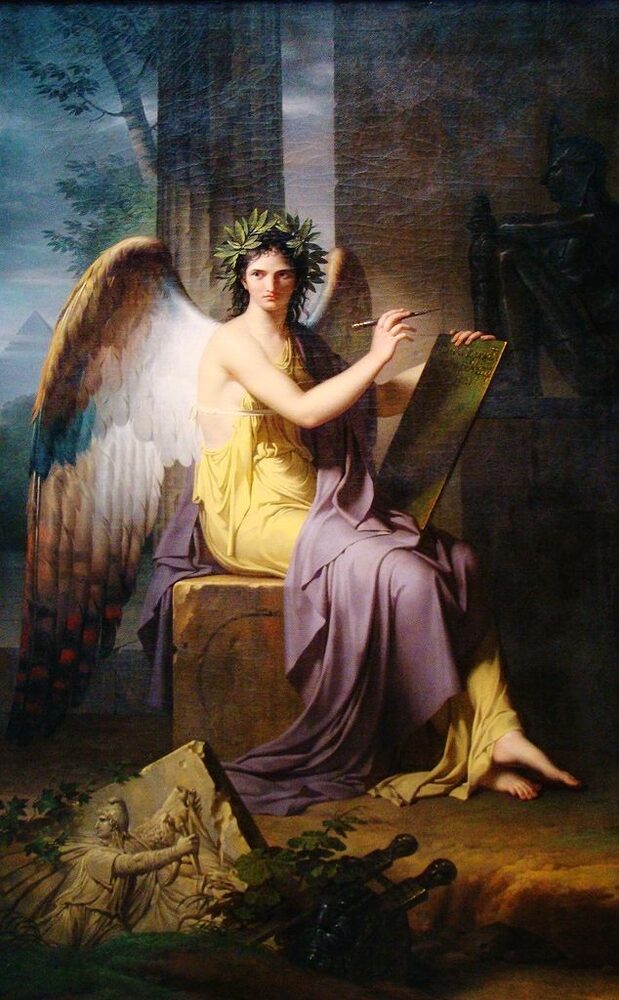
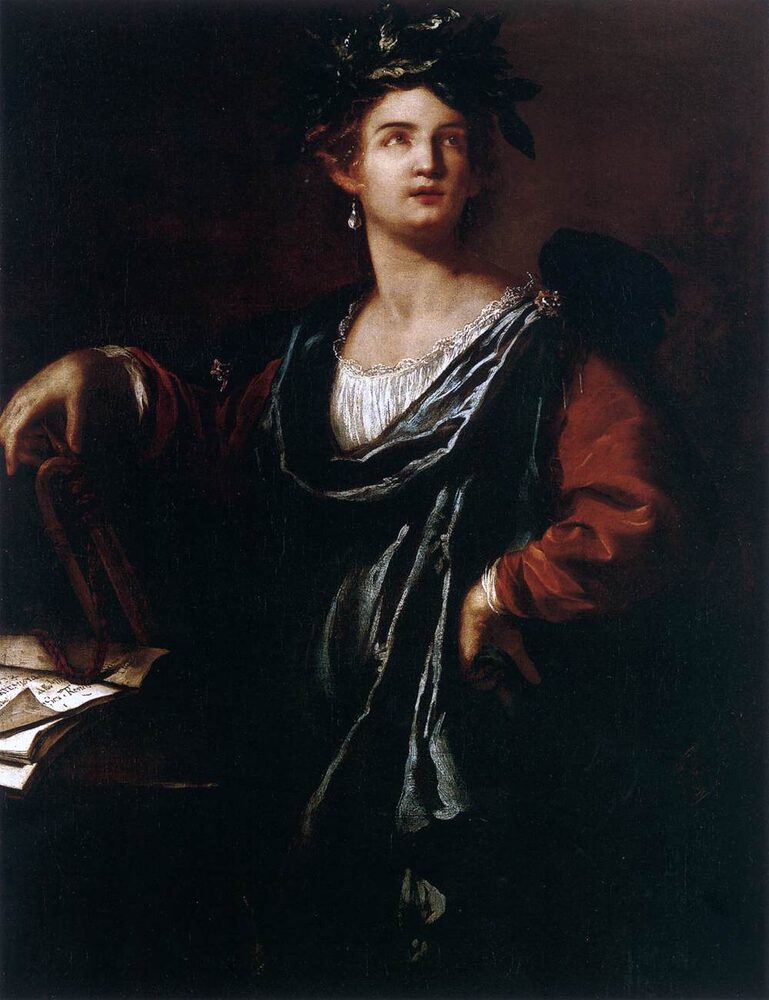
Clio (KLY-oh), in Greek Κλειώ (Kleiō), is one of the nine Muses, the daughters of Zeus and Mnemosyne (Memory), and in the systematised tradition of later antiquity she is the Muse of history. Her name holds the key to her: it is built from kleos, "glory" or "fame" — the lasting report of a great deed — and the verb kleiein, "to celebrate, to proclaim." Clio is therefore "the Proclaimer," she who makes renowned; her gift is to confer the kind of fame that outlives death, taking a deed or a life and fixing it in memory through record and praise so that it is not lost when the doer is gone. Where her sisters inspire the song and the dance, Clio inspires the keeping of the account — the remembering, the setting-down, the handing-on.
Among the nine she is usually reckoned near the head of the choir, and Hesiod names her first of all when he lists the sisters. Her emblem in art is the scroll — the roll of written record — often with a writing-tablet, a chest or stack of books, and, in later and Roman art, a trumpet (the trumpet of fame she sounds for great deeds) and a water-clock. Like all the individual Muses she is sparsely drawn in the earliest sources: the Greeks told few separate stories of any single Muse, and treated the nine largely as one voice. What Clio has that is wholly her own is her name and its meaning, one notable myth of her own, and the long afterlife of her title — for "Clio" has meant "history" itself, in the mouths of historians, for more than two thousand years.
Mythology
Her name, and the gift of kleos
Before Clio is the Muse of history she is "the Proclaimer," and that older, deeper meaning is the heart of her. Her name comes from kleos — one of the great words of Greek culture — meaning the glory, the fame, the undying report that attaches to a great deed and keeps the doer's name alive after death. For a warrior at Troy, kleos was the whole point of a short life: to do something worth singing, so that the song would carry the name down the generations when the body was dust. And that song was the Muses' to give. Clio's name marks her as the one among the nine who most purely embodies this office — kleiein means "to make famous, to celebrate, to proclaim," and so Clio is the power by which a deed becomes known and remembered. History, in this light, is only the later and more formal name for what Clio always did: to confer the fame that outlasts the grave, and to keep in public memory what would otherwise vanish. She is Memory's daughter whose particular work is to make memory sound aloud.
The Muse of history — a later ordering
The familiar picture of Clio with her scroll, presiding over history while her sisters each keep their own art, belongs to a late systematisation and not to the oldest tradition. In Hesiod and Homer the nine Muses are a single choir who sing with one voice; no early source assigns history to Clio or tragedy to Melpomene or astronomy to Urania. The tidy "division of labour," in which each Muse receives one province of art or knowledge, is first set out clearly by Diodorus Siculus (4.7) and became standard only in the Hellenistic and Roman ages — the same late scheme that gave each Muse a single emblem in art. So when Clio is called the Muse of history, the title is true to how the later world understood her, but it is a tradition laid over an older figure who was simply one of the nine. Fittingly, though, the art she was given was the one her name already pointed to: the keeping and proclaiming of great deeds.
Clio and Aphrodite — the love laid on her as a punishment
Clio's one notable story of her own is a cautionary tale told by Apollodorus (Bibliotheca 1.3.3). Clio, it is said, once mocked Aphrodite for the goddess's love of the mortal Adonis — reproaching the goddess of love for stooping to desire a man. Aphrodite does not forgive such a slight, and her revenge was exactly fitted to the offence: she made Clio herself fall in love with a mortal, the man Pierus, king of Macedonia and son of Magnes. By Pierus the Muse bore a son, Hyacinthus — the beautiful youth who would later be loved by Apollo and killed by accident when a discus, thrown by the god (or turned aside by a jealous wind), struck him down, so that from his blood sprang the flower that bears his name. The tale is a small, sharp lesson of a very Greek kind: the Muse who proclaims the deeds and loves of others is herself brought low by love, and made to feel what she had scorned. (This kinship is told in the sources as a note of lineage only; the myth's weight lies in the mockery and its punishment, not in any household the goddess kept.)
Clio and the alphabet — the bringer of letters
A later Greek tradition credits Clio with a gift that suits the Muse of record especially well: the introduction of the Phoenician alphabet — writing itself — to Greece. In this account the letters that came from Phoenicia, by which deeds could at last be set down and kept, were brought or taught by Clio, so that the Muse whose name means "the Proclaimer" is made the patron of the very means by which proclamation is made permanent. The story is a late and secondary one, not found in the early poets, and in the better-known tradition the Phoenician letters are brought to Greece by Cadmus; but the association is a natural and telling one, binding the Muse of history to the written word that history depends upon. In some accounts it is simply said that Clio presides over writing and the keeping of records, the alphabet being her proper instrument.
Worship — Ancient
Clio was worshipped chiefly as one of the nine, not apart from them. Her cult is the Muses' cult: the sanctuary and the great festival of the Mouseia in the Valley of the Muses on Mount Helicon, which Pausanias saw and described (9.29–31) with its grove, its springs, and its statues of the nine; the shrines of the Muses (the mouseia) that stood at the heart of the philosophical schools and gave us the word "museum"; and above all the poet's or scholar's invocation, the calling-upon the Muse that opened a work and acknowledged the song as a loan from the daughters of Memory. Within that shared devotion Clio's particular tie was to the recording and the praising of great deeds — so that the historian setting down what truly happened, no less than the poet, worked under her patronage and could rightly call on her for clear sight and true report. To honour Clio in the ancient manner was to pour clear water, to offer honey and a made work, and to begin by asking the Muse that the account be remembered and told straight.
Worship — Modern
Clio's enduring legacy is that her name became another word for history itself. Historians from antiquity onward have invoked her as the patroness and personification of their craft — "the Clio of historians" — and her name still marks the discipline wherever it is honoured: history journals, learned societies, and awards are named for her (the Clio Awards and many a scholarly "Clio" among them), and the winged, scroll-bearing figure of Clio recurs in the art of libraries, archives, and halls of record as the emblem of history kept and told. She remains the image of the idea that deeds must be remembered truly — that memory, set down and proclaimed, is what saves a life or an age from vanishing.
A modern devotee honours Clio in the key of her art, which is the key of truth and memory. To write or record true history, to keep an honest account, to remember and name those who would otherwise be forgotten, to tend an archive or tell a family's story straight — these are her truest offerings, more fitting than incense. Following the ancient shape, one might pour a simple libation of clear water, recalling the Muses' springs, light a candle, and dedicate the work of recording to her before beginning, asking the Proclaimer for clear sight and a true report. To keep faith with Clio is to keep memory honest, and to give the dead and the past the kleos — the lasting, truthful fame — that is her gift.
Epithets & Cult Titles
- Κλειώ (Kleiō) — "the Proclaimer," she who makes renowned — Her name is her office. From kleos ("glory, fame") and kleiein ("to celebrate, to proclaim"), Clio is the Muse who confers renown — who takes a deed and makes it famous by singing or recording it, so that it outlasts the doer. In the Greek understanding a thing is not truly remembered until it is proclaimed, and that proclaiming is her gift
- daughter of Mnemosyne (Memory) — Like all the nine, Clio is a child of **Zeus** and **Mnemosyne**, Memory — and the kinship is especially telling for her, the Muse later given history as her province. History is memory made public and lasting; the recorder of great deeds is, fittingly, Memory's own daughter
- Heliconian and Pierian Maiden — She shares the two homelands of the choir: **Pieria** north of Olympus, where the nine were born, and **Mount Helicon** in Boeotia, where they dance about the springs. "Pierides" and "the Heliconian Muses" name her as one of the sisters before any single art was parcelled out among them
- Muse of History — The title the later tradition fixed to her — Clio as the presiding power of history, the recording and the praising of what truly happened. The assignment is a late systematisation (see below), but it took so firm a hold that "Clio" and "history" became almost one word in the learned imagination
Sources & Variants
- Hesiod, Theogony 77–79 (the naming of all nine Muses, with Kleio named first); and 1–115 (the proem: the Muses of Helicon, their birth to Zeus and Mnemosyne over nine nights in Pieria, their office of song and true speech)
- Apollodorus, Bibliotheca 1.3.1 (the nine Muses, daughters of Zeus and Mnemosyne, listed by name)
- Apollodorus, Bibliotheca 1.3.3 (Clio mocks Aphrodite for her love of Adonis; in revenge Aphrodite makes Clio love Pierus son of Magnes, by whom Clio bears Hyacinthus)
- Diodorus Siculus, Library of History 4.7 (the systematic account of the nine Muses and the particular art assigned to each — the source for the later ordering that made Clio the Muse of history)
- Pausanias, Description of Greece 9.29–31 (the Valley of the Muses and the sanctuary on Helicon; the springs; the statues, names, and number of the Muses; the traditions of the mountain)
Gallery