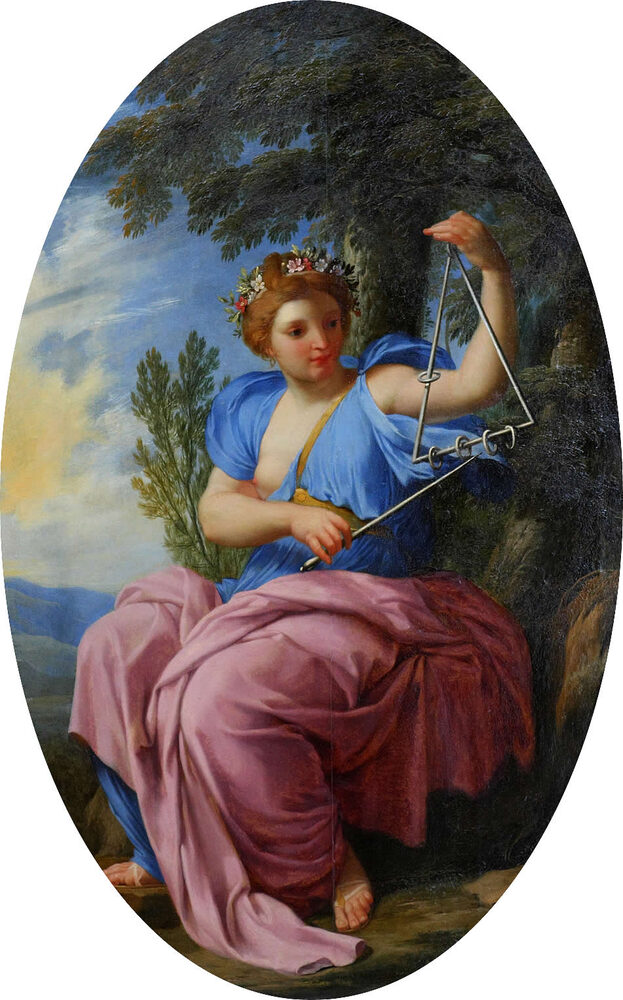
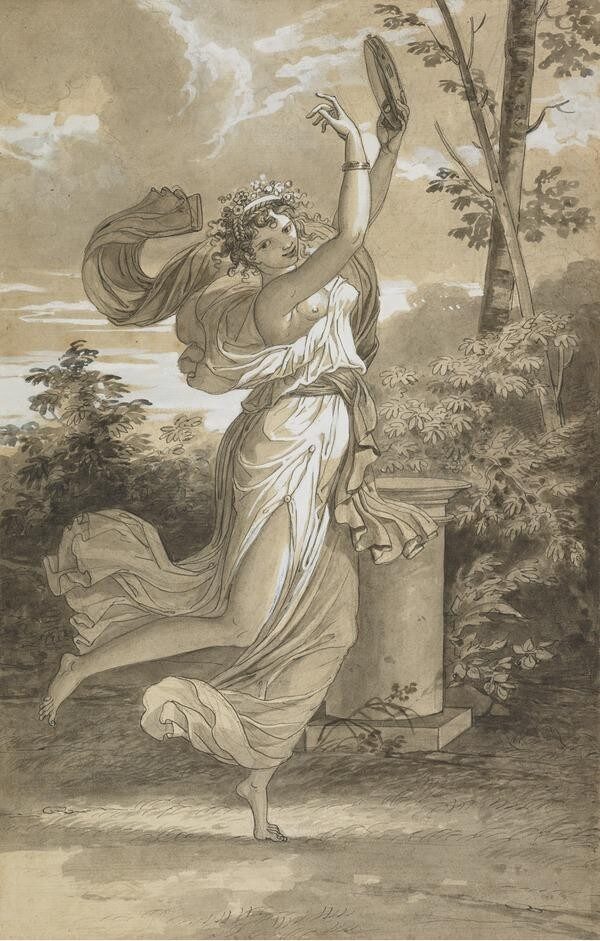
Terpsichore
First Appearance
Terpsichore first steps into the record where all nine Muses do: in the proem of Hesiod's Theogony, the oldest poem to name them one by one. Having told how Mnemosyne bore her daughters to Zeus over nine nights in Pieria, Hesiod lists the nine in order — "Clio and Euterpe and Thalia and Melpomene and Terpsichore, and Erato and Polyhymnia and Urania and Calliope, who is the chief of them all" (77–79). She is given no separate story there and no single art; she is simply one voice in the choir of the daughters of Memory, named between Melpomene and Erato — which is, for most of the Muses taken singly, exactly as much as the earliest poets tell us.
— Hesiod, Theogony 77–79 (the naming of the nine Muses in the proem; Terpsichore at line 78)
Who They Are
Terpsichore (terp-SIK-uh-ree), in Greek Τερψιχόρη, is one of the nine Muses, the goddesses of poetry, music, and the arts who are daughters of Zeus and Mnemosyne (Memory). Her name means "delight in dancing" — from terpein, "to delight," and choros, the ring-dance of singers — and by the later arrangement that gave each of the nine her own province she became the Muse of dance and of choral song, the sister in whom the Muses' art takes on a body and moves. She is most often shown seated or standing with a lyre and its plectrum, for in her the dance is never silent: she both leads the dancers and plays the music they move to. (She belongs, as all the nine do, to the collective page on the Muses, where their shared birth, their mountain-haunts, their invocation, and their contests are told; this page is for Terpsichore in particular.)
It is worth saying plainly that the single art assigned to each Muse — Terpsichore's dance, Calliope's epic, Urania's astronomy — is a late systematisation, no older than the Hellenistic and Roman handbooks; the early poets treat the nine as one choir singing with one voice, and give the individual Muses almost no separate myth. Terpsichore's domain, though, was a happy fit, because her name already held it. To the Greeks, dance, song, and music were not three arts but one — the choros was at once a dance, a chorus of singers, and the music that carried them, performed together at every festival and in every tragedy — and Terpsichore's name names exactly that union. She is the Muse of the moment when words are sung and the singers move, and the three become inseparable.
Mythology
Her name, and the one art given to each Muse
Terpsichore is, before she is anything else, a name — and the name is the key to her. It joins terpein, "to delight, to gladden," to choros, the ring-dance of singers, and so means "she who delights in the dance" or "she who makes the dance a joy." In the earliest poetry she has no office of her own: Hesiod names her among the nine (Theogony 78) and no more, and Homer calls on the Muses as a single choir. Only later, in the systematising handbooks of the Hellenistic and Roman world — the fullest is Diodorus Siculus (4.7), who sets out the whole scheme — was each of the nine assigned a particular art, and Terpsichore, by the plain sense of her name, was given dance and the choral lyric. This "division of labour" is a tidy afterthought laid over a much older and vaguer tradition, and it is honest to say so; but of all the assignments it is the least arbitrary, for it only wrote down what her name had always meant.
The choros — why dance, song, and music are one
To understand Terpsichore's domain one has to set aside the modern habit of keeping the arts in separate rooms. The Greek choros was all of them at once: a body of performers who sang, danced, and moved in figured patterns together, to music, as one thing. The chorus of a tragedy danced its odes; the maidens' songs sung at festivals were danced as they were sung; the hymn to a god was carried on moving feet. There was no dance without song and no choral song without the dance — and the word choros meant both the dancing-floor and the dancers and the dance itself. Terpsichore's name reaches straight into the heart of this: she is the Muse of the danced song, the presiding power of the moment when music, poetry, and movement are a single act. Her emblem the lyre, held with its plectrum, marks this exactly — she is not a dancer only but the one who both leads the dance and makes the music it answers to.
Mother of the Sirens — a famous variant
Terpsichore's one real thread of myth is a question of parentage, and it is a tangled and much-disputed one. In several sources the Sirens — the bird-women whose song lured sailors onto the rocks — are called the daughters of a Muse by the river-god Achelous, and the Muse most often named is Terpsichore. Apollonius of Rhodes, in the Argonautica (4.895–896), says outright that the Sirens were born of Achelous and Terpsichore, "one of the Muses." But the tradition does not agree: Apollodorus (Bibliotheca 1.3.4) names their mother instead as Terpsichore's sister Melpomene (the Muse later given to tragedy), and still other writers name other Muses or no Muse at all. This is a genuine variant, not a settled fact — in some accounts Terpsichore is the Sirens' mother, in others Melpomene — and the disagreement is itself the interesting thing: it was felt fitting that creatures of such deadly, beautiful song should be born of a Muse, but which Muse was never fixed. (There is a certain irony in it, too, for elsewhere the Muses defeat the Sirens in a singing-contest and strip their feathers — a tale told on the Muses' own page.)
Mother of Linus
A fainter strand of the same kind makes Terpsichore the mother of Linus, the musician whose name was given to a famous dirge and who, in myth, was the brother or teacher of Orpheus and a figure of music's own origin and early death. Here again the tradition is divided and not to be pressed: Linus is variously called the son of Calliope, of Urania, or of Terpsichore, by Apollo or by a mortal, and no account is canonical. It belongs with the Sirens-tale as one of the few places where Terpsichore is given issue at all — and, tellingly, what she is given are figures of song and music, as though the Muse of the danced song could only be mother to the things that sing.
Otherwise, one of the nine
Beyond these contested scraps of parentage, Terpsichore has no myth of her own — no adventure, no quarrel, no transformation. This is not a gap in the record so much as the nature of the individual Muses: taken one by one they are sparse, almost abstract, their reality lying in the choir rather than in separate stories, and it would be a false enrichment to pretend otherwise. What is told of Terpsichore is told of the nine together — their birth of Zeus and Memory, their dancing on Helicon, their singing before the gods, their gift to poets, their contests with the Pierides and the Sirens and with Thamyris. She shares in all of it. Her distinctness is not a story but a meaning: among the nine, she is the one who dances, and whose name made "delight in the dance" a thing with a face.
Worship — Ancient
Honoured among the nine
Terpsichore had no separate cult, no temple and no priesthood of her own; she was worshipped as one of the Muses, wherever the nine were honoured together. That worship clustered on their sacred mountains and in the places where music, poetry, and learning were pursued — above all in the Valley of the Muses on Mount Helicon in Boeotia, below the springs Hippocrene and Aganippe, where the town of Thespiae kept a sanctuary set with statues of all nine and held the great festival of the Mouseia, with its contests of poetry and music. Pausanias, who toured the sanctuary in the second century AD (Description of Greece 9.29–31), describes the grove, the spring, and the images of the Muses that stood there. To honour Terpsichore was to honour the choir she sang and danced in; her offerings were theirs — clear water from their springs, honey, first-fruits, and the fitting gift of a song or a dance made in their name.
The Muse of the choral dance at the heart of worship
If Terpsichore had no cult of her own, she nonetheless stood very close to the heart of Greek religious life, because the thing she presided over — the choros, the danced and sung chorus — was itself one of the chief acts of worship. Greek festivals were danced; choruses of boys and girls sang and moved in honour of the gods at Delphi, Delos, Sparta, and Athens; the dithyramb danced for Dionysus and the maidens' partheneia danced for Artemis and Apollo were religious performances before they were anything else. Dance was not entertainment at the edge of the sacred but a form of prayer at its centre. Terpsichore, the Muse of exactly that danced and choral song, was therefore invoked and present in the commonest and most public of all Greek rites — the moving, singing chorus by which a whole community honoured its gods.
Worship — Modern
The lasting patroness of the dance
Of all the nine, Terpsichore has kept the clearest and most living afterlife, because her art never fell out of use and her name travelled with it. She remains, simply, the Muse of dance — the figure invoked wherever dance is spoken of with reverence or wit. The adjective "terpsichorean," meaning "of or relating to dancing," is her name worn down into ordinary English: a dancer's art is the terpsichorean art, and to trip the terpsichorean measure is to dance. Ballet companies, dance schools, and theatres bear her name; she presides, in paint and marble, over opera-house ceilings and the frontispieces of books on the dance. She is the one Muse most people can still name the province of, and that province is the oldest and most universal of the arts.
Honouring Terpsichore today
A modern devotee drawn to Terpsichore honours her best in the key of her own art — by moving. To dance, in joy or in grief or in prayer; to make or join in choral music, song and movement together as the Greeks knew them; to pour a simple libation of clear water, recalling the springs of Helicon; and to dedicate the work — the dance danced, the chorus sung, the step learned — to the Muse before beginning: these are truer offerings to her than incense. Her name is an instruction as much as a title. It says that the dance is meant to be a delight, and that to give oneself to the choros — to move and sing with others as one body — is itself the oldest way of keeping faith with the daughter of Memory who delights in the dance.
Epithets & Cult Titles
- Τερψιχόρη (Terpsichorē) — "delighting in the dance" — Her own name read as a title: the Muse whose joy is the choros, the choral dance of singers. Where her sisters' names describe a voice or a theme, hers describes a body in motion — she is the one of the nine in whom song becomes movement and movement becomes song
- Μοῦσα ὀρχήσεως (Mousa orchēseōs) — "Muse of Dance and Choral Song" — The office assigned to her in the later systematisation of the nine (as in Diodorus): she presides over dance and over the choral lyric sung to it. The assignment is a late tidying-up, but it fits her name so exactly that it has never been displaced — Terpsichore has been the Muse of the dance for two thousand years
- Ἑλικωνιάς / Πιερίς (Helikōnias / Pieris) — "the Heliconian / Pierian Maiden" — A Muse of Mount Helicon in Boeotia and of Pieria north of Olympus, dancing about the springs with her sisters; and, as all nine are, a daughter of Mnemosyne (Memory) — one of the Mnemosynides, so that even the dance is, in the Greek understanding, a form of remembering made visible
Sources & Variants
- Hesiod, Theogony 77–79 (the naming of the nine Muses in order, Terpsichore at line 78); 1–115 (the proem as a whole: the Muses of Helicon, their birth to Zeus and Mnemosyne over nine nights in Pieria, their dancing and their office of song)
- Apollonius of Rhodes, Argonautica 4.895–896 (the Sirens born of the river Achelous and the Muse Terpsichore)
- Apollodorus, Bibliotheca 1.3.4 (the nine Muses listed; the Sirens as daughters of Achelous and Melpomene — the variant parentage to Apollonius; the Muses and the parentage of Orpheus and Linus)
- Diodorus Siculus, Library of History 4.7 (the systematic account of the nine Muses and the particular art assigned to each — the source for the 'division of labour' by which Terpsichore is made Muse of dance and choral song)
- Pausanias, Description of Greece 9.29–31 (the Valley of the Muses and the sanctuary on Helicon; the spring Hippocrene; the statues of the Muses and the traditions of the mountain; the number and names of the nine)
- Homer, Iliad 2.484–493 and Odyssey 24.60–62 (the Muses invoked as one choir, present at all things and remembering; the nine singing the dirge at the funeral of Achilles) — the earlier tradition that treats the Muses collectively, before the single arts were assigned
Gallery