Calliope
First Appearance
Calliope first steps out of the choir of her sisters in the oldest poem about the gods. Hesiod, naming all nine daughters of Zeus and Mnemosyne in the proem of the Theogony (77–79), keeps her for last and crowns her with a line that fixed her rank for all antiquity: "…and Calliope, who is the chiefest of them all, for she attends on revered kings." To be named last in Hesiod's list is to be named first in honour — and from this single verse the whole later tradition drew its picture of Calliope as the eldest and greatest of the Muses, the leader of the nine, and the goddess whose voice serves poet and king alike.
— Hesiod, Theogony 77–79 (the naming of the nine Muses, and Calliope named last and greatest)
Who They Are
Calliope (kuh-LY-uh-pee), in Greek Καλλιόπη, is the chief and eldest of the nine Muses, and in the later ordering of the sisters the Muse of epic poetry — the heroic song of gods and heroes in the long hexameter line. Like all her sisters she is a daughter of Zeus and Mnemosyne (Memory), born with the nine over as many nights in Pieria, and for her shared story — the birth in Pieria, the dancing-grounds of Mount Helicon and the springs Hippocrene and Aganippe, the poet's invocation, the contests and the music-cult — her page points back to the collective page of the Muses, of which this is one leaf. What is proper to Calliope herself is her primacy. Her name means "beautiful-voiced," from kallos ("beauty") and ops ("voice"), and she is the one of the nine named directly for the quality of her song.
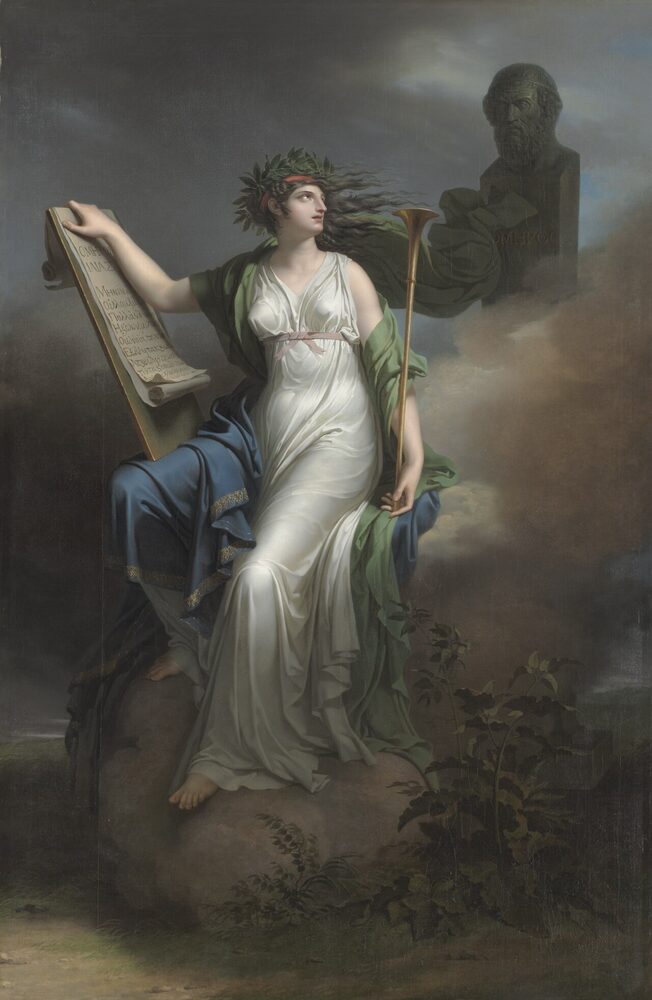
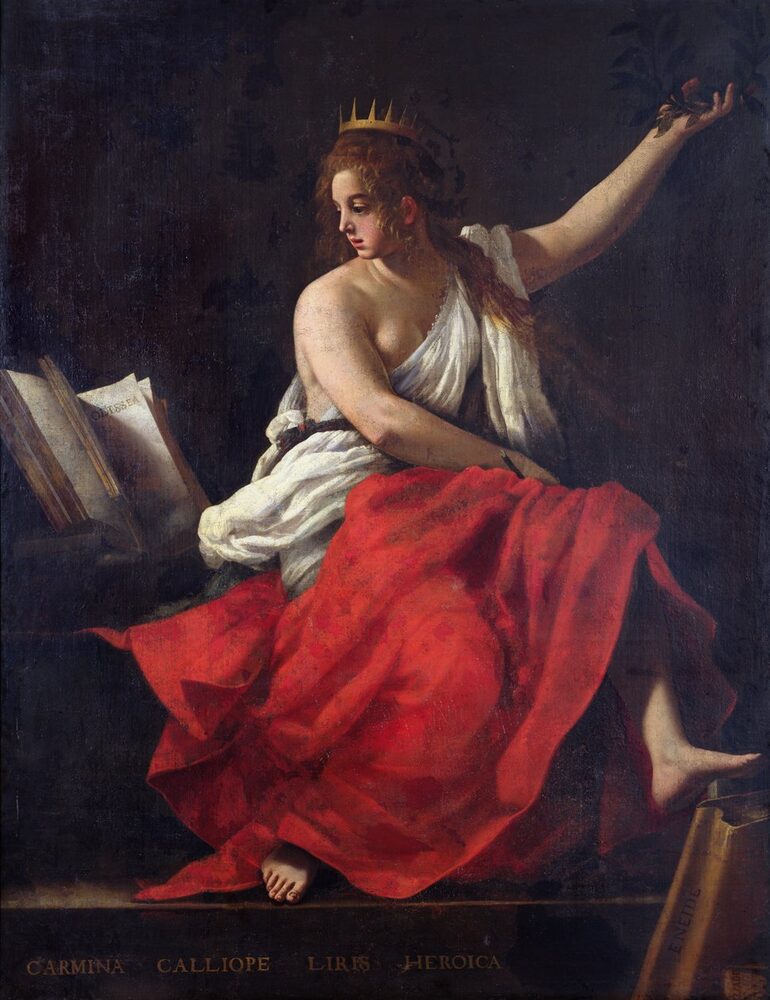
It is Hesiod who sets her at the head of the choir. Naming the nine in the Theogony, he keeps Calliope for last and adds that she "is the chiefest of them all, for she attends on revered kings" (79) — so that her office is double from the very first: she pours her gift both on the poet, whose song she makes beautiful, and on the just king, whose speech she makes persuasive and whose judgements she makes straight. Her emblems, fixed by later art, are the writing-tablet and stylus and the scroll of epic (she is commonly shown beside a bust of Homer, and sometimes holding a trumpet, the instrument of far-carrying fame). The assignment of epic poetry to her in particular is, like the one-art-each scheme for all the Muses, a late systematisation — the early poets treat the nine as one choir — but it fell to Calliope by right, for the grandest of the arts belonged to the greatest of the Muses.
Mythology
Her name, her rank, and the one-art-each scheme
Calliope's name is her first myth. Καλλιόπη is "beautiful-voiced" — kallos, "beauty," joined to ops, "voice" — and of all the nine Muses she alone is named directly for the quality of her utterance, so that her very name declares what she gives. Hesiod fixes her rank in the Theogony (77–80), naming her last of the nine and calling her "the chiefest of them all," the one who "attends on revered kings"; from this the later tradition made her the eldest of the sisters and the leader of the choir. The particular art she came to preside over — epic poetry, the long heroic hexameter — belongs to the later division of labour among the Muses, the one-art-each scheme set out by Diodorus (4.7) and the Roman handbooks and not found in the early poets, who treat the nine as a single voice. But the assignment suited her: the greatest and oldest of the poetic arts fell to the greatest of the Muses, and it is Calliope, above all her sisters, whom the epic poets mean when they open a poem by calling on "the Muse." Her emblems in art — the writing-tablet and stylus, the scroll inscribed with Homer or Virgil, now and then a trumpet for far-sounding fame, and the figure of Homer himself at her side — all speak of this office.
Mother of Orpheus, the supreme singer
The myth most firmly attached to Calliope herself is that she was the mother of Orpheus, the greatest of all mortal singers, whose music moved stones and trees and stayed the rivers in their beds. On his father the tradition tells it two ways. In the common account he was born to Calliope by Oeagrus, a king of Thrace; in another, which Apollodorus reports alongside the first (Bibliotheca 1.3.2), his father was Apollo himself, god of the lyre — a parentage that made the supreme human musician the son of the god of music and the chief of the Muses together. Either way the point is the same, and it is a beautiful one: the greatest singer among men was reckoned the son of the greatest of the Muses, his gift an inheritance from the daughters of Memory. When Orpheus was torn apart in Thrace, the poets say, it was the Muses — his mother and her sisters — who gathered his scattered limbs and gave them burial, and set his lyre among the stars. (Some sources make Calliope the mother of other singers too, such as Linus; but it is as the mother of Orpheus that she is best and most firmly remembered.)
The contest with the Pierides — Calliope's winning song
When the nine daughters of Pierus, a Macedonian king, grew so proud of their singing that they came to Helicon and challenged the Muses to a contest — nine mortals against the nine goddesses — it was Calliope who rose to sing for her sisters, and the choice was fitting, for the chief of the Muses answered the chief presumption. The fullest telling is Ovid's (Metamorphoses 5.294–678), and there the mortal sisters sing first an insolent song of how the gods had fled from the monster Typhoeus; then Calliope sings, and her theme is the rape of Persephone and the long grief and wandering of Demeter, the gift of grain and the ordering of the seasons — a song of such surpassing beauty that the nymphs who judged gave the goddesses the victory without a dissenting voice. When the daughters of Pierus railed against the verdict, the Muses turned them into chattering magpies. The episode is one of the few places in surviving literature where we are given a Muse's actual song at length, and Ovid lets Calliope stand for the art of the nine at its height.
The judgement over Adonis
A quieter tale gives Calliope the role not of singer but of judge. Hyginus preserves it (Astronomica 2.7): when the infant Adonis, loveliest of mortals, was quarrelled over by two goddesses — Aphrodite, who had hidden him away, and Persephone, into whose keeping she had given him and who would not give him back — Zeus set the dispute before Calliope to arbitrate on his behalf. Her ruling was a model of measured justice: the boy should divide the year, spending one part of it with Aphrodite, one part with Persephone, and keeping one part for himself. It is a small myth, but a telling one, for it shows the chief Muse exercising the very gift Hesiod gave her — the clear, ordering, judicious speech that settles great quarrels with gentle words. (The story goes on to say that Aphrodite, angered by the judgement, stirred up the Thracian women against Calliope's son Orpheus, so that they tore him apart — a dark thread binding this myth back to the first.)
A note on what is not told
Beyond these, the individual stories of Calliope are few — as they are for all nine of the Muses, who live more as a single choir than as separate characters. She has no temple-cycle of her own, no long saga; she is the eldest and greatest of her sisters, the mother of the greatest singer, the voice that won on Helicon and the judgement that divided the year. The encyclopedist's honesty requires saying plainly that the rest of what is sometimes written of her is either shared with all the Muses or spun late from her name. Her greatness is real, and so is the sparseness of her myth; both belong to the truth of her.
Worship — Ancient
Honoured among the nine
Calliope received no separate cult of her own: she was worshipped as one — the first — of the Muses, and her worship is their worship. On Mount Helicon, in the Valley of the Muses below the springs Hippocrene and Aganippe, the Boeotian town of Thespiae kept the sanctuary of the nine, with its grove, its altars, and its statues, and there the great festival of the Mouseia was held with its contests of poetry and music; Pausanias saw the grove and the statues when he toured Boeotia (Description of Greece 9.29–31). Wherever learning was pursued — in the philosophical schools gathered about a mouseion, and in the great Mouseion of Alexandria from which our word museum descends — the Muses, Calliope among them, were the presiding powers. (For the full shape of the Muses' cult, see their collective page.)
The first voice of the invocation
What was most especially Calliope's, within that shared worship, was the epic poet's invocation. When a singer of heroic song opened his poem by calling on "the Muse" to sing of the wrath of Achilles or the man of many turns or the arms and the man, it was above all Calliope, chief of the nine and goddess of epic, to whom the appeal was made. To begin a great narrative song was to acknowledge that its matter and its ordering came not from the poet but as a loan from her — and so the rite most proper to Calliope was performed, unknowingly, at the head of every epic ever sung: the asking of the Beautiful-Voiced for a voice.
Worship — Modern
The name that carried on
Calliope's name has had a long and curious afterlife. As the chief of the Muses and the goddess of epic she stands behind the whole Western idea of the heroic poem, and poets who invoke "the Muse" at an epic's head — Virgil, Dante, Milton — are reaching, whether they name her or not, for Calliope's gift. But her name travelled further than her office: in the nineteenth century it was given to the steam organ, the loud, bright, carnival instrument of fairgrounds and riverboats — named, with a wink, for the "beautiful-voiced" Muse, though its voice is anything but gentle. So the same name graces the loftiest of the arts and a steam-whistle calliope on a paddle-steamer, which is a very human sort of immortality.
Honouring Calliope today
A modern devotee drawn to Calliope honours her in the key of her own art — the art of the long story told in verse. To write or recite epic or narrative poetry, to take up a great tale and give it ordered, beautiful shape, is the truest offering to the chief of the Muses; so too is any work of just and persuasive speech, for Hesiod gave her the tongue of kings as well as of poets. Following the ancient shape, one might pour a libation of clear water in memory of the Muses' springs, speak an invocation asking for a true and carrying voice, and dedicate the finished work to her before letting it go. To keep faith with Calliope is to begin the great undertaking by asking for help with it, and to make the song as beautiful as her name.
Epithets & Cult Titles
- Καλλιόπη (Kalliopē) — "the Beautiful-Voiced" — Her own name read as a title: kallos ("beauty") and ops ("voice"). Of all the Muses she alone is named directly for the quality of her voice, and the name marks her as the fairest-speaking of the nine — the goddess whose utterance is itself beautiful, fit for the grandest song
- προφερεστάτη (propherestatē) — "the foremost of them all" — Hesiod's own word for her at Theogony 79: she is προφερεστάτη, pre-eminent, the chiefest and first-ranked of the nine, named last in his list of the Muses precisely because she is greatest. The later tradition reads her as the eldest of the sisters, the leader of the choir
- Muse of Epic Poetry — The art assigned to her in the later systematisation of the nine (Diodorus and the Roman handbooks): hers is the heroic hexameter, the long narrative song of gods and heroes. This is why she is shown with the tablet and the scroll of Homer, and why the epic poets invoke "the Muse" at a poem's head looking, above all, to her
- attendant of kings — Hesiod says she "attends on revered kings" (Theogony 79–80): the Muse who pours sweet dew on a just king's tongue so that his judgements are straight and his words settle great quarrels gently. Her gift is thus twofold — the beautiful song of the poet and the persuasive, ordering speech of the good ruler
Sources & Variants
- Hesiod, Theogony 77–79 (the naming of the nine Muses, with Calliope named last and called 'the chiefest of them all, for she attends on revered kings'); and 1–115 (the Muses' birth to Zeus and Mnemosyne in Pieria, their office of song and the dew they pour on poet and king alike — the shared context of all nine)
- Apollodorus, Bibliotheca 1.3.1 (the nine Muses, daughters of Zeus and Mnemosyne, listed by name); 1.3.2 (Calliope the mother of Orpheus by Oeagrus — or, in the other account, by Apollo — and of Linus)
- Ovid, Metamorphoses 5.294–678 (the contest of the Muses with the daughters of Pierus; Calliope rises to sing for the nine, her song of the rape of Persephone and the grief of Demeter; the victory of the goddesses and the transformation of the mortals into magpies) — Roman retelling
- Hyginus, Astronomica 2.7 (Calliope appointed by Zeus to arbitrate the quarrel of Aphrodite and Persephone over the infant Adonis, ruling that he divide the year among them; and the consequence for her son Orpheus)
- Diodorus Siculus 4.7 (the systematic account of the nine Muses and the particular art assigned to each, the source of Calliope's association with epic poetry) — the later 'division of labour' among the nine
- Pausanias, Description of Greece 9.29–31 (the Valley of the Muses and the sanctuary on Helicon, the springs, and the statues of the Muses — the setting of the cult Calliope shares with her sisters)
Gallery