Orpheus
First Appearance
Orpheus is not named in Homer or Hesiod, but he was clearly ancient by the archaic age: the lyric poet Ibycus, writing in the sixth century BCE, already calls him "famous Orpheus" (onomaklyton Orphen), naming him as a byword for renown as though the audience needed no explanation. A little earlier the poet Simonides speaks of how countless birds flew above his head and fish leapt straight up out of the dark water at his beautiful song — so that the picture of the beast-charming singer is fixed in Greek poetry from its earliest surviving mentions, long before the full descent-myth is written down.
— Ibycus, fragment 306 (Page) — 6th century BCE
Who They Are
Orpheus (OR-fee-us) is the supreme musician of Greek myth — a mortal, not a god, yet honoured with a devotion and a cult that few heroes ever received. The Greeks made him the son of the Muse Calliope ("Beautiful-Voiced," the eldest of the nine and the Muse of epic song), so that music was his birthright: he was, quite literally, the son of a Muse. His father in the usual telling is the Thracian king Oeagrus, though one strand of the tradition made his true father Apollon himself, the god of the lyre; either way it was Apollon, the myths agree, who gave or taught him the instrument, and Orpheus repaid the gift with a lifetime's devotion to the god.
What set him apart was not skill alone but power. When Orpheus sang and touched the strings, the whole world stopped to listen: wild beasts lay down tame at his feet, birds wheeled above his head, the trees pulled up their roots and crowded near, the rivers turned in their beds, and even the bare stones of the hillside shifted to follow him. His was the music that could move the unmoveable — and it is this power, carried to its furthest reach, that drives the story for which he is best remembered: that he sang his way down into the land of the dead and very nearly sang his wife back out of it.
But Orpheus is more than a love-story. His name became attached to a whole religious movement — Orphism, a mystery tradition with its own sacred books, its own account of the birth of the gods, and its own hard doctrine of the soul, its guilt, and its long journey through death and rebirth. So he stands at a strange crossroads of Greek imagination: at once the tenderest figure in myth, the husband who could not stop himself from looking back, and the awesome founder-name of a religion of the soul. (Content note: his story turns on grief, the death of a spouse, and a violent death; these are treated frankly below but not graphically.)
Mythology
The singer whom all things followed
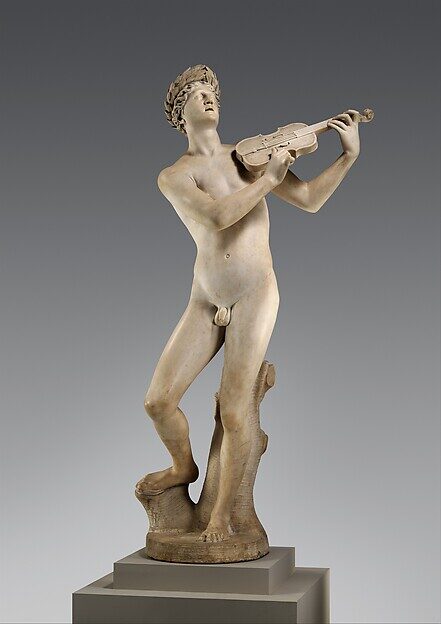
Orpheus was born in Thrace to the Muse Calliope, and from his mother's line he took a voice and a musicianship beyond any mortal's. The lyre was his — a gift, the poets said, of Apollon, who in one tradition was his very father — and he brought it to a perfection that reached past human ears. When he played, the order of nature bent toward him: oaks came down from the mountains and stood in ranks to hear him, savage animals grew gentle, birds hung in the air, and the rivers stilled their currents. This is the constant image of Orpheus in Greek and Roman art and verse, the singer ringed by a listening world. His gift also had a practical fame: when he sailed with Jason and the Argonauts in search of the Golden Fleece, his lyre set the beat for the oars and calmed quarrels among the heroes, and when the ship passed the Sirens, whose song lured sailors to their deaths, Orpheus simply out-sang them, drowning their deadly music with his own so that the Argo passed unharmed.
Eurydice and the descent to the dead
(Content note: grief and the death of a spouse.) The heart of his myth is his love for Eurydice, in most tellings a nymph, whom he married. Their joy was brief. Soon after the wedding Eurydice, walking through the grass — in one famous version fleeing the unwanted pursuit of the herdsman Aristaeus — was bitten on the foot by a hidden serpent and died, and her shade went down to the house of the dead. Orpheus could not bear it. Rather than mourn from a distance, he did what no living man was meant to do: he went down alive into the underworld to bring her back, carrying only his lyre. Past the terrors of that realm he went, and where sword or strength would have failed, his song opened the way. He sang before the dread rulers of the dead — Hades and his queen Persephone — and his lament was so piercing that, the poets said, the whole underworld wept: the bloodless ghosts shed tears, the tormented paused in their torments, and for the first and only time the iron cheeks of the powers below were wet. Moved as they had never been moved, the king and queen of the dead granted what had never been granted: Eurydice might follow him back up to the light.
The backward glance
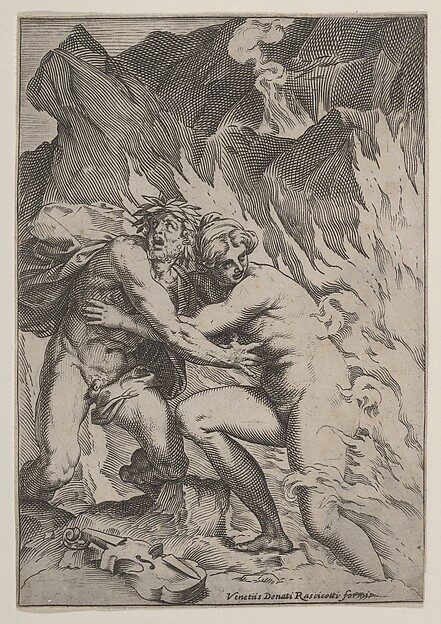
But there was one condition, laid down by Hades: Orpheus must walk ahead and not turn to look at her until both of them had passed fully out of the underworld into the upper air. So they climbed the long dark road, he in front and her shade following behind, up through the silence toward the world of the living. And at the very threshold — with the daylight in sight, but before Eurydice herself had stepped into it — Orpheus was overcome. Some say by fear that she was not there, some by longing, some by a lover's simple inability to wait; whatever the cause, he turned and looked back. In that instant she slipped from him. With a last faint farewell that he could barely hear, Eurydice was drawn back down into the dark, this time beyond all recovery. He had been given the impossible and lost it by a single glance. He tried to follow again, but the way was shut to him now; the ferryman would not carry a living man across a second time, and he was left to grieve on the wrong side of death. The backward glance has become one of the most enduring images in all of Western art — the moment when love and doubt destroy the very thing they reach for.
The death of Orpheus and the singing head
(Content note: a violent death, described plainly, not graphically.) After the loss of Eurydice, Orpheus withdrew from the company of women and gave himself wholly to grief and to his music, and to the worship of Apollon and the sun. In the best-known account this drew upon him the fury of the maenads — the frenzied women of the Thracian worship of Dionysus — who, in the throes of the god's ecstatic rites and enraged (variously) by his scorn of them or by his neglect of Dionysus for Apollon, fell upon the lone singer and tore him apart. But even death did not silence him. His severed head, cast with his lyre into the river Hebrus, went on singing as it floated down to the sea, and the lyre sounded with it; the current carried the head across the water until it came to rest on the island of Lesbos, where it was buried and where — the Greeks said — it kept the gift of prophecy, giving oracles from its shrine until Apollon himself bade it fall silent. From that relic, the poets liked to say, came the island's unrivalled fame for lyric song. His lyre, meanwhile, was taken up into the sky and set among the stars as the constellation Lyra. And his own shade, some told, went down at last to the underworld a second time — now as one of the dead — and there found Eurydice again, and walks with her still, free at last to turn and look back at her as often as he likes.
The name that founded a religion
Beyond his story, Orpheus became the presiding name of the Orphic mysteries — treated in full below — the singer remade into a prophet and theologian, the supposed author of hymns and sacred poems and of a rival account of how the gods and the human soul came to be.
Worship — Ancient
Orpheus as founder of the Mysteries
Unusually for a hero, Orpheus was the centre of a genuine religious tradition — a body of belief and practice the Greeks themselves called Orphic (Orphika), after him. This was a mystery tradition: not the civic religion of temple and public sacrifice, but a set of private teachings and initiations concerned above all with the fate of the soul. Its adherents ascribed to Orpheus a library of sacred writings — the Orphic hymns, and above all an Orphic theogony, a poem on the birth of the gods that ran alongside Hesiod's but told the story differently. (It is important to be frank that this is a religious tradition attached to Orpheus's name in antiquity, not a set of adventures he is said to have had; the historical Orpheus, if there was one, is beyond recovery, and "Orpheus" here functions as the authoritative name under which the teachings circulated.)
The Orphic doctrine of the soul
The core of Orphism was a teaching about the soul unlike the grey, shadowy afterlife of Homer. In the Orphic account the human being carries a divine spark but also an inherited guilt — bound up with the myth of the child-god Dionysus (Zagreus), torn apart by the Titans, from whose ashes humankind arose. The soul is therefore something fallen, imprisoned in the body ("the body is a tomb," ran the Orphic-Pythagorean slogan), and destined to pass through a long cycle of deaths and rebirths. Through purity of life — the Orphics characteristically abstained from meat and from bloodshed — and through initiation and the right ritual knowledge, the soul could at last be cleansed and released from the wheel of rebirth into a blessed state among the gods. It is a doctrine of sin, purification, and salvation that stands strikingly apart from mainstream Greek religion, and it looked to Orpheus, the man who had been to the land of the dead and come back, as its natural founder and guide.
The gold tablets and the itinerant priests
This was no mere literary fancy. Archaeology has recovered thin gold tablets (the "Orphic" or Bacchic gold leaves) buried with the dead in southern Italy, Crete, Thessaly and elsewhere from the fifth century BCE onward, inscribed with instructions for the soul's journey through the underworld — which spring to drink from and which to avoid, and the passwords to speak to the guardians of the dead ("I am a child of Earth and starry Heaven"). These were, in effect, maps for the afterlife placed in the grave of an initiate. The initiations themselves were carried out by wandering freelance priests — the Orpheotelestai, "those who perform the rites of Orpheus" — who went from door to door offering purification and, for a fee, deliverance in the next world; Plato mentions them with some disdain, which itself proves how widespread they had become.
Hero-cult and the oracle of the head
Orpheus also received honour as a hero in the older sense. On Lesbos, where his singing head was said to have washed ashore, there was a shrine (near Antissa) and a tradition that the head had given oracles there until Apollon silenced it; the island's greatness in lyric poetry — the home, later, of Sappho and Alcaeus — was popularly traced to the buried relic. Other Thracian and Macedonian sites claimed his tomb and told of nightingales that sang more sweetly over his grave than anywhere else. So Orpheus was honoured at once as a cult-hero with a shrine and an oracle, and as the founding prophet of a mystery-religion of the soul — a range of worship almost no other mortal figure in Greek myth commanded.
Worship — Modern
Honouring Orpheus today
Orpheus holds a special place for modern devotees precisely because he is a mortal raised to something close to the divine — the patron of musicians, poets, singers, and grieving lovers, and a guide-figure for those drawn to the mysteries of the soul and the afterlife. A simple shrine — a clean shelf with an image of a lyre, a laurel wreath, and a lamp or candle — gives him a place in the home. Because his whole being was music, he is honoured above all through sound: he is a fitting patron to invoke before performing, composing, writing, or recording, and many who work in music keep him in mind as the first and greatest of their art. Some also turn to him as a companion in grief and mourning, for no figure in myth knew loss more deeply.
Offerings
The offering most truly his is music or poetry — a song sung, a piece played, a poem written or read aloud in his honour; nothing pleases the son of Calliope more. Alongside this, a libation of wine, or of water, milk, or honey, poured into a bowl set aside for him is traditional, as are laurel leaves, first-fruits, and incense. Because the Orphic tradition prized purity and abstained from bloodshed, a bloodless offering — the fruits of the garden, grain, honey — suits his memory especially well, and some devotees drawn to the Orphic path keep to that older abstinence in his honour.
Prayer & the Orphic legacy
Call on Orpheus as the Father of Songs when beginning any work of music or verse, that his gift may touch it; as the Thracian Singer whose music moved beasts and stones, when you long to reach or to soften something that will not yield; and as the singer who went down among the dead and came back, in grief and mourning, or when your thoughts turn to those you have lost. Devotees drawn to the deeper tradition may read the surviving Orphic Hymns, a genuine ancient collection of short invocations to the gods that circulated under his name, and find in them a way of prayer that reaches back to his legend. Above all, honour him as the Greeks did: as the proof that song can cross even the border of death — almost.
Epithets & Cult Titles
- Father of Songs (descriptive) — The archetypal poet and singer from whom, the Greeks said, all song and the lyre-craft descended — invoked as the first and greatest of mortal musicians
- The Thracian Singer (descriptive) — Named for Thrace, the wild northern land of his birth and death, where he sang among its rivers and mountains and where the myth places his cult
- Charmer of Beasts and Stones (descriptive) — He whose music moved the unmoveable — drawing wild animals, trees, and rocks after him and stilling rivers to listen
- Founder of the Mysteries (descriptive) — The legendary founder and namesake of the Orphic rites and the theogony and hymns that bore his name — the teacher of the soul's fate after death
- The Argonaut (descriptive) — The singer who sailed with Jason, whose lyre kept the rowers' stroke and out-sang the Sirens to save the ship
Sources & Variants
- Ibycus fr. 306 (Page) and Simonides fr. 567 (Page) — the earliest surviving mentions, the beast-charming 'famous Orpheus' (6th century BCE)
- Euripides, Alcestis 357–362 and Bacchae — allusions to Orpheus charming the underworld and to his Thracian music
- Apollonius of Rhodes, Argonautica 1.23–34 (Orpheus joins the Argo), 1.494–515 (his cosmogonic song), 4.891–911 (out-singing the Sirens)
- Virgil, Georgics 4.453–527 (Eurydice, the descent, the backward glance, and the death by the Thracian women) — the foundational full narrative
- Ovid, Metamorphoses 10.1–85 (the descent and the lost glance) and 11.1–66 (the death of Orpheus, the singing head, and the lyre) — Roman retellings
- Pausanias, Description of Greece 9.30.4–12 (traditions of Orpheus, his death, tomb, and the Muse Calliope as his mother)
- Plato, Symposium 179d (a sceptical version of the descent); Republic 364e (the itinerant Orpheotelestai and their books)
- Philostratus, Life of Apollonius 4.14 (the oracle of the head on Lesbos, silenced by Apollon)
- The Orphic Hymns (Hellenistic/Roman collection) and the Derveni Papyrus (4th-century-BCE commentary on an Orphic theogony) — the Orphic religious tradition
- Bacchic/Orphic gold tablets (Thurii, Petelia, Hipponion, Pelinna, etc., 5th c. BCE onward) — the soul's passwords for the afterlife
Gallery