Urania
First Appearance
Urania is first named, with no story of her own, in the roll-call of the nine Muses in Hesiod's Theogony, where the poet lists the daughters of Mnemosyne one after another in a single breath: "…Terpsichore and Erato and Polymnia and Urania and Calliope, who is the chief of them all." She appears here simply as one name in the choir — "Urania" set among her sisters — and that is where she stands in the oldest poetry: not a figure with a myth, but one of the nine, known at first only by her lovely, sky-turned name. The particular office of astronomy was fixed on her much later.
— Hesiod, Theogony 78 (within the naming of the nine, 77–79)
Who They Are
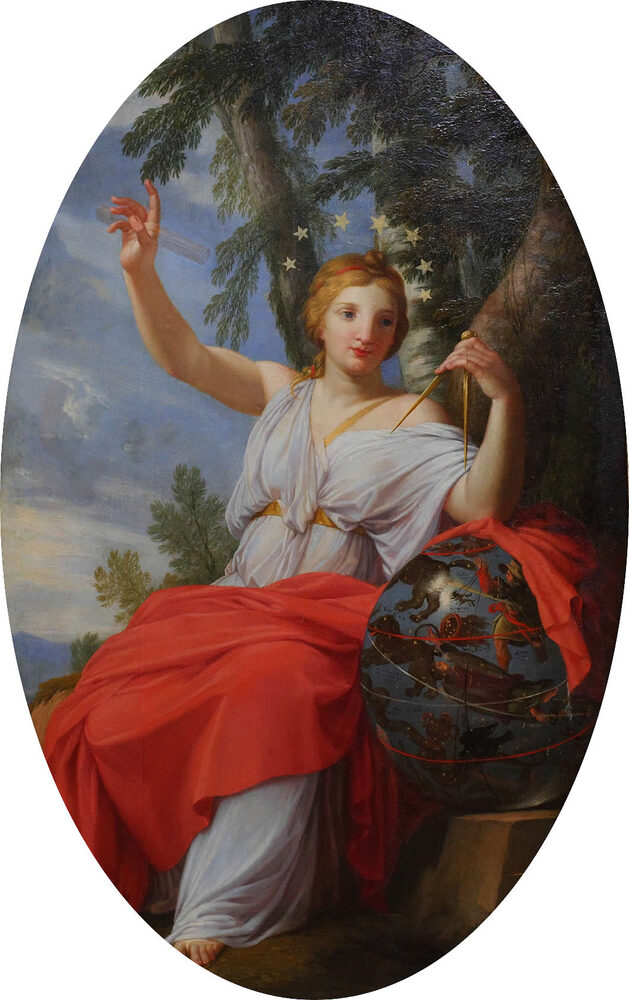
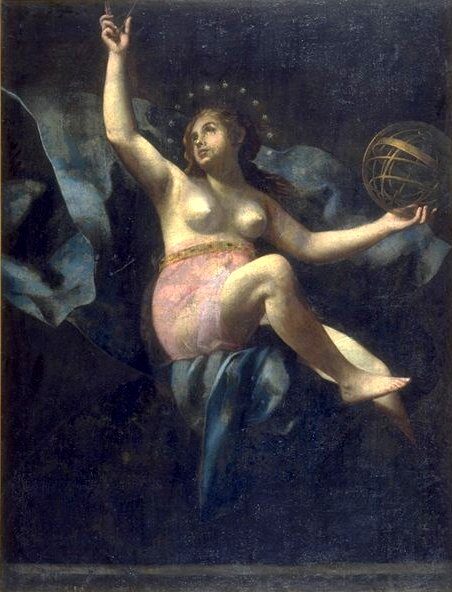
Urania (yoo-RAY-nee-uh), in Greek Οὐρανία (Ourania), is the Muse of astronomy and of the study of the heavens. Like all her sisters she is a daughter of Zeus and of Mnemosyne (Memory), and in the early poetry she is simply one of the nine, named in the choir and nothing more. But her name set her apart: it means "the heavenly one," from ouranios, "of the sky," and when the later tradition came to give each of the nine a particular art, the Muse whose very name pointed at the heavens was the natural one to preside over the mapping of the stars and the courses of the sky. By that reckoning she is the loftiest and most philosophical of the Muses — the one whose gaze is turned upward where her sisters sing of love, war, dance, and the deeds of men — and her emblems are a celestial globe and a compass or small pointing-staff, with which she traces the figures of the constellations. In art she is often crowned or robed with stars, her finger lifted to the sky.
Two cautions belong at the head of her page. The first is that her office of astronomy is a late assignment — the neat division of the nine among the arts is a Hellenistic-and-Roman systematisation, not the early Greek picture, in which the Muses sang as one choir with one voice. The second, and more important, is that Urania the Muse must not be confused with Aphrodite Urania ("Heavenly Aphrodite"), which is an epithet of the goddess of love — a wholly different figure. They share only the adjective "heavenly"; one is a Muse and daughter of Memory, the other is Aphrodite under a cult-title. Beyond her name and her emblems, Urania has very little myth of her own, and that is honest to the sources: the individual Muses are sparse, and she is known chiefly as one of the nine.
Mythology
The Muse "the heavenly," and the late one-art-each scheme
In the oldest poetry Urania is only a name. Hesiod lists her among the nine (Theogony 78), and that is nearly all the early tradition gives her: she is one of the daughters of Mnemosyne, singing in the choir on Olympus and dancing on Helicon with her sisters, with no separate story, no separate cult, and no fixed office of her own. The division of the nine Muses among the particular arts — Calliope for epic, Clio for history, Melpomene for tragedy, and the rest — is a later systematisation, set out most fully by Diodorus Siculus (4.7) and worn smooth by the Roman age; the early Greeks treated the Muses as a single company who sang with one voice. (On the choir as a whole, and on this late tidying of their roles, see the main Muses page.) When that scheme was drawn up, Urania was given the heavens — and the reason is written in her name. Of all the nine, hers alone points directly upward: Ourania is "the heavenly one," from ouranios, "of the sky," itself from Ouranos, the Heaven. The Muse called "heavenly" became, fittingly, the Muse of the sky.
How "the heavenly" came to preside over astronomy
Once the office was hers, it became the loftiest of the nine. Where her sisters presided over the arts of the human voice and body — song, dance, love-poetry, the drama — Urania was given the one art that looks away from the earth altogether: the mapping of the stars and the study of the courses of the heavens, the harmony of the turning sky. Her emblems fix this. She is shown holding a celestial globe, the sphere of the fixed stars, and a compass or a slender pointing-staff (the radius) with which she measures and traces the constellations; sometimes she is crowned or clothed with stars, or points upward with a lifted hand. To the ancient mind astronomy was not a dry science but the most exalted of the arts, the contemplation of the divine order of the cosmos, and so Urania came to be reckoned the most elevated and philosophical of the Muses — the one whose work touched the eternal and unchanging things above, rather than the passing affairs of men.
Her genealogical threads — Linus and Hymenaeus
Urania has a few slender threads of myth beyond her office, and they are the sort of minor, variously-assigned parentages that attach to the Muses here and there — never certain, and told differently by different authors. In some accounts she is named as the mother, by Apollo, of the musician Linus — a legendary singer and teacher of music whose early death was long lamented in song (the "Linus-song" of the Greeks). In some she is likewise called the mother of Hymenaeus, the god of the wedding-hymn, whose name was cried at marriages. Apollodorus (1.3.1), listing the children of the Muses, records these parentages among others while noting that the sources disagree — Linus and Hymenaeus are elsewhere assigned to Calliope or to other Muses, and the traditions simply do not settle. These are minor strands, offered here as the ancient handbooks offer them: in some accounts Urania is their mother, but no single, fixed genealogy can be claimed. (This page records the attestations and keeps no children or consorts of its own.)
The later contemplation of the heavens — and a required caution
Urania's greatest afterlife in antiquity was philosophical. In Plato and the thinkers who followed him, the adjective ouranios — "heavenly" — carried a weight of meaning: the heavenly was the higher, the contemplative, the turning of the soul from the things of earth to the eternal order above. The Muse named "the heavenly," set over the study of the stars, was drawn into this current, and in the later Platonic and Neoplatonic tradition Urania became associated with the contemplation of the heavens and the music of the spheres — the idea that the turning heavenly bodies make a cosmic harmony, inaudible but perfect. This made her a favourite of philosophers and astronomers, the patroness of those who studied the sky and heard in its order a kind of music. But here the one firm caution of her page must be sounded. In Plato's Symposium there is a famous figure called Aphrodite Urania — "Heavenly Aphrodite" — set against "Common Aphrodite" to distinguish a higher love from a lower. This Aphrodite Urania is not the Muse. It is an epithet of Aphrodite, the goddess of love, meaning simply "Heavenly" — a different figure entirely, belonging to Aphrodite's cult and to Plato's argument about love, and sharing with the Muse only the single adjective "heavenly." The two must never be run together: one is a daughter of Memory who presides over astronomy, the other is Aphrodite under a cult-title. Beyond these threads, Urania is honestly known chiefly as one of the nine.
Worship — Ancient
Honoured among the nine
Urania had almost no separate cult of her own; she was worshipped, as the individual Muses nearly always were, together with her sisters as one of the nine. Her worship was their worship: the sanctuary and the great festival of the Mouseia in the Valley of the Muses on Mount Helicon, where the town of Thespiae kept a sacred grove with altars and statues of all nine; the libations of water from the Muses' own springs, the honey-cakes and first-fruits, and above all the offering of a song or poem made in their honour; and the invocation at the head of a poem or a work of learning, the poet's or scholar's oldest and most characteristic act of devotion. (For the full shape of Muse-cult — the Mouseia, the springs, the shrines in the philosophical schools, and the great Mouseion of Alexandria that gives us the word museum — see the main Muses page.) Wherever the nine were honoured, Urania was honoured among them.
The Muse of those who studied the heavens
What distinguished her, within that shared cult, was her fitting place among the learned — and especially among those whose study was the sky. Because a Greek place of organised learning was formally a shrine of the Muses (a mouseion), and because Urania presided over astronomy and the contemplation of the heavens, she was the natural patroness of the astronomer and the philosopher of the cosmos. To take up the study of the stars was, in the old understanding, to work under her protection; the scholar who mapped the heavens or reasoned about their harmony did so in the Muse's name, and his work was itself a kind of offering to the daughter of Memory called "the heavenly."
Worship — Modern
The enduring Muse of astronomy
Of all the nine, Urania has had perhaps the clearest single afterlife: she remains, simply and enduringly, the Muse of astronomy, the recognised patroness of the study of the stars. Her name is scattered across the sky-sciences and the arts that look upward. Observatories and astronomical societies have borne her name; the great star-atlases of the early modern age invoked her — most famously the Uranometria of Johann Bayer and, later, popular star-guides titled Urania's Mirror; poets have addressed her as the heavenly Muse, from Milton's "Heavenly Muse" to the Urania of later verse; and the very word "Uranian," along with the planet-name Uranus and the element uranium, carries forward the same root — ouranios, "of the heavens" — that stands at the head of her name. Where the ancient devotee honoured her with a hymn, the modern one honours her simply by looking up.
Honouring Urania today
A modern devotee drawn to Urania honours her in the key of her own art: by turning the gaze upward and taking the heavens seriously. To study the night sky — to learn the constellations, to follow the courses of the planets, to keep even a small telescope or simply a dark-sky vigil — is the truest devotion to the Muse of astronomy; so too is the pursuit of the sciences more broadly, carried out with the care and wonder the ancients thought the Muses gave. Following the old shape, one might pour a libation of clear water (recalling the Muses' springs), light a candle beneath the open sky, and dedicate the work — the night's observing, the term's study, the finished page — to Urania before beginning. To keep faith with the heavenly Muse is to keep looking up, and to remember that the order of the stars was once heard as a kind of music.
Epithets & Cult Titles
- Οὐρανία (Ourania) — "the Heavenly One" — Her own name read as a title: she of the heavens, from ouranios, "of the sky." Alone among the nine her name points directly at her office — the Muse whose domain is the sky itself and the ordered stars within it, and whose art looks upward where the others look to the human heart and voice
- Daughter of Memory (Mnemosynis) / the Heliconian and Pierian Maiden — Like all her sisters, Urania is a child of Mnemosyne (Memory) by Zeus, and shares their two homes — born in Pieria and dancing on Mount Helicon by the springs. She is one of the nine before she is anything particular, and this title keeps her within the choir to which she belongs
- Muse of Astronomy / of the heavens (astronomias) — The art assigned to her in the later systematisation of the nine (set out fully by Diodorus): the study of the stars and the courses of the heavens. By this reckoning she is the Muse of astronomy, and her emblems — the globe and the compass — mark her out as the one who maps and contemplates the sky
Sources & Variants
- Hesiod, Theogony 77–79 (Urania named within the roll-call of the nine Muses: '…Polymnia and Urania and Calliope'); and 1–115 (the proem: the birth of the Muses to Zeus and Mnemosyne in Pieria, their homes on Helicon and in Pieria, and their office of song) — the earliest source, where Urania is only a name among the nine
- Diodorus Siculus, Bibliotheca Historica 4.7 (the systematic account of the nine Muses and the particular art assigned to each) — the source for the later 'division of labour' by which Urania was given astronomy
- Apollodorus, Bibliotheca 1.3.1 (the nine Muses listed; the children of the Muses, including Urania as mother by Apollo of Linus and of Hymenaeus — parentages the sources variously assign to different Muses)
- Plato, Phaedrus 259b–d (the Muses and the heavenly turning of the soul; the association of 'the heavenly' with contemplation); Symposium 180d–181c (the figure of Aphrodite Urania, 'Heavenly Aphrodite' — a cult-epithet of Aphrodite, NOT the Muse, cited here precisely to mark the distinction) — the current that made the heavenly Muse a favourite of philosophers
- Pausanias, Description of Greece 9.29–31 (the Valley of the Muses and the sanctuary on Helicon; the statues of the nine Muses, among them Urania; the number and names of the Muses) — the witness to the shared cult in which Urania was honoured
- Homeric Hymn 25 (To the Muses and Apollo) (the Muses and Apollo as the source of singers upon the earth; their descent from Zeus and Mnemosyne) — context for the choir to which Urania belongs
Gallery