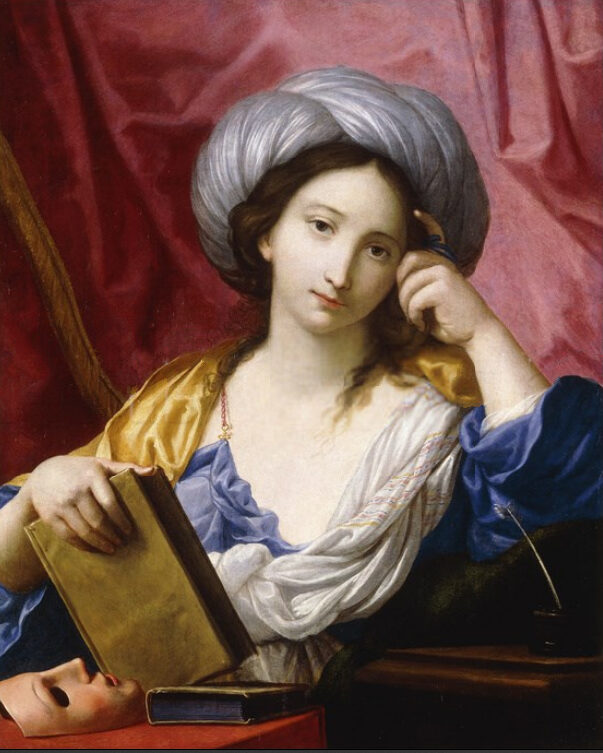
Melpomene
First Appearance
Melpomene is first named, with no story attached to her alone, in the roll-call of the nine Muses that Hesiod sets near the opening of the Theogony. Having told how the daughters of Zeus and Mnemosyne were born in Pieria, he names them one by one (77–79): "Clio and Euterpe and Thalia and Melpomene and Terpsichore and Erato and Polyhymnia and Urania and Calliope" — and adds that Calliope is the chief of them all. Here, at the fountainhead of the tradition, Melpomene is simply one sister in a single choir of singers; the Theogony gives her no separate art and no separate myth. Everything that later marks her out as the Muse of tragedy is a growth of centuries after Hesiod set down her name.
— Hesiod, Theogony 77–79 (the naming of the nine Muses in the proem)
Who They Are
Melpomene (mel-POM-uh-nee), in Greek Μελπομένη, is one of the nine Muses, the daughters of Zeus and Mnemosyne (Memory), and in the settled tradition she is the Muse of tragedy — the presiding power of tragic drama and solemn song. Her name tells her oldest nature plainly: it comes from the verb melpein, "to sing and dance in celebration," so that she is at root simply "the singing one," a singer among singers. In the earliest sources she has no particular province of her own; she is one voice in the single choir of the nine, who sing together before the gods. Only later, as the arts came to be parcelled out among the sisters, was she given tragedy for her portion — and it is that late assignment, more than anything Hesiod or Homer says of her, that has made her name stand for sorrow and the grave stage ever since.
She is known above all by her emblem: the tragic mask — the downturned, grieving mask that the actors of the Greek theatre wore — often paired with the high boot of the tragic player, the buskin (cothurnus), and sometimes a crown of ivy or vine, or a sword or club in her hand. Set beside her sister Thalia, whose smiling comic mask answers Melpomene's weeping one, she forms half of the twin image of masks that has signified the theatre itself down to the present day. Like each of the nine, Melpomene has little myth of her own — the individual Muses are sparse figures, and that is honest to the sources; she is encountered chiefly as one of the choir. (For the full story of the Muses' birth, their mountains and springs, the invocation, and their contests, see the collective Muses page; this page gathers what belongs to Melpomene in particular.)
Mythology
The singer who became the Muse of tragedy
Melpomene's name is a small window onto how the Muses changed over time. It is built from the verb melpein, "to sing and dance in celebration" — a word of festal, joyful song — and so means nothing more pointed than "the singing one." In Hesiod (Theogony 77) she is named among her sisters with no art set apart for her; the early poets treat the nine as one choir of singers, not as nine specialists, and Melpomene is simply a voice in it. The familiar scheme by which each Muse owns a single art — Calliope epic, Clio history, Melpomene tragedy, and so on — is a late systematisation, worked out in the Hellenistic and Roman periods and given its fullest surviving form by Diodorus Siculus (4.7). It is in that late settling of offices that "the singer" became specifically the patroness of tragic drama.
How a goddess whose name means merely "she who sings" came to preside over tragedy is a matter of this later ordering rather than of any old story. Once the assignment was made it stuck fast, and it reshaped how she was imagined: the generic singer was given the tragic mask and the buskin — the thick-soled boot (cothurnus) of the tragic actor — and sometimes a sword or a club and a crown of ivy, the plants of the Dionysiac stage. In the art of the Roman age and after, these attributes fix her instantly: where Thalia holds the grinning mask of comedy, Melpomene holds the downturned mask of grief, and the two together became the enduring sign of the theatre. The gravity we now hear in her name is the echo of this office, read back into a word that first meant only song.
The mother of the Sirens — a variant to flag
The one genealogical thread that attaches to Melpomene in particular concerns the Sirens, the bird-women whose singing lured sailors to their deaths. In several ancient accounts the Sirens are her daughters. Apollodorus (Bibliotheca 1.3.4) names Melpomene, by the river-god Achelous, as their mother, and the same parentage is given in the Epitome (7.18), where the Sirens are called daughters of Achelous and a Muse. It is a fitting descent, if a dark one: that the goddess of tragic song should be mother to the sweetest and deadliest singers of all, whose music was beautiful enough to kill.
But the tradition is not single here, and the variant should be flagged clearly. Other sources instead name her sister Terpsichore as the Sirens' mother by Achelous (so, for instance, Apollonius of Rhodius), and still others give a different Muse or leave the mother unnamed. The ancients did not agree, and no one telling is "the" true one — which parentage a reader meets depends on the source. What is common to the Melpomene-versions is only the pairing: the Muse of tragic song and the river Achelous, parents of the singing women of the rocks. Beyond this single contested thread, Melpomene has no consorts and no settled children in the myths; she is known, honestly, chiefly as one of the nine.
Worship — Ancient
Melpomene received almost no cult in her own right; she was worshipped, as the individual Muses nearly always were, together with the nine. Her honours are theirs: the sanctuary and the great festival of the Mouseia in the Valley of the Muses on Mount Helicon, where Pausanias (Description of Greece 9.29–31) saw the grove and the statues of all nine; the libations of spring-water, honey, and first-fruits; the offering most proper to the Muses, a song or poem made in their honour; and the daily invocation by which poets called on the Muse to sing. Wherever learning was pursued — in the philosophers' schools and in the great mouseion ("shrine of the Muses") of Alexandria that gives us the word museum — Melpomene was honoured among her sisters as a patroness of the arts.
What is particular to her is her tie to the tragic stage. Her art was performed, in the Greek world, at the festivals of Dionysus — above all the City Dionysia at Athens, where the tragedies of Aeschylus, Sophocles, and Euripides were staged in competition before the assembled city. Tragedy was a sacred performance given in the god's theatre, under his precinct on the slope of the Acropolis; and though the rite belonged to Dionysus, it was Melpomene who, in the later ordering of the arts, stood as the Muse presiding over that solemn stage — the ivy and vine of her crown, and the mask and buskin of the tragic actor, binding her to the Dionysiac theatre where her art had its life.
Worship — Modern
Melpomene's great modern legacy is as the enduring personification of tragedy itself. Her weeping mask, paired with the smiling mask of her sister Thalia, is the universal symbol of theatre and drama — the two masks ("sock and buskin," comedy and tragedy) that hang over stage doors, mark playbills and drama schools, and stand in countless emblems for the art of the stage the world over. To invoke "the tragic Muse," or to name Melpomene, is to invoke tragedy in the grand sense; her name has outlived her cult as a figure of speech for sorrowful and lofty drama.
A modern devotee drawn to Melpomene honours her in the key of her art. One might write, perform, or attend a tragedy — give or receive the grave kind of drama that is her portion — and offer the work itself to her, as the ancients thought the fittest gift to the Muses was song. Following their shape, pour a simple libation of clear water (recalling the Muses' springs), light a candle before beginning, and dedicate the work — the play written, the part learned, the performance given — to the Muse of tragedy, asking for true feeling and clear sight. To keep faith with Melpomene is to take the tragic seriously: to make, or to witness with full attention, the drama of grief and greatness that is hers.
Epithets & Cult Titles
- Μελπομένη (Melpomene) — "the Singing One" — Her own name, from the verb melpein, "to sing and dance in celebration." Before ever she was the Muse of tragedy she was simply "the singer" — one of nine goddesses whose shared gift was song — and the name keeps that older, simpler sense beneath its later gravity
- Πιερίς / Ἑλικωνιάς (Pieris / Helikonias) — "the Pierian / Heliconian Maiden" — A title she shares with all her sisters, marking the two homelands of the Muses: Pieria north of Olympus where they were born, and Mount Helicon in Boeotia where they dance about the springs. Like the rest of the nine she is a daughter of Memory (Mnemosyne), born of Zeus — song made the child of remembrance
- Muse of Tragedy (Μοῦσα τῆς τραγῳδίας) — The office fixed to her by the later systematisers of the arts: of the nine Muses, Melpomene is the one who presides over tragic drama — over the grave and sorrowful stage, the fall of the great, and the tears of the theatre. It is this assignment, late though it is, that made her name a byword for tragedy itself
Sources & Variants
- Hesiod, Theogony 77–79 (the naming of the nine Muses: 'Clio and Euterpe and Thalia and Melpomene and Terpsichore and Erato and Polyhymnia and Urania and Calliope'; Melpomene given no separate art), and 1–115 (the proem: the Muses' birth to Zeus and Mnemosyne in Pieria, Helicon and its springs, their office of song)
- Apollodorus, Bibliotheca 1.3.1 (the nine Muses, daughters of Zeus and Mnemosyne, listed by name); 1.3.4 (Melpomene and the river Achelous named as parents of the Sirens)
- Apollodorus, Epitome 7.18 (the Sirens as daughters of Achelous and a Muse, named at their encounter with Odysseus)
- Apollonius of Rhodius, Argonautica 4.892–896 (the Sirens as daughters of Achelous and the Muse Terpsichore — the variant parentage)
- Diodorus Siculus, Bibliotheca Historica 4.7 (the systematic account of the nine Muses and the particular art assigned to each — the late source for Melpomene's office of tragedy)
- Pausanias, Description of Greece 9.29–31 (the Valley of the Muses and the sanctuary on Helicon; the springs; the statues and number and names of the Muses — the shared cult in which Melpomene was honoured)
Gallery