Seirēnes (Sirens)
First Appearance
The Sirens step into literature already fully dangerous, in Circe's briefing to Odysseus. "First you will come to the Sirens," she warns, "who bewitch all men that come to them. Whoever draws near in ignorance and hears the voice of the Sirens, never again do wife and little children stand beside him and rejoice — for the Sirens enchant him with their clear song, sitting in their meadow, and about them is a great heap of the bones of mouldering men, their skins shrivelling upon them" (12.39–46). She tells him the remedy: stop the crew's ears with kneaded beeswax, and if he himself would hear, have them bind him hand and foot upright to the mast, and bind him tighter still if he begs to be loosed. At 12.165–200 he does exactly so — and past the ears-stopped rowers the Sirens call him by name: "Come hither, renowned Odysseus, great glory of the Achaeans" (12.184), promising the knowledge of all that the gods have brought to pass upon the earth.
— Homer, Odyssey 12.39–54 (Circe's warning) and 12.165–200 (the passage of Odysseus)
Who They Are
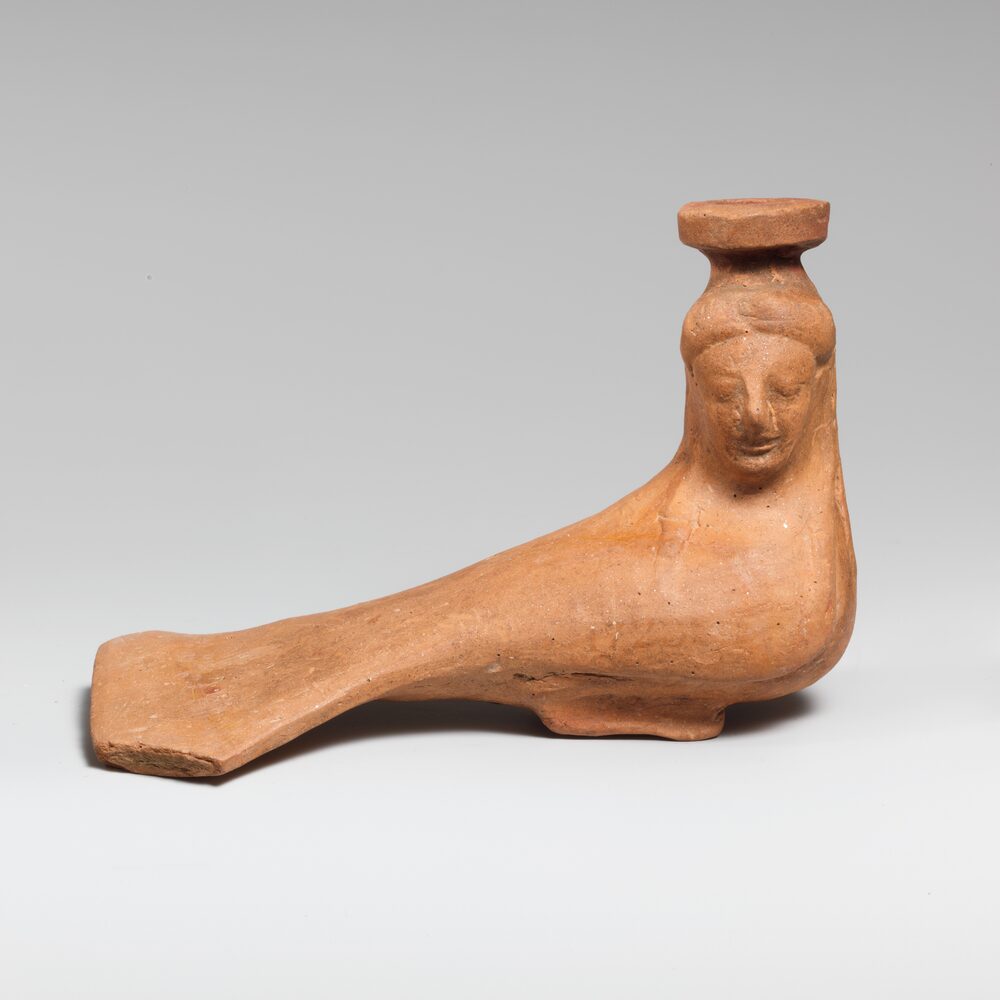
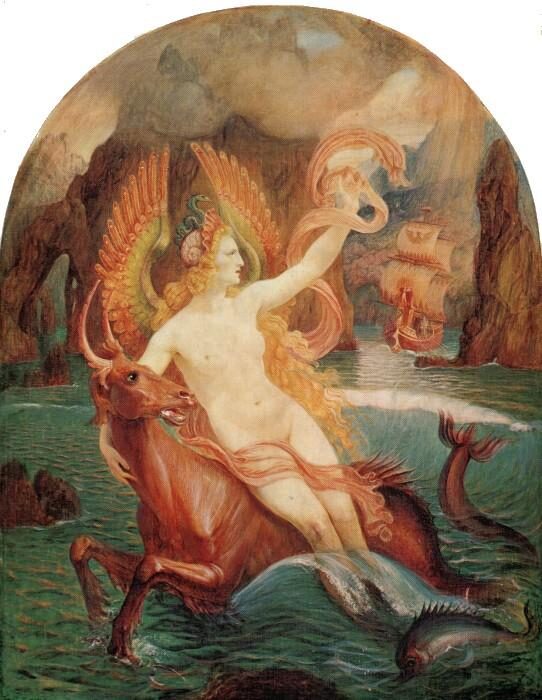
The Sirens (SY-renz; Greek Σειρῆνες, Seirēnes) are the singing monsters of the Greek sea — women's faces and voices set upon the bodies of great birds, who perch in a flowering meadow on their island and sing so sweetly that every sailor who hears them steers to his death. They are not the fish-tailed mermaids of later imagination: in every classical source, and in all the ancient art, they are bird-women, feathered and taloned, with a woman's head and often a woman's breast and arms, sometimes holding a lyre or a flute. The mermaid image is a medieval conflation, many centuries later than the Greek myth, and it should be firmly flagged as such — the Sirens the Greeks knew were creatures of the air, not the water.
What makes them terrible is not force but sound. They neither pursue nor fight; they simply sing, and the song is irresistible — Homer calls it "honey-voiced," and its lure is knowledge as much as pleasure, for the Sirens promise the listener that they know everything that has happened and will happen in the world. The sailor who slows his ship to listen never leaves; the meadow around the singers is white with the bones of the men who came before. They are the archetype of the beautiful, fatal voice — the danger that destroys not by overpowering the will but by charming it into consent.
The Greeks told two great stories of ships that met the Sirens and lived, and both turn on countering song with something stronger. Odysseus stopped his crew's ears with wax and had himself bound to the mast, so that he alone heard the song and survived to tell of it. The Argonauts were saved a different way: Orpheus snatched up his lyre and out-sang the Sirens, drowning their voices with a louder and sweeter music, so that only one man, Butes, leapt overboard toward them — and he was plucked from the water by Aphrodite. And there was a prophecy over the Sirens' own heads: that they were fated to die on the day a ship passed them unharmed. So the very survival of these heroes was the Sirens' doom, and the tradition says that when their song failed, they flung themselves from their rocks into the sea and perished.
Mythology
What the Sirens were, and what they were not
The classical Sirens are bird-women: the head, and usually the upper body, of a woman joined to the feathered body, wings, and clawed feet of a large bird. This is how they appear without exception in Greek and Roman art — on painted vases, on carved gems, and above all on the grave-monuments where they stand as mourners — and it is how the poets describe them. It cannot be stressed too strongly, because the popular picture is wrong: the fish-tailed mermaid Siren is a much later, medieval conflation, arising in the Latin West more than a thousand years after Homer, when the word siren was pulled toward sea-creatures and the bird-body was gradually replaced by a fish-tail. In the Greek sources there is no fish and no tail. The Sirens are creatures of the air who happen to sing beside the sea.
Their number and names shift with the source. Homer, using the Greek dual, seems to imagine only two, and names neither. Later writers give three or occasionally four, and supply names — always names of the voice. Apollodorus calls them Peisinoe, Aglaope, and Thelxiepeia, and assigns each an art: one plays the kithara, one sings, one plays the flute, and so together they weave the spell. Another and very influential tradition, rooted in the Greek cities of southern Italy, names them Parthenope, Ligeia, and Leucosia, each attached to a stretch of the Campanian and Lucanian coast where her body was said to have washed ashore.
Their parentage
The Sirens are children of the river — their father, in nearly every account, is the great river-god Achelous, the eldest and mightiest of the river-gods, which is why the poets sometimes call them Acheloïdes, "daughters of Achelous." Their mother is usually named as one of the Muses, most often Melpomene (the Muse later associated with tragedy), which fits creatures whose whole power lies in irresistible song; some sources instead name her sister Terpsichore, the Muse of dance and choral song, and a few give other mothers. That a monster of deadly music should be born of a Muse is a deliberate and pointed genealogy: the Sirens are art turned lethal, the gift of song bent to destruction.
How they became bird-women: the search for Persephone
One well-known tradition explains the strange form. In this telling, preserved most beautifully by Ovid (Metamorphoses 5.551–563), the Sirens were once ordinary maidens, the companions and playmates of Persephone, and were with her in the meadow on the day Hades carried her off to the Underworld. When their friend vanished and they had searched the whole earth for her in vain, they prayed the gods for wings, so that they might seek her across the sea as well — and the gods granted the prayer, feathering their bodies and their limbs, but leaving their maiden faces and their human voices unchanged. Ovid is at pains to note that they kept the song and the beauty of feature; only the body became a bird's. In this version the Sirens begin not as monsters but as grieving girls, transformed by the very depth of their loyalty — a softer origin that sits under the terror.
Odysseus at the mast
The most famous of all Siren-stories is Odysseus's, and it turns on a plan given him by the witch Circe (his own page tells the wider tale). Warned that the Sirens sit singing in their meadow, ringed by the rotting bones of the men their voices have killed, Odysseus took precautions of two kinds. For his crew he cut a great round of beeswax, kneaded it soft in his hands, and stopped the ears of every man at the oars, so that not one of them could hear a note. For himself he chose differently: he wanted to hear the song and live, the only man ever to do so. So he had his sailors lash him upright to the mast, hand and foot, with the strict order that if he begged or signalled to be let go, they were to bind him only tighter. As the ship drew level with the island the wind dropped to a dead calm, and out of the stillness the Sirens sang — calling him by name, "renowned Odysseus, great glory of the Achaeans," and promising him not pleasure but knowledge: that they knew all the sufferings of Troy, and everything that comes to pass upon the earth. Odysseus was seized with longing and jerked his head and frowned at his men to free him, but Eurylochus and Perimedes only rose and bound him faster, and the crew rowed on until the song fell away behind them. He alone had heard the Sirens and passed by.
The Argonauts and Orpheus
The other ship that survived them was the Argo, and it was saved by music rather than by wax and rope (Orpheus, whose story is told on his own page, is the hero of this episode). Apollonius of Rhodes tells it (Argonautica 4.891–919): as the Argonauts came near the Sirens' island of Anthemoessa ("the flowery"), and the maidens began their clear song and the crew made ready to run their cable ashore and stay, Orpheus the Thracian snatched up his Bistonian lyre and struck from it a rushing, high, brilliant melody, so loud and so lovely that it overwhelmed the Sirens' voices and drowned them, and the ship drove on unharmed. Only one man could not be held: Butes, alone among the Argonauts, was still pierced by the sweetness of the Sirens' song through Orpheus's music, and he flung himself from the ship into the sea and began to swim toward the rocks and his death — but Aphrodite (whom Apollonius calls Cypris) snatched him up out of the surf and set him safe at Lilybaeum, on the western cape of Sicily, and made him her own. So the Argo, like Odysseus's ship, passed the Sirens without loss.
The prophecy, and the death of the Sirens
Over the Sirens themselves hung a doom. It was fated — Apollodorus and Hyginus both preserve the oracle — that the Sirens would live only until a ship passed them unharmed, and would die on the day it happened. When Odysseus sailed by bound to his mast and his crew rowed clear (in the other tradition, when the Argo escaped through Orpheus's playing), the prophecy came due. Their song had failed for the first time, and by the terms of their fate they could not survive it: the Sirens flung themselves from their rocks into the sea and perished. In the Italian tradition this is how the named Sirens came to their several shores — the body of Parthenope washed up where Naples would rise, Leucosia at the cape that bears her name off Paestum, Ligeia on the coast of Bruttium — each drowned singer giving her name to the place that received her, so that the map of southern Italy became a memorial of the Sirens' death.
The contest with the Muses
One further story, local to Boeotia, sets the Sirens against their own mother's kind. Pausanias (9.34.3), describing a statue-group near Coroneia, reports the tradition that the daughters of Achelous were persuaded by Hera to enter a singing-contest against the Muses. The Muses won — and, victorious, they plucked out the Sirens' feathers and made themselves crowns of them. It is a small myth of hubris and its wages, and it belongs to the same idea that runs through all their stories: the Sirens are the dark twin of the Muses, song that has forgotten its place, beauty that kills — and set beside the true divine singers, they lose.
Worship — Ancient
Monsters, not gods — but not without cult
The Sirens were monsters, and there was no Panhellenic worship of them as such; one did not build temples to the creatures who lured sailors to their deaths. But they occupied a real and important place in Greek religious imagination, and in two settings they were genuinely honoured — on the tomb, and at Naples. To speak of "worship" of the Sirens is really to speak of these: the funerary Siren who mourns the dead in Greek art, and the cult of Parthenope in the city that claimed her body.
The funerary Siren — mourners and psychopomps
The most widespread ancient use of the Siren was not as a sea-peril at all but as a figure of death and mourning. From the fifth century BC onward the Sirens appear again and again on Greek graves — carved in marble as free-standing statues set atop or beside tombs, and painted on the white-ground funeral vases (lekythoi) left as offerings for the dead. In this role the Siren is a mourner: she stands with a lyre or beats her breast and tears her hair in grief over the departed, and her song, elsewhere a lure to death, becomes here a lament that soothes and accompanies the soul. Plato, at the close of the Republic (the Myth of Er), even sets Sirens singing upon the whirling spheres of the cosmos, each sounding a single note of the harmony of the heavens — a memory of the Siren-song raised to the music of the universe. The funerary Siren is close kin to a psychopomp, a being that attends the passage from life to death, and it is in this gentler, sorrowing form that most ordinary Greeks would have met the image of a Siren: not on a distant sea, but standing guard, singing, over the graves of their own dead.
The tomb of Parthenope and the cult at Neapolis
The one Siren who received something like civic cult was Parthenope, at Naples. The Greek settlers of the Bay of Naples told that when the Sirens perished after failing to hold Odysseus, the body of Parthenope was carried by the sea to the little island of Megaride and the shore where their earliest settlement rose, and that they buried her there and named the place Parthenope after her. When the city was refounded it took the name Neapolis ("new city"), the origin of modern Naples — but Parthenope was never forgotten. Strabo (5.4.7) records that in his own day the tomb of the Siren Parthenope was still shown at Neapolis, and that a gymnastic contest with a torch-race was celebrated in her honour by the command of an oracle. She was, in effect, the honoured foundress and patron-figure of the city, a Siren remembered not as a monster but as a name to be kept and games to be run — the single clear instance of continuing Greek cult paid to one of the Sirens.
Worship — Modern
A name that outlived the myth
No living tradition worships the Sirens, and none did in antiquity beyond the special cases above — they are monsters, not gods, and their true afterlife is not in cult but in culture, where they have been extraordinarily persistent. The Sirens gave the modern languages the very word "siren": the emergency siren that wails to warn a city takes its name directly from the singers whose voice carried across the water, and the phrase "siren song" — an alluring invitation that leads to ruin — is one of the oldest myths still doing daily work in ordinary speech. To call something a siren song is to invoke Homer without knowing it.
The mermaid conflation — a medieval, post-classical error
Any honest account of the modern Sirens must flag the great change that overtook them. The fish-tailed mermaid that most people now picture when they hear "Siren" is not the creature of Greek myth but a medieval, post-classical conflation, and the shift can be traced. In the Latin West the word sirena drifted toward the sea, and from roughly the early Middle Ages the bird-body of the classical Siren was progressively redrawn as a fish-tail, until in the Romance languages sirène, sirena, sereia simply became the word for "mermaid." The image is now so dominant that the original bird-women look strange to us — but it is worth insisting that for the entire span of Greek and Roman antiquity the Sirens had feathers, not fins. The mermaid is a later story wearing the Sirens' name.
In art and literature
The Sirens have never left Western art. Odysseus at the mast, straining against his bonds while the bird-women wheel about the ship, is one of the oldest and most-painted scenes in the whole tradition, from a red-figure vase of about 480 BC (the "Siren Vase" in the British Museum) to J. W. Waterhouse's canvas and beyond. In modern literature they have become a favourite emblem of temptation and of the artist's own dangerous relation to beauty: Franz Kafka wrote a famous short parable, "The Silence of the Sirens," arguing that Odysseus's real danger was not their song but their silence, and that they may not have sung at all; the Sirens surface across modern poetry — in Rilke, in Margaret Atwood's wry "Siren Song," and elsewhere — always as the voice that promises everything and means death. It is a fitting survival for a myth about the power of song: the Sirens live on precisely as a story that is still irresistible to tell.
Epithets & Cult Titles
- Σειρῆνες (Seirēnes) — The Sirens — the collective name of the singing bird-women. Homer names none of them individually and, using the Greek dual, implies a pair; later poets multiply and name them, but the plural Seirēnes remains their proper title.
- the bird-women of the meadow — A descriptive title drawn from Homer (Odyssey 12.45): they sit singing in a flowering meadow (leimōn) that is heaped about with the mouldering bones of the men their voices have destroyed — the beauty of the song and the horror of the place held in one image.
- the honey-voiced (meligērues) — From Homer's own phrase for their singing — the meligērun (honey-toned) voice that pours from their lips (Odyssey 12.187) — the quality that makes the song irresistible.
- Parthenope, Ligeia, and Leucosia — The names of the South-Italian (Tyrrhenian) Sirens, each tied to a place on the Campanian and Lucanian coast — Parthenope ('maiden-face') to Naples, Leucosia to the cape and island off Paestum, Ligeia ('clear-toned') to Terina in Bruttium.
- Thelxiepeia, Aglaope, and Peisinoe — The trio of names Apollodorus gives, all speaking of the seductive voice: Thelxiepeia ('she who enchants with words'), Aglaope ('of the splendid voice' — the variant Aglaopheme belongs to the later scholiastic tradition, not Apollodorus), and Peisinoe ('she who persuades the mind') — one for the lyre, one for song, one for the flute.
Sources & Variants
- Homer, Odyssey 12.39–54 (Circe's warning: the Sirens who enchant, the meadow heaped with the bones of dead men, the remedy of wax and the mast) and 12.158–200 (Odysseus stops the crew's ears, is bound to the mast, hears the song — 'renowned Odysseus, great glory of the Achaeans' — and passes by)
- Apollonius Rhodius, Argonautica 4.891–919 (the Argo at the Sirens' island of Anthemoessa; Orpheus out-sings them on his lyre; Butes alone leaps overboard and is saved by Aphrodite/Cypris at Lilybaeum)
- Apollodorus, Bibliotheca 1.3.4 (the Sirens as daughters of Achelous and the Muse Melpomene; the names Peisinoe, Aglaope, Thelxiepeia) and Epitome 7.18–19 (their bird form, their three instruments, the oracle that they must die when a ship passes them, and their death after Odysseus)
- Ovid, Metamorphoses 5.551–563 (the Sirens as companions of Persephone, granted wings to search for her, keeping maiden faces and human voices) — Roman retelling
- Hyginus, Fabulae 125 (the Odyssey summarised) and 141 (the Sirens as daughters of Achelous and Melpomene — Parthenope, Leucosia, Ligeia — fated to live only until a mortal who hears their song sails past, whereupon they cast themselves into the sea)
- Pausanias, Description of Greece 9.34.3 (the daughters of Achelous set on by Hera to contest with the Muses in song; the Muses win and pluck the Sirens' feathers for crowns)
- Strabo, Geography 5.4.7 (the tomb of the Siren Parthenope shown at Neapolis/Naples, and the torch-race and gymnastic contest held in her honour by an oracle's command)
- Plato, Republic 10.617b (the Myth of Er: a Siren sings upon each of the eight whirling spheres, sounding the harmony of the cosmos)
- Sophocles and later authors on the Siren as a figure of the tomb; and the extensive corpus of Greek funerary art — marble Siren grave-monuments and white-ground lekythoi — showing the Siren as mourner and psychopomp
Gallery