Mousai / Muses
First Appearance
The Muses open the oldest poem about the gods themselves. Hesiod's Theogony begins not with the gods but with the goddesses who make it possible to sing of them: "From the Heliconian Muses let us begin to sing, who hold the great and holy mountain of Helicon, and dance on soft feet about the violet-dark spring and the altar of the mighty son of Cronus." Hesiod then tells, uniquely, of his own calling: as he was shepherding his lambs on the slopes of Helicon, the Muses taught him beautiful song and breathed into him a divine voice, that he might sing of things to come and things past — and they gave him a staff of laurel and made him a poet. In the same proem (53–79) he names all nine and their mother, Mnemosyne (Memory), whom Zeus lay with for nine nights in Pieria.
— Hesiod, Theogony 1–115 (the proem: the Muses of Helicon meet Hesiod)
Who They Are
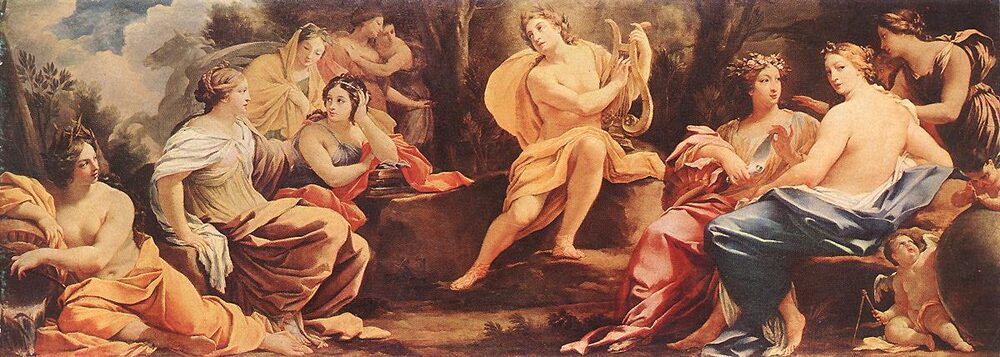
The Muses (MYOOZ-iz), in Greek the Μοῦσαι (Mousai), are the nine goddesses of poetry, song, music, dance, and — in the fuller ancient understanding — of every art and science that depends on inspiration and memory. They are the daughters of Zeus, king of the gods, and Mnemosyne (Memory), the Titaness, and that parentage is the key to everything about them: they are the children of power married to memory, and their gift is to let a mortal hold in mind and utter aloud what would otherwise slip away. When a Greek poet begins "Sing, goddess" or "Tell me, Muse," he is not striking a pose. He means it literally: the knowledge of the far past and the shape of the song are not his own, but come as a loan from these goddesses, and without them he could no more recite the catalogue of the ships or the generations of the gods than he could count the leaves of a forest.
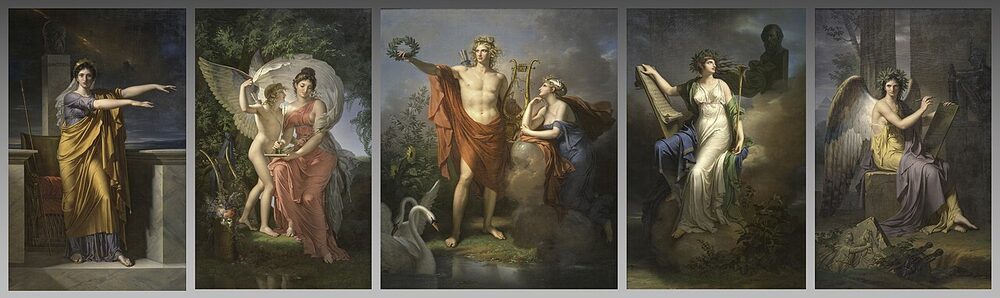
There are nine of them, and by the time of the Roman age each had come to preside over a particular art, so that together they map the whole territory of the imaginative and learned life: Calliope ("beautiful voice"), the eldest and greatest, of epic poetry; Clio ("the proclaimer"), of history; Erato ("the lovely"), of love-poetry; Euterpe ("well-pleasing"), of music and the flute; Melpomene ("the singer"), of tragedy; Polyhymnia ("many hymns"), of sacred song and the solemn hymn; Terpsichore ("delight in dancing"), of dance and choral song; Thalia ("the blooming, festive one"), of comedy and light verse; and Urania ("the heavenly"), of astronomy and the study of the stars. This tidy division of labour is largely a later systematisation — the early poets treat the nine as a single choir singing with one voice — but it captures a real truth about how the Greeks saw them: not as mere patrons of pretty songs, but as the presiding powers of knowledge itself, from the oldest epic to the mapping of the heavens. (Each of the nine has her own page in this encyclopedia; this page is the overview of the choir as a whole.)
Two mountain-haunts belong to the Muses, and the tradition keeps both. In Pieria, the region just north of Mount Olympus, they were born and there lies the sacred Pierian Spring; and on Mount Helicon in Boeotia, far to the south, they danced about the springs Hippocrene ("the Horse's Fountain," struck from the rock by the hoof of Pegasus) and Aganippe, and there they came to a shepherd named Hesiod and made him a poet. To drink of these waters was to be inspired, and the phrase "the Pierian Spring" still means the source of poetic and learned inspiration. The Muses are gentle and generous to those they favour — but they are goddesses, and jealous of their art: those who challenged them, the mortal Pierides and the boastful bard Thamyris, learned that the gift of song is theirs to give and theirs to take away. (A Roman note: the Latin poets identified the Greek Muses with the old Italian Camenae, native spring-nymphs of prophecy and song, and the two names became interchangeable in Latin verse.)
Mythology
Born of Zeus and Memory in Pieria
Hesiod gives the canonical account of the Muses' birth in the Theogony (53–62), and it is one of the most quietly beautiful passages in the poem. In Pieria, the upland country just north of Olympus, Mnemosyne — "Memory," one of the Titan daughters of Earth and Sky — lay with Zeus for nine nights in succession, apart from the other immortals; and when the year had turned and the seasons came round, she bore nine daughters, all of one mind, "with song their only care, and their hearts free of sorrow, a little way from the topmost peak of snowy Olympus." Nine nights of union, nine daughters: the number is the point. The Muses are memory's overflow, the children of the union of sovereign power with the faculty that holds the past — and so, Hesiod says, they were born to be "a forgetting of ills and a rest from cares," for when a poet sings of the deeds of old, the grieving heart is eased.
Their office: singing before Zeus, and inspiring the poet
Hesiod goes on to describe what the Muses do (Theogony 36–52, 63–74). On Olympus they sing, with Apollo leading them, of the gods — of Zeus and the immortals, of Earth and the race of men and giants — and their song delights the great mind of their father. But their gift reaches down to earth as well: "Happy is the man whom the Muses love; sweet flows speech from his mouth." They pour a sweet dew upon the tongue of the poet and the just king alike, so that the one sings truly and the other gives straight judgements and settles great quarrels with gentle words. This is the double nature of the Muses' gift — it is at once poetry and true speech, the ability both to make beautiful song and to say what is real. And in a famous and unsettling line (Theogony 27–28), the Muses tell Hesiod that they know how "to speak many false things that resemble the truth," but also, when they wish, "to utter what is true" — a warning, built into the very first account of them, that inspired song is a powerful and not always trustworthy thing.
The meeting on Helicon — the making of a poet
The Muses appear in myth not only as the daughters of Memory but as goddesses who actually descend to touch a mortal life, and the greatest instance is their calling of Hesiod himself (Theogony 22–35). As he was pasturing his lambs on the slopes of Mount Helicon, the Muses came to him — the shepherd-poet's own testimony, set at the head of his poem. They addressed him, half in scorn and half in love ("shepherds of the wilderness, wretched things of shame, mere bellies"), and then breathed into him "a divine voice, to celebrate things that shall be and things that were," and plucked and gave him a staff of sturdy laurel, the sign of the poet. From that moment the herdsman was a singer. This scene — a working man on a mountainside, suddenly filled with the power of song by the goddesses in person — became the model for every later poet's claim of inspiration, and it fixed Helicon, with its springs, as the Muses' southern home.
The two haunts — Helicon and Pieria, and the inspiring springs
The tradition gives the Muses two homelands and keeps both without ever quite reconciling them. Pieria, north of Olympus, is their birthplace and holds the Pierian Spring, from which comes the name Pierides and the enduring phrase for the fountain of inspiration. Mount Helicon, in Boeotia far to the south, is where they dance and where Hesiod met them, and there rise their two sacred waters: Aganippe, and above all Hippocrene, "the Horse's Fountain," which the winged horse Pegasus (offspring of Medusa, and himself the subject of another page) was said to have struck from the living rock with a blow of his hoof, so that the spring of poetry burst from the ground where the horse of the gods had stamped. To drink from these springs, or even to sleep beside them, was to receive the gift of song; the waters of the Muses are among the oldest images we have for where inspiration comes from.
The contest with the Pierides — the daughters of Pierus
(This tale is told most fully by Ovid, and its neat allegory has a Hellenistic-and-Roman polish.) The Muses' gentleness had a limit, and it was reached whenever a mortal presumed to rival them. In one story (Ovid, Metamorphoses 5.294–678), a Macedonian king named Pierus had nine daughters, so proud of their own singing that they came to Helicon and challenged the Muses to a contest of song, the nine mortals against the nine goddesses, with the mountain nymphs as judges. The daughters of Pierus sang an insolent song mocking the gods — telling how the Olympians had fled in terror from the monster Typhoeus and hidden themselves in the shapes of animals. Then Calliope, greatest of the Muses, rose and sang of the rape of Persephone and the grief and gifts of Demeter, a song of such surpassing beauty that the nymphs gave the goddesses the victory without dispute. When the mortal sisters would not accept the verdict and railed on, the Muses turned them into chattering magpies, birds that still fill the woods with a harsh, endless, meaningless noise — the perfect punishment for those who mistook loud presumption for the art of song. (Note the confusing doubling the poets enjoyed: the defeated mortal sisters were also called Pierides, the very name that belongs by right to the Muses themselves.)
Thamyris the bard, blinded for his boast
A second and older story of the same kind is that of Thamyris, and Homer himself tells it (Iliad 2.594–600), which makes it one of the earliest attested Muse-myths. Thamyris was a Thracian bard of such skill that he grew arrogant, and he boasted that he could outsing the Muses themselves, even the daughters of Zeus. The goddesses, meeting him at Dorion as he came from the house of Eurytus, were "roused to anger" by the boast: they maimed him, Homer says, and took away his wondrous song and made him forget the art of the lyre — struck him blind, in the fuller tradition, and robbed him of the very gift he had presumed upon. The story is the darker twin of the Pierides: where they were turned to noisy birds, Thamyris was left silent and sightless, the singer unsung. Both carry the same warning that runs through all the Muses' myths — the gift of poetry is a divine loan, and to claim it as one's own possession, or to set oneself above its givers, is to lose it utterly.
The Muses and the dead — the singers of lament
The Muses are not only goddesses of festive song; they preside also over the great and solemn lament, and the tradition brings them to the deaths of heroes. At the funeral of Achilles, the Odyssey tells (24.60–62), the nine Muses came and sang the dirge over his body, answering one another with sweet voices, and there was not a Greek by the ships whose eyes were dry. Calliope or the muse of epic is named as the mother, by Apollo or by a Thracian king, of Orpheus, the supreme mortal singer whose music moved stones and stayed the rivers — so that the greatest of all human musicians was reckoned a Muse's own son, and his death by dismemberment was mourned, the poets say, by the Muses who gathered his scattered limbs for burial. In these strands the Muses touch the boundary of death itself: song is what the living give the dead, and memory — their mother — is the only thing that outlasts a mortal life.
Worship — Ancient
Goddesses of the grove and the school
The Muses received real cult, and it clustered where their myth was rooted and where their gift was prized: on their sacred mountains, and in the places where poetry, music, and learning were pursued. Their worship was gentle in character — offerings of water from their own springs, of honey and honey-cakes, of first-fruits, and above all the offering that suited them best, a song or poem made and performed in their honour. A poet might dedicate his finest work to the Muses as a farmer dedicates his first sheaf; the gift most fitting to the givers of song was song itself.
The sanctuary and festival on Helicon
The heart of their cult was the Valley of the Muses on Mount Helicon in Boeotia, below the springs Hippocrene and Aganippe, where the town of Thespiae maintained a sanctuary — a sacred grove set with altars and with statues of the nine. Here was held the great festival of the Mouseia, which grew from a local observance into a Panhellenic celebration with contests of poetry and music: composition, recitation, singing to the lyre and the flute. Pausanias, touring Greece in the second century AD (Description of Greece 9.29–31), describes the grove, the spring of Hippocrene, and the statues of the Muses that stood there, and records the local traditions of the mountain — our best witness to the living cult. To compete and win at the Mouseia, in the very grove where the goddesses were said to dance, was among the highest honours a poet or musician could hold.
The Muses of learning — from Plato's grove to the Museum of Alexandria
Beyond their mountain, the Muses were the presiding powers of every place of organised learning, and this is one of the most important and lasting facts about them. A Greek philosophical school was, formally, a religious association gathered around a shrine of the Muses — a mouseion — and both Plato's Academy and Aristotle's Lyceum are said to have had such a shrine at their heart, so that the pursuit of knowledge was carried on under the goddesses' protection and the community's common meals and rites were held in their name. The grandest example was the Mouseion of Alexandria, the "shrine of the Muses" founded by the early Ptolemies — a great research institution and library, home to the scholars and scientists of the Hellenistic world, placed formally under the Muses' patronage. It is from that Mouseion that our word museum descends: every museum in the world is, etymologically, a house of the Muses.
Invocation — the poet's first act
The most widespread "worship" of the Muses was neither sacrifice nor festival but the daily practice of poets: the invocation. Greek and Roman poetry from Homer onward opens by calling upon the Muse to sing, to tell, to remember — "Sing, goddess, the wrath of Achilles"; "Tell me, Muse, of the man of many turns"; "From the Heliconian Muses let us begin." This was a genuine religious act, an acknowledgement that the song did not belong to the singer but was given, and that the truth of the past could only be reached through the daughters of Memory. To begin a poem without the Muses was, in the old understanding, to try to sing on borrowed breath with no lender.
Worship — Modern
The word that outlived the altar
The Muses' plainest modern legacy is woven into everyday language. A museum is, by its very name, a "shrine of the Muses," the direct descendant of the Alexandrian Mouseion; music is "the art of the Muses" (mousikē, the Muses' art); to muse is to be lost in the reflective, half-inspired state the goddesses were thought to bring; and a poet's or artist's muse — the person or power that inspires their best work — carries the old idea, worn smooth by use, that inspiration comes from outside the self as a kind of gift. Few pantheon-figures have sunk so deeply and so quietly into the common tongue.
The living idea of inspiration
More than through formal cult, the Muses survive as an idea that never lost its usefulness: the sense that creative work is not wholly willed but partly received — that the good line "comes," that the artist is at their best a listener as much as a maker. Poets from Dante and Milton (who opens Paradise Lost by calling on a "Heavenly Muse") to the moderns have kept the ancient gesture of invocation alive, sometimes in earnest and sometimes in play, and the figure of "the muse" as the beloved or the inspiring presence behind an artist's work is a commonplace of biography and criticism to this day. The Muses named a real experience — the arrival of inspiration from somewhere that does not feel like the self — and because that experience persists, so do they.
Honouring the Muses today
A modern devotee drawn to the Muses honours them fittingly in the key of their own art: by making and offering something. A poem written and read aloud, a piece of music played, a dance danced, a work of learning pursued with care — any of these is a truer offering to the daughters of Memory than incense alone. Following the ancient shape, one might pour a simple libation of clear water (recalling their springs), light a candle, and dedicate the work of one's hands and mind to the nine before beginning; the invocation at the head of a task, asking for clear sight and true words, is the Muses' oldest and most characteristic rite, and it costs nothing but attention. To keep faith with the Muses is to keep making, and to remember — for memory is their mother, and the making is their joy.
The nine, and the map of the arts
The Muses endure, too, as the oldest map the West drew of its own imaginative and intellectual life. The division of the nine among epic and history and love-song and tragedy and comedy and dance and hymn and astronomy — for all that it was a late systematisation — remains a recognisable chart of the arts and sciences, and their images (each with her emblem: Calliope's tablet, Clio's scroll, Melpomene's tragic mask, Urania's globe and compass) recur through the whole history of European art, from Roman sarcophagi to Renaissance ceilings to the frontispieces of learned books. Nine goddesses, one choir; the arts many, but inspiration one. That is the Muses' enduring picture of what it is to make and to know.
Epithets & Cult Titles
- Ἑλικωνιάδες (Helikoniades) — "the Heliconian Maidens" — The Muses of Mount Helicon in Boeotia, the mountain where Hesiod met them and where their springs Hippocrene and Aganippe rose; Hesiod opens the Theogony by singing of "the Heliconian Muses" who dance about the violet spring and the altar of Zeus
- Πιερίδες (Pierides) — "the Pierian Maidens" — The Muses of Pieria, the region north of Mount Olympus where Hesiod says they were born to Mnemosyne, near the Pierian Spring; "Pierides" is one of their oldest and most common names. Confusingly, the same name was later given to the mortal daughters of Pierus whom they defeated and transformed — a doubling the poets played on
- Ὀλυμπιάδες (Olympiades) — "the Olympian Maidens" — The Muses as dwellers on Olympus, singing before Zeus and the gods; Homer calls on the "Olympian Muses, daughters of Zeus" when he needs them to remember what a mortal poet cannot, as at the great catalogue of ships in the Iliad
- Μοῦσαι (Mousai), "daughters of Memory" (Mnemosynides) — A descriptive title marking their mother: the nine are the children of Mnemosyne (Memory), and so song, in the Greek understanding, is memory made beautiful — the Muse is what lets the poet hold and hand on what would otherwise be lost
Sources & Variants
- Homer, Iliad 1.1 and 2.484–493, 2.594–600 (the opening invocation 'Sing, goddess'; the appeal to the Muses before the Catalogue of Ships, since only they, being present at all things, truly remember; the maiming of the bard Thamyris for his boast)
- Homer, Odyssey 1.1 ('Tell me, Muse, of the man of many turns'); 8.62–64, 8.480–481 (the Muse loves and inspires the blind bard Demodocus); 24.60–62 (the nine Muses sing the dirge at the funeral of Achilles)
- Hesiod, Theogony 1–115 (the proem: the Muses of Helicon; the calling of Hesiod on the mountain; their birth to Zeus and Mnemosyne over nine nights in Pieria; the naming of all nine; their office of song and true speech, and the line on speaking falsehoods like the truth)
- Homeric Hymn 25 (To the Muses and Apollo) (the Muses and Apollo as the source of singers and lyre-players upon the earth; their descent from Zeus and Mnemosyne)
- Pindar, passim (repeated invocation of the Muse and the Pierides; the Muses as the givers of the victory-song)
- Ovid, Metamorphoses 5.250–678 (the contest of the Muses with the daughters of Pierus; Calliope's song of Demeter and Persephone; the transformation of the defeated mortals into magpies) — Roman retelling
- Apollodorus, Bibliotheca 1.3.1–4 (the nine Muses, daughters of Zeus and Mnemosyne, listed by name; the Muses and the parentage of Orpheus; the contest and blinding of Thamyris)
- Pausanias, Description of Greece 9.29–31 (the Valley of the Muses and the sanctuary on Helicon; the spring Hippocrene struck by Pegasus; the statues of the Muses and the traditions of the mountain; the number of the Muses and their names)
- Callimachus, Aetia fr. 2 (the poet's dream of meeting the Muses on Helicon, in imitation of Hesiod) — Hellenistic
- Diodorus Siculus 4.7 (a systematic account of the nine Muses and the arts assigned to each) — the source for the later 'division of labour' among the nine
Gallery