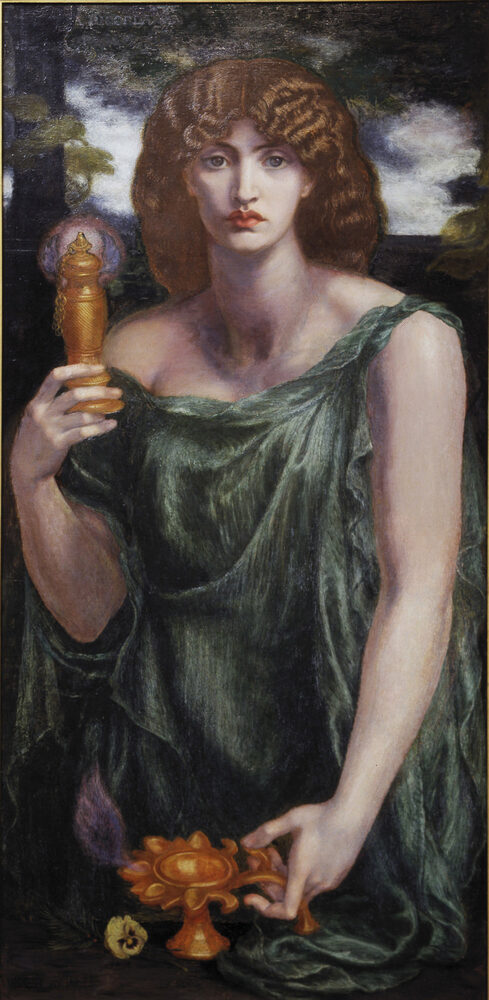
Mnemosyne
First Appearance
Mnemosyne first appears as one of the twelve Titans, the children of Gaia (Earth) and Uranus (Sky): Hesiod names her in a single breath among her sisters — "Theia and Rhea and Themis and Mnemosyne and gold-crowned Phoebe and lovely Tethys." She is thus of the oldest generation of gods, born before the Olympians and before the very existence of remembering had a keeper.
— Hesiod, Theogony 135
Who They Are
Mnemosyne (nem-OH-suh-nee / ne-MOS-in-ee) is the Titaness of Memory — Memory itself made a goddess, and, through her, the mother of the nine Muses. Her name is simply the Greek word for remembrance (mnēmē), so that to speak of her is to speak of the faculty by which the mind holds fast what would otherwise be lost. Among the twelve Titans born of Gaia and Uranus she is the least storied in her own right and yet, in an oral world, one of the most quietly powerful: she is the source from which song, knowledge, and the very continuity of a people spring.
Her great myth is her union with Zeus. For nine consecutive nights the king of the gods lay with her, and in time she bore nine daughters, the Muses, goddesses of epic and lyric, of history and astronomy, of dance and hymn — of every art and science the Greeks knew. That Memory should be the mother of the arts is no accident of genealogy but a statement of how the Greeks understood their culture. Before writing was common, all poetry, all genealogy, all law and lore lived only in the mind and the voice; the poet who could recite the deeds of gods and heroes did so because Memory had granted it. The singer's power is Memory's gift.
Beyond Hesiod she takes on a deeper, stranger role in the mystery cults. In the Orphic vision of the afterlife the soul must choose between two waters — the fatal draught of Lethe, Forgetting, and the cold, saving water of the Lake of Mnemosyne, Memory, which preserves consciousness and identity beyond death. And at the oracle of Trophonius in Boeotia her spring stood beside Lethe's at the very threshold of prophecy. In every setting Mnemosyne guards the same treasure: the continuity of the self and of the world, held against the tide of forgetting.
Mythology
The nine nights and the birth of the Muses
Mnemosyne's central myth is told by Hesiod at the very opening of the Theogony, where the poet sings of the Muses before he sings of anything else — for it is they, and through them their mother, who make his song possible. In Pieria, Hesiod says, Mnemosyne "who reigns over the hills of Eleuther" lay in union with Zeus, the son of Cronus, and bore the Muses as "a forgetting of ills and a rest from sorrows." For nine nights wise Zeus lay with her, going up to her sacred bed apart from the other immortals; and when a year had turned and the seasons come round, she bore nine daughters of one mind, "whose hearts are set upon song and their spirit free from care" (Theogony 53–62). Hesiod repeats the descent plainly in his catalogue of Zeus's unions: Mnemosyne bore to him the nine gold-crowned Muses (Theogony 915–917). Their names he gives as Clio, Euterpe, Thalia, Melpomene, Terpsichore, Erato, Polyhymnia, Urania, and — chief of them all — Calliope (Theogony 77–79). Born in Pieria, near Mount Olympus, they are called the Pierides; they also haunt Helicon in Boeotia and the springs there.
Why Memory is the mother of the arts
That the goddess of remembrance should give birth to the goddesses of poetry, music, and knowledge is one of the most revealing genealogies in Greek myth. It belongs to a world before books, in which culture survived only by being remembered. The epic poet did not read Homer; he recited — holding tens of thousands of lines, the names and lineages of heroes, the order of events, the fixed formulae of the verse, entirely in his trained memory. Genealogy, ritual, law, the deeds of ancestors: all of it lived in the mind and passed from voice to ear across the generations. To lose memory was to lose the past itself. So when the poet opens by calling on the Muses — "Sing to me, Muse..." — he is asking, at bottom, for the gift their mother embodies. The Muses are the arts; Mnemosyne is the faculty without which none of the arts could exist. The Greeks made her their mother because they understood that in an oral culture the poet's power simply is Memory's gift, and that to remember and to create were, in the end, the same divine act.
The spring of Memory and the water of Lethe (Orphic)
In the mystery-cult tradition — and this belief must be marked clearly as Orphic, not part of the common Hesiodic myth — Mnemosyne governs the fate of the soul after death. A set of thin gold funerary tablets, buried with initiates in southern Italy, Crete, and Thessaly from about 400 BCE onward (the Hipponion and Petelia tablets among the most famous), give the dead soul its instructions for the underworld. It will find, the tablets say, a spring on the left beside a white cypress — this water it must not drink, for it is the water of Forgetting, which later tradition names Lethe, and to drink it is to lose the memory of who one is and to be dissolved back into the anonymous cycle. Instead the soul must go on to another, colder water flowing from the Lake of Mnemosyne, Memory, where guardians stand watch. To them it must declare its divine lineage — "I am a child of Earth and starry Heaven" (Ge and Ouranos, Mnemosyne's own parents) — and beg: "I am parched with thirst and perishing; give me quickly the cold water flowing from the Lake of Memory." By drinking Memory's water rather than Lethe's, the initiate keeps consciousness and identity intact and escapes the wheel of rebirth. Here Mnemosyne is no longer merely the mother of song but the keeper of the soul's very self beyond death.
The oracle of Trophonius at Lebadeia
The same pairing of the two waters governed one of the most awe-inspiring oracles of Greece, that of the hero Trophonius at Lebadeia in Boeotia, described in vivid detail by Pausanias (9.39). Before a consultant could descend into the terrifying underground chasm to receive the oracle, the priests led him to two springs that flowed close together, called Lethe and Mnemosyne. First he drank from the water of Lethe, Forgetfulness, so that he might let go of every thought he had held until then; then he drank from the water of Mnemosyne, Memory, so that he would remember all that he saw and heard once he had gone down into the oracle. After the ordeal below — from which men came up numb with terror — he was set upon the throne called the Seat of Mnemosyne, and the priests asked him everything he had seen and learned, that Memory might fix the vision before it faded. In this rite the two goddesses of the mind stand at the very door of prophecy: one clears the seeker's mind, and the other seals the revelation into it.
Worship — Ancient
A goddess honoured with her daughters
Mnemosyne had no great temple or Panhellenic festival of her own; her worship was quieter and more diffuse than that of the Olympians, and she was most often honoured together with the Muses she bore. On Mount Helicon in Boeotia, the chief cult centre of the Muses, and in Pierian country beneath Olympus, Memory was revered as the wellspring of their inspiration. Poets and rhapsodes invoked her at the outset of performance, for it was she who steadied the reciter's mind and let the long song flow unbroken. A surviving Orphic Hymn (77) addresses her directly as the consort of Zeus and mother of the holy Muses, and prays that she rouse remembrance in the initiate and drive away forgetfulness — a prayer that shows how naturally she belonged to the world of the mysteries.
The springs and the oracle
Her most concrete cult was tied to water and to the threshold of the underworld. At Lebadeia, as Pausanias records (9.39.5–8), the spring of Mnemosyne stood beside the spring of Lethe at the oracle of Trophonius, and drinking from it was an indispensable part of the rite; there too stood the Seat of Mnemosyne on which the returning consultant was questioned. In the Orphic gold tablets, the cold water of the Lake of Mnemosyne is the soul's salvation in the afterlife. Across these settings the offering that suited her was water itself — libations poured from a pure spring — together with the honey and incense customary in the gentler, chthonic and mystic rites. To honour Mnemosyne was to honour the act of remembering as something sacred: the faculty that carried the gods' names, the ancestors' deeds, and the soul's own identity safely across time.
Worship — Modern
Honouring Mnemosyne today
A modern devotee can give Mnemosyne a place wherever memory and learning are cherished — a desk, a bookshelf, a study corner. A simple shrine bearing a small bowl of clear spring water, a lamp or candle, and perhaps an open book or an image of the Muses is enough. Because she is the mother of the arts and the keeper of the mind, she is a fitting goddess to call upon before study, writing, composition, performance, or any work that depends on holding and recalling what matters. Approach her with a quiet, attentive mind — the very faculty she embodies — and address her as Titaness of Memory and mother of the Muses.
Offerings
Water is the offering most truly hers: pour a libation of cold, clean spring water into a bowl set aside for her, in memory of the Lake of Mnemosyne from which the initiate drinks. Honey and a little incense (frankincense is traditional) suit her gentler, mystic character. If you keep a devotion to the Muses as well, honour mother and daughters together. Present the offering with a few words of thanks for what you are able to remember and create, and afterward pour out or set aside what was given so that it is truly hers.
Prayer & practice
Call on Mnemosyne when you begin any work of memory or art: at the start of study, before writing or performing, when committing something to heart, or when you wish to preserve a memory against forgetting. Ask her, as the Orphic Hymn does, to rouse remembrance and hold back the water of Lethe. In gratitude, name aloud the people, deeds, or knowledge you do not wish to lose — for to remember well, the Greeks believed, is itself an act of reverence to the goddess Memory.
Epithets & Cult Titles
- Mother of the Muses (Μουσῶν μήτηρ) — Her defining title — from her nine daughters flow poetry, music, dance, and all the arts and knowledge
- Queen of the hills of Eleuther — Hesiod's phrase (Theogony 54) — she who reigns over the uplands about Eleutherae, on the Boeotian border near the Muses' Pierian and Heliconian haunts
- Titanis — Titaness — one of the elder gods born of Earth and Sky before the reign of the Olympians
Sources & Variants
- Hesiod, Theogony 53–62 (the nine nights and the birth of the Muses), 77–79 (the names of the Muses), 135 (Mnemosyne among the Titans), 915–917 (Zeus's union with Mnemosyne)
- Orphic gold funerary tablets — the Hipponion tablet (c. 400 BCE) and the Petelia tablet (4th century BCE, British Museum) — the Lake of Mnemosyne and the water of Lethe (flagged Orphic / mystery-cult)
- Orphic Hymn 77 to Mnemosyne
- Pausanias, Description of Greece 9.39.5–8 (the springs of Lethe and Mnemosyne and the Seat of Mnemosyne at the oracle of Trophonius at Lebadeia)
Gallery