Typhon
First Appearance
Typhoeus first appears at the climax of Hesiod's Theogony, born of Gaia (Earth) in union with Tartarus (the Pit) after the Titans had been thrown down — the last and most fearsome challenger to Zeus's new order. From his shoulders grew a hundred snake-heads with dark flickering tongues, fire flashing beneath their brows, and voices of every kind: now the speech of gods, now the bellow of a bull, the roar of a lion, the yelp of hounds, the hiss that echoed back from the mountains. Had Zeus not been quick to strike, Hesiod says, this creature would have come to rule over mortals and immortals alike.
— Hesiod, Theogony 820–880
Who They Are
Typhon (TY-fon / TY-fohn), whom Hesiod calls Typhoeus (ty-FOH-ee-us), is the last and most terrible monster of Greek myth — the storm-giant born of Earth and the Pit to overthrow Zeus, the single foe who came closest of all to unmaking the rule of the Olympians. He is not a Titan, not one of the older gods, but a thing beyond them: a hundred-headed horror of coiling serpents, fire, and screaming winds, so vast (the poets say) that his head brushed the stars and his outstretched arms reached from the eastern edge of the world to the western. Where the Giants and the Titans challenged the gods as armies, Typhon challenged them as a single monstrous force of chaos, and for a moment he seemed about to win.
His parentage is itself a statement of what he means. In Hesiod he is the youngest child of Gaia (Earth) and Tartarus (the abyss beneath the world) — the mother of all things mating with the deepest pit to bring forth, in her grief and rage at the defeat of her earlier children the Titans, one last champion to avenge them. He is Earth's answer to Zeus: the chaos that was there before order, rising up out of the ground to pull the new-made cosmos back down into the dark. That he fails, and is buried under a mountain, is the myth's whole point — Zeus's victory over Typhon is the final seal on the Olympian order, the moment the reign of the sky-god becomes secure.
Yet Typhon does not simply vanish when he is beaten. He goes on siring monsters — with the serpent-woman Echidna he fathers the whole brood that the heroes will spend the next age of the world hunting down — and his own defeated body becomes a permanent feature of the earth, pinned writhing beneath Mount Etna, whose eruptions and earthquakes are his struggles and his fiery breath still leaking up through the mountain. And his name outlives him in the language of storms: the Greek words for the smoking whirlwind cluster around his, and the very word typhoon carries an echo of him. He is chaos made flesh — beaten but never quite killed, buried but never quite gone.
Mythology
Born of Earth and the Pit
Hesiod places Typhoeus's birth at the very end of the Theogony, after Zeus and the Olympians have thrown down the Titans and shut them away below. Grieved and enraged, Gaia — Earth herself — lay with Tartarus, the black abyss at the bottom of the world, and brought forth her last and youngest child: a monster made to be the undoing of the god who had beaten her earlier children. (This is the parentage the Theogony gives: Earth mating with the Pit to avenge the fallen Titans and Giants.) A later and different tradition is worth flagging: in the Homeric Hymn to Apollo (305–355), it is not Gaia and Tartarus but Hera who produces Typhaon — bringing him forth alone, without Zeus, out of spite after Zeus had borne Athena from his own head — and gives the infant monster to the she-dragon of Delphi to rear. Both versions agree on what he is: a birth of pure resentment, a weapon shaped against the king of the gods.
The hundred-headed horror
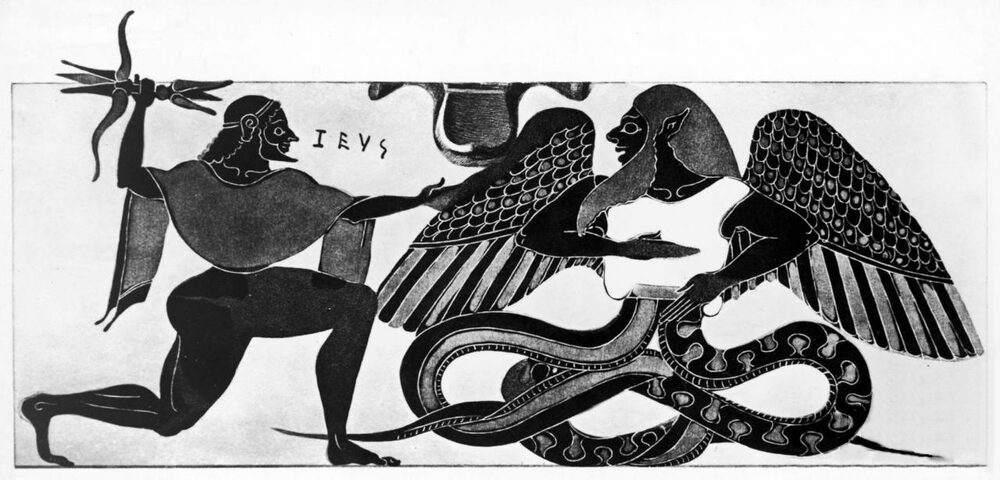
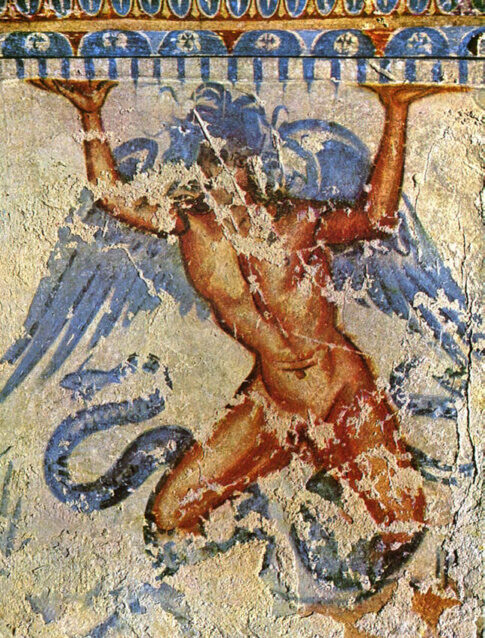
Picture him as Hesiod does: a being of appalling scale and multiplicity. From his shoulders sprang a hundred serpent-heads, the heads of a fearful dragon, their dark tongues flickering; fire flashed from the eyes beneath every brow; and from all those heads at once came a chaos of voices — sometimes a sound the gods could understand, sometimes the bellowing of a proud bull, sometimes the roar of a lion, sometimes a sound like a pack of hounds, sometimes a hissing that the great mountains threw back as an echo. Later poets pile on the same horror: Apollodorus makes him so tall his head scraped the stars and his hands reached out to the sunrise and the sunset, with wings, with a hundred dragon-heads, with viper-coils for legs that hissed and reached up to his own head, his whole body winged and his hair and beard streaming in the wind, fire pouring from his eyes and mouth. He is the biggest, loudest, most monstrous thing in all of Greek myth.
The gods flee to Egypt
When this creature came storming up against heaven, the Olympians — in the version Apollodorus preserves — panicked. The gods fled all the way to Egypt and, to hide from him, disguised themselves as animals: the tradition that the Greeks used to explain why the Egyptians worshipped gods in the shapes of beasts. Only Zeus stood, and (in some tellings) Athena with him, to shame him into turning back. This flight-of-the-gods motif measures how terrible Typhon was: not one Olympian among them, save the king of the gods himself, dared face him head-on.
Typhon cuts out the sinews of Zeus
Here is the heart of the story, and the moment Zeus came within a hair of losing everything — the episode as Apollodorus (1.6.3) tells it in full. Zeus first fought Typhon at a distance, pelting him with thunderbolts; then, closing in, he struck at him with an adamantine sickle (the harpe). Wounded, Typhon fled to Mount Casius in Syria, and there, seeing Zeus badly hurt, the monster closed with him hand to hand. He wound his vast serpent-coils around the god and gripped him fast — and wrenched the sickle out of Zeus's own hand, and with it cut the sinews (the tendons) out of Zeus's hands and feet. Crippled, unable to stand or wield his bolts, Zeus was helpless. Typhon hoisted the maimed god onto his shoulders, carried him across the sea to Cilicia, and dumped him in the Corycian cave. He hid the severed sinews there too, wrapped in a bear's skin, and set a guard over them: the she-dragon Delphyne, a monster half-maiden and half-beast. So the king of the gods lay dismembered and imprisoned, and the whole order of the cosmos hung on getting his sinews back.
The sinews stolen back, and Zeus restored
The rescue came by stealth, not force. Hermes and Aegipan (a goat-god figure, part of the Pan-tradition) crept into the Corycian cave, stole the hidden sinews out from under the dragon Delphyne, and secretly fitted them back into Zeus's hands and feet. (A second, later tradition — most fully told in Nonnus's Dionysiaca, where it is Zeus's thunderbolts as much as his sinews that Typhon has stolen — gives the trickery to Cadmus, the future founder of Thebes: disguised as a humble herdsman, Cadmus charms the music-loving monster with his shepherd's pipes and coaxes Typhon into handing over the sinews, saying he needs them to string a lyre worthy of such a listener; Typhon, enchanted, gives up the very thing that made him invincible, and Zeus snatches back his weapons.) His strength restored, Zeus rose again.
The pursuit and the trick of the Fates
Whole again and armed, Zeus came down out of heaven in a chariot drawn by winged horses and drove Typhon before him in a running battle across the world, hurling thunderbolt after thunderbolt. On Mount Nysa the Fates (Moirai) worked their own deception on the fleeing monster: they persuaded him to taste of the "ephemeral fruits," telling him they would make him stronger, when in truth they only weakened him — a strange episode that Apollodorus alone preserves. Failing and hunted, Typhon fled at last through the sea toward Sicily.
Buried beneath Mount Etna
There the chase ended. As Typhon fled across the Sicilian sea, Zeus heaved up Mount Etna and threw the whole mountain down on top of him, pinning the monster forever beneath its roots. And there, the poets agree, he still lies. Pindar (Pythian 1.15–28) describes Typhon crushed under Etna and the pillar of the sky, and makes the volcano's eruptions his: the fountains of unapproachable fire, the rivers of glowing smoke by day and rolling flame by night, are Typhon's breath and his struggling. Aeschylus (Prometheus Bound 351–372) gives the same picture — the hundred-headed dweller of the Cilician caves, blasted by the thunderbolt and now a charred and sprawling body wedged beneath Etna's roots, from which one day rivers of fire will burst. So the monster's defeat is written permanently into the landscape: every eruption of Etna, every earthquake in the region, is Typhon writhing under his mountain, and his volcanic fire is the last of the chaos-fire the Olympians could bury but never entirely put out.
The father of monsters
Even in defeat, Typhon leaves a lasting legacy through his mate, the serpent-woman Echidna — half lovely maiden, half fearful snake, who has her own page in this collection. From their union came the great monster-brood that stalks the age of heroes. Hesiod names among their children Orthrus, the two-headed hound of Geryon; Cerberus, the fifty-headed (later three-headed) hound of Hades; and the Lernaean Hydra, the many-headed water-serpent of the marsh. To Typhon and Echidna the tradition also assigns the fire-breathing Chimera (lion, goat, and serpent in one body), the riddling Sphinx who terrorized Thebes, and — in Apollodorus and others — the Nemean Lion, the eagle that gnawed Prometheus's liver, the Ladon dragon of the Hesperides, and more. Every one of these was a monster that a hero would one day have to face and kill: Heracles at the Hydra and the lion and Cerberus, Bellerophon at the Chimera, Oedipus at the Sphinx. In this sense Typhon casts the longest shadow of any monster in Greek myth — the age of heroes is, in large part, the age of hunting down Typhon's children.
Worship — Ancient
Not a god to be worshipped — a force to be understood
Typhon received no cult. He is the enemy of the gods, chaos itself risen against the order of Zeus, and no altar was ever raised to him. But he was never merely a story either: for the Greeks he carried a heavy freight of cosmic and natural meaning, and it is that meaning — rather than any invented worship — that belongs here.
The meaning of the myth: chaos against order
At its core the Typhon myth is the Greek account of how the world's order was finally secured. The Titanomachy (Zeus against the Titans) and the Gigantomachy (the gods against the Giants) both told of the Olympians overcoming older powers; the battle with Typhon is the last and hardest of these struggles, and the closest-run. That Zeus is dismembered and nearly destroyed, and wins only by getting his stolen sinews back, makes the point sharply: the cosmos is not a thing that was safe from the beginning, but a thing that had to be fought for, against a chaos that came terribly close to swallowing it. When Zeus buries Typhon under Etna, the reign of law and order over the primeval violence of Earth is complete. Poets used the image exactly this way — Pindar set the crushed Typhon beneath Etna as a figure of unruly force mastered by Olympian order, a lesson in the fate of those who rise against Zeus.
Storm and whirlwind
Typhon was also the Greeks' way of personifying the most frightening kind of weather. Hesiod makes the sudden, ship-wrecking storm-winds the literal offspring of the defeated Typhoeus, and the cluster of Greek words around his name — typhos (smoke, stupor), typhon (whirlwind, hurricane) — ties him to the smoking, spinning storm-blast that fell without warning on sailors and farmers. Many scholars, ancient and modern, have thought he was in origin a storm-god or wind-demon before he became the great cosmic monster.
Volcano and earthquake: Etna, Cilicia, the Corycian cave
Above all Typhon explained the burning, shaking earth. His prison under Mount Etna in Sicily made him the myth behind that volcano's eruptions — the fire, the smoke, the tremors all read as the buried monster's struggles and breath (Pindar and Aeschylus both make this explicit; other traditions pinned him under the volcanic fields of Cumae near Naples, or under the island of Ischia/Pithecusae). His lair in life was placed at the real Corycian cave in Cilicia (southern Asia Minor), a genuine and awe-inspiring cavern that local tradition tied to the monster and to the theft of Zeus's sinews. Wherever the earth smoked or shook or opened, the Greeks could feel Typhon underneath it. The Greeks also identified him with the Egyptian god Set, the desert-and-disorder deity — Herodotus and Plutarch equate Typhon with Set — folding him into the religious landscape of Egypt as the principle of destructive chaos.
Worship — Modern
A figure of reception, not cult
Typhon has no worship today, ancient or modern — he is a monster, the adversary of the divine order, and there is no cult of Typhon to revive or reconstruct. What he has instead is a long afterlife in language, art, and imagination, and that reception is his true modern legacy.
The word for the storm
His most everyday monument is a word. The English typhoon — the great cyclonic storm of the Pacific — sits at the meeting-point of several languages (Arabic ṭūfān, "flood, deluge"; Chinese tái fēng, "great wind"), but its European form was shaped and reinforced by the Greek typhon, "whirlwind," and by Typhon's own name; the older English spellings touffon and tuffoon were pulled toward "typhoon" under the Greek monster's influence. (The link is one of mutual reinforcement rather than a single clean descent — worth flagging honestly rather than overclaiming.) The adjective typhonic and the meteorological sense of a violent, spinning storm keep his name alive every hurricane season, and modern science borrows it too — the giant chaos of Typhon lends itself readily to anything vast, violent, and disordered.
The Zeus-versus-Typhon motif in art and story
The image of the sky-god hurling his thunderbolt at the serpent-legged monster is one of the oldest and most enduring in Western art. It appears already on Greek vase-paintings and temple sculpture (a famous early example is the winged, serpent-tailed Typhon on a sixth-century Athenian pediment), and the "storm-god slays the chaos-dragon" pattern that Typhon embodies is shared across the whole ancient Near East — echoing the battles of the Hittite storm-god with the dragon Illuyanka, of Marduk with Tiamat in Babylon, and standing behind later dragon-slaying imagery. In modern fantasy, games, and fiction Typhon is a stock name for the ultimate monster or final adversary, precisely because that is what the Greeks made him: the biggest, the last, and the most nearly victorious of all the things the gods had to overcome.
What he still means
For a reader today, Typhon endures as the perfect image of chaos that can be defeated but not destroyed — beaten by Zeus, buried under a mountain, and yet still smoking, still shaking the ground, still fathering monsters, still lending his name to every storm that spins up out of a clear sky. He is the reminder built into the very foundations of the Greek cosmos that order is something won, and held, against a darkness that is only ever pinned down, never wholly gone.
Epithets & Cult Titles
- Typhoeus (Τυφωεύς) — Hesiod's fuller form of the name — the same monster under his oldest poetic title, the youngest and most terrible child of Earth; the two names, Typhon and Typhoeus, are used interchangeably in the sources
- Father of the winds (πατὴρ ἀνέμων) — A descriptive title drawn from Hesiod: from the defeated Typhoeus spring the wild, destructive storm-winds that fall upon the sea and wreck ships and ruin the works of men — the sudden squalls sailors could not foresee (the fair winds Notos, Boreas, and Zephyros are set apart, being of the gods)
- Father of monsters — A descriptive title marking his union with the serpent-woman Echidna, from whom he sired the great monster-brood of Greek myth — Cerberus, the Lernaean Hydra, the Chimera, the Sphinx, Orthrus, the Nemean Lion, and the dragon Ladon among them
- Hundred-headed / hekatonkephalos (ἑκατοντακέφαλος) — A descriptive title after his shape in Hesiod and Pindar — a hundred serpent-heads springing from his shoulders, each with flickering black tongues and fire flashing from the eyes, uttering every kind of voice
- The Cilician one (Κιλίκιος) — A local title binding him to the Corycian cave in Cilicia (in what is now southern Turkey), the cavern where he was said to lair and where, in Apollodorus, he hid the stolen sinews of Zeus
Sources & Variants
- Hesiod, Theogony 820–880 (the birth of Typhoeus from Gaia and Tartarus, the hundred serpent-heads and many voices, the battle with Zeus and his hurling into Tartarus, and the destructive storm-winds that spring from him)
- Hesiod, Theogony 295–332 (Typhaon's union with Echidna and their monstrous offspring: Orthrus, Cerberus, the Hydra, and the Chimera)
- Homeric Hymn to Apollo 305–355 (the variant birth: Hera bears Typhaon alone in spite, and gives him to the she-dragon of Delphi to rear)
- Apollodorus, Bibliotheca 1.6.3 (the full battle: the gods flee to Egypt as animals, the sickle, Typhon severing the sinews of Zeus and hiding them in the Corycian cave under the she-dragon Delphyne, Hermes and Aegipan stealing them back, the Fates' trick of the ephemeral fruits at Nysa, and the burial under Mount Etna)
- Pindar, Pythian 1.15–28 (the hundred-headed Typhon crushed beneath Etna, the volcano's fire and smoke as his struggle); Pythian 8.15–16 (the Cilician, hundred-headed Typhon)
- Aeschylus, Prometheus Bound 351–372 (the earth-born dweller of the Cilician caves, blasted by Zeus's thunderbolt and pinned beneath the roots of Etna, whence rivers of fire will burst)
- Nonnus, Dionysiaca 1–2 (Typhon steals Zeus's thunderbolts/sinews; Cadmus charms him with pipe-music and tricks him into surrendering them, and Zeus destroys him) — late epic elaboration
- Herodotus 2.144, 3.5 and Plutarch, On Isis and Osiris (the Greek identification of Typhon with the Egyptian god Set); on the etymology and storm-wind associations of the name
Gallery