Kerberos
First Appearance
Cerberus is first named in Hesiod's Theogony, twice over. In the catalogue of the monstrous brood of Typhoeus and Echidna (310–312) he is "Cerberus who eats raw flesh, the brazen-voiced hound of Hades, fifty-headed, relentless and strong." Later (769–773) Hesiod sets him at his post before the echoing house of the dead: a pitiless watchdog with a cruel trick, who fawns with tail and ears alike on all who go in, but will not let a single soul back out again — lying in wait to devour any who try to return through the gates.
— Hesiod, Theogony 310–312 and 769–773
Who They Are
Cerberus (SUR-buh-rus), in Greek Κέρβερος (Kerberos), is the monstrous hound that guards the gates of the underworld — the dog of Hades, who lets the dead go in and lets none come back out. He is one of the great brood of monsters born to Typhon and Echidna, the "father and mother of all fearful things," and full brother to the Hydra, the Chimaera, and Orthus; but where his siblings are scattered across the upper world for heroes to hunt down, Cerberus keeps the one post that never changes hands, planted before the halls of the dead at the edge of the world where the living are not meant to pass. To the Romans he is simply Cerberus, the name unaltered.
The Cerberus of settled tradition — the one on the vases and in the poets — has three dog's heads, a serpent for a tail, and a mane and back bristling with the heads of snakes. But his form was never fixed: Hesiod, the earliest to name him, gives him fifty heads and calls his voice a ringing of bronze; Pindar and Horace raise the count to a hundred; some early painters gave him only two. The three heads won out, and it is as the three-headed hound that he has kept his grip on the imagination for three thousand years, down to the black dog with three heads that still guards a trapdoor in a children's story.
His myth turns almost entirely on a single question: can anyone get past him, and come back? Twice the answer is yes, and each time it is the measure of the one who does it. Heracles, for his twelfth and last and greatest labour, goes down alive and drags Cerberus up into the daylight with his bare hands — the one hero strong enough to master death's own dog. Orpheus, going down after his dead wife, gets past him another way entirely, charming the beast to stillness with the sound of his lyre. The guardian who cannot be forced can, it seems, be lulled; and between the strong man and the singer, Cerberus became the fixed image of the barrier at the end of everything — the thing you must get past to reach the dead, and past again to come home.
Mythology
Born of Typhon and Echidna
Cerberus belongs to the most terrible family in Greek myth. His father was Typhon (Typhoeus), the storm-monster who once fought Zeus for the mastery of the cosmos; his mother was Echidna, the she-serpent, half beautiful woman and half enormous snake, who "dies not nor grows old all her days." From that union came the pack of monsters the heroes would spend their lives killing: Orthus, the two-headed hound of Geryon; the Hydra of Lerna; the fire-breathing Chimaera; and, in Hesiod's list, Cerberus himself, set down between his brothers as "the brazen-voiced hound of Hades, fifty-headed, relentless and strong." Alone among that brood he was not made to be hunted and slain — he was made to be a guard, and he was given the one gate that matters, the door of the house of the dead.
What Cerberus looked like
His shape shifts from poet to poet, and the storytellers knew it. Hesiod, the oldest source, gives him fifty heads and a voice like struck bronze (chalkeophōnos). Pindar was said to have given him a hundred, and Horace calls him a "hundred-headed beast" (belua centiceps). Some of the earliest vase-painters, on the other hand, drew him with only two heads. But the form that became canonical is the one Apollodorus records in his account of the twelfth labour: three dogs' heads, the tail of a serpent (a living snake for a tail, that could bite), and along his back and neck the heads of all kinds of snakes, a bristling mane of serpents. That is the canonical Cerberus — three heads, serpent-tail, snake-maned — with Hesiod's fifty and Horace's hundred flagged as the older and the grander variants of a monster whose whole nature is excess.
The watchdog of Hades
Cerberus stands his watch before the gates of the underworld, on the far bank of the Styx, and his duty is not to keep the dead out but to keep them in. Hesiod draws the trap exactly: to every soul that comes down and passes inward, the hound is all friendliness, fawning and wagging with tail and both ears; but the moment a shade tries to slip back out through the gate toward the light, he falls on it and devours it. He is the reason the underworld is one-way — the living door of a country with no exit. This is what makes getting past him the true test of any journey to the dead: it is not the going down that Cerberus guards against, but the coming back up.
The Twelfth Labour: Heracles drags him into the light
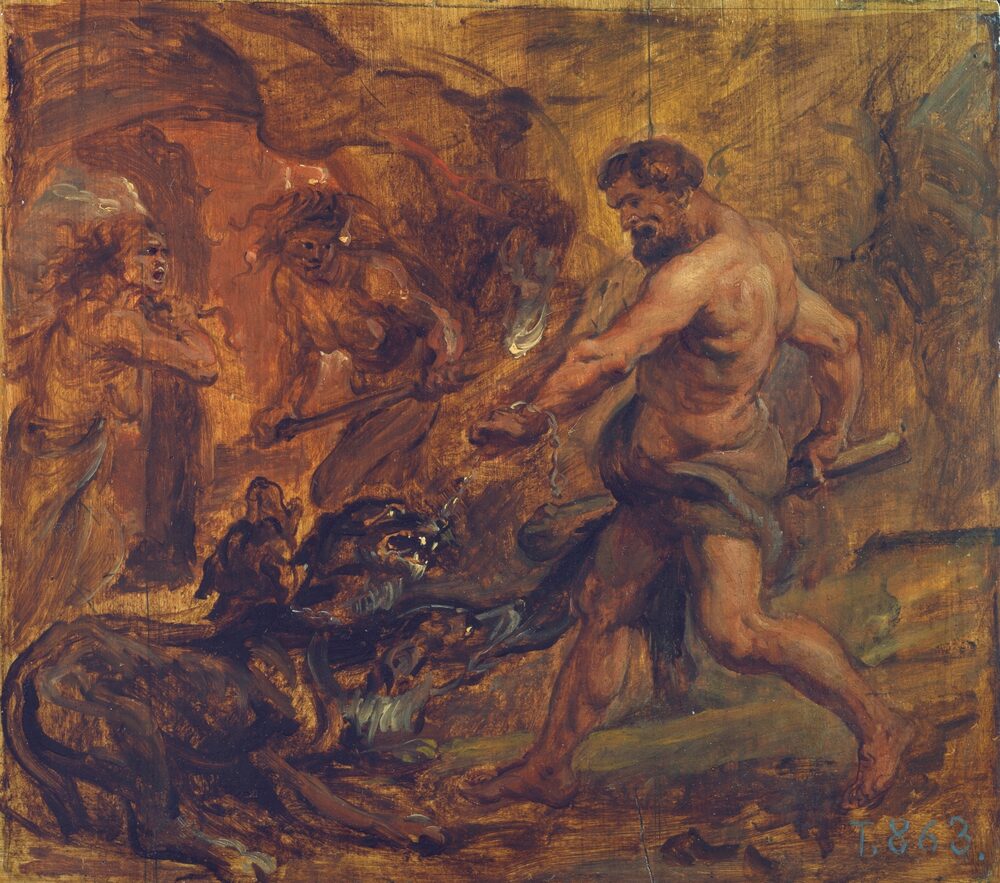
The centrepiece of Cerberus's myth is the last and hardest of the Labours of Heracles, whose own story the Golden Thread tells in full. For his twelfth labour Eurystheus set Heracles the one task meant to be impossible — to go down alive into the house of Hades and bring back Cerberus. Heracles descended (in the usual telling through the cave-mouth at Taenarum, the great chasm at the southern tip of Laconia that opened on the underworld), and, guided by Hermes and Athena, came at last before the throne of Hades himself. He asked the lord of the dead outright for the hound. Hades granted it — on one condition: that Heracles master the beast using no weapons, armed only with his lion-skin and his own strength. Heracles found Cerberus at the gates of Acheron, threw his arms around the creature's necks, and held on. The serpent-tail whipped round and bit him; the snakes of the mane struck at him; the hero never loosened his grip, but squeezed and throttled until the beast gave way. Then he carried the choking, subdued Cerberus up out of the dark — surfacing, Apollodorus says, at Troezen — and brought him before Eurystheus, who is said to have hidden in a great jar at the sight of him. Having shown the dog, Heracles carried him back down and set him again at his post: the one creature ever taken from the underworld alive and returned. It is the crown of the Labours precisely because it is a victory over death's own guard, won bare-handed and by the leave of Hades, not stolen.
Orpheus, and the music that stilled him
Where Heracles overpowered Cerberus, Orpheus — whose descent the Golden Thread also follows — got past him by another art entirely. Going down into the underworld to win back his dead wife Eurydice, Orpheus carried no club and no lion-skin, only his lyre; and when he played and sang, the whole kingdom of the dead was spellbound. Virgil, in the Georgics, gives the unforgettable image of the effect: Cerberus stood with his three mouths hanging open, agape and silent, the bark stopped in his throats by the sound. Seneca too has the hound of hell laying his heads down and stilling his serpents at the singer's music. The lesson the Greeks drew from setting the two descents side by side is plain enough: the guardian who could not be forced by any strength short of Heracles' could still be charmed — that even the pitiless dog of the dead was not proof against the power of song.
The Roman honey-cake, and the poison in his slaver
A later, Roman variation gives a third way past the hound: not strength and not music, but a drugged treat. In Virgil's Aeneid (Book 6), when the Sibyl leads Aeneas down to the underworld, Cerberus fills the realm with his triple-throated barking (latratu trifauci) and rears up, the snakes bristling on his necks — until the Sibyl throws him a honey-cake steeped in soporific drugs (melle soporatam et medicatis frugibus offam). He snaps it up in his ravening three mouths, and his huge body sinks slack across the cave, letting the travellers slip past. This Roman scene — flagged here as later and Latin — is the source of the English phrase "a sop to Cerberus," a small bribe thrown to a fierce guardian to buy safe passage. One last mark of him lingers in the upper world: when Heracles dragged Cerberus into the daylight, Ovid tells, the maddened beast slavered and thrashed, and where the white foam of his mouth fell on the earth it took root and grew as aconite (wolfsbane), the deadly poison — so that even the flower carries the venom of the hound of hell.
Worship — Ancient
A guardian, not a god
Cerberus is a monster, not a deity, and he received no cult of his own — no temple, no festival, no priesthood, no sacrifice raised in his honour. To worship him would have made no sense to a Greek: he is a thing to be got past, not petitioned. But he had a real and constant place in ancient religious life all the same, at the one point where every person was certain to meet him. He was the guardian of the threshold every soul had to cross, and the care of the dead was shaped, in part, around the crossing he stood over.
The sop to Cerberus
The most concrete trace of him in ancient practice is the honey-cake — a small cake of honeyed meal (the Greek melitoutta) placed in or beside the hands of the dead at burial, provisioning them for the journey below. In the mythic logic preserved by the poets, the cake was a sop for the hound: something sweet to throw the guardian so that the soul might pass his gate unharmed, exactly as Virgil's Sibyl throws the drugged offa to quiet him. The dead were sent down equipped for the doorway they would face — most famously with the coin for the ferryman Charon, and, in this strand of the tradition, with the cake for the dog. To be buried without the proper rites was, in this imagining, to arrive at the gate empty-handed.
His place in the geography of death
Cerberus also anchored the ancient map of the underworld's entrances. The cave at Taenarum in the Mani — a real place, a dark chasm by the sea at the southernmost point of the Greek mainland — was widely held to be the mouth by which Heracles had dragged the hound up, and it drew the awe due to a gate of the dead. Through such places the living imagined the boundary that Cerberus kept: the fixed frontier past which the funeral sent them, and from which the watchdog ensured there was no return. His role in ancient religion, then, was not that of a god who was served, but of a fact that was reckoned with — the shape the Greeks and Romans gave to the finality of death itself.
Worship — Modern
Not a god to be honoured, but a figure that endures
As a monster, Cerberus has no worship, ancient or modern, and no place in the devotional practice of anyone reviving the old religion — there is no cult of the hound of Hades to keep. What he has instead is one of the longest and liveliest afterlives of any figure in Greek myth. He survives not as a god who is served but as an image that will not die: the three-headed dog at the gate, the guardian you have to get past, has outlasted almost all the gods who once stood above him.
"A sop to Cerberus"
His clearest legacy in ordinary speech is the phrase "a sop to Cerberus" — drawn straight from Virgil's drugged honey-cake — meaning a small concession or bribe offered to appease a dangerous, obstructive guardian and buy passage past them. To "give a sop to Cerberus" is to quiet a fierce gatekeeper with a token, and the idiom is still current in English wherever someone throws a minor gift to a formidable obstacle. It is a small, exact fossil of the whole myth: the barrier at the door, and the sweet thing thrown to get by it.
The three-headed dog in art, story, and the sky
In art Cerberus has been a fixture from Greek vases through Dante — who set him in the third circle of the Inferno, clawing and howling at the gluttonous — to Rubens and Blake and beyond, almost always in the grip of Heracles or cowering at Orpheus's song. In modern story he is everywhere the myth of the guarded threshold is retold, from the three-headed "Fluffy" guarding a trapdoor in Harry Potter to countless games, films, and comics where a three-headed hound means the door to the land of the dead. And he has been set, twice over, among the heavens: the astronomer Johannes Hevelius in the seventeenth century drew a now-defunct constellation, Cerberus, as a three-headed serpent clutched in the hand of Hercules; and in 2013 one of the small moons of dwarf-planet Pluto — fittingly, a satellite of the lord of the underworld — was named Kerberos. The watchdog of the dead keeps his post still, in language and in the sky.
Epithets & Cult Titles
- the Hound of Hades (Ἀΐδεω κύων / Aïdeō kyōn) — The dog of the house of Hades — Hesiod's own naming of him (Theogony 311), the guard-dog set before the gates of the dead; Homer alludes to him with the same phrase, 'the hound of Hades', without giving the name
- the fifty-headed (πεντηκοντακέφαλος / pentēkontakephalos) — Fifty-headed — Hesiod's count in the Theogony (312); the canonical three heads of Apollodorus and of art are a later and more familiar reckoning, while Pindar and Horace push the tally to a hundred (Horace's belua centiceps)
- the bronze-voiced (χαλκεόφωνος / chalkeophōnos) — Brazen-voiced — Hesiod's epithet (Theogony 311), a voice like ringing bronze; Virgil's Latin answer to it is the triple bark that makes the whole realm echo, latratu trifauci
- the flesh-devourer (ὠμηστής / ōmēstēs) — Eater of raw flesh — Hesiod's word (Theogony 311); it names the trap of his post, for he fawns on souls entering but devours any who try to turn back out through the gate
Sources & Variants
- Hesiod, Theogony 310–312 (Cerberus born of Typhon and Echidna: the flesh-eating, brazen-voiced, fifty-headed hound of Hades)
- Hesiod, Theogony 767–773 (Cerberus at his post before the house of the dead — fawning on those who enter, devouring those who try to leave)
- Homer, Iliad 8.366–369 and Odyssey 11.623–626 (Heracles sent down to fetch 'the hound of Hades'; the dog alluded to but not named)
- Apollodorus, Bibliotheca 2.5.12 (the Twelfth Labour: three dogs' heads, a serpent's tail, snake-heads along the back; Hades' condition of no weapons; the bite of the tail; the ascent through Troezen)
- Euripides, Heracles 22–25, 610–615, 1276–1278 (the fetching of the three-bodied hound of hell as the crown of the labours)
- Virgil, Aeneid 6.417–425 (the triple-throated bark, the snake-bristling necks, and the Sibyl's drugged honey-cake that quiets him) — Roman retelling
- Virgil, Georgics 4.481–484 (Cerberus standing with his three mouths agape, spellbound by the song of Orpheus) — Roman
- Ovid, Metamorphoses 7.406–419 (Heracles drags Cerberus up; the flecks of his foam take root as aconite/wolfsbane) — Roman
- Horace, Odes 2.13.33–36 (the belua centiceps, the 'hundred-headed beast', its ears soothed by song); 3.11.13–20 (the porter of the hall yielding to the lyre) — Roman
- Seneca, Hercules Furens 782–812 (the three heads dragged into the daylight) and 569–591 (his serpents stilled by Orpheus's music) — Roman
- Pindar (cited by scholiasts) — the hundred-headed reckoning of Cerberus, an early variant to Hesiod's fifty
Gallery