Chimaira (Chimera)
First Appearance
The Chimera enters Greek literature already fully formed, in the sixth book of the Iliad, where Glaucus tells the tale of his ancestor Bellerophon: the hero was commanded first of all to slay "the Chimera, the raging monster, of divine stock and not of men — in front a lion, behind a serpent, and in the middle a goat, breathing forth the terrible might of blazing fire" (πρόσθε λέων, ὄπιθεν δὲ δράκων, μέσση δὲ χίμαιρα). Hesiod's Theogony (319–325) repeats the same triple body almost word for word and sets her in the great family of monsters, "breathing invincible fire," slain in the end by Pegasus and noble Bellerophon.
— Homer, Iliad 6.179–183; Hesiod, Theogony 319–325
Who They Are
The Chimera (ky-MEER-uh / ki-MAIR-uh; Greek Χίμαιρα, Chimaira) is the great fire-breathing monster of Lycia and one of the strangest creations in all of Greek myth — a single living beast made of three animals at once: a lion in front, a goat in the middle, and a serpent for a tail, breathing living flame from her jaws. She belongs to the terrible brood of Typhon and Echidna, the monster-parents whose children include Cerberus, the Hydra, and the Sphinx, and like them she exists to be a scourge upon the earth and a trial for a hero — in her case the young rider Bellerophon, who alone could reach her, mounted on the winged horse Pegasus.
Her very name is a paradox. Χίμαιρα is an ordinary Greek word meaning simply "she-goat" — a young female goat that has survived a single winter — and it was borrowed for the monster because the middle of her three bodies is a goat's. That so homely a word came to name so impossible a creature is the heart of what she is: from a farmyard animal, Greek imagination built the definitive image of things that cannot and should not exist joined into one. It is exactly this that the word "chimera" has come to mean in every language since — a fantastic impossibility, a thing stitched together from parts that do not belong together.
Yet for all her fantastical body, the Chimera was rooted by the ancients in a real and visible place. The Greeks connected her fire to a genuine geological marvel — the eternal flames of Mount Chimaera in Lycia (modern Yanartaş, "the flaming rock," in south-western Turkey), where natural gas seeping from the mountainside has burned in the open air for thousands of years without going out. The monster, in other words, had an address, and travellers could stand before the burning ground and see the beast's breath still rising from the earth. (Later writers, from the scholiasts onward, would add the famous clever detail of how Bellerophon killed her — a trick not found in Homer; the earliest telling says only that he trusted in the signs of the gods.)
Mythology
The brood of Typhon and Echidna
The Chimera was born, the tradition holds, of the two most monstrous beings in the world: Typhon, the hundred-headed storm-giant who once fought Zeus himself for the mastery of heaven, and Echidna, the half-woman, half-serpent "mother of all monsters." Apollodorus states it plainly (2.3.1), and Hesiod's Theogony sets her in the same fearsome litter — brothers and sisters that read like a catalogue of everything a Greek hero would ever have to face: Cerberus, the hound of the underworld; the Lernaean Hydra; Orthus, the two-headed dog; and, in the wider reckoning of Hyginus (Fabulae 151), the Sphinx of Thebes and the Nemean lion as well. (A textual note: at Theogony 319 the Greek "she bore" is grammatically ambiguous — the mother may be Echidna or, on a stricter reading of the lines, the Hydra named just before. The dominant ancient tradition, followed by Apollodorus and Hyginus and adopted here, makes her the child of Typhon and Echidna.) To this family the Chimera belonged by nature: a creature made not to live but to devastate, "a single beast with the force of three."
The three-formed, fire-breathing body
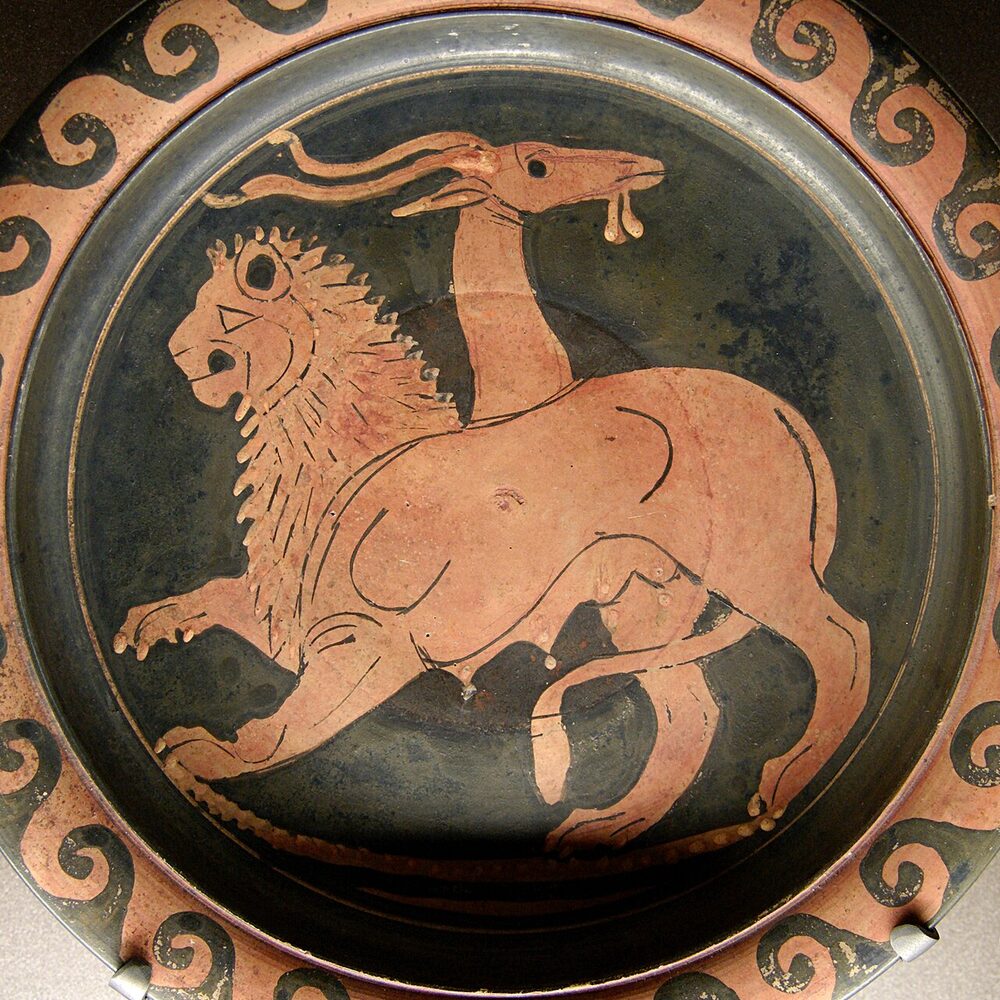
What made the Chimera unforgettable was her body, and every ancient source dwells on it. She was, in Homer's exact order, a lion in front, a serpent behind, and a goat in the middle — one animal fused of three, moving as a single creature. Her foreparts were those of a great lion; her tail was a living serpent (later writers make it a dragon's tail, sometimes ending in a snake's head that could bite of its own accord); and rising from the middle of her back, between the two, was the head and neck of a goat — the she-goat, chimaira, that gave her the name. This is the form the Greeks and Etruscans painted and cast in bronze: the lion's body prowling forward, the snake-tail lashing behind, and the goat's head thrown up and back from the spine, all three mouths alive at once. And from her — from the lion's jaws in Homer, from the goat's throat in Apollodorus's telling — came her one weapon, a blast of living fire, "the terrible might of blazing flame," that no ordinary warrior could come near. Homer calls her amaimaketē, the raging and irresistible; she "harried the cattle and devastated the country," a plague upon the whole land of Lycia that no shepherd or soldier could drive off.
Bellerophon and Pegasus
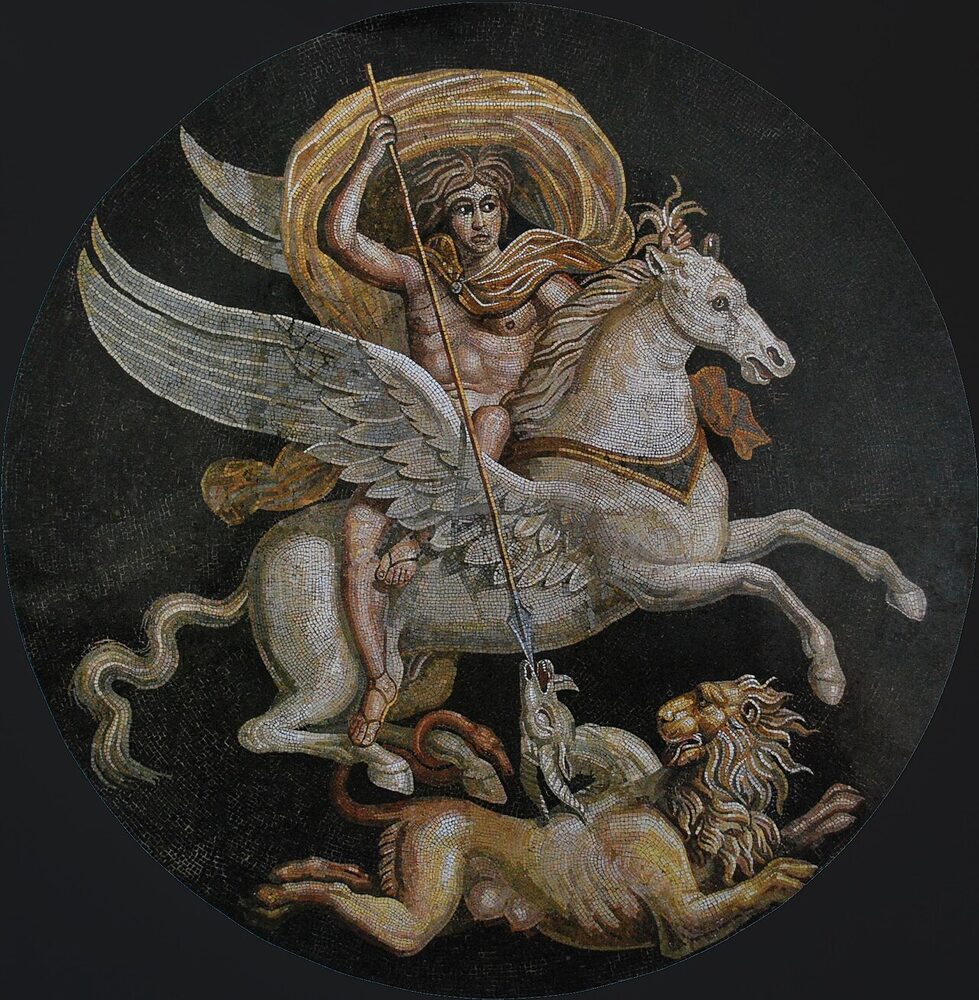
Because no man on foot could face her flame, the Chimera's slaying required two things no ordinary hero had: the winged horse Pegasus, to fight her from the safety of the air, and a trick to defeat a breath that no blade could pass. The task fell to Bellerophon, a young Corinthian prince sent to Lycia by King Iobates with a sealed letter secretly asking that its bearer be killed. Bound by the sacred law of hospitality not to murder his guest outright, Iobates instead set him against the Chimera, "a thing no man was meant to survive." But Bellerophon had first tamed Pegasus, bridling the winged horse at the spring of Peirene with a golden bridle given him by Athena (his own story, and Pegasus's, are told on their pages). Mounted and airborne, out of reach of the fire, he could at last engage the monster on something like even terms — though her burning breath still meant that to close with her was to die.
The lump of lead and the monster's own fire
Here the tradition supplies its cleverest turn — though it is worth flagging that this detail is absent from Homer and Hesiod, appearing only in later sources (the ancient scholia on the Iliad and the mythographers who followed them); the oldest account says simply that Bellerophon "slew her, trusting in the signs of the gods." In the fuller, clever telling, Bellerophon solved the problem of the fire by turning it against its owner. He fixed a lump of lead to the tip of his spear, and, swooping close on Pegasus, drove the lead-tipped point into the Chimera's fire-breathing jaws. The monster, doing what it always did, breathed out its blast of flame — and the heat of its own breath melted the lead. The molten metal ran down the creature's throat, and there it burned and choked her from the inside, searing her guts and stopping her breath, until the Chimera died of her own fire turned back upon her. So the beast made of three animals, whom no sword could reach, was undone by a soft grey metal and her single greatest strength — the neatest possible image of a monster destroyed by exactly the thing that made it terrible.
After the Chimera
The Chimera was only the first of the trials heaped on Bellerophon: Iobates, seeing him return alive, sent him next against the fierce Solymi and then the Amazons, and at last laid an ambush of Lycia's best warriors — all of which the hero survived, until the king relented, recognized his worth, and gave him his daughter and half the kingdom. But the Chimera's death was the deed that mattered, the one Homer's Glaucus names first and the one that fixed both hero and monster in memory forever. Homer adds one further note (Iliad 16.328–329): the Chimera had been reared by a man named Amisodarus, "a bane to many men" — a hint of some older, lost story in which the monster was fostered rather than merely born wild. But in the myth as it came down, she has one destiny only: to ravage Lycia until the boy on the winged horse came, and to die with molten lead in her throat.
Worship — Ancient
A monster, not a god — but a real place
The Chimera received no cult: she was a monster to be slain, not a power to be worshipped, and there is no temple, festival, or offering to her anywhere in the Greek world. What she had instead was something almost stranger — a home the ancients could visit. The Greeks and Romans identified the monster's undying fire with a genuine natural wonder in Lycia: the perpetual flames of Mount Chimaera, on the slopes above the ancient city of Olympos near Phaselis (today Yanartaş, "the flaming rock," in Antalya Province, Turkey), where methane and other gases seeping from vents in the rock have burned in the open air, day and night, for as far back as human memory reaches. Ancient writers — among them Pliny the Elder (Natural History 2.110) and later geographers — describe the mountain of Lycia "that flames with a fire that never goes out," and it was natural for them to say that here was the very lair, or the very breath, of the Chimera. The myth thus had a geography: a monster you could in some sense still see burning.
The Chimera in ancient art
If she had no altars, the Chimera had an extraordinary afterlife in art, where her impossible body was a gift to painters and sculptors. She appears on Greek vases and, above all, in the masterpieces of Etruscan bronze-working: the celebrated Chimera of Arezzo (c. 400 BC, now in Florence), a wounded, snarling bronze beast with the lion's body, the goat's head rising from its back, and the serpent-tail curling to bite, is one of the greatest surviving works of Etruscan art and the definitive ancient image of the monster. Scenes of Bellerophon and Pegasus striking down the Chimera were popular from the Archaic period onward, on pottery, coins (the Chimera was a civic badge on the coinage of several Lycian and Greek cities, including Sikyon), gems, and mosaics — the flying hero and the three-bodied beast making one of the most recognizable combat images in the whole repertoire of classical art.
In the poets and mythographers
Beyond Homer and Hesiod, the Chimera runs through the whole tradition as the type of the monstrous foe. Pindar sings of Bellerophon slaying "the Chimaera breathing fire" as he flew on Pegasus (Olympian 13). Apollodorus (Bibliotheca 2.3.1) gives the fullest prose account of her body and parentage, and Hyginus (Fabulae 57 and 151) preserves both the tale of her killing and her place in the brood of Typhon and Echidna. Virgil sets her among the horrors at the mouth of the underworld (Aeneid 6.288), and Lucretius (5.905) uses her as his standard example, to a philosophical end, of a creature that reason shows cannot really exist — a use that points straight ahead to what her name would come to mean.
Worship — Modern
The word that outlived the monster
No creature of Greek myth has left a longer shadow in ordinary language than the Chimera, and she survives today far less as a story than as a word. To call something chimerical is to call it a fantasy, a hope with no possible substance — exactly the sense Lucretius already reached for when he named her as the type of the thing that cannot be. And a chimera, in plain English, is any wild impossibility or any grotesque fusion of unlike parts: the monster has become a metaphor so complete that most people who use the word have no idea it was once a specific beast with a lion's head and a goat rising from its back.
Chimera in science
Most strikingly, the Chimera has been drafted into modern biology and medicine, where her old meaning — one body made of parts that belong to different creatures — turns out to describe something real. A genetic chimera is a single organism whose cells carry two or more distinct sets of DNA, formed (for instance) when two embryos fuse; the term is used for everything from a person with two genomes to the grafted plants and laboratory "geep" (a goat-sheep chimera) that literally combine two species. In cutting-edge cancer therapy, CAR-T cells — "chimeric antigen receptor" T-cells — are immune cells re-engineered with a receptor stitched together from different proteins, a treatment that has saved real lives; the fusion-monster's name has become the name for a fusion-cure. From cell biology to genetics to immunology, scientists reach again and again for the same 3,000-year-old word whenever they need to describe two natures joined in one body.
In art, story, and the burning mountain
The Chimera remains a favourite of artists, writers, and designers wherever a striking impossible beast is wanted — in fantasy fiction and games she is a standard monster, and the Chimera of Arezzo is still a touchstone of ancient art. And her oldest home is still on fire: the flames of Yanartaş above Olympos in Turkey burn to this day, a popular hike for travellers who climb at dusk to watch the natural gas flicker from the bare rock exactly as it did when the ancients called it the breath of the monster. Of all the creatures of Greek myth, the Chimera may be the one whose reality is easiest to touch — a word in every scientist's mouth, and a mountainside that has never stopped burning.
Epithets & Cult Titles
- the Chimaera of Lycia (ἡ Λυκίη Χίμαιρα) — Descriptive of place — the fire-breathing bane fixed by the myth in Lycia, the mountainous corner of south-western Asia Minor she ravaged and where her name still clings to a burning hillside
- the Fire-breather — From Homer's line 'breathing forth the terrible might of blazing fire' (deinon apopneiousa pyros menos aithomenoio, Iliad 6.182) — the single trait every ancient source keeps: a beast whose weapon is living flame
- amaimaketē (ἀμαιμακέτη) — The epic epithet Homer and Hesiod give her — 'raging,' 'irresistible,' 'not to be fought against' — the standard word marking her as a force no ordinary man was meant to face
- Χίμαιρα — 'she-goat' — The name itself, an ordinary word for a yearling nanny-goat, taken from the goat that forms her middle; that so plain a word came to mean 'a monstrous impossibility' is the whole paradox of the creature
- trimorphos / triple-bodied — Descriptive — 'of three forms,' the later Greek and Latin way of naming her fusion of lion, goat, and serpent into one living body 'with the power of three beasts' (Apollodorus 2.3.1)
Sources & Variants
- Homer, Iliad 6.179–183 (the Chimera in the tale of Bellerophon: 'in front a lion, behind a serpent, in the middle a goat, breathing forth blazing fire')
- Homer, Iliad 16.328–329 (the Chimera reared by Amisodarus, 'a bane to many men')
- Hesiod, Theogony 319–325 (her three-formed body, 'breathing invincible fire,' and her death at the hands of Pegasus and Bellerophon; parentage in the brood of Typhon and Echidna, with the textual ambiguity at line 319)
- Pindar, Olympian 13.84–90 (Bellerophon on Pegasus slaying the fire-breathing Chimaera)
- Apollodorus, Bibliotheca 2.3.1 (fullest prose account: the body — lion's fore-parts, dragon's tail, goat's head belching fire — 'one beast with the power of three,' begotten by Typhon on Echidna and reared by Amisodarus)
- Hyginus, Fabulae 57 (Bellerophon sent to kill the three-formed, fire-breathing Chimaera, which he slew riding Pegasus) and 151 (the Chimaera in Lycia listed among the offspring of Typhon and Echidna)
- Lucretius, De Rerum Natura 5.901–906 (the Chimera as the philosopher's standard example of a creature that cannot really exist)
- Virgil, Aeneid 6.288 (the Chimera among the monsters at the entrance to the underworld)
- Pliny the Elder, Natural History 2.110 (Mount Chimaera in Lycia, which burns with a flame that never goes out) — the natural fires identified with the monster, modern Yanartaş
- The molten-lead killing (lead fixed to the spear, melted by the Chimera's own fire): a post-Homeric detail transmitted by the ancient scholia on the Iliad and the later mythographers, not found in Homer or Hesiod
Gallery