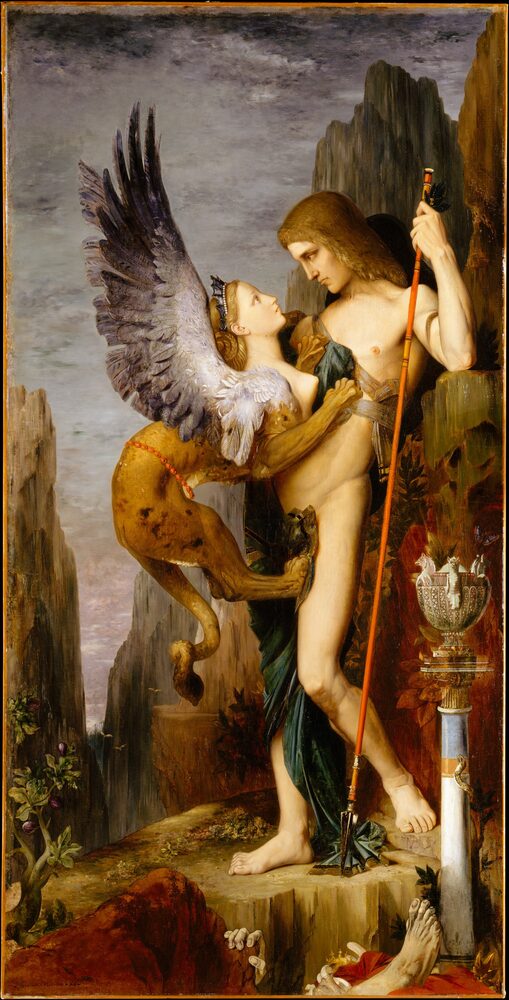
Sphinx
First Appearance
The Sphinx first appears in Hesiod's Theogony (326–329), in the long catalogue of monsters descended from Echidna and Typhon. There she is called by her older Boeotian name, Phix (Φίξ): the poet says that "she" — in the Greek the antecedent is disputed, either the Chimaera or Echidna herself — lay with the two-headed hound Orthrus and bore "the deadly Phix, destruction to the Cadmeans" (Φῖκ' ὀλοήν, Καδμείοισιν ὄλεθρον), naming her in the same breath as the Nemean Lion. From her very first line in Greek literature she is already what she will remain: not a guardian but a plague, bred of monsters and sent to ruin a city.
— Hesiod, Theogony 326–329
Who They Are
The Sphinx (SFINGKS; Greek Σφίγξ, from an older Boeotian form Phix) is the riddling monster of Thebes — a winged lioness with the face and breast of a woman, who sat on a rock outside the city, put a single deadly question to every passer-by, and strangled and devoured all who could not answer, until Oedipus solved her riddle and she flung herself to her death. She is the great riddle-monster of Greek myth, and her one puzzle — "what walks on four legs, then two, then three?" — is probably the most famous riddle ever asked.
It is worth flagging at once, because the confusion is universal, that the Greek Sphinx is a very different creature from the Egyptian sphinx most people picture. The Egyptian sphinx — the colossus at Giza is the type — is male (an androsphinx), wingless, and benign: a serene royal guardian couched before temples and tombs. The Greek Sphinx is female, winged, and murderous: a demon with a woman's face, an eagle's wings, and a lion's body, who kills with a question. The Greeks borrowed the sphinx-image from Egypt and the Near East (it reaches Greek art in the Bronze Age and blooms in the orientalising seventh century BCE), but they turned the calm guardian into a singing predator and gave her a story all her own.
In that story she is a monster of the mind. Where Perseus's Gorgon kills by sight and the Hydra by venom, the Sphinx kills by ignorance — she is defeated not by a sword but by an answer, and the answer she demands is nothing exotic but the plainest fact in the world, the shape of a human life. That is what has kept her alive far beyond her myth: the "riddle of the Sphinx" has become a byword for the puzzle at the threshold, the question one must solve to pass, and she stands in the Western imagination as the guardian of a mystery whose solution is simply man.
Mythology
Bred of monsters: her parentage
The Sphinx belongs to the great brood of monsters that Greek genealogy traces to Typhon, the hundred-headed storm-giant, and Echidna, the half-woman half-serpent "mother of monsters" — the same litter that produced the Nemean Lion, the Hydra, Cerberus, and the Chimaera. Apollodorus states it plainly: the Sphinx "was the daughter of Echidna and Typhon" (Bibliotheca 3.5.8). Hesiod, our oldest source, tells it differently and more obscurely: in the Theogony (326–329) the Sphinx (his "Phix") is born when a female monster lies with the two-headed hound Orthrus — but the Greek leaves it grammatically uncertain whether the mother is Echidna or her own daughter the Chimaera, and both readings have ancient defenders. The traditions thus vary between Typhon and Echidna (Apollodorus), Orthrus and Echidna, and Orthrus and the Chimaera (the two readings of Hesiod). What every version agrees on is her stock: she is monster-born, kin to the beasts the great heroes were sent to kill, and no natural creature at all. (This page follows Apollodorus in naming Typhon and Echidna as her parents.)
What she looked like
The Greek Sphinx is a composite, and the combination is precise and consistent: the face and breast of a woman, the body, feet, and tail of a lion, and the wings of a bird (an eagle's). Apollodorus gives exactly this description; Greek vase-painters and sculptors show her the same way for centuries — a lioness at rest, wings folded or raised, turning a girl's serene, archaic-smiling face toward her victim. In some art a serpent tips her tail, a nod to her Echidna blood. The femaleness and the wings are the two features that most sharply divide her from the Egyptian sphinx, and the Greeks felt the difference: their word Σφίγξ is grammatically feminine, and their Sphinx is emphatically a she.
The Sphinx comes to Thebes
Thebes, the city of Cadmus, was under a curse in the days after its king Laius was killed on the road (by Oedipus, though no one yet knew it). Into that stricken city came the Sphinx. Apollodorus says the goddess Hera sent her, in anger at Thebes; other sources name Ares or simply the general doom hanging over the house of Laius. She settled on Mount Phikion, the "Sphinx's mountain" just outside the walls (which took its name from her older name, Phix), perching on a high rock or, in some tellings, on a column, and from there she held the city hostage. She had learned a riddle from the Muses (Apollodorus), and she put it to every Theban who passed, and every Theban who passed and failed she seized, throttled, and ate — the name "Strangler" made flesh. One by one the young men of Thebes died on her rock; last and most bitterly, Apollodorus says, she devoured Haemon, the son of Creon, the man then ruling the city.
The riddle
Her question, in the plain prose form Apollodorus preserves, was this:
"What is it that has one voice, and yet becomes four-footed and two-footed and three-footed?" (τί ἐστιν ὃ μίαν ἔχον φωνὴν τετράπουν καὶ δίπουν καὶ τρίπουν γίνεται;)
A fuller, poetic version survived in verse — quoted by Athenaeus (Deipnosophistae 10.456b) and in the ancient scholia to Euripides' Phoenician Women — expanding the puzzle into hexameters:
"There is on earth a thing two-footed, and four-footed, and three-footed, that has one voice, and alone of all the creatures that move on the earth, or through the air, or down in the sea, it changes its nature; yet when it goes propped upon the most feet, then is the speed in its limbs the feeblest of all." (ἔστι δίπουν ἐπὶ γῆς καὶ τετράπον, οὗ μία φωνή, / καὶ τρίπον… — schol. Eur. Phoen. 50; Athenaeus 10.456b)
The Thebans had an oracle that they would be freed of the Sphinx only when someone read her riddle; so they met and argued the answer, and when they failed she took another life.
Oedipus answers, and the Sphinx falls
In desperation, Creon proclaimed that whoever could solve the riddle would be given the kingdom of Thebes and the hand of the widowed queen, Jocasta (Laius's widow — and, though neither of them knew it, Oedipus's own mother). The stranger Oedipus, arriving from Corinth, faced the Sphinx and gave the answer: man. For a human being crawls on all fours as an infant — "four-footed" in the morning of life — walks upright on two legs in his prime, and leans on a staff, a "third foot," in old age. The single voice is the one human voice that carries through every stage. At the sound of the true answer the Sphinx was undone: she hurled herself down from her rock (or from the citadel) and was killed (Apollodorus 3.5.8). Some later sources say Oedipus killed her, but the older and more resonant version is her self-destruction — the riddler destroyed by the solving of her own riddle. (Oedipus's terrible reward — the throne of Thebes and marriage to his own mother — belongs to his own story, told on his page.)
The rationalised Sphinx
Not every ancient writer would swallow a winged monster. The travel-writer Pausanias (9.26.2–4), visiting Mount Phikion, reports the sceptical, "historicising" versions the Thebans themselves offered: that the Sphinx was really a bastard daughter of Laius, to whom he had confided the secret Delphic oracle given to Cadmus, and who tested each pretender to the throne by demanding he prove his descent by knowing it — killing those who could not; or, more prosaically, that she was a pirate captain who raided the region with a fleet from her mountain stronghold until Oedipus overwhelmed her with a larger force. These rationalisations are a window onto how uneasily the classical Greeks sometimes sat with their own monsters — and a reminder that the riddling Sphinx was, even in antiquity, half-symbol.
Worship — Ancient
A monster, not a god — no cult
The Sphinx received no worship. She was a monster and an enemy, a thing sent to destroy a city, and there was no altar to her, no festival, no priesthood — the reframing here is not of a cult but of a setting and a reception: the place she haunted, and the strange, powerful hold her image had on the Greek imagination in art and in death-ritual.
The Theban setting: Mount Phikion
Her one story is rooted in a real landscape. Mount Phikion (Φίκιον ὄρος), a limestone hill on the road out of Thebes toward Glisas and the Euboean gulf, was pointed out for centuries as the Sphinx's mountain, and it carried a form of her ancient name. Pausanias walked the road and recorded the local traditions attached to the place (9.26.2–4). Thebes made the Sphinx part of its own civic self-image: she appears as a civic emblem on Theban coinage, the monster the city's founder-hero conquered turned into a badge of the city itself — the defeated enemy kept close as a token of survival.
The Sphinx in Greek art and funerary sculpture
Far more than through story, the Sphinx pervaded Greek art. Borrowed from Egyptian and Near Eastern models, the winged, woman-faced lioness became one of the most beloved figures of the orientalising and archaic periods (7th–6th centuries BCE): she crouches on vases, ivories, and bronzes, and above all she was carved to guard the dead. Archaic Greek grave-markers were regularly crowned with a marble Sphinx, seated atop the tall stele or column as a guardian of the tomb — watchful, apotropaic, and faintly menacing, an escort or snatcher of souls. The most famous survivor is the colossal Sphinx of the Naxians at Delphi (c. 560 BCE), a marble Sphinx more than two metres tall set on a ten-metre Ionic column as a Naxian dedication in the sanctuary of Apollo. In this funerary role the Greek Sphinx comes closest to her Egyptian cousin's guardian function — but she keeps her woman's face, her wings, and her air of deadly knowing.
The riddle-culture behind her
Her defining act — the deadly riddle — was not arbitrary. Riddling (the griphos) was a living Greek pastime, a game of the symposium where wit was tested over wine; Athenaeus devotes a long stretch of his Deipnosophistae (Book 10) to riddles and quotes the Sphinx's own in verse. The Sphinx is that convivial game turned lethal: the riddle as a matter of life and death, posed not across a wine-cup but on a lonely rock, with a monster for the questioner and a city's young men for the stakes.
Worship — Modern
No cult — a living symbol
The Sphinx has no worshippers, ancient or modern; she survives not as an object of devotion but as one of the most durable symbols the Greek imagination ever produced. Where a devotee might turn to a god, the Sphinx belongs instead to art, thought, and language — and there her afterlife has been enormous.
The "riddle of the Sphinx"
Her single question outlived her myth to become a permanent English idiom. "The riddle of the Sphinx" now means any deep or defining puzzle set at a threshold — the question one must answer to pass — and her answer, man, has made her a lasting emblem of self-knowledge: the monster whose riddle is solved only by understanding the shape of a human life. The three-part answer (crawling infancy, upright prime, staff-propped age) is one of the oldest and most-repeated meditations on the arc of mortality.
Freud, Hegel, and the Sphinx of the mind
Because her riddle's solution is "man," later thinkers made her the guardian of self-understanding. Hegel read the Egyptian sphinx as the symbol of the human spirit half-emerging from the animal, and set the Greek riddle — answered by "man" — as the moment consciousness turns to know itself. Freud, who kept an image of Oedipus and the Sphinx and built his central complex on the Theban story, read her as the riddle of origins and desire that every child confronts. The Sphinx became, in modern thought, the figure of the question the self must ask about the self.
Art, letters, and the enduring image
She has never left the visual imagination: from Ingres' luminous Oedipus and the Sphinx (1808) to Gustave Moreau's brooding Symbolist canvases, from Oscar Wilde's poem "The Sphinx" to countless films, games, and logos, the winged riddler endures. And her name keeps its edge in everyday English — a "sphinx-like" person is one who is inscrutable, silent, keeping a secret behind an impassive face — the last trace, in ordinary speech, of the monster on the rock who knew the one answer that mattered and killed everyone who did not.
Epithets & Cult Titles
- the Theban Sphinx (ἡ Θηβαία Σφίγξ) — The Sphinx of Thebes — the standard descriptive title that fixes her in the one story that made her famous and distinguishes the riddling Greek monster from the many decorative sphinxes of Greek and Near Eastern art
- Phix (Φίξ) — Hesiod's older Boeotian name for her (Theogony 326), from which Mount Phikion (Φίκιον ὄρος), her haunt outside Thebes, took its name — evidence that her name is pre-Greek and only later assimilated to the verb sphingein, 'to strangle'
- the Strangler (from σφίγγω, sphingō) — The living etymology the Greeks heard in her name — 'she who squeezes, binds, throttles' — matching the tradition that she throttled the young men who failed her riddle before devouring them
- the riddling hound (ῥαψῳδὸς κύων) — Sophocles' phrase for her (Oedipus Tyrannus 391) — literally the 'rhapsode dog,' the chanting she-hound who sang her deadly verse; the tragedians repeatedly call her a 'hound' (kyōn) rather than name her outright
- the winged maiden (πτερόεσσα κόρα / παρθένος) — Euripides' image of her in the Phoenician Women — the girl-faced, wing-shouldered creature who snatched Thebes' young men up into the air, emphasising the woman's face and bird's wings that mark the Greek Sphinx off from all others
Sources & Variants
- Hesiod, Theogony 326–329 (the Sphinx as 'Phix,' born to Orthrus and Echidna/Chimaera, 'destruction to the Cadmeans')
- Apollodorus, Bibliotheca 3.5.8 (the fullest narrative: daughter of Typhon and Echidna; her form; the riddle learned from the Muses; Mount Phicium; Haemon devoured; Creon's proclamation of the kingdom and Jocasta; Oedipus's answer 'man'; the Sphinx casts herself from the citadel)
- Sophocles, Oedipus Tyrannus 130–131, 391, 508, 1198–1200 (the Sphinx as the 'riddling hound,' the 'winged maiden,' the 'harsh singer' whose riddle Oedipus alone solved)
- Euripides, Phoenician Women 45–54, 806–811, 1019–1042, 1505–1506 (the 'winged maiden' who snatched Theban youths; the mountain haunt; the riddle)
- Scholia to Euripides, Phoenician Women 50 (the riddle preserved in hexameter verse)
- Athenaeus, Deipnosophistae 10.456b (the riddle quoted in verse, within a discussion of riddles/griphoi)
- Pausanias, Description of Greece 9.26.2–4 (Mount Phikion; the rationalised versions — the Sphinx as bastard daughter of Laius, or as a pirate captain)
- Diodorus Siculus 4.64.3–4 (the riddle and Oedipus's solution) — later summary
Gallery