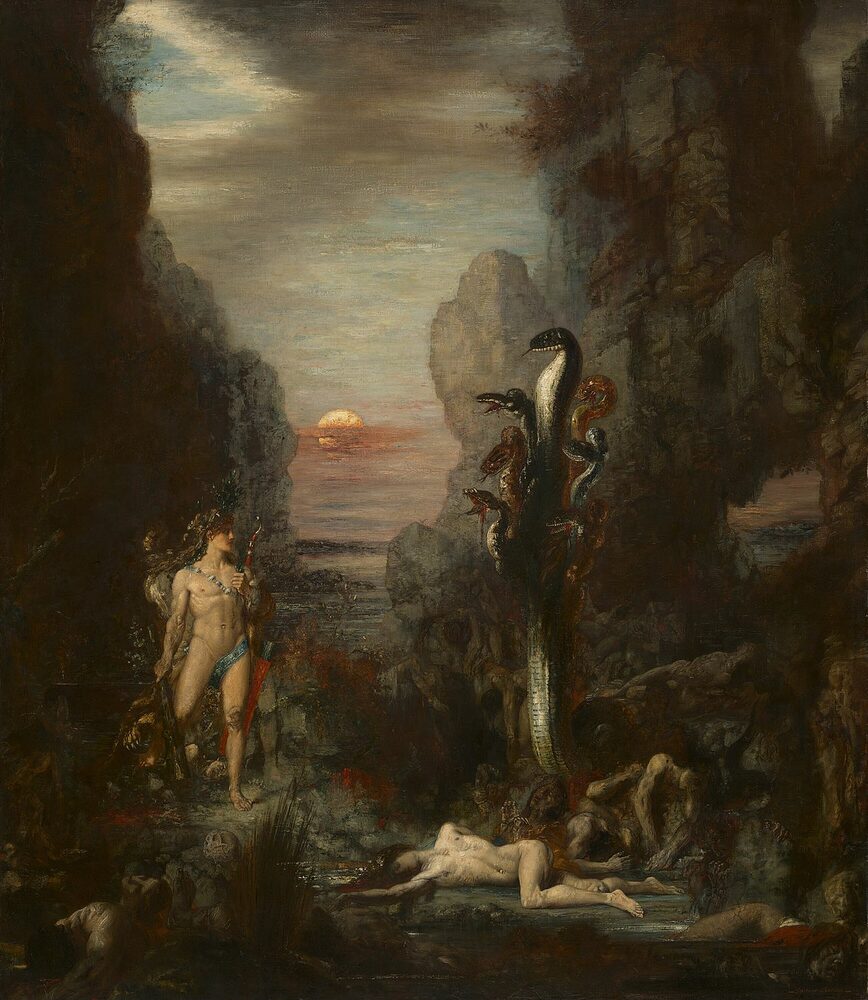
Hydra
First Appearance
The Hydra first appears in Hesiod's Theogony (313–318) in the catalogue of the monstrous brood of Typhon and Echidna. Hesiod names her third among their children, after Orthus and Cerberus: "the Lernaean Hydra, knowing destruction, whom the goddess white-armed Hera nourished, being measurelessly angry with mighty Heracles." In the same breath he tells her end — that Heracles, son of Zeus, of the house of Amphitryon, destroyed her with pitiless bronze together with warlike Iolaus and by the counsels of Athena, driver of the spoil. From her earliest mention, then, the Hydra exists inside the story of her own slaying: a monster reared by a jealous goddess for the sole purpose of killing a hero, and killed by him instead.
— Hesiod, Theogony 313–318
Who They Are
The Lernaean Hydra (LUR-nee-an HY-druh; Greek Ὕδρα, "water-snake") is the many-headed serpent of the marsh of Lerna, the monster of the Second Labour of Heracles and, after the Nemean Lion, the most famous beast he was set to destroy. She is a child of the two greatest monsters of Greek myth — the storm-giant Typhon and the serpent-woman Echidna — and sister to the hell-hound Cerberus, the two-headed dog Orthus, and (in most tellings) the fire-breathing Chimera. From that terrible parentage she inherited a body no ordinary killing could master: for every head a hero struck off, two more grew in its place, so that the very act of fighting her multiplied the danger.
What makes the Hydra unforgettable is exactly this quality of self-renewing menace. She is the monster you cannot defeat by force, because force feeds her; she is beaten only by cleverness — by Heracles' nephew Iolaus searing each stump with fire the instant a head was cut, so that no new heads could sprout. To this the sources add two details that give the episode its particular colour: the single immortal head that could not be killed at all, which Heracles finally buried alive beneath a great rock, and the giant crab that the goddess Hera sent scuttling out of the swamp to bite the hero's heel while he fought — a crab she afterwards set among the stars as the constellation Cancer.
The Hydra's shadow reaches far beyond her own death. Heracles dipped his arrows in her venom, and that poison became the deadliest thing he owned — and, in the end, the instrument of his own destruction, for the same Hydra-gall would return years later, smeared on a shirt through the dying centaur Nessus, to burn the life out of the hero who had slain her. She is thus not only a labour survived but a doom deferred: the monster reached out of her grave to keep, at last, the promise of her birth.
Mythology
Birth from the monsters and the anger of Hera
The Hydra belongs to the oldest and most fearsome family in Greek myth. Hesiod's Theogony (306–318) makes her the daughter of Typhon — the hundred-headed storm-giant who once fought Zeus for the throne of heaven — and Echidna, the woman-serpent who dwelt in a cave beneath the earth. Her litter-mates are the dog Orthus, the hell-hound Cerberus, and (by most readings of Hesiod) the Chimera; she is, in short, sister to the monsters. But the Theogony adds something the other siblings lack: a motive for her existence. The Hydra, Hesiod says, was reared by Hera herself, "being measurelessly angry with mighty Heracles" — the goddess nursed the monster deliberately, fattening a horror in the marsh of Lerna against the day it might be loosed on the son her husband Zeus had fathered on another woman. From the first line written about her, the Hydra is a weapon aimed at Heracles.
The lair at Lerna
Her home was Lerna, a place of springs and standing water on the coast of the Argolid, south of Argos. Apollodorus (Bibliotheca 2.5.2) sets her in the swamp of Lerna, from which she would issue out to lay waste the surrounding land and destroy the cattle. Pausanias, who walked the country (Description of Greece 2.37.4), places her more precisely still: beneath a plane tree at the source of the spring of Amymone, one of the sacred waters of Lerna. The marsh was already an eerie, sacred spot — nearby lay the bottomless Alcyonian lake, which the Argives believed to be one of the secret entrances to the underworld — and the Hydra fits it perfectly: a chthonic thing of poison and stagnant water, breathing out a stench and a venom so foul, the poets said, that the very smell of her breath or the fumes of her tracks could kill.
How many heads? — an argument the ancients never settled
Here the sources openly disagree, and it is worth naming the disagreement rather than smoothing it over. Hesiod gives her no number at all — she is simply "the Hydra." The lyric poet Alcaeus (c. 600 BC) is said to have given her nine heads; a generation or so later Simonides raised the count to fifty; and Diodorus Siculus (4.11.5) reports a version with a hundred. Apollodorus (2.5.2) settles on the figure that became canonical — nine heads, eight mortal and the ninth immortal — but even he is only one voice among many, and other authors give as few as three or seven. Pausanias, the sceptic, thought the whole multiplication a poet's invention: in reality, he argued (2.37.4), the beast of Lerna was a single very large water-snake with one head and a uniquely deadly venom, and it was the epic poet Peisander of Camirus who first "gave the Hydra her many heads, to make the creature more frightful and his own poetry more remarkable." The one point on which the tradition is united is the horror that made the number matter at all: whatever the count, two heads grew back for every one that was cut off, so that to wound the Hydra was to strengthen her.
The Second Labour: Heracles and Iolaus
The killing of the Hydra was the second of the Twelve Labours that Heracles performed for Eurystheus, king of Tiryns, in expiation of the madness in which he had killed his own children. Following the account of Apollodorus (2.5.2): Heracles drove to Lerna in his chariot with his nephew and companion Iolaus. He first forced the Hydra out of her lair by pelting it with flaming arrows, and when she came writhing into the open he seized her and held fast. But now the horror of her nature showed itself — for as he smashed each head with his club (or cut it with his sword), two more grew up in its place, and he could make no headway. Worse, Hera, watching, sent up out of the marsh a giant crab (Greek karkinos, the Roman Carcinus) which fastened its claws on Heracles' foot to help her monster. Heracles crushed the crab underfoot — and Hera, in gratitude to the little creature that had died in her service, set it among the stars as the constellation Cancer, the Crab.
Fire against regeneration, and the immortal head
Overwhelmed, Heracles called on Iolaus for the stratagem that won the labour. Iolaus set fire to part of the neighbouring wood, and with blazing firebrands he seared each neck the instant Heracles struck the head from it, cauterizing the stump so that no new heads could sprout from the burnt flesh. Working together in this way — Heracles cutting, Iolaus branding — they killed off the mortal heads one by one. There remained the one immortal head, which no blade and no fire could destroy. Heracles cut it off all the same, and buried it, still living and hissing, in the ground beside the road that runs through Lerna toward Elaeus, and rolled a heavy rock down on top of it to hold it forever (Apollodorus 2.5.2). Under that stone, the story insists, the immortal head lies to this day — the Hydra reduced to a single buried mouth that cannot die and cannot escape. (Because Iolaus had helped, Eurystheus later refused to count this among the ten labours he had set, and demanded further ones in its place — a bookkeeping cruelty that would stretch the Ten into Twelve.)
The venom, and the doom Heracles carried away
Before he left the marsh, Heracles did the thing that would matter most in the long run: he slit open the Hydra's body and dipped his arrow-heads in her gall, her venomous blood (Apollodorus 2.5.2). It made his arrows the deadliest weapons in the world — a scratch from one was death, for the wound carried the Hydra's own unkillable poison. With them he would bring down the Stymphalian birds, the giant Geryon, and other monsters; with one, by tragic accident, he mortally wounded the wise centaur Chiron. But the venom's darkest work was saved for its maker. Years later Heracles shot the centaur Nessus with a Hydra-poisoned arrow for assaulting his wife Deianeira; and the dying Nessus, in revenge, told Deianeira to save some of his blood as a love-charm that would keep her husband faithful. When she later feared Heracles' love was straying, she smeared that blood — soaked through with the Hydra's venom from the very arrow that had killed Nessus — onto a shirt and sent it to him. The poison ate into his flesh with an agony no strength could bear, and Heracles, unable to die and unable to endure, had himself burned alive on a pyre on Mount Oeta. So the Hydra kept, in the end, the promise of her birth: the monster Hera reared to destroy Heracles destroyed him after all, reaching out of her own grave through her poison to bring down the hero who had slain her. (Heracles' own page tells the fuller tale of Nessus and the shirt.)
Worship — Ancient
A monster, not a god
The Hydra received no cult: she was a horror to be destroyed, not a power to be worshipped, and no altar or festival in the Greek world was raised in her honour. What she had instead was a place — the marsh of Lerna — and a reception in poetry, art, and the sky. Her "worship," properly speaking, is the long afterlife of her story: the landscape that claimed her, the artists who drew her, and the constellations that were said to remember the night she died.
Lerna and the Argolid
Lerna was a real and storied spot on the coast south of Argos, and the local landscape kept the memory of the Hydra alive. Pausanias (2.37.4), touring the Argolid in the second century AD, was shown the plane tree at the spring of Amymone under which the beast was said to have grown, and recorded the local, rationalizing belief that the "Hydra" had truly been one outsized and uniquely venomous water-snake, magnified into a many-headed monster only by the poets. The neighbourhood was thick with older sanctity — Lerna held Mysteries of Demeter, and the bottomless Alcyonian lake nearby was reckoned a mouth of the underworld — so that the Hydra belonged to a genuinely uncanny corner of Greece, a marsh where the boundary between the living world and the chthonic was felt to be thin. The slaying was among the most popular of all subjects in Greek art from at least the seventh century BC: black-figure and red-figure vases, bronze reliefs, and temple sculpture show Heracles and Iolaus at work on the writhing coils, often with the crab underfoot and Athena standing by, and it appeared among the canonical Labours carved on the metopes of temples such as the Hephaisteion at Athens.
The Crab and the Serpent in the stars
The Hydra sent two of her creatures into the night sky. The crab that Hera dispatched to bite Heracles became, by the goddess's thanks, the constellation Cancer (the Crab) — the faint zodiacal sign whose star-myth, told by Hyginus and Eratosthenes, is precisely this moment of the Second Labour. The great southern constellation Hydra, the longest in the sky, was sometimes identified with the Lernaean monster herself, coiled beneath the hero's foot. Here honesty requires a flag: the fuller and older classical star-myth of that constellation, as Hyginus tells it (Astronomica 2.40), attaches it not to Heracles' Hydra at all but to a different water-snake — the one in the tale of Apollo's raven, the crow sent for water that lingered and lied, punished by being fixed in the stars beside the Cup (Crater) with the Serpent forever between it and its drink. The link between the celestial Hydra and the Lernaean Hydra is a real ancient association, but a secondary and shifting one, not the constellation's original charter.
Worship — Modern
The word that outlived the monster
The Hydra's truest modern life is linguistic. Because she was the monster who grew two heads for every one cut off, "a hydra" and "hydra-headed" have become standard English (and European) metaphors for any problem that multiplies when attacked — a corruption, an insurgency, a bureaucracy, a disease — that cannot be beaten by force because force only breeds more of it. To "cut off one head and two grow back" is now a proverb detached from Lerna entirely, one of the handful of Greek myths that survive as everyday idiom. As a monster of pure regeneration she has become the natural image for anything self-renewing and hard to kill, invoked as readily in political columns and boardrooms as in fantasy fiction and games, where the multi-headed hydra is a fixture.
Named in science and the sky
Naturalists and astronomers gave the Hydra's name a second immortality. The freshwater animal Hydra — a tiny tube-shaped polyp — was so named by the 18th-century naturalist Abraham Trembley and his contemporaries precisely because of its near-miraculous power of regeneration: cut one apart and each piece grows into a whole new animal, exactly the property that made the myth. The genus is still called Hydra today, and "hydra" remains a byword in biology for regenerative capacity. Overhead, the constellation Hydra — the largest of the 88 modern constellations, sprawling more than a quarter of the way around the sky — still carries her name, with the little crab Cancer riding the zodiac not far off, the pair of them a permanent monument to the Second Labour.
In story and devotion
For those who keep the Greek myths as living tradition, the Hydra is not an object of veneration but a figure of meaning: an image of the evils that grow when we strike at them blindly, and of the wisdom (Iolaus' fire, Athena's counsel) needed to end them for good. She is a favourite of retellings on page and screen — from ancient vase to modern film and animation, the swamp-serpent with her ever-sprouting heads has never left the popular imagination — carrying, wherever she appears, the same ancient warning her myth first taught: that some things cannot be conquered by force alone, and that the poison of a monster can outlast the monster herself.
Epithets & Cult Titles
- the Lernaean Hydra (Ὕδρα Λερναία) — The water-serpent of Lerna — her standing title in every source, binding her to the marsh and springs of Lerna in the Argolid where she made her lair and which Heracles came to cleanse
- polykephalos (πολυκέφαλος) — The many-headed — the descriptive epithet that defines her, though the poets never agreed on how many heads 'many' was; kindred forms like polykranos ('many-cranied') recur in tragedy
- hydra (ὕδρα) — The water-snake itself — the name is simply the common noun for a water-serpent, so that to the Greek ear 'the Hydra' meant nothing grander than 'the Water-Snake,' the plainest possible name for the most monstrous of serpents
- nursling of Hera (θρέμμα Ἥρας) — Reared by Hera — Hesiod says the white-armed goddess herself nourished the Hydra out of her measureless anger at Heracles, raising the monster expressly to be his undoing
Sources & Variants
- Hesiod, Theogony 306–318 (the Hydra as child of Typhon and Echidna, reared by Hera against Heracles, and slain by Heracles with Iolaus by Athena's counsel)
- Apollodorus, Bibliotheca 2.5.2 (the fullest narrative: nine heads with the middle one immortal, two growing for each cut, the flaming arrows, Iolaus' cauterizing firebrands, Hera's crab, the immortal head buried under a rock near Elaeus, and Heracles dipping his arrows in the venom)
- Diodorus Siculus, Library of History 4.11.5–6 (the Second Labour; a version giving the Hydra a hundred necks/heads, and the poisoning of the arrows)
- Euripides, Heracles 419–424 and 1188–1190 (the Lernaean hydra among the labours, the many-headed serpent of the marsh)
- Pausanias, Description of Greece 2.37.4 (Lerna, the plane tree at the spring of Amymone, the rationalizing 'one-headed water-snake,' and the attribution of the many heads to the poet Peisander of Camirus)
- Hyginus, Fabulae 30 (the Twelve Labours, the Hydra of Lerna) and 151 (the offspring of Typhon and Echidna); Astronomica 2.23 (Cancer, Hera's crab set in the stars) and 2.40 (the constellation Hydra and the myth of Apollo's raven)
- Alcaeus fr. 443 and Simonides fr. 569 PMG (as reported by the scholia on Hesiod, Theogony 313: nine heads and fifty heads respectively — the ancient disagreement over the count)
- Sophocles, Trachiniae 573–587, 831–840 (the Hydra's venom carried through Nessus' blood onto the shirt that kills Heracles); Ovid, Metamorphoses 9.129–210 (the same doom, the poisoned robe on Oeta) — Roman retelling
Gallery