Kyklopes
First Appearance
The Cyclopes first appear in Hesiod's Theogony (139–146) as three of the eldest children of Uranus (Sky) and Gaia (Earth): Brontes ("Thunder"), Steropes ("Lightning"), and Arges ("Bright"), "who gave Zeus the thunder and fashioned the thunderbolt." They were like the gods in every way, Hesiod says, save one — a single round eye was set in the middle of their foreheads — and from that eye they took their name, the Kyklopes, the "round-eyed" ones; and "strength and might and craft were in all their works." From the very first line, then, the Cyclopes are two things at once: monstrous in body, and the supreme smiths whose craft armed the gods.
— Hesiod, Theogony 139–146 (the three elder smith-Cyclopes)
Who They Are
The Cyclopes (sy-KLOH-peez; singular Cyclops, SY-klops), in Greek the Κύκλωπες (Kyklopes), "the round-eyed," are the one-eyed giants of Greek myth — but that single phrase hides two very different races that the ancients kept largely separate, and the first thing to understand about the Cyclopes is that there are two kinds. Leading them, and older by far, are the three great smith-Cyclopes: Brontes ("Thunder"), Steropes ("Lightning"), and Arges ("Bright"), sons of Uranus and Gaia and brothers of the Titans, the master craftsmen who forged the weapons that won the Olympians their world. Later and quite separate are the shepherd-Cyclopes of Homer's Odyssey — lawless, savage herdsmen living without farming, law, or fear of the gods, of whom the man-eating Polyphemus is the one every reader remembers.
The smiths come first because they matter first. When Zeus made war on the Titans, he freed the Cyclopes from the prison in the earth where first Uranus and then Cronus had bound them, and in gratitude they became the toolmakers of the Olympian victory: they forged Zeus's thunderbolt, Poseidon's trident, and Hades's helm of invisibility — the three weapons with which the three brothers overthrew their father's generation and divided the cosmos between them. Without the craft of the Cyclopes there is no Olympus. Their end is one of the saddest chains of cause and effect in all myth: when Zeus killed Apollo's son Asclepius with one of their bolts, Apollo could not strike back at Zeus, so he killed the Cyclopes who had made the bolt — and was punished for it with a year of servitude on earth (that story is told with Apollo, who has his own page).
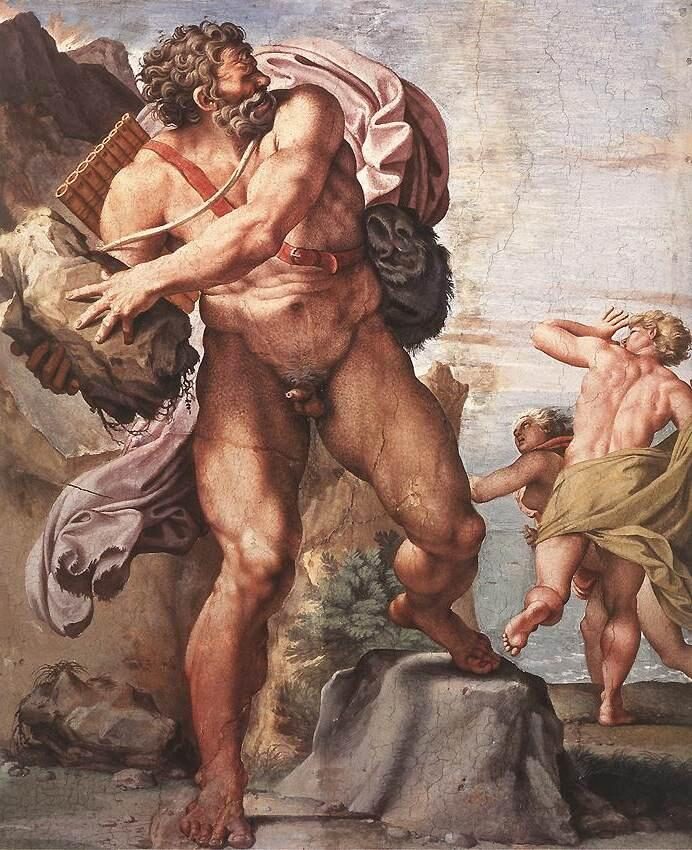
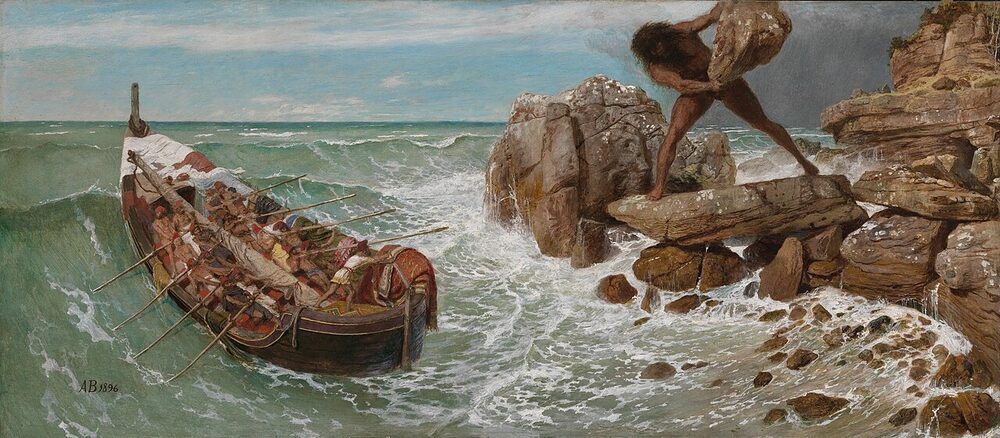
The shepherd-Cyclopes are a wholly different creature: not craftsmen but the opposite of civilisation, giants who neither plant nor plough nor gather in assembly, each ruling his own cave and family with no law but his own will. Their episode — Odysseus trapped in the cave, the companions eaten, the name "Nobody," the fire-hardened stake driven into the single eye, the escape beneath the rams, and Polyphemus's terrible curse to his father Poseidon — is one of the most famous stories the Greeks ever told, and its frame is the whole Odyssey (Odysseus has his own page). (A Roman note: the Latin poets keep the Greek name, Cyclopes, and set the smiths' forge under Mount Etna in the workshop of Vulcan.) This page follows Hesiod, Homer, and their heirs in holding both races in view — the makers of the thunderbolt and the eaters of men, the same round eye seen once as genius and once as horror.
Mythology
The smith-sons of Sky and Earth
In Hesiod's Theogony, the oldest full account (139–146), the Cyclopes are among the very first beings born: Gaia (Earth) lay with Uranus (Sky) and bore, alongside the twelve Titans, three sons "overweening in spirit," Brontes, Steropes, and Arges — Thunder, Lightning, and Brightness. They were godlike in stature and strength but for the single round eye in the centre of the brow, and in their hands was a craft beyond any other: "strength and might and craft were in all their works." Their three names are not decoration but a description of what they make, for taken together Thunder + Lightning + the bright Flash simply are the thunderbolt. From the beginning the Cyclopes are defined by the forge, and the first thing the tradition tells us they forged is the master-weapon of the sky.
Bound in the earth, and freed for the war
Uranus, Hesiod tells, hated the fearsome children Gaia bore him and would not let them into the light; he pressed them back down into the body of the Earth as fast as they were born, and there the Cyclopes lay imprisoned in the dark. The mythographer Apollodorus (Bibliotheca 1.1.2–1.2.1) sets the sequence out plainly: Uranus bound the Cyclopes and the hundred-handed Hecatoncheires and cast them into Tartarus; when the Titans overthrew Uranus they brought their brothers up again, but Cronus, once he held power, distrusted the giants and bound them back down in Tartarus a second time. So the Cyclopes spent the whole reign of the Titans in chains beneath the world — until Zeus, rising against Cronus and the Titans and warned by Gaia that he could not win without them, went down and freed the Cyclopes from their prison. It is the hinge of the whole cosmic war.
The forging of the Olympian weapons
In gratitude for their freedom, the Cyclopes armed the young gods for the Titanomachy, and this is their greatest deed. To Zeus they gave the thunder and the thunderbolt and the lightning — the weapon that would become the very sign of his kingship; to Hades they gave the kyneē, the helm or cap of darkness that makes its wearer invisible (the same helm of invisibility that the hero Perseus would later borrow to escape the Gorgons); and to Poseidon they forged the trident, the three-pronged spear that shakes the sea and the earth. Armed with these three Cyclopean weapons, the three brothers overthrew Cronus and the Titans, cast them into the Tartarus the Cyclopes themselves had known, and divided the universe by lot — sky to Zeus, sea to Poseidon, the underworld to Hades. The Cyclopes were, quite literally, the smiths of the Olympian order: every emblem of the three ruling gods came off their anvil.
The death of the smith-Cyclopes — Apollo's revenge for Asclepius
Their end came out of a father's grief, and it is one of the great chains of consequence in Greek myth (Apollodorus, Bibliotheca 3.10.4). Asclepius, the son of Apollo, grew so great a healer that he learned to raise the dead — and this Zeus would not allow, for it overturned the order of things and the boundary between mortal and immortal. So Zeus struck Asclepius dead with a thunderbolt — one of the very bolts the Cyclopes had forged. Apollo, wild with grief and unable to take vengeance on Zeus himself, turned instead on the makers of the weapon: he killed the Cyclopes (or, in a variant the sources preserve, their sons — since in later tradition the Cyclopes are immortal workmen who cannot truly die, some tellers soften the killing to their offspring). For this bloodshed Zeus would have hurled Apollo into Tartarus, but at the plea of Apollo's mother Leto the sentence was commuted to a term of servitude: Apollo was made to serve a mortal, Admetus king of Pherae, as a herdsman for a year. The whole grim sequence — dead healer, dead smiths, enslaved god — is told at greater length on Apollo's own page; here it is the Cyclopes' ending. (Variant to flag: whether Apollo slew the Cyclopes themselves or only their sons is a genuine ancient disagreement, arising because the smith-Cyclopes go on working in later poetry.)
The forge under the volcano — Hephaestus's workmen
For that reason, later Greek and Roman poetry keeps the Cyclopes alive and busy as the immortal workmen of Hephaestus (Roman Vulcan), the smith-god, labouring at his forge beneath a volcano — Mount Etna in Sicily, or the Aeolian island of Lipara. In Callimachus's Hymn to Artemis (3.46–86) the little goddess Artemis, still a child, is carried to the Cyclopes' forge on Lipara, where Brontes, Steropes, and their fellows are hammering out a great horse-trough for Poseidon; the din of their anvils shakes Etna and Italy, and they are so huge and grim that the other goddess-children of Olympus quail at the sight of them — Callimachus notes drily that mothers frightened naughty children by threatening to call the Cyclopes. Artemis, unafraid, sits in Brontes's lap and demands a bow and arrows, and the smiths make them for her. In Virgil's Aeneid (Book 8, lines 416–453) the same scene turns Roman: in Vulcan's cavern under the Aeolian isles the Cyclopes Brontes, Steropes, and Pyracmon ("Fire-anvil") beat out a half-finished thunderbolt for Jupiter, and are set to forging the great shield and armour of Aeneas. The Cyclopes have become the eternal industry beneath the mountain — the roar and glare of the volcano explained as the sound and fire of their forge.
A different race — the shepherd-Cyclopes of the Odyssey
Homer's Cyclopes (Odyssey, Book 9) are something else entirely, and the poet never links them to the smiths or to Uranus and Gaia. These are a wild, pastoral race of one-eyed giants who are the very image of the uncivilised: they "neither plant with their hands nor plough," trusting the earth to feed them unsown; they have no ships and no shipwrights, no assemblies for taking counsel and no laws (themistes); each lives apart in a cave on the mountain-heights, "and each is a law to his own children and wives, and they care nothing for one another." Above all they have no fear of the gods and no rule of hospitality (xenia) — the sacred bond that Homer's whole world runs on. Where the smith-Cyclopes are craft and order, the shepherd-Cyclopes are the absence of both: giants living before, or outside, civilisation altogether. Later writers placed their land in Sicily, near the smoking cone of Etna — where Virgil's Aeneas, in Aeneid Book 3, sails past their coast and rescues Achaemenides, a Greek stranded there by Odysseus, in the shadow of Polyphemus himself.
Odysseus in the cave of Polyphemus
(Content note: this episode turns on cannibalism and mutilation.) The most famous Cyclops of all is Polyphemus — and, crucially, he is not a son of Uranus and Gaia but the son of Poseidon and the sea-nymph Thoosa (Odyssey 1.71–73), which is why his story is told here in prose and not drawn onto the family tree. Making his way home from Troy, Odysseus landed on the Cyclopes' island and, with twelve chosen men and a skin of potent unmixed wine, went up to explore a great cave — the cave of Polyphemus, full of pens of lambs and kids, racks of drying cheeses, and pails of milk. His men begged to snatch some cheese and animals and flee to the ship; but Odysseus, wanting to see the cave's owner and claim the guest-gift that custom owed a visitor, insisted they stay. It was the mistake that killed six of them. Polyphemus came home at dusk, drove in his flocks, and sealed the mouth of the cave with a boulder so vast that no twenty wagons could have shifted it. Seeing the strangers, he asked who they were; when Odysseus appealed to Zeus, protector of guests and suppliants, the Cyclops laughed — the Cyclopes, he said, care nothing for Zeus, being far stronger. Then he seized two of the men, dashed out their brains on the floor, tore them limb from limb, and ate them raw, and lay down to sleep among his sheep. Odysseus dared not kill him in the night, for only Polyphemus could roll away the stone: to kill him was to be entombed alive.
"Nobody," the stake, and the single eye
In the morning the Cyclops ate two more men, drove out his flock, and sealed the survivors in again. Odysseus laid his plan. From a great club of green olive-wood the men cut a stake, sharpened it to a point, and hardened the point in the fire, then hid it. That evening, when Polyphemus had eaten two more of the crew, Odysseus offered him the strong dark wine, bowl after bowl. Delighted, the Cyclops drank himself to drunkenness and, as a "guest-gift," asked his visitor's name — and Odysseus told him his name was "Nobody" (Οὖτις, Outis). "Then Nobody I shall eat last of all," the Cyclops promised, and toppled over into a drunken sleep. Now Odysseus and four men heated the olive stake in the embers until it glowed, and drove it deep into the giant's single eye, spinning it as a shipwright spins a drill, and the eye hissed and burst. Polyphemus woke roaring, and the other Cyclopes came running to his cave in the dark and called through the stone: who was hurting him, by trickery or by force? "Nobody is killing me by trickery, nobody by force!" he bellowed — and they, hearing that no one (mē tis) was harming him, told him a sickness from Zeus must be on him, that he should pray to his father Poseidon, and went away. Odysseus's false name had turned the giant's own cry for help into the thing that sent his rescuers home. (The Greek pun is exact: ou tis / mē tis, "no one," echoes mētis, "cunning" — Odysseus's defining quality.)
The escape, the boast, and the curse
At dawn the blinded Polyphemus rolled back the stone and sat in the doorway, spreading his hands to feel the back of each sheep as it passed, sure the men would try to ride out among the flock. But Odysseus had lashed his men in threes beneath the bellies of the great fleecy rams, each man slung under the middle sheep and hidden by the two on either side, and himself clung under the belly of the mightiest ram of all. So they passed out under the very hands of the Cyclops — who, feeling only the backs of his sheep, suspected nothing, and even spoke tenderly to his favourite ram, wondering aloud why the beast that always led the flock now came last, grieving (the Cyclops thought) for its master's ruined eye. Once aboard and pulling for open water, Odysseus could not resist a shout of triumph, taunting the giant; and when Polyphemus, guided by the voice, hurled boulders that nearly swamped the ship, Odysseus shouted again — and this time gave his true name: "Say, if any ask, that Odysseus, sacker of cities, son of Laertes, who dwells in Ithaca, put out your eye." It was the second great mistake, for now the Cyclops could curse him by name. Lifting his hands to the stars, Polyphemus prayed to his father Poseidon: that Odysseus might never reach home — or if he must, that he come late and in evil case, in a stranger's ship, having lost all his companions, to find sorrow waiting in his house. Poseidon heard his son, and that curse is the engine of the whole Odyssey: the ten hard years, the drownings, the loss of every man, and the trouble that meets Odysseus at last in Ithaca all flow from the boast Odysseus could not swallow outside the Cyclops's cave. (Euripides dramatised the same episode as a comedy in his satyr-play Cyclops, the only complete satyr-play we still have, with Silenus and the satyrs enslaved to Polyphemus in Sicily and Odysseus plying him with Dionysus's wine.)
The lovesick Cyclops — a later, gentler Polyphemus
One strand of later poetry made Polyphemus almost sympathetic, and it should be flagged as a later literary reinvention far removed from Homer. The Hellenistic poet Theocritus (Idylls 11 and 6) turned the man-eating monster into a shy, awkward young Cyclops hopelessly in love with the beautiful sea-nymph Galatea, consoling his unrequited longing by singing to her across the waves — a comic and oddly tender portrait of the ugly giant who cures the wound of love with music. Ovid took the story up in the Metamorphoses (13.750–897): here the jealous Polyphemus, spurned by Galatea for the handsome youth Acis, catches the lovers together and crushes Acis beneath a torn-off crag; the boy's blood becomes a clear river, and Acis lives on as a Sicilian stream. This wooing, music-making Cyclops belongs to a softer, urbane age of poetry; the Homeric monster in the cave is the older and darker figure, and the two should not be confused.
Worship — Ancient
Not worshipped but credited — the makers behind the marvels
Like the other monstrous races, the Cyclopes had no cult of their own: they were not gods to be petitioned but figures invoked to explain things too great, too old, or too terrible to have an ordinary human cause. And explain they did, on a huge scale — for the ancient Greeks credited the Cyclopes with the most astonishing works of engineering they could see around them. Where a later people looks at a wonder it cannot account for and says "the gods built it," the Greeks of the Classical age looked at the colossal prehistoric walls of their own land and said: the Cyclopes built this.
Cyclopean masonry — the walls of Mycenae and Tiryns
The great Bronze Age citadels of Mycenae and Tiryns in the Argolid are ringed by walls of gigantic, roughly-hewn limestone boulders, some weighing many tons, fitted together without mortar — the ruins of the Mycenaean palace-world, already ancient and half-legendary by the Classical period. The Greeks who lived among these ruins could not believe that ordinary men had raised them, and so they said the walls had been built by the Cyclopes, the only beings strong enough to lift such stones. Pausanias, touring the Argolid in the second century AD (Description of Greece 2.16.5 and 2.25.8), reports the tradition as established fact: the wall of Tiryns, he writes, was made by the Cyclopes out of stones so huge that the smallest of them could not be stirred by a yoke of mules — and Proetus, the old king, was said to have brought the Cyclopes from Lycia to build it. From this belief comes the term still used by archaeologists today: "Cyclopean masonry," the technical name for walls built of massive, irregular, mortarless blocks. The Cyclopes' cult, if it can be called one, was the awe of a later people standing before the works of a lost age.
The forge beneath the mountain
The other great thing the Cyclopes explained was the volcano. The fire and thunder of Mount Etna — the glow in the night sky, the roar from underground, the ring of what sounded like a titanic hammer on a titanic anvil — were understood by poets as the Cyclopes at their forge, working for Hephaestus (Vulcan) in his subterranean workshop. Callimachus makes their anvils shake all Sicily and Italy; Virgil sets the sparks flying and the cavern groaning under their blows. The forge under the volcano gave a face and a cause to the most frightening natural power the Greeks and Romans knew, and tied it back to the Cyclopes' oldest role as the smiths whose fire armed the gods.
The Cyclops in the ancient imagination
In art and story the Cyclopes belonged to the vase-painter, the poet, and the nursery rather than the altar. The blinding of Polyphemus was one of the earliest identifiable myth-scenes in Greek art — it appears on the neck of the great Eleusis amphora of about 650 BC, and on Corinthian and Attic vases, Odysseus and his men driving the stake into the seated giant's eye — evidence of how early and how deeply the episode gripped the Greek imagination. And Callimachus's aside about mothers invoking the Cyclopes to hush unruly children shows the other, homelier life of the figure: the one-eyed giant as the oldest of bogeymen, the monster in the dark that a child is told to fear.
Worship — Modern
The word that outlived the myth
The plainest modern legacy of the Cyclopes is linguistic and enduring. "Cyclopean" is still the standard term in archaeology and architecture for building in massive, unworked, mortarless stone — every guidebook to Mycenae and Tiryns uses it — so that the ancient Greeks' guess about who raised those walls survives, fossilised, in the vocabulary of the scholars who now study them properly. In everyday English "cyclopean" means simply huge, of a scale beyond the human. And the biological term "cyclopia" names the rare and severe birth defect in which the developing eyes fail to divide and a single central eye forms — a condition named directly for the myth, one of many places where the Cyclopes' one round eye has passed into the language of science.
Polyphemus, still in the cave
Above all, the Cyclops endures through Homer. The Polyphemus episode is among the most retold stories in Western literature — the trapped hero, the eaten companions, the trick of the false name, the burning stake, the escape beneath the sheep — and it has been reworked endlessly, from ancient vase-painting to James Joyce's "Cyclops" chapter in Ulysses (where the one-eyed monster becomes a narrow-minded, bellowing nationalist in a Dublin pub) to countless films, novels, and games. The blinding of the single eye is one of those primal images that never loses its charge, and the one-eyed giant has become a stock figure of the whole fantasy tradition, ultimately traceable to Homer's cave in Sicily.
Genius and horror, one round eye
What the modern world inherits, in the end, is the double figure the ancients drew. On one side stand the smith-Cyclopes, the master craftsmen whose forge armed the gods and whose supposed handiwork still rings the hills of the Argolid — the Cyclops as maker, as the fire under the mountain, as genius on a monstrous scale. On the other stands Polyphemus in his cave, lawless and man-eating, the giant who scorns the gods and pays for it with his sight — the Cyclops as the raw, uncivilised force that the cunning of a civilised man must outwit to survive. Both are the round-eyed ones; and the Golden Thread keeps them side by side, the toolmakers of Olympus and the ogre of the Odyssey, the same single eye seen once as the light of the forge and once as the darkness of the cave.
Epithets & Cult Titles
- Κύκλωπες (Kyklopes) — "the round-eyed" — The name proper, from kyklos ("circle, wheel") and ōps ("eye"): the ones with a single circular eye in the middle of the forehead. Hesiod gives this very etymology in the Theogony — "Cyclopes was their name, because a single round eye was set in their foreheads"
- Βρόντης (Brontes) — "Thunder" — The first of the three elder smith-Cyclopes, named for brontē, the thunder-clap; the crash of the storm made into a craftsman. He has his own stub page in this encyclopedia
- Στερόπης (Steropes) — "Lightning" — The second smith-Cyclops, named for steropē, the flash of lightning (also spelled Asteropes); the lightning-bolt as a maker of bolts. He has his own stub page here
- Ἄργης (Arges) — "Bright" / "Vivid" — The third smith-Cyclops, named for the dazzling brightness (argēs) of the levin-flash; the glare of the bolt itself. He too has his own stub page. Together the three names — Thunder, Lightning, Brightness — simply spell out the thunderbolt they forge
- "the one-eyed" (monommatos) — A descriptive byname for the whole race, single-eyed giants: the defining feature that makes the blinding of Polyphemus possible, since to put out the one eye is to blind the monster wholly
Sources & Variants
- Hesiod, Theogony 139–146 (the three elder Cyclopes Brontes, Steropes, and Arges, sons of Uranus and Gaia, who fashioned Zeus's thunderbolt; the etymology of the name from the single round eye)
- Hesiod, Theogony 501–506 (Zeus frees the Cyclopes from their bonds, and they give him thunder and the thunderbolt in gratitude)
- Homer, Odyssey 1.68–73 (Polyphemus the Cyclops, son of Poseidon and the nymph Thoosa)
- Homer, Odyssey 9.105–566 (the full episode: the lawless shepherd-Cyclopes; Odysseus in the cave; the eaten companions; the wine; the name 'Nobody'/Outis; the blinding with the olive stake; the escape beneath the rams; Odysseus's boast and Polyphemus's curse to Poseidon)
- Apollodorus, Bibliotheca 1.1.2–1.2.1 (the Cyclopes bound in Tartarus by Uranus and again by Cronus, freed by Zeus, and their forging of Zeus's thunderbolt, Hades's helm of invisibility, and Poseidon's trident for the war on the Titans)
- Apollodorus, Bibliotheca 3.10.4 (Zeus thunderbolts Asclepius for raising the dead; Apollo kills the Cyclopes — or their sons — in revenge and is punished with servitude to Admetus)
- Euripides, Cyclops (the only complete surviving satyr-play — the blinding of Polyphemus in Sicily, with Silenus and the satyrs, played as comedy)
- Callimachus, Hymn to Artemis (3) 46–86 (the child Artemis at the Cyclopes' forge on Lipara; the smiths as Hephaestus's fearsome workmen; the Cyclopes as a bogey for naughty children)
- Virgil, Aeneid 8.416–453 (Vulcan's forge under the Aeolian isles; the Cyclopes Brontes, Steropes, and Pyracmon forging Jupiter's thunderbolt and the armour of Aeneas); Aeneid 3.569–681 (the land of the Cyclopes by Etna, Polyphemus, and the rescue of Achaemenides)
- Theocritus, Idylls 11 and 6 (the lovesick Cyclops Polyphemus wooing the sea-nymph Galatea — the later, gentler figure) — flagged as post-Homeric reinvention
- Ovid, Metamorphoses 13.750–897 (Polyphemus, Galatea, and Acis; the jealous Cyclops crushes his rival, who becomes a Sicilian river) — Roman retelling
- Pausanias, Description of Greece 2.16.5 and 2.25.8 (the walls of Mycenae and Tiryns built by the Cyclopes — the origin of the term 'Cyclopean masonry')
Gallery