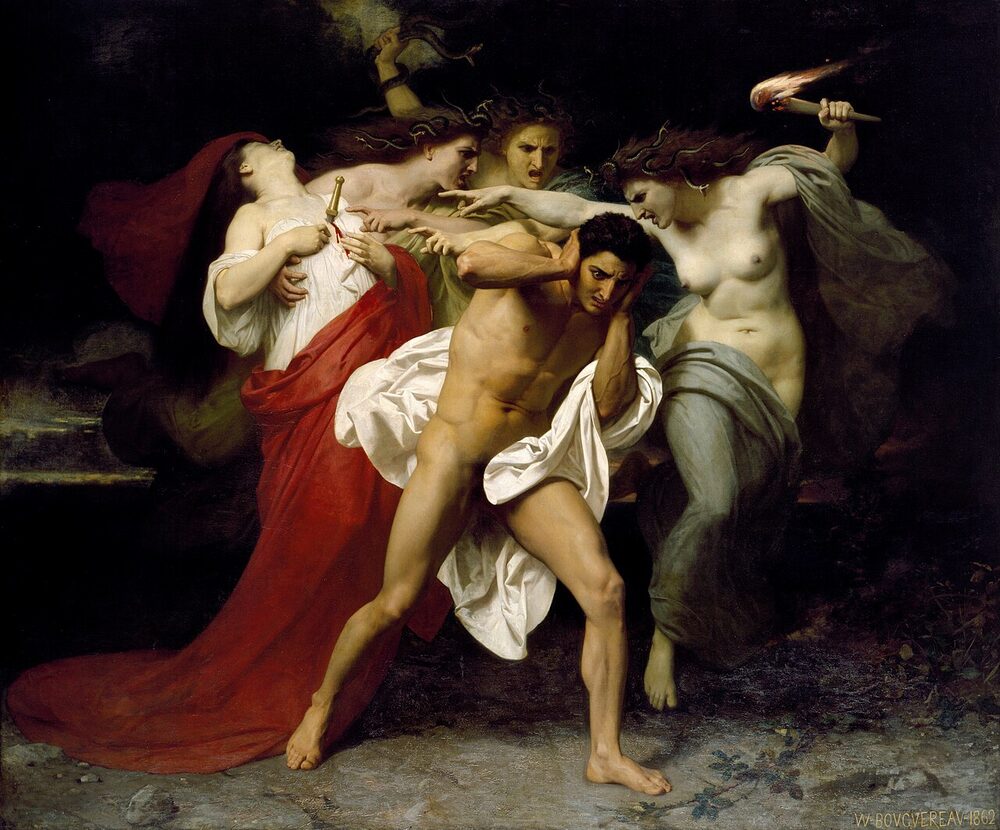
Erinyes / the Furies
First Appearance
The Erinyes are among the very oldest powers in Greek myth, born at the first great wound in the cosmos. Hesiod's Theogony (183–185) tells how, when Cronus castrated his father Uranus (Sky) with the sickle and the drops of blood fell upon Gaia (Earth), the Earth received them and in due season brought forth the Erinyes, along with the Giants and the ash-tree Nymphs — so that the Furies are born from an act of violence against a father, and exist forever after to punish exactly such crimes against kin. Homer already knows them well: in the Iliad (9.454) the old man Phoenix tells how his father cursed him and "the Erinyes fulfilled it," and how (9.571) a mother's curse called up the Erinys "that walks in darkness" against her son; elsewhere (19.259–260) they are the powers "who beneath the earth punish dead men, whoever has sworn a false oath." From the first they are the avengers of the broken bonds of family and the enforcers of the sworn word.
— Hesiod, Theogony 183–185; Homer, Iliad 9.454 and 9.571 (with 19.259–260)
Who They Are
The Erinyes (eh-RIN-ee-eez; singular Erinys, eh-RIN-iss), whom the Romans called the Furies, are the ancient, terrible goddesses of vengeance — the powers that hunt down those who spill the blood of their own kin, who wrong a parent, or who break a sacred oath. They are among the oldest beings in the world, born (Hesiod says) from the blood of the castrated Sky-god Uranus when it fell upon the Earth: so they spring from a son's violence against his father, and they exist ever after to punish precisely that — the crime of one family member against another, the sin against the natural order that binds parent to child.
They are not evil, and this is the first thing to understand about them. The Greeks did not think of the Furies as demons or as the enemies of the gods; they were a necessary and even righteous force, the guarantee that the deepest human bonds could not be broken without a reckoning. A murdered kinsman's blood cries out, and the Erinyes answer it. A parent's curse falls on an ungrateful child, and the Erinyes carry it out. A man swears falsely by the gods, and beneath the earth the Erinyes are waiting for him. They are the anger of the wronged made into a divine power — relentless, tireless, and utterly without pity, because pity is not their office. Their office is that the debt be paid.
In the oldest poetry they are an unnumbered, shadowy swarm — "the Erinyes that walk in darkness" — with no faces and no names, felt rather than seen. Only later were they fixed at three and given the names by which we now know them: Alecto ("the Implacable," she who never rests), Tisiphone ("the Avenger of Murder"), and Megaera ("the Grudging," the jealous one). Art gave them their unforgettable shape — snakes writhing in their hair and wound about their arms, blazing torches and brass-studded whips in their hands, black robes, and (later still) the wings of bats — as they pursue the guilty across the world and into madness. And yet their most famous story is not one of terror but of mercy: at the trial of Orestes, the matricide, the Furies who hound him are at the last persuaded to lay down their wrath and become the Eumenides, the "Kindly Ones," honoured protectors of Athens. It is one of the great turns in all of Greek myth — the powers of blind vengeance transformed, without ceasing to be themselves, into the guardians of justice under law.
Mythology
Born from the wound of the Sky
The Erinyes come into being at the first crime of the cosmos, and their origin is also their charter. In Hesiod's Theogony (183–185), the primordial Sky, Uranus, hated the children the Earth Gaia bore him and would not let them be born, pressing them back into her body; and Gaia, in agony, made a great sickle and set her youngest Titan son, Cronus, in ambush. When Uranus next came down over the Earth, Cronus struck — castrating his own father and flinging the severed parts away. Where the drops of Uranus's blood fell upon Gaia, the Earth received them and in time brought forth three kinds of avenging powers: the Giants, the ash-tree Nymphs, and the Erinyes. (Cross-reference: this is the same wound from which, in a different direction, Aphrodite is born of the sea-foam — one act of violence gives rise both to love and to vengeance. Uranus has his own page.)
Their birth is the key to everything they do. They are born of a son's violence against his father — the first and worst offence against the bond of kin — and so they exist forever after to avenge exactly that crime: the wrong done by one family member to another, and above all the shedding of a relative's blood. Some later poets gave them other parents (Aeschylus calls them daughters of Night, Nyx; others make them children of the Earth or of the underworld darkness), and these alternative parentages are worth flagging as genuine variants. But the Hesiodic account is the oldest and the most telling, because in it the Furies are made of the very thing they punish.
An unnumbered swarm — the Furies of early epic
It is important to know that the neat picture of "the three Furies with their three names" is a later development. In Homer and the oldest poetry the Erinyes are not three, and they have no individual names at all. They are a plural, shadowy, faceless power — "the Erinyes that walk in darkness," an indefinite swarm of avenging spirits felt as a presence rather than seen as persons. Homer speaks of "the Erinys" in the singular when a single curse is at work, and of "the Erinyes" in the plural, but he never counts them and never names one of them. They are the anger of the wronged, wherever it rises. The fixing of their number at three, and the giving of the names Alecto, Tisiphone, and Megaera, belongs to later authors — the number three appears with the tragedians and mythographers, and the three names together are found in full only in later sources (they are canonical by the time of the Roman poets, especially Virgil and Ovid). Keep this in mind: the swarm is old, the three named sisters are young.
The three sisters and their names
When the tradition did settle on three, it gave each a name that spells out an aspect of vengeance:
- Alecto (Ἀληκτώ), "the Implacable" or "the Unceasing" — she whose anger never ends and who cannot be turned aside. In Virgil's Aeneid she is the Fury whom Juno summons up from the underworld to break the peace of Italy, infecting queen Amata and the warrior Turnus with murderous frenzy — the very image of rage let loose.
- Tisiphone (Τισιφόνη), "the Avenger of Murder" (from tisis, "retribution," and phonos, "slaughter") — the punisher of the killing itself, who in later poetry stands guard at the gates of the place of punishment in the underworld, scourge in hand.
- Megaera (Μέγαιρα), "the Grudging" or "the Jealous" (from megairō, "to bear a grudge, to envy") — whose name gives us the English word megaera for a spiteful woman, and whose province is the resentment that will not let a wrong go unpaid.
What the Furies punish
Their domain is precise, and it is narrower and deeper than "wrongdoing" in general. The Erinyes are the avengers of crimes against the natural order of kin and of the sworn word. Chief among these is the shedding of kindred blood — and above all matricide, the killing of a mother, the worst violation their world could imagine, because it turns the source of one's own life into a victim. Close beside it stand the murder of a father, of a brother, of any blood-relative; the wronging or dishonouring of a parent by a child; the mistreatment of the aged and of beggars and suppliants who fall under the gods' protection; and the breaking of a solemn oath. A parent's curse was thought to summon them directly: when the wronged mother or father cried out to the powers below, it was the Erinyes who came to fulfil the curse. And beneath the earth, Homer says, they punish the dead who swore falsely in life. Their punishment in this world is not a clean execution but a hounding — they pursue the guilty relentlessly, driving them into wandering exile and into madness, the frenzy that the Greeks called the visitation of the Furies, until the blood-guilt is somehow purged or paid.
How they were pictured
In the oldest imagination the Erinyes had no fixed shape, being felt rather than seen. But the poets and painters, and above all the stage, gave them a form that became one of the most frightening in all Greek art. They appear as dark, dreadful women, their hair a mass of writhing snakes, more snakes coiled about their arms and waists; their eyes drip blood or tears of blood; they wear black robes and carry blazing torches to light the guilty in the dark and whips or brass-studded scourges to drive them on. Aeschylus, staging them in his Eumenides, made them so hideous — a chorus of black, gorgon-like hags, snorting and dripping — that ancient tradition (surely exaggerated) claimed the sight of them made children faint and pregnant women miscarry in the theatre. The bat-like wings with which later art and modern imagination equip them are a later addition, not part of the oldest picture; the earliest Furies are wingless. In the underworld they are the tormentors of the damned; in this world they are the shape that guilt takes when it comes hunting.
The great story — the pursuit of Orestes
(Content note: the following turns on the killing of a mother by her son, and on the cycle of family murder that surrounds it.) The Furies' most important myth is the tragedy of the house of Atreus, told most fully in Aeschylus's great trilogy the Oresteia (458 BC), and it is the story in which they are transformed forever. It runs like this. Agamemnon, king of Mycenae, sacrificed his own daughter Iphigenia to gain fair winds for the fleet sailing to Troy. When he came home from the war ten years later, his wife Clytemnestra, who had never forgiven that killing, murdered him — cut him down in his bath. So far the Furies have their work cut out on both sides: a father who killed a child, a wife who killed a husband. But then comes the terrible knot. Agamemnon's son Orestes, commanded by Apollo's own oracle at Delphi to avenge his father, returns in secret and kills his mother Clytemnestra (and her lover Aegisthus) — avenging one parent by murdering the other.
Hounded into madness
Orestes has obeyed a god and avenged his father; and yet he has done the one thing the Furies exist to punish — he has shed his mother's blood. The instant the deed is done, they come for him. In Aeschylus they rise as a chorus of black horrors, roused by the ghost of the murdered Clytemnestra herself, who cries out from below for her blood to be avenged. They fasten on Orestes and hound him from Argos, driving him mad and in flight across the whole Greek world, sleepless and pursued, a polluted man whom no one may shelter. He takes refuge at last at Delphi, at the altar of Apollo who had sent him to the deed — but Apollo can only purify and protect him so far; he cannot make the Furies let go. The god sends Orestes on to Athens, to throw himself on the mercy and judgement of the goddess Athena. This is the crux of the whole story and of the Furies' meaning: two divine claims stand in direct opposition. Apollo, god of the new order, insists that a son must avenge his father and that Orestes acted rightly. The Erinyes, powers of the old order, insist that the blood of a mother cries out no matter what, that no command can wipe out matricide, and that they will have their due. There is no obvious right answer — and that is the point.
The trial on the Areopagus and Athena's casting vote
Athena will not decide it alone. Instead — and this is the moment the myth is really about — she founds a court. She summons a jury of Athenian citizens to the hill called the Areopagus (the "Hill of Ares") and establishes there the first trial by jury for a charge of murder, so that the endless private cycle of blood for blood can be replaced by public justice under law. Apollo speaks for the defence; the Erinyes are the prosecution, arguing their ancient right. The human jurors cast their ballots, and the votes come out equal — the city itself is split down the middle, unable to resolve the impossible case. Then Athena casts the deciding vote, and she casts it for Orestes: where the count is tied, she rules, mercy and the accused shall prevail, and Orestes is acquitted. The blood-debt is discharged not by more killing but by a verdict.
From Furies to "the Kindly Ones"
But the story does not end with the acquittal, and its true greatness is in what comes after. The Erinyes are enraged — they have been overruled, their ancient prerogative denied, their honour trampled by these upstart younger gods and their new-fangled courts. They threaten to loose their poison on the land of Athens, to blight its crops and its children in revenge. And here Athena does the wise and beautiful thing: she does not fight them or banish them. She persuades them. She offers them not defeat but a new and higher honour — a permanent home and cult in the heart of Athens, a place of reverence beneath the earth, the first-fruits of the city's sacrifices, and the dignity of being the guardians who bless marriages, guard against civil bloodshed, and watch over the very justice they once served blindly. Won over, the Furies lay down their wrath. They accept the honour, and in accepting it they are transformed: from the Erinyes, the dread avengers, they become the Eumenides, "the Kindly Ones" — and, taking up their new place of honour beneath the city, they turn their power from curse to blessing, calling down fruitfulness on the Athenian land instead of blight. The trilogy ends with a torchlit procession escorting them, robed now in reverence, to their new shrine. It is the mythic image of a whole civilisation's greatest step: the taming of vengeance into justice, the moment blind blood-anger is not destroyed but honoured, given a lawful place, and turned to the community's good. The Furies do not stop being what they are; they become the guardians of the very order that overruled them.
The Eumenides and the grove at Colonus
That reconciliation is why the Athenians could worship the terrible goddesses under gentle names. In Sophocles's late play Oedipus at Colonus, the blind, polluted Oedipus — himself a man crushed by family crime — comes at the end of his wandering to a sacred grove just outside Athens, at Colonus, that belongs to the Eumenides; and it is precisely there, in the ground sacred to the goddesses of vengeance who have become gracious, that the gods at last take him and grant him a peaceful, blessed end. The choice of setting is deliberate and moving: the man most hounded by inherited guilt finds rest in the grove of the powers of guilt themselves, now turned kindly. The Furies who begin as the horror of the Oresteia end as the quiet, honoured guardians of a holy wood.
Worship — Ancient
The dangerous name and the reverent one
The worship of the Erinyes was governed above all by fear of their name. To speak the true name of a power of vengeance was thought to risk drawing its attention upon you, and so the Greeks worshipped them under euphemisms — flattering, appeasing titles meant to turn their anger aside. They were the Eumenides, "the Kindly Ones"; the Semnai or Semnai Theai, "the Venerable / August Goddesses," "the Solemn Ones"; in Arcadia the Maniai. You did not stand at their altar and call them the Furies. The whole shape of their cult is an act of careful, frightened courtesy — honouring dreadful powers by naming them for the mercy you hope to receive rather than the wrath you fear.
The shrine on the Areopagus at Athens
The most important cult of the Furies stood at Athens, exactly where their great myth placed it. At the foot of the Areopagus, the hill of the murder-court, was a sacred precinct and a cleft in the rock sacred to the Semnai Theai, the Venerable Goddesses — the Erinyes worshipped in their reconciled form as guardians of the city and its justice. Pausanias (Description of Greece 1.28.6) saw it: a sanctuary where the goddesses were shown as images "with nothing terrible about them," a deliberate softening, and where those acquitted of murder sacrificed in thanks. The precinct was an asylum, a place of refuge; and the cult was tended with the special solemnity owed to underworld powers. The link between the shrine and the court was the living continuation of Aeschylus's story — the same goddesses who prosecuted Orestes were honoured beside the tribunal that acquitted him.
Wineless offerings — the rites of the powers below
The Erinyes were chthonic powers, gods of the earth and the world below, and their worship followed the distinct ritual grammar reserved for such powers rather than the bright sacrifices offered up to the Olympians. Their offerings were nēphalia — "wineless" libations, poured without wine: water, or milk, or honey, or a mixture of honey and water (melikraton), given to the sober powers who were thought to shun the wine of the upper gods. To these were added honey-cakes (pelanoi) and the flowers of their sacred groves. Where an animal was offered it was a black victim — a black sheep or ewe — its blood let down into the earth for the powers below rather than burnt upward for the sky-gods, and (in the manner of underworld sacrifice) often burnt whole, with no feast shared by the worshippers. Every element — the wineless drink, the black beast, the downward-poured blood, the holocaust with no human portion — marks these as goddesses of the dark earth, approached with dread and appeasement.
Other cults across Greece
Beyond Athens their worship reached across the Greek world. At Sicyon, Pausanias records, there was a grove and temple of the Semnai where a yearly festival was kept and the offerings were sheep heavy with young, honey-libations, and untrimmed flowers rather than woven garlands — again the wineless, earth-facing rite. Near Megalopolis in Arcadia stood a sanctuary of the goddesses under the name Maniai ("the Madnesses"), a spot local legend tied directly to the madness of Orestes — it was there, they said, that the Furies first drove him mad, appearing to him black, and there that, after he bit off one of his own fingers in his frenzy and so appeased them, they appeared to him white, and he recovered his mind. At Colonus near Athens was the grove of the Eumenides made famous by Sophocles, a place so holy it could not be trodden or spoken of lightly. Across all these cults the pattern holds: local groves, solemn wineless rites, black victims, and the careful use of the kindly names.
The Erinys of the oath and the curse in daily belief
Below the level of formal temples, the Erinyes lived in everyday Greek belief as the enforcers of the two things that held society together: the oath and the bond between parent and child. When Greeks swore a solemn oath they called the Erinyes to witness and to punish the forsworn, "the Erinyes who beneath the earth take vengeance on men, whoever has sworn falsely." And a wronged parent's or elder's curse was genuinely feared, because it was believed to summon the Furies against the offender — the curse of Oedipus on his sons, the curse of Althaea on Meleager, the curse of Phoenix's father, all bring the Erinyes down. In this the Furies were less a temple-cult than a moral force woven through the whole of life: the invisible guarantee that you could not betray your sworn word or your own blood and simply walk away.
Worship — Modern
Honouring them under the kindly names
In the modern revival of Greek polytheism, the Erinyes hold a real and carefully-approached place, and the practices around them follow the ancient logic closely. A devotee honours them above all as the Eumenides and the Semnai, "the Kindly and Venerable Ones," keeping the old wisdom that these are powers named for the mercy one hopes for rather than the wrath one fears. They are turned to as guardians of justice where ordinary justice fails, as avengers of the abused — especially the wronging of family, the betrayal of children, the breaking of solemn promises — and as stern but not cruel powers who insist that wrongdoing carries a cost. They are not petitioned lightly, and they are not asked to curse; they are honoured, and their sense of a debt owed is respected.
Wineless offerings, kept as of old
Because their ancient rite is so distinct and so well recorded, it carries over almost unchanged. Offerings to the Erinyes are traditionally wineless (nēphalia): pure water, milk, or honey mixed with water, poured out onto the earth rather than raised up — given wholly, not shared, as befits powers of the world below. Honey-cakes, and flowers left uncut or unwoven into garlands (in memory of the untrimmed offerings of their old groves), sit well on their altar; where the ancients gave a black sheep, a modern devotee might offer a dark-coloured food or simply the honey and water. A candle or a torch lit in a dim place recalls the flame they carry; and the offering is best made in a quiet, solemn spirit, with the reverence owed to old and dangerous powers approached in hope of their goodwill.
The myth that still speaks
More than through cult, though, the Erinyes live on today through the enduring power of their great story. Aeschylus's Oresteia — the pursuit of Orestes, the founding of the first jury-court, Athena's casting vote, and the transformation of the Furies into the Eumenides — is one of the most studied and most staged works in the world, read as the founding myth of the very idea of the rule of law: the moment a society replaces the endless private cycle of blood-vengeance with public justice, and does so not by destroying the old avenging anger but by honouring it and giving it a lawful place. Psychology borrowed their name for the pursuing force of guilt and conscience — the "furies" that hound the wrongdoer are an image writers reach for still. And in poetry and everyday speech the Furies remain the very picture of righteous, relentless vengeance: to be "pursued by the Furies" is to be hunted by a wrong that will not rest until it is answered. The snake-haired avengers who turned, at the last, into the guardians of a city's justice have never really left the imagination of the West.
Epithets & Cult Titles
- Εὐμενίδες (Eumenides) — "the Kindly Ones" — The great reverent by-name, "the Gracious" or "Kindly Ones." It is a name of appeasement — you do not call the powers of vengeance by their fearful name and risk drawing their notice, so you call them the opposite of what they are, hoping to turn their anger to favour. In Aeschylus this name is earned: at the end of the Oresteia the Furies are actually transformed into the Eumenides, kindly guardians of Athens
- Σεμναί (Semnai) / Σεμναὶ Θεαί (Semnai Theai) — "the Venerable / August Ones", "the Revered Goddesses" — The name under which they received real cult at Athens, at their shrine on the Areopagus, and at Sicyon. Again it names them by their dignity rather than their dreadfulness — "the Solemn Goddesses" — the safe and honouring way to speak of powers too dangerous to name plainly
- Μανίαι (Maniai) — "the Madnesses" — A cult-name used in Arcadia (Pausanias records a sanctuary of the Maniai near Megalopolis), naming the goddesses by the effect they work on the guilty — the driving frenzy, the madness of Orestes, that the pursuit of blood-guilt brings on the mind
- Ἀραί (Arai) — "the Curses" — A name that identifies the Erinyes with the curses they carry out. A parent's or a suppliant's curse was thought to summon them; Aeschylus can call them by this name, for they are the living force of a curse laid on a house
Sources & Variants
- Hesiod, Theogony 183–185 (the Erinyes born from the blood of the castrated Uranus falling upon Gaia, together with the Giants and the ash-tree Nymphs)
- Homer, Iliad 9.454 (the Erinyes fulfil the curse of Amyntor against his son Phoenix); 9.571 (a mother's curse calls up the Erinys 'that walks in darkness'); 19.259–260 (the Erinyes who beneath the earth punish those who swear false oaths); 21.412 (the Erinyes of a mother)
- Homer, Odyssey 2.135; 11.280; 15.234 (the Erinyes as avengers of a parent's curse and of wrongs within the family)
- Aeschylus, Eumenides (the whole play: the Furies rouse from Clytemnestra's ghost, pursue Orestes to Athens, are opposed by Apollo, plead their case before Athena's new court on the Areopagus, are overruled by Athena's casting vote, and are persuaded to become the honoured Eumenides beneath Athens) — the central text; the Furies as daughters of Night
- Aeschylus, Libation Bearers (Choephoroi) (Orestes kills Clytemnestra at Apollo's command and is set on by the Furies at the play's end)
- Sophocles, Oedipus at Colonus 36–43, 84–110 (the sacred grove of the Eumenides at Colonus, where Oedipus finds his blessed end)
- Euripides, Orestes and Iphigenia among the Taurians (Orestes hounded by the Furies and driven mad after the matricide)
- Apollodorus, Bibliotheca 1.1.4 (the Erinyes born from the blood of Uranus); Epitome 6.25 (the madness of Orestes and his pursuit)
- Virgil, Aeneid 7.323–571 (Juno summons the Fury Alecto from the underworld to loose war and madness on Italy); 6.570–575 (Tisiphone guarding the gates of the damned) — Roman, and a key source for the three named sisters
- Ovid, Metamorphoses 4.451–511 (Tisiphone sent to madden Athamas and Ino; the Furies described with snakes and torches in the underworld) — Roman retelling; the canonical three names
- Pausanias, Description of Greece 1.28.6 (the sanctuary of the Semnai Theai at the Areopagus in Athens, where the acquitted sacrifice); 2.11.4 (the grove and rites of the Semnai at Sicyon); 8.34.1–3 (the sanctuary of the Maniai near Megalopolis and the madness of Orestes)
Gallery