Gigantes
First Appearance
The Giants first appear in Hesiod's Theogony (183–187), born at the very beginning of the world: when Kronos castrated his father Uranus and flung the severed genitals away, the blood-drops that fell upon Gaia (Earth) made her pregnant, and in due time she bore the Erinyes (Furies), the Giants — "great, in gleaming armour, holding long spears in their hands" — and the ash-tree nymphs, the Meliae. Hesiod says nothing yet of a war; the great battle of the Giants against the Olympian gods, the Gigantomachy, is a later development, sketched by Pindar and Euripides and told in full only by the mythographer Apollodorus.
— Hesiod, Theogony 183–187 (birth); the developed Gigantomachy in Pindar, Euripides, and fully in Apollodorus, Bibliotheca 1.6.1–2
Who They Are
The Giants (Gigantes, jy-GAN-teez) are an earth-born race of monstrous warriors who rose up against the Olympian gods in the Gigantomachy, the "War of the Giants" — the second of the two great revolts that the reign of Zeus had to survive. They are not gods but a brood of the Earth, born (in the oldest account) from the blood of the castrated sky-god Uranus falling upon Gaia, and made to be the enemies of heaven. In the developed myth they pile up the mountains, hurl flaming oaks and boulders at the sky, and are put down one by one in a pitched battle that the gods, for all their power, could not win alone.
(Content note: their origin turns on an act of divine violence, the castration of Uranus by his son Kronos — told frankly here and in fuller detail on the pages for Uranus and Gaia.) It is worth stopping at the very start to clear up the single most common confusion in all of Greek myth: the Giants are not the Titans. The two are constantly mixed up in popular retelling, and the mistake is easy — both are older, earth-connected powers who fight the Olympians and lose — but the Greeks kept them firmly apart. The Titans are the elder gods, the twelve children of Uranus and Gaia (Kronos, Rhea, Oceanus, and their siblings), and their war against Zeus is the Titanomachy. The Giants are a later, separate brood — not gods but monsters of the Earth — and their war is the Gigantomachy, a different battle in a different generation. Getting this straight is the key to the whole story.
What the Gigantomachy meant to the Greeks is as important as what happened in it. It was the myth of order defeating chaos: the young Olympian order, barely secured after the fall of the Titans, facing one more surge of the old earth-born violence and mastering it. The battle became the favourite subject of civic and religious art — carved on the great altar at Pergamon, on the metopes of the Parthenon, and woven into the robe the Athenians gave their goddess each year — precisely because it stood for the victory of the gods, and of the ordered city under their protection, over the forces that would tear both down. And the Giants left a mark on the language too: from their enormous size comes the everyday word gigantic, and from their war the term gigantomachy for any titanic (that word, ironically, from their cousins the Titans) clash of great powers.
Mythology
Born from the blood of Uranus
The Giants' birth is one of the primal events of the cosmos, and the oldest source for it is Hesiod. At the beginning of things the sky-god Uranus (Heaven) lay heavily upon Gaia (Earth), hating and imprisoning the children she bore him. Gaia, in her pain, made a great sickle and set her son Kronos to ambush his father; when Uranus next came down upon her, Kronos castrated him with the sickle and flung the severed parts away. Where the blood-drops fell upon the Earth, Gaia conceived, and in the fullness of time brought forth three broods at once (Theogony 183–187): the avenging Erinyes (Furies), the ash-tree nymphs the Meliae, and the Giants — a race of huge warriors born already armoured, "in gleaming armour, holding long spears." So the Giants are, from their first instant, children of Earth and of an act of violence against Heaven: earth-born (gēgeneis), and made for war. (Note that Hesiod alone gives them this birth from Uranus's blood; some later writers make them simply children of Gaia, or of Gaia and Tartarus, but the blood-of-Uranus origin is the canonical one this page follows.)
The Giants are not the Titans — flagging the great mix-up
Because this confusion is so widespread, it deserves its own heading. In popular speech "Titans" and "Giants" are used almost interchangeably for "huge primeval beings who fought the gods," and even some ancient authors blur the two — but the classical tradition keeps them distinct, and their two wars are not the same war. The Titans (Kronos, Rhea, Oceanus, Hyperion, Iapetus, and the rest) are the elder gods, the direct children of Uranus and Gaia; they ruled the cosmos before the Olympians and were overthrown by Zeus in the Titanomachy, then imprisoned in Tartarus. The Giants are a different generation and a different kind of being — not gods but a monstrous earth-born race — and their revolt, the Gigantomachy, comes later, against the already-established Olympian order. One useful way to hold them apart: the Titanomachy is gods against gods, an internal succession-struggle within the divine family; the Gigantomachy is the gods, now united, against an external brood of the Earth that rose to avenge the defeated Titans. Two wars, two enemies, two meanings — kept separate here as the Greeks kept them.
Why the war began, and the prophecy of the mortal
The fullest narrative of the war is Apollodorus's (Bibliotheca 1.6.1–2). Gaia, enraged at the fate of her children the Titans, brought forth the Giants against the gods — earth-born monsters of unmatched size and strength, terrible to look upon, with (in the art and the later descriptions) shaggy hair and beards and, in the developed iconography, coiling serpents for legs. They made war on heaven from Phlegra (or Pallene), hurling up at the sky great blazing oak-trees and boulders and flaming crags. But there was a catch built into the fight from the start, and it is central to the story: it was prophesied that the gods could not kill a single Giant by their own hands — the Giants could only be brought down if a mortal fought on the side of the gods. This is why the story needs Heracles: no Olympian alone could finish a Giant, and so Athena summoned the greatest mortal hero, the son of Zeus by a mortal woman, to strike the killing blows the gods themselves were forbidden to land.
Gaia's herb, and Zeus's counter-stroke
Gaia knew the prophecy too, and moved to defeat it. Learning that her Giants could be slain once a mortal joined the gods, she went searching for a certain drug-herb (pharmakon) that would make them proof even against a mortal's blow — a plant of invulnerability. But Zeus was quicker. He forbade Eos (Dawn), Selene (the Moon), and Helios (the Sun) to shine, and in the darkness he combed the earth and cut the whole of the herb himself before Gaia could find it — and only then had Athena summon Heracles to the battle. It is a small, cunning detail, but a revealing one: even the king of the gods wins this war partly by forethought and stealth, not brute force alone.
Alcyoneus — deathless on his native soil
Three named Giants stand out from the brood, and the first is Alcyoneus (Ἀλκυονεύς), the eldest and one of the two strongest of the brood. His terror was that he was immortal so long as he fought upon the land where he was born (Pallene). Heracles shot him with an arrow, and the Giant fell — but the moment he touched his native ground he sprang back up, revived, unkillable. It was Athena who saw the answer: she counselled Heracles to drag Alcyoneus out beyond the borders of his homeland, and once hauled off the soil that renewed him, the Giant lost his deathlessness and died. Alcyoneus is the perfect emblem of a strength that force alone cannot beat — a foe undone only by wit, by moving the fight to ground where his gift no longer held.
Porphyrion — the king who reached for Hera
The second is Porphyrion (Πορφυρίων), whom Pindar names outright as the king of the Giants and the leader of the assault on heaven. In the battle Porphyrion rushed upon Heracles and Hera — and here Zeus turned the Giant's own violence against him. Zeus cast into Porphyrion a mad lust for Hera, and when the Giant, inflamed, tore at the goddess's robes to assault her, he gave Zeus the opening: the king of the gods struck him with the thunderbolt, and Heracles finished him with an arrow. So the mightiest of all the Giants, the king, was brought down by the two together — the god's bolt and the mortal's shaft — exactly as the prophecy required.
Enceladus — buried under the burning mountain
The third is Enceladus (Ἐγκέλαδος). As he fled the losing battle, Athena tore up a whole island and flung it down upon him: in Apollodorus she throws the island of Sicily and pins him beneath it. In the tradition that became most famous — through Virgil, Callimachus, and later poets — the weight that crushes Enceladus is specifically Mount Etna, the great Sicilian volcano, and his buried body is the reason the mountain burns and shakes: Etna's eruptions are Enceladus's fiery breath, and its earthquakes are the pinned Giant shifting and struggling beneath it. (Content note / cross-reference: this is exactly the story told of the monster Typhon, who has his own page in this collection — and here is a genuine and much-noted overlap. Both Enceladus and Typhon are said, in different sources, to lie imprisoned under Etna as the cause of its fire. The traditions are parallel and were never fully reconciled by the ancients; where Pindar and Aeschylus put Typhon under Etna, Virgil and others put Enceladus there. Both are true to a strand of the myth, and the doubling is worth flagging honestly rather than smoothing over.)
The other Giants and the end of the war
Around these three the rest of the brood fell one by one, each to a god working in concert with Heracles's finishing arrow. Ephialtes was blinded by two arrows at once — Apollo shooting out his left eye and Heracles his right. Eurytus was killed by Dionysus with his thyrsus; Clytius by Hecate's torches; Mimas by Hephaestus with red-hot metal; Pallas was flayed by Athena, who used his skin as a shield; Polybotes was chased across the sea by Poseidon, who broke off a piece of the island of Cos and hurled it down to bury him (the islet of Nisyros, said to be that fragment). One by one the earth-born were put down, and every killing stroke, by the terms of the prophecy, was sealed by the mortal Heracles. When the last Giant fell, the second great revolt against the Olympians was over, and the order of Zeus stood unshaken.
Worship — Ancient
Not a race to be worshipped — a myth to be displayed
The Giants received no cult: they are monsters, the enemies of the gods, and no altar was ever raised to them. But the story of their defeat — the Gigantomachy — was one of the most important images in all of Greek public and religious life, and it is that meaning and reception, not any invented worship, that belongs here. To carve or weave the Gigantomachy was to proclaim the victory of the gods and of civilized order over chaos, and Greek cities used it exactly so, again and again, on their most sacred buildings.
What the myth meant: order against chaos
At its heart the Gigantomachy is a companion-piece to the Titanomachy and the myth of Typhon: the story of how the Olympian order, having overthrown the elder gods, put down one last uprising of the old earth-born violence and made its rule secure. The Giants stand for everything the ordered cosmos is set against — brute force without law, the raw power of the Earth in revolt against Heaven, chaos surging up to pull the young world back into disorder. Their defeat is the gods' final guarantee. For the Greek polis (city-state), the meaning carried a civic charge as well: the gods' triumph over the Giants became a mirror of the city's own triumph over the forces — barbarian, monstrous, disordered — that threatened it, which is why the theme was so beloved of civic art in the centuries after the Persian Wars.
The Parthenon and the peplos of Athena
In Athens the Gigantomachy was woven into the very fabric of the city's devotion to Athena. It was carved on the east metopes of the Parthenon (the side facing the rising sun and the great altar), showing the gods battling the Giants; it was depicted on the inside of the shield of the colossal gold-and-ivory Athena Parthenos within the temple; and — most tellingly — it was the scene embroidered on the Panathenaic peplos, the great saffron robe that the Athenians wove anew each year and carried in solemn procession up the Acropolis to drape upon the ancient statue of Athena Polias. The goddess who had summoned Heracles and buried Enceladus wore her own victory as her festival garment. To honour Athena at the Panathenaia was, in part, to celebrate the Gigantomachy.
The Great Altar of Pergamon
The single most famous work of ancient art on the theme is the Great Altar of Pergamon (second century BCE), whose enormous marble frieze — over a hundred metres of high-relief sculpture, now reconstructed in Berlin — shows the whole assembly of the gods locked in furious combat with the serpent-legged Giants. It is the masterpiece of the Hellenistic "baroque," all straining muscle, streaming drapery, and anguished faces, and it made the Gigantomachy a monument of dynastic and civic pride: the kings of Pergamon cast their own victories over invading Gauls (the Galatians) as a Gigantomachy, their enemies as the Giants and themselves as the gods of order. Here the myth's political meaning is at its most explicit — the defeat of the earth-born monsters standing for the defeat of the barbarian and the triumph of the civilized kingdom.
Worship — Modern
A figure of reception, not cult
The Giants have no worship, ancient or modern — they are the adversaries of the gods, and there is no cult of the Gigantes to keep or revive. What they have instead is a long and vivid afterlife in language, science, and art, and that reception is their real legacy.
The words they left behind
Their most everyday monument is a pair of words. From the sheer size of the Gigantes comes the ordinary English adjective gigantic, and the noun giant itself (through Latin gigas, gigant- and Old French geant) — so that every time we call something "gigantic" we are, distantly, naming it after this earth-born brood. From their war comes gigantomachy, still used for any clash of colossal powers or, in criticism (after Plato's Sophist), for a great battle of ideas. The Giants have quietly given the language its very measure of the enormous.
Volcanoes and the shaking earth
Because Enceladus was buried under a burning mountain, the Giants became one of the Greeks' explanations for volcanism and earthquakes — the fire and tremors of Etna read as a pinned Giant's breath and struggle, and the volcanic Phlegraean Fields ("burning fields") near Naples took their very name from Phlegra, the battlefield of the Gigantomachy. The science that eventually replaced these stories kept the names: the sixth moon of Saturn is called Enceladus (its icy geysers a fitting echo of the buried Giant's breath), and other Giants — Mimas, Pallene — lend their names to Saturn's moons as well, so that the earth-born brood now circles a planet in the outer solar system.
The Gigantomachy in art and imagination
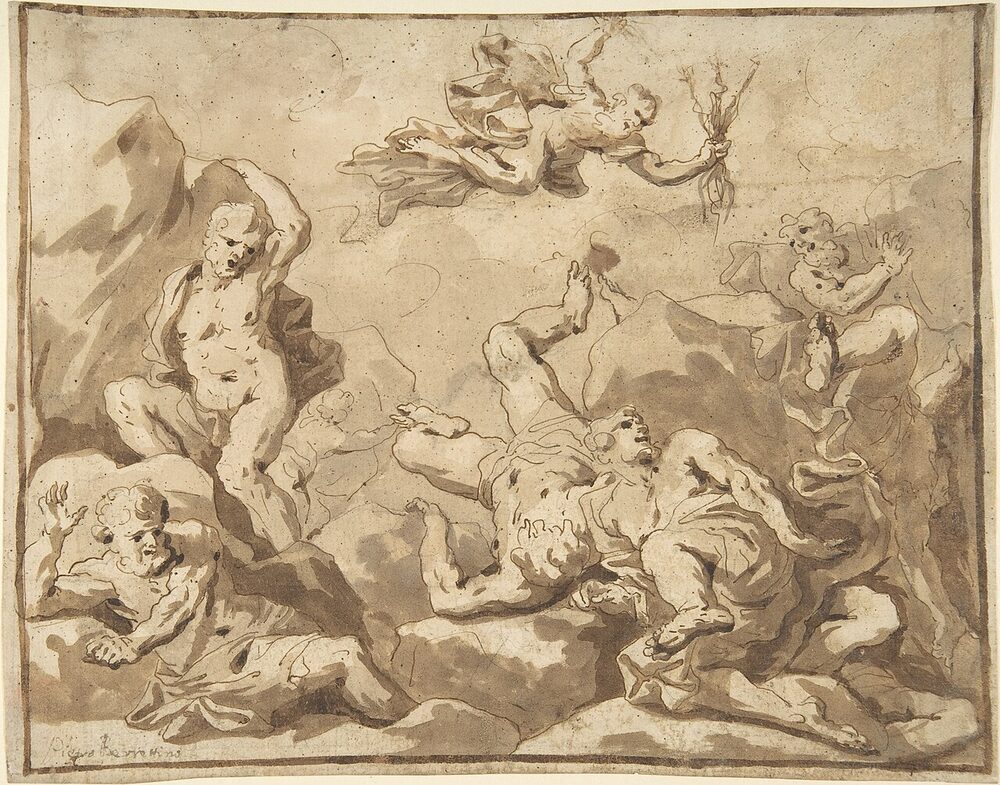
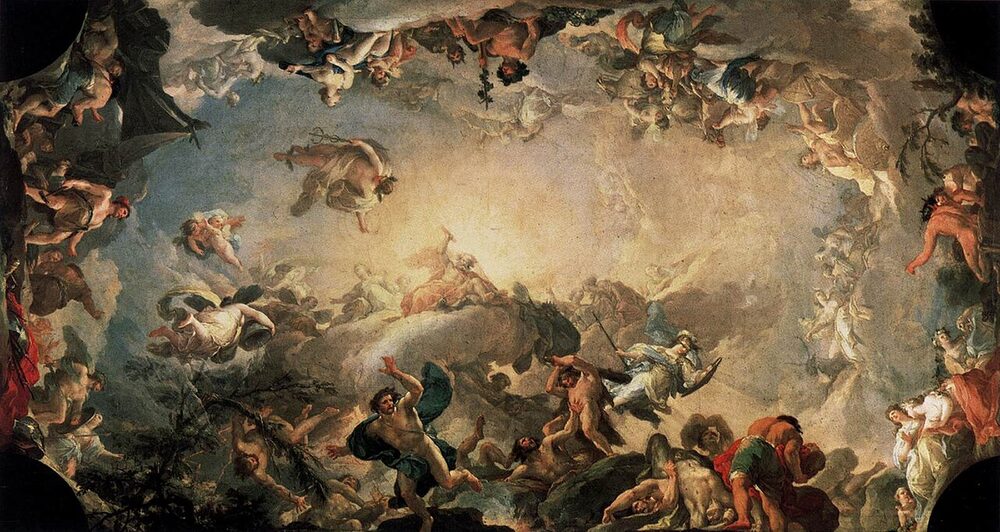
Above all the Giants survive in art. The image of the gods and Giants locked in cosmic battle runs from the Pergamon Altar and the Parthenon through Renaissance and Baroque painting — Giulio Romano's dizzying Fall of the Giants frescoes in the Palazzo del Te at Mantua, where a painted room seems to collapse on the viewer, is the most spectacular example — and on into modern fantasy, film, and games, where "the giants" are a stock image of primordial, world-threatening power. And the myth's core meaning still reads clearly across the centuries: the Gigantomachy remains the West's great picture of order won and held against chaos — the ordered world defended, one more time, against the blind strength of the Earth in revolt.
Epithets & Cult Titles
- Gēgeneis (γηγενεῖς) — The earth-born — the standard descriptive title of the Giants, marking their birth from Gaia (Earth) herself when the blood of castrated Uranus fell upon her; it is the sense the ancients heard in the very name Gigantes
- Phlegraioi (Φλεγραῖοι) — The Phlegraeans — 'those of Phlegra' (from phlegō, 'to blaze, to burn'), after Phlegra, the 'burning field' where the Gigantomachy was fought; identified both with the peninsula of Pallene in Thrace and, later, with the volcanic Phlegraean Fields near Cumae in Italy
- Porphyrion basileus (Πορφυρίων βασιλεύς) — 'Porphyrion the king' — the byname of the mightiest Giant, named by Pindar as king of the Giants; he led the assault on heaven and was felled by Zeus's thunderbolt and Heracles's arrow
- Alkyoneus (Ἀλκυονεύς) — The eldest and one of the two strongest Giants, deathless so long as he fought on the soil of his birth — a name that became a byword for a strength that could only be beaten by cunning, not force
Sources & Variants
- Hesiod, Theogony 183–187 (the birth of the Giants, with the Erinyes and the Meliae, from the blood of castrated Uranus falling on Gaia — 'great, in gleaming armour, holding long spears')
- Apollodorus, Bibliotheca 1.6.1–2 (the fullest narrative of the Gigantomachy: Gaia bears the Giants to avenge the Titans; the prophecy that no Giant can be slain by gods without a mortal; Gaia's herb of invulnerability and Zeus's forbidding of Dawn, Moon and Sun so he could cut it first; Athena summoning Heracles; Alcyoneus immortal on his native soil and dragged from it; Porphyrion, Hera and the thunderbolt; Enceladus and Sicily; Ephialtes blinded by Apollo and Heracles; the deaths of Eurytus, Clytius, Mimas, Pallas, Polybotes and the rest)
- Pindar, Pythian 8.12–18 and Nemean 1.67–69 (Porphyrion king of the Giants, and Heracles at the Gigantomachy alongside the gods)
- Euripides, Ion 205–218 (the Gigantomachy carved on the temple at Delphi, with Athena, Zeus's thunderbolt against Mimas, and Dionysus); Heracles 177–180 and Bacchae 542–544 (allusions to Heracles and the Giants)
- Virgil, Aeneid 3.578–582 (Enceladus buried beneath Mount Etna, the volcano's fire his breath and its tremors his shifting) — Roman; cf. Callimachus and Claudian for the same Etna tradition
- Ovid, Metamorphoses 1.151–162 (the Giants storming heaven by piling mountains, and the earth-born race sprung from their blood) — Roman retelling
- Pausanias, Description of Greece 8.29.1–4 (discussion of the Giants, Phlegra/Pallene, and rationalizing traditions about giant bones); 1.25.2 (the Gigantomachy among the dedications on the Athenian Acropolis)
- On the monuments: the Great Altar of Pergamon frieze (2nd c. BCE, Pergamonmuseum, Berlin); the east metopes and the shield of the Athena Parthenos on the Parthenon; the Gigantomachy embroidered on the Panathenaic peplos of Athena
Gallery