Polyhymnia
First Appearance
Polyhymnia enters the written record not in a story of her own but in a list — the oldest naming of the nine Muses, in the proem of Hesiod's Theogony. Having told how Mnemosyne bore her daughters to Zeus, Hesiod names them one by one (77–79): Clio and Euterpe, Thalia and Melpomene, Terpsichore and Erato and Polyhymnia, "and Polymnia and Urania, and Calliope — she who is the chief of all." She is given no epithet and no deed there, only her place in the choir; and this, as it turns out, is how she stays through almost all of Greek poetry — one of the nine, named and honoured, but without a myth to call her own.
— Hesiod, Theogony 78 (within the naming of the nine Muses, lines 77–79)
Who They Are
Polyhymnia (pol-ee-HIM-nee-uh), in Greek Πολύμνια, is one of the nine Muses, the daughters of Zeus and Mnemosyne (Memory), and her name tells her office: it is built from polys, "many," and hymnos, "hymn," so that she is "she of the many hymns" — the Muse of sacred song, of the solemn praise raised up to the gods. In the later division of the arts among the nine (a systematisation of Roman date, set out by Diodorus Siculus and others), she is given the gravest and most reverent portion: not the love-song, not the comedy, but the serious hymn, the worshipful utterance, the song that is addressed upward to the divine. In some of these late lists her province widens to take in eloquence and rhetoric, the arts of pantomime and the expressive dance of mime, and even meditation, memory, agriculture, and geometry — a scattering of assignments that never settled into one agreed scheme, and that differs from source to source.
What does stay constant is her image. Alone of the nine, Polyhymnia carries no instrument — no lyre, no flute, no writing-tablet — and the painters and sculptors show her instead veiled and pensive, wrapped close in a mantle, a finger often laid thoughtfully to her lips, or leaning in meditation upon a pillar or a rock, her gaze turned downward and inward. She is the Muse caught in the act of thought: of composing the grave hymn before it is sung, or of the silent recollection that song comes from. It is a quieter figure than her sisters, and a fitting one, for the hymn to the gods is the most inward and most solemn of all the kinds of song. (For the birth of the nine from Zeus and Mnemosyne, the springs of Helicon and Pieria, the invocation, and the late one-art-each scheme to which Polyhymnia belongs, see the Muses' own page; this page is her own.)
Mythology
Her name, and the Muse of the solemn hymn
Polyhymnia is, before she is anything else, her name — Πολύμνια, "she of the many hymns," from polys ("many") and hymnos ("a hymn, a song of praise"). A hymn, to a Greek, was a particular and serious thing: a song addressed to a god, sung in worship, grave and praising where other songs were festive or amorous or sorrowful. And so when the later tradition came to divide the arts among the nine Muses — giving epic to Calliope, history to Clio, love-poetry to Erato, and the rest — the portion that fell to Polyhymnia was, fittingly, the sacred hymn: the solemn, serious song raised up to the gods in their praise. This division of labour is not Hesiod's and not early; it is a systematisation of Hellenistic and Roman date, set out most fully by Diodorus Siculus (4.7), who assigns to each Muse her field and derives each name as a description of it. The early poets knew no such scheme — for Homer and Hesiod the nine sing together as one choir — but the late scheme fixed Polyhymnia forever as the Muse of sacred song, and it is in that character that she is chiefly remembered.
The veiled and pensive Muse
More than by any deed, Polyhymnia is known by how she is shown, and here the ancient and the later tradition agree on a single, striking picture. Alone among the nine she holds no instrument and bears no obvious emblem of her art; instead she stands veiled and thoughtful, wrapped in a long mantle drawn close about her, often with a finger laid to her lips or a hand raised to her cheek, frequently leaning on a pillar or a rock as one lost in reflection, her eyes cast down. The ancient writers read this pose as the very sign of her province. Because her gift widened, in the later tradition, to include not only the sacred hymn but eloquence and the art of pantomime — the silent, expressive gesture that tells a story without words — and because she was tied as well to meditation and to memory itself (the gift of her mother Mnemosyne), she came to stand for the inward, composing, remembering side of the Muses' art. She is the hymn before it is sung and the thought before it is spoken: the pause of recollection out of which solemn song and persuasive speech alike arise. It is this that the veil and the finger to the lips were understood to mean — stillness, gravity, the gathering of the mind.
Thin threads of kinship: Orpheus, Triptolemus, and Eros
Polyhymnia has no myth of her own — no story in which she is the agent, no deed told of her apart from the choir — and the honest shape of her legend is a few faint and divergent threads of parentage, none of them secure. Some accounts make her the mother of Orpheus, the supreme mortal singer whose music moved stones and stilled rivers; but this role is far more often given to her sister Calliope, the Muse of epic, and Polyhymnia's claim to it is a minority report. A few sources make her instead the mother of Triptolemus, the hero of the Eleusinian mysteries who carried the gift of grain to mankind — a thread sometimes tied to the late assignment of agriculture to her. And a scattered tradition connects her to Eros, love, naming her (in one such genealogy) as a mother or nurse of the love-god; others of the nine are given the same honour elsewhere, and the attribution is loose. These threads are minor, late, and contradictory, and the tradition is divided on every one of them. The truth to keep is the plain one: Polyhymnia is known not for a story but for a character and an image — the grave, veiled, meditative Muse of the sacred hymn, one of the nine, honoured chiefly in their company and in the solemn, inward portion of their gift.
Worship — Ancient
Honoured among the nine
Polyhymnia received no separate cult of her own; like her sisters she was worshipped with the nine, and all that belonged to the Muses belonged to her. Her honours were their honours: the sanctuary and the great festival of the Mouseia in the Valley of the Muses on Mount Helicon, below the springs where the goddesses were said to dance; the offerings that suited the givers of song — clear water from their own springs, honey and honey-cakes, first-fruits, and above all a hymn or poem made and sung in their praise; and the mouseion, the shrine of the Muses that stood at the heart of the philosophical schools and gave its name, through the great Mouseion of Alexandria, to every museum since. To honour the nine was to honour Polyhymnia among them. (For the full shape of the Muses' cult — Helicon, the Mouseia, the invocation, and the schools — see the Muses' page.)
The Muse fit for the hymn
Yet her particular portion gave her a fitting and natural place in the most solemn kind of worship, for the hymn — the grave song of praise addressed to a god — was itself an act of cult, and it was her own province. Wherever a hymn was raised to the gods, in procession or at the altar or at the opening of a rite, it fell within Polyhymnia's domain; she is, of all the nine, the Muse closest to worship itself, since the sacred song she presided over was not entertainment but devotion. And the inward, meditative cast the ancients gave her — the tie to memory and to reflection — suited her to the quieter, more serious side of the Muses' gift: not the contest or the feast, but the composed and reverent praise, and the silent recollection out of which it comes.
Worship — Modern
The lasting image of the pensive Muse
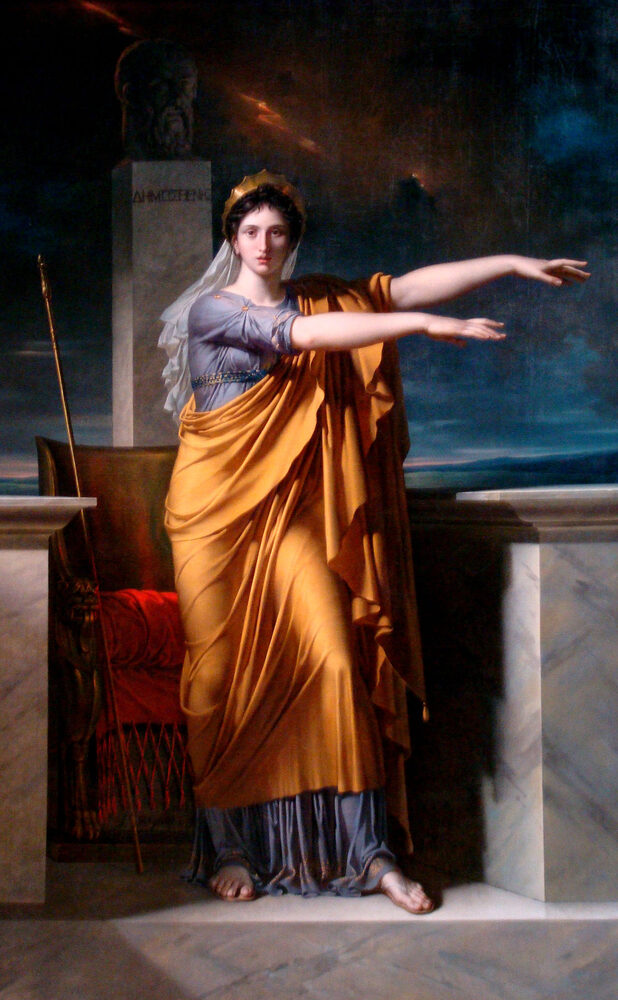
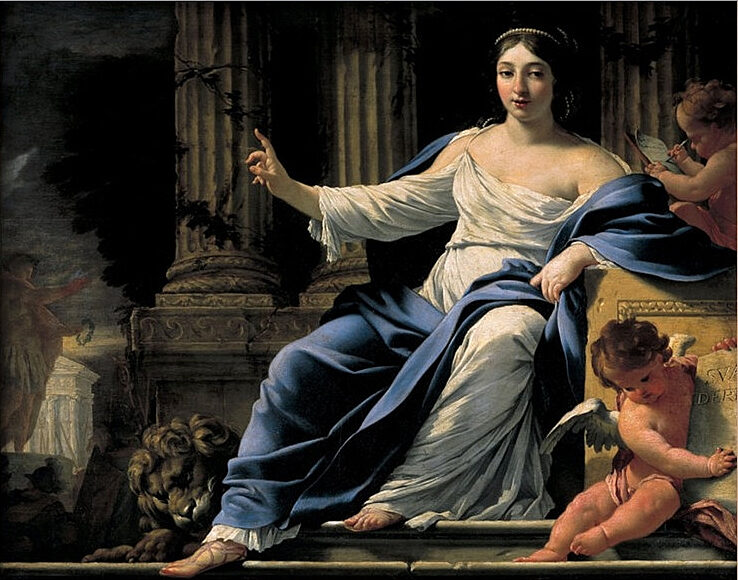
Polyhymnia's clearest legacy is a picture. The veiled, thoughtful Muse — mantle drawn close, finger to the lips, leaning in meditation on a pillar, eyes cast inward — became one of the most recognisable of all the nine in European art, recurring from Roman sculpture through the Renaissance and the painters of the Muses (as in the eighteenth- and nineteenth-century canvases that style her the Muse of Eloquence) down to the present. Where her sisters are known by their instruments, Polyhymnia is known by her stillness, and that image of grave, silent reflection — of the sacred hymn and the persuasive word gathering in the mind before they are uttered — is her enduring contribution to the way the West has pictured thought and inspiration.
Honouring Polyhymnia today
A modern devotee drawn to Polyhymnia honours her in the key of her own province: the sacred and the solemn, the sung praise and the inward art. One might compose or sing a hymn — a true song of praise, grave and heartfelt — or turn a hand to the art of eloquence, the speech or the written word shaped to move and persuade; one might keep a time of meditative study or silent recollection in her name, honouring the memory and reflection she stands for. Following the Muses' ancient shape, pour a simple libation of clear water, keep a moment of quiet, and dedicate the work — the hymn, the speech, the thought — to her before beginning. Of all the nine she asks least for an instrument and most for attention: to honour Polyhymnia is to make something grave and true, and to remember.
Epithets & Cult Titles
- Πολύμνια (Polymnia) — "of the many hymns" — Her own name read as a title: polys, "many," and hymnos, "hymn" — the Muse of the many songs of praise, whose charge among the nine is the sung worship of the gods. The ancients heard the meaning plainly in the name itself, and it fixed her, in the later division of the arts, as the Muse of sacred song.
- Μοῦσα ὕμνων ἱερῶν (Mousa hymnōn hierōn) — "Muse of sacred hymns" — A descriptive title of her later office: of all the choir she presides over the solemn, serious hymn addressed to the divine — not the love-song of Erato nor the festive verse of Thalia, but the grave praise sung in worship. Diodorus and the later systematisers give her this grave and sacred portion.
- Daughter of Mnemosyne, the Pierian Maiden — Like all her sisters she is a child of Memory, born in Pieria north of Olympus and dancing on Helicon; this title marks her not as singular but as one of the nine — a Pierian and Heliconian maiden, memory's daughter, whose solemn hymns are, like all their song, memory made beautiful.
Sources & Variants
- Hesiod, Theogony 77–79 (the naming of the nine Muses; Polymnia named between Erato and Urania); and 1–115 (the proem: the Muses of Helicon, their birth to Zeus and Mnemosyne in Pieria, their office of song) — the earliest attestation of her name, within the choir
- Diodorus Siculus, Bibliotheca 4.7 (the systematic account of the nine Muses and the art assigned to each, with each name derived from its field; Polyhymnia as the Muse of the hymn) — the chief source for the later 'division of labour' among the nine
- Plutarch, Table Talk / Moralia (on the Muses as patrons of memory, learning, and the serious discourse of the mind — the meditative and recollective cast of their gift to which Polyhymnia belongs)
- Apollodorus, Bibliotheca 1.3.1–4 (the nine Muses, daughters of Zeus and Mnemosyne, listed by name; the divergent traditions of the Muses' motherhood of Orpheus and others)
- Pausanias, Description of Greece 9.29–31 (the Valley of the Muses and the sanctuary on Helicon; the springs, statues, and traditions of the nine, among whom Polyhymnia was honoured)
- Note: the specific art-assignments among the nine Muses (which Muse presides over which art, and the further ties of Polyhymnia to eloquence, pantomime, meditation, agriculture, and geometry) are a late systematisation and vary considerably from source to source; the early poets treat the nine as a single choir and give Polyhymnia no fixed separate office
- Note on parentage: Polyhymnia is named mother of Orpheus in a minority of accounts (the role is far more often Calliope's), and elsewhere of Triptolemus, and is loosely connected to Eros in a scattered tradition; the sources are divided and none of these threads is secure
Gallery