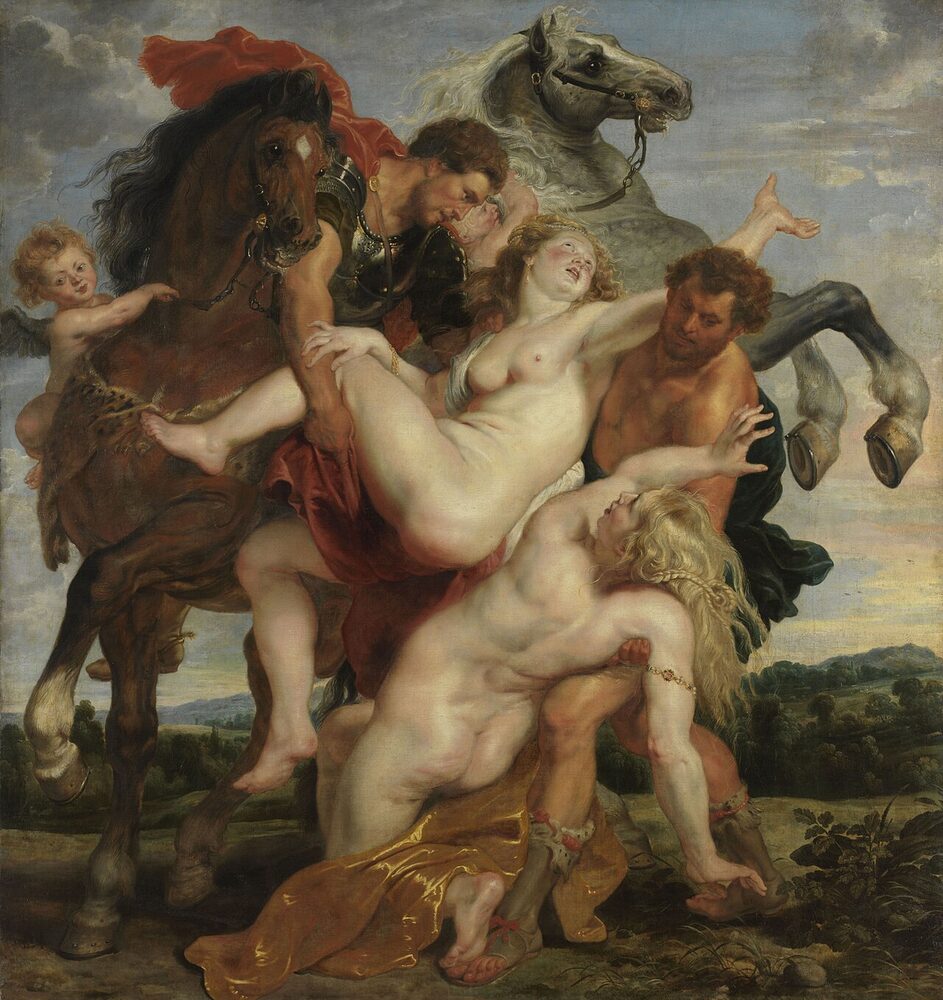
Dioskouroi / the Dioscuri
First Appearance
The Dioscuri appear at the very roots of Greek poetry. In the Iliad (3.236–244) Helen, looking down from the walls of Troy, searches the Greek ranks for her two brothers, "Castor tamer of horses and Polydeuces good with his fists," and wonders why she cannot see them — not knowing, the poet adds in one of Homer's most haunting lines, that "the life-giving earth already held them fast, there in Lacedaemon, in their own dear native land." The Odyssey (11.298–304) tells why: Odysseus in the land of the dead sees the shade of Leda, mother of "Castor tamer of horses and Polydeuces good with his fists," and learns the strange gift the two brothers share — "even under the earth they have honour from Zeus: one day they live, and the next day they are dead, turn and turn about, and they are given honour like the gods." The two Homeric Hymns to the Dioscuri (17 and 33) sing them as "saviours of men upon the earth and of swift-going ships when storms rush down over the pitiless sea" — sailors calling on the sons of Zeus, who come on tawny wings through the upper air and still the waves.
— Homer, Iliad 3.236–244 and Odyssey 11.298–304; Homeric Hymns 17 and 33
Who They Are
The Dioscuri (dy-OSS-kyoo-rye), in Greek the Διόσκουροι (Dioskouroi), "the youths of Zeus," are the twin brothers Castor and Polydeuces — the latter better known by his Latin name, Pollux — the most beloved of all the Greek hero-pairs and, uniquely, a set of twins who ended half in heaven and half in the grave. They are the horseman and the boxer, the rescuers of sailors, the helpers in battle, the patrons of hospitality and of brotherly love; and their story turns on a single strange and moving fact that the Greeks never tired of telling — that although they were born the same night to the same mother, one of them was mortal and one was divine, and rather than be parted by death they chose to share a single immortality between them, taking turns.
Their double nature runs right down to their birth. Their mother was Leda, queen of Sparta, and on one night she lay both with her husband, the mortal king Tyndareus, and with Zeus, who came to her in the form of a swan. From that night she bore, in the fullest form of the tale, two sets of children: Castor and Clytemnestra, the mortal pair fathered by Tyndareus, and Polydeuces and Helen — the Helen of Troy — the immortal pair fathered by Zeus. So the twins carry two fatherhoods in their two names: as Tyndaridae, "sons of Tyndareus," they belong to the Spartan royal house and to the earth; as Dioskouroi, "sons of Zeus," they belong to heaven. Castor, the son of the mortal, could die; Polydeuces, the son of the god, could not. That inequality is the seed of everything that matters in their myth.
What makes the Dioscuri unforgettable is what they did with it. When Castor was at last killed — in a cattle-raid gone wrong, in the quarrel with their cousins Idas and Lynceus — Polydeuces, who could not be killed, would not take the gift of a deathless life alone. He begged his father Zeus to let him die too, or to share his immortality with his brother; and Zeus, moved, granted the second. The twins were allowed to divide a single immortality between them, spending their days turn and turn about — one day among the gods on Olympus, the next day below the earth among the dead — so that the brothers are never parted and never both in the same place, forever passing each other between heaven and the grave. And, the ancients said, Zeus set their likeness in the sky as the constellation Gemini, the Twins, where they still stand side by side. To the sailor in the storm, the two stars rising were the brothers coming to save him.
Mythology
Leda, the swan, and the doubled birth
The twins' whole nature is decided on the night they are conceived. Their mother is Leda, wife of Tyndareus, king of Sparta; and on a single night, the story goes, she lies both with her mortal husband and with Zeus, who comes to her in the shape of a swan. From this doubled union comes a doubled birth — and the sources disagree, in a way worth flagging, about exactly how the children are divided. In the fullest and commonest version, Leda bears two pairs: Castor and the girl Clytemnestra, the mortal children of Tyndareus, and Polydeuces and the girl Helen, the immortal children of Zeus. (Some tellers, playing on the swan, have Helen and the twins hatched from an egg.) The essential point, on which the whole myth turns, is fixed: of the two brothers, Castor is the son of the mortal Tyndareus and can die, while Polydeuces is the son of Zeus and cannot. Two boys, born the same night of the same mother, one of the earth and one of heaven — that inequality is the wound the rest of the story tries to heal. (Variant to note: a minority of ancient writers made both twins sons of Zeus, or both sons of Tyndareus; but the tradition that carries the great myth, and that Pindar sings, is the split fatherhood, and this page follows it.)
The horseman and the boxer
From boyhood the brothers are inseparable and famous for two complementary skills that Homer fixes in a single tag repeated across Greek poetry: Castor is the tamer of horses (hippodamos), the great horseman and charioteer, and Polydeuces is the master of the fists (pyx agathos), the unbeaten boxer. The pair together make up the ideal of the young Spartan warrior-athlete — the man on the horse and the man in the ring, cavalry and combat — and it is as this glorious pair of striplings, the kouroi of Zeus, that they win their name. They belong to the great heroic generation: they sailed with Jason and the Argonauts in the quest for the Golden Fleece, and on that voyage Polydeuces faced the brutal king Amycus of the Bebrycians, who forced all comers to box with him to the death, and beat him in the ring — the boxer-twin's most celebrated single combat (in Apollonius he kills Amycus with the finishing blow; in Theocritus's telling he spares him once he has him at his mercy, on an oath never again to wrong strangers). And when their sister Helen was carried off as a girl by Theseus and hidden away in Attica, the twins invaded the land, recovered her, and brought her safely home to Sparta — the brothers as the protectors of their sister, a role that shadows the greater loss to come.
The quarrel with Idas and Lynceus
(Content note: this is the episode in which Castor is killed.) The turning-point of the whole myth is the twins' fatal quarrel with another pair of brothers, their cousins Idas and Lynceus, the sons of Aphareus — themselves a famous pair, Lynceus so sharp-eyed he could see through the earth, Idas the strongest man of his day. The cause of the fight is told two ways. In the older version (Pindar's), the trouble is over cattle: the four cousins carry out a joint cattle-raid, and when it comes to dividing the herd Idas cheats the Tyndaridae of their share, and blood follows. In another well-known version the quarrel is over two women, the Leucippides — the daughters of Leucippus, Phoebe and Hilaeira — who were promised to Idas and Lynceus but were carried off and married by Castor and Polydeuces instead; the wronged cousins pursue, and the fight breaks out. (The two motives are sometimes combined; the outcome is the same.) In the clash, Castor — the mortal twin — is struck down and killed, run through by Idas (or by Lynceus). Polydeuces avenges him, killing Lynceus, and Zeus himself finishes the quarrel, striking Idas dead with a thunderbolt; but the vengeance cannot give Castor back. The mortal brother lies dead, and the immortal brother is left alive and alone — the exact wound of their doubled birth, now made unbearable.
"Let me not live if my brother is dead" — the shared immortality
This is the heart of the myth, and the reason the Greeks loved the Dioscuri above almost any other pair. Polydeuces, standing over his dead brother, cannot bear the gift that his father's blood has given him: he is deathless, and Castor is dead, and he would rather die than keep his immortality alone. He prays to Zeus — in Pindar's telling, weeping, he begs the god to let him die too, or to find some way that the brothers need not be parted. And Zeus comes to him and lays a choice before him (Pindar, Nemean 10): Polydeuces may, if he wishes, escape death and old age altogether and live forever on Olympus among the gods, in his father's house — or, if he cannot endure to be sundered from his brother, he may share his own immortality with Castor, the two of them dividing it equally between them. Polydeuces does not hesitate. He gives up half his deathlessness to save his brother, and Zeus grants it: the twins are made to live turn and turn about, one day above and one day below — "one day they live, the next day they are dead," as the Odyssey has it — spending their alternating days now among the gods on Olympus, now beneath the earth among the dead in the hollows of their homeland Lacedaemon. So the brothers are never divided and never wholly lost: whichever world you find one in, the other is in the other, and the next dawn they change places. It is the ancient world's supreme image of brotherly love — an immortality that Polydeuces would only accept if he could halve it with the brother he could not live without.
The Twins in the sky — the constellation Gemini
For their love, and for their honour, Zeus set the brothers' likeness among the stars, as the constellation Gemini — "the Twins" — where Castor and Polydeuces stand side by side in the sky, the two bright head-stars still bearing the brothers' own names (Castor and Pollux) to this day. The catasterism (the "setting-among-the-stars") was told as the seal of their story: the pair who would not be parted on earth were placed together forever in heaven, the clearest and most enduring monument the Greeks gave them. The two stars of Gemini rising over the horizon were, to a sailor, the very sight of rescue — the sons of Zeus coming over the sea.
Saviours of sailors — the twin stars on the mast
Of all their powers, the one the ordinary Greek and Roman prized most was the twins' rescue of men at sea. The Homeric Hymn (33) calls them "saviours of men upon the earth and of swift-going ships, when the storm-winds rage over the pitiless sea": the sailors, in terror, pray and vow white lambs to the sons of Zeus and climb to the stern to call on them — and suddenly the brothers come "darting through the air on tawny wings," they still the winds and lay the waves flat on the shining sea, and the seamen rejoice and their toil is over. This was not only poetry. Sailors saw the twins with their own eyes, in the eerie electrical glow that gathers on a ship's masts and rigging in a storm — the pale, flickering fire that later ages, and the sailors of the Mediterranean, came to call St Elmo's fire. When the glow appeared as two flames, one at each masthead, it was Castor and Polydeuces themselves come to save the ship, and it meant the storm would break and calm was near; a single flame was the unlucky sign (later sometimes called "Helen," their sister, and reckoned to bring ill). To see the twin lights was to know the brothers had come. This is why they are, above all, the Sōtēres, "the Saviours," and why their cult followed Greek and Roman ships across the whole Mediterranean.
Helpers in battle — the horsemen who appear
On land the twins kept the same character: shining young horsemen who appear out of nowhere at the moment of crisis to turn the tide of a fight. As the patrons of cavalry and of the two Spartan kings they were felt to ride at the head of Sparta's armies, and the most famous story of their battlefield rescue belongs to the Romans, who took the twins over wholesale (Roman note below): at the Battle of Lake Regillus, the Romans said, two magnificent young horsemen on white steeds were seen fighting at the front of the line, and afterwards appeared in the Forum at Rome watering their horses at a spring to bring the news of victory before any messenger could — and it was for this that Rome built the twins their great temple in the Forum. The pattern is Greek to the core: the Dioscuri as the sudden, gleaming horsemen who come when they are needed, in war as at sea, the divine rescuers who ride to the help of those who call them.
Worship — Ancient
Sparta's own sons
The Dioscuri were worshipped across the whole Greek world, but their home and heart was Sparta, whose royal house they belonged to and whose ideal of manhood they embodied. There they were not distant Olympians but native heroes-become-gods, the patrons of the city's two kings (a fitting pair of divine brothers for a city ruled by two royal lines), of its cavalry, and of its athletes and young warriors. The Spartans honoured them with the dokana — two upright wooden beams joined by two crossbars, an old aniconic emblem standing for the two brothers and their unbreakable bond — and carried this emblem out to war at the head of the army as the twins' battlefield presence; the tradition that both dokana went out when both kings marched, and only one when only one king did, shows how tightly the twins were bound to the kingship. Their cult reached far beyond Sparta: they had famous sanctuaries as the Anakes ("the Lords") at Athens (the Anakeion) and at Argos, and shrines the length of the Greek world, wherever men rode horses, sailed ships, or boxed.
The theoxenia — feasting the twins as guests
The rite most particularly theirs was the theoxenia, the "entertaining of the gods": worshippers would lay out a couch (klinē) and spread a table with food and wine and invite Castor and Polydeuces to come as honoured guests and share the meal, exactly as one would welcome a pair of travelling noblemen who had ridden up to the door. The twins were imagined arriving on their white horses to accept the hospitality — and this made them, fittingly, the patrons of xenia, guest-friendship itself, the sacred bond of host and guest. Pindar (Olympian 3) shows the ruling family of Acragas in Sicily keeping such a hospitable table for the Tyndaridae, and the rite is found across the Greek and later the Roman world. To feast the Dioscuri was to secure the brothers' goodwill and their help, whether on the sea, in the saddle, or in the ring.
The saviour-gods of the sea
Because their power to rescue ships was prized by everyone who put out to sea, the cult of the Dioscuri spread with the sea-lanes across the whole Mediterranean, carried by sailors and traders far from Sparta — to the Greek cities of Italy and Sicily, to the ports of the east, and eventually into Roman religion, where their temple by the sea and their patronage of seafarers kept the same shape. The twin caps crowned with stars (the piloi with stars above them), the two horsemen, and the two spears became instantly recognisable emblems on coins, reliefs, and household shrines all round the Greek and Roman world. Whatever else a worshipper wanted from them — a safe voyage, help in battle, a fair contest, an honoured guest safely received — the Dioscuri were the bright, approachable, ever-helpful pair, the demigods most likely to come when they were called.
Worship — Modern
Honoured as the helping twins
In modern Hellenic (Greek reconstructionist) practice the Dioscuri are honoured much as the ancients honoured them — as the ever-helpful brothers, the rescuers and protectors, and above all as the great example of loyalty between kin. A devotee drawn to them might keep the old theoxenia in simple form: setting out a small table or a couch with a share of food and a cup of wine, and inviting the two brothers as guests to the household — a rite easily kept at home, and one that ties the worshipper to the twins' own domain of hospitality and welcome. They are natural patrons to call on for a safe journey (their ancient care for travellers by sea now easily extended to any voyage), for help in difficulty, for athletes and competitors, and for the bond between brothers and sisters and close companions.
Offerings and remembrance
The offerings that suit them are the ones the ancients gave: a libation of wine poured out, a lamp or candle lit for the pair, first-fruits or a share of a meal set on the twins' table, and the telling of their story — especially the moment of Polydeuces's choice, which is the truest thing about them. Because their whole myth honours a love that would not be parted even by death, acts of loyalty and care toward one's own brother, sister, or dearest friend sit well as a living tribute to them: the Dioscuri are, before anything else, the gods of not leaving each other behind.
The Twins in the sky and in the language
More than through formal cult, the Dioscuri live on where the Greeks set them: in the night sky as the constellation Gemini, the Twins, whose two brightest stars still carry the brothers' names — Castor and Pollux — and are still pointed out and taught to every child who learns the constellations. Their sailors' fire endures too: the electrical glow on a ship's masts that they were seen in is still called St Elmo's fire, and the old lore that two flames (the twins) meant rescue and one flame (their sister Helen) meant danger was passed down among Mediterranean sailors for centuries. In the calendar, the zodiac sign Gemini keeps their memory in a place millions read each day without knowing they are looking at Castor and Polydeuces. The horseman and the boxer, the pair who divided a single deathlessness between them rather than be parted, remain among the most quietly loved figures the Greeks ever imagined — the brothers who came when you called, and who would not go to heaven alone.
Epithets & Cult Titles
- Tyndaridae (Τυνδαρίδαι) — "Sons of Tyndareus" — the twins named for their mortal father, the Spartan king Tyndareus, husband of their mother Leda; the standard patronymic in Homer and the poets, standing beside their other name as sons of Zeus and holding the two fatherhoods in a single pair of titles
- Anakes / Anaktes (Ἄνακες) — "The Lords" or "the Kings" — an ancient cult-title, especially at Athens and in Argos, where the twins were honoured as the Anakes, the lordly protectors; their sanctuary at Athens was the Anakeion
- Kastor (Κάστωρ) — Castor, the horse-taming twin — remembered above all as the great tamer and driver of horses (hippodamos), the mortal-born brother; his name became a byword for skill with horses and chariots
- Polydeukes / Pollux (Πολυδεύκης) — Polydeuces, latinised as Pollux, the boxing twin — the immortal son of Zeus, unbeaten with his fists; the name is often glossed "much sweet wine" or "very sweet," though the etymology is uncertain
- Sōtēres (Σωτῆρες) — "The Saviours" — the twins as deliverers, above all of sailors caught in storm at sea, who appear as saving lights on the masthead and bring calm; one of their most important and most loved functions
Sources & Variants
- Homer, Iliad 3.236–244 (Helen searches the Greek ranks for her brothers Castor and Polydeuces, not knowing the earth already holds them fast in Lacedaemon)
- Homer, Odyssey 11.298–304 (Odysseus sees Leda's shade; the twins' alternating life and death, honoured like the gods, one day alive and the next dead, turn and turn about)
- Homeric Hymn 17 (to the Dioscuri — Castor and Polydeuces, sons of Zeus and Leda, born of Tyndareus's queen) and Homeric Hymn 33 (to the Dioscuri — the saviours of men and of ships, who come through the air to still the storm and calm the waves)
- Pindar, Nemean 10.55–90 (the fullest and greatest telling: the quarrel with Idas and Lynceus, the death of Castor, Zeus's offer to Polydeuces, and the choice to share immortality day by day between Olympus and the underworld)
- Pindar, Olympian 3 (the theoxenia of the Tyndaridae kept by the Emmenid house of Acragas)
- Theocritus, Idyll 22 (the Hymn to the Dioscuri — Polydeuces's boxing-match with King Amycus of the Bebrycians, and Castor's fight with Lynceus; the twins as saviours of ships at sea)
- Apollonius of Rhodes, Argonautica 2.1–163 (Polydeuces boxes and kills Amycus on the Argonauts' voyage) and 4.588–594 (the twins among the crew)
- Apollodorus, Bibliotheca 3.10.6–3.11.2 (Leda, the swan, and the birth; the twins' deeds; the recovery of Helen from Theseus; the Leucippides; the quarrel with Idas and Lynceus, the death of Castor, and the shared immortality)
- Hyginus, Fabulae 80 (Castor and Pollux; the fight with Idas and Lynceus over the Leucippides) and Poetica Astronomica 2.22 (the twins set in the sky as the constellation Gemini) — Roman
- Euripides, Helen and Electra (the deified Dioscuri appear as divine helpers and rescuers at sea; their care for their sister Helen)
- Cicero, De Natura Deorum 2.6, and Dionysius of Halicarnassus 6.13 (the twins seen fighting at the Battle of Lake Regillus and bringing the news to the Forum; the temple of Castor and Pollux at Rome) — Roman material, flagged
Gallery