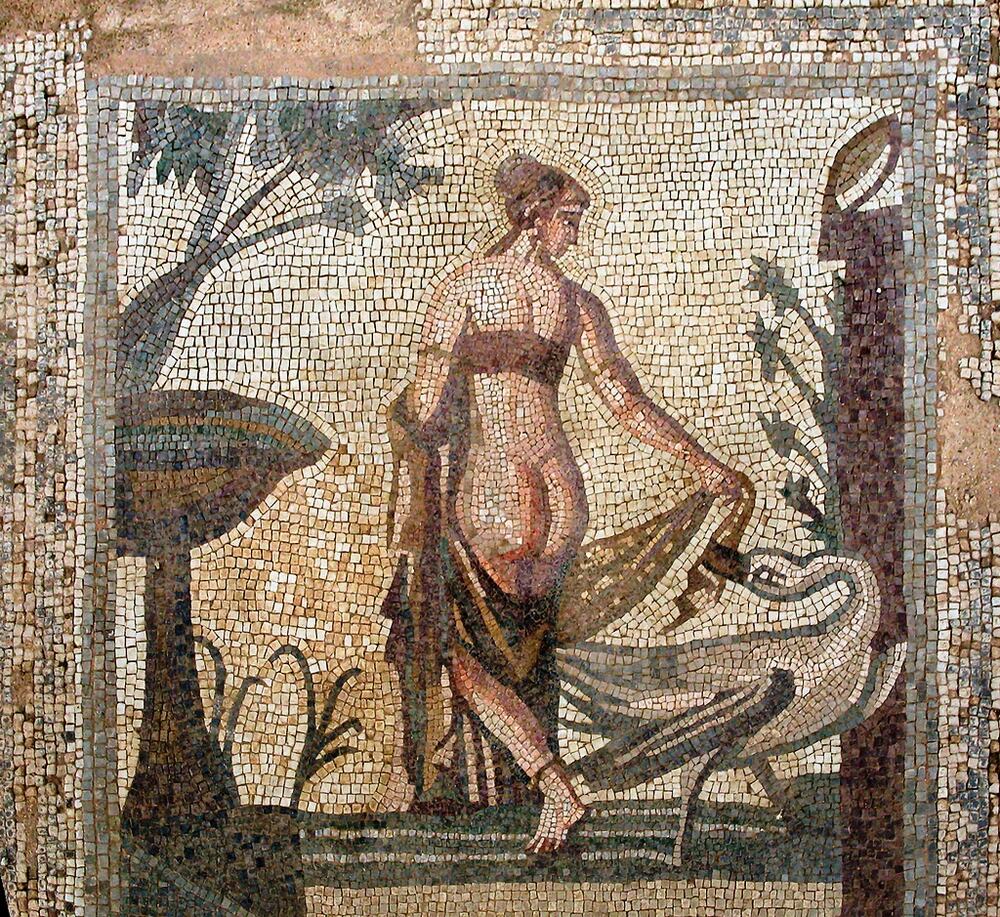
Lēda
First Appearance
Leda first appears in the parade of famous women Odysseus sees among the dead (Odyssey 11.298–304): "And I saw Leda, the wife of Tyndareus, who bore to Tyndareus two sons strong of heart, Castor the horse-tamer and Polydeuces good with his fists — and these two the life-giving earth holds, yet living, for even beneath the earth they have honour from Zeus: one day they live, the next they are dead, turn and turn about, and they have won honour equal to the gods." In this oldest notice both twins are called children of Tyndareus, and the strange gift of shared, alternating life is already theirs; the swan and the sorting of the children into mortal and immortal belong to later, fuller tellings.
— Homer, Odyssey 11.298–304
Who They Are
Leda (LEE-duh) is the queen of Sparta, wife of King Tyndareus, and the mortal mother at the centre of one of the most famous and most painted of all Greek myths — the night that Zeus came to her in the form of a swan. She is counted here among the heroes because she was a mortal woman, a queen of the house of Lacedaemon, who was neither goddess nor nymph; yet her story turns on a god's desire, and the children she bore reshaped the age of heroes. From her came Helen, whose face launched the Trojan War, and the Dioscuri, the twin horsemen Castor and Polydeuces who became stars.
Her myth is short and strange and endlessly retold: Zeus, desiring her, came to her disguised as a swan, and lay with her — and that same night, in the ordinary way, she also lay with her husband Tyndareus. From this double union she brought forth not children in the usual manner but one or more eggs, and from the egg (or eggs) hatched children of mixed fathering — some the offspring of the god, some of the mortal king. The sorting of who belonged to whom varies from teller to teller, but the commonest reckoning gives Helen and Polydeuces to Zeus, as the immortal children, and Castor and Clytemnestra to Tyndareus, as the mortal ones.
Leda herself does little in the stories; she is acted upon rather than acting, the vessel of a god's desire and the mother of a terrible and glorious brood. But her image — the queen and the swan — became one of the most enduring in all of Western art, and behind it lies an older and stranger tale, in which the egg was never really hers at all.
Mythology
The swan and the egg
The heart of Leda's myth is the coming of Zeus in the shape of a swan (Greek kyknos). Desiring the queen of Sparta, the god took the swan's form and lay with her; and in the fullest telling (Apollodorus, Bibliotheca 3.10.7) the same night she also lay, in the ordinary human way, with her husband Tyndareus, king of Sparta. From this doubled union Leda did not bear children in the usual manner. Instead she brought forth an egg — in some accounts two — and from it hatched her famous brood, children of two fathers mingled in a single birth. It is one of the most peculiar births in all of Greek myth: a mortal queen laying an egg like a bird, because the father who came to her had come on wings.
The sorting of the children: mortal and immortal
Because two fathers lay with Leda on one night — the god and the king — her children were understood to be of mixed nature, and the ancients tried in various ways to sort them. The commonest reckoning, given by Apollodorus (Bibliotheca 3.10.7), is this: Helen and Polydeuces (Latin Pollux) are the children of Zeus, and are therefore of the god's immortal line; Castor and Clytemnestra are the children of Tyndareus, and are therefore mortal. This is why, in the most famous of all the twin-stories, when Castor is killed Polydeuces may share his own immortality with his brother — for one twin was a god's son and deathless, the other a mortal man who had to die (see the page on the Dioscuri for that bargain of shared life among the stars).
But the sorting was never fixed. Homer, the oldest voice, makes both twins the sons of Tyndareus and says nothing of Zeus or the swan (Odyssey 11.298–304), and counts them already dead and buried, honoured by Zeus with their day-and-day-about existence. Hesiod's Catalogue of Women (fr. 24 Merkelbach–West) gives Leda daughters to Tyndareus — Timandra, Clytemnestra, and Phylonoe — and tells of the egg; and other writers shuffle the parentage further, sometimes making Helen the only child of Zeus, sometimes giving the god both of one sex. What stays constant through all the variants is the shape of the thing: a double fathering, a birth from the egg, and children divided between heaven and earth.
The older, stranger tale: the egg that was Nemesis's
Behind the familiar picture of Leda and the swan lies an older tradition in which the queen of Sparta was not the true mother at all. In the lost epic the Cypria (the poem of the Trojan cycle that told the war's origins), it was the goddess Nemesis — the divine power of retribution and due measure — whom Zeus pursued, and who fled him by changing from shape to shape across land and sea. At last, in the form of a goose (or a swan), she was caught by Zeus in the form of a swan, and from that union she laid an egg. The egg was then found — left in a marsh, or brought by a herdsman, or, in the version Apollodorus preserves, dropped into Leda's lap — and Leda took it in, kept it, and when Helen hatched from it, raised the child as her own. In this telling Leda is Helen's foster-mother, not her mother; the fatal beauty of Helen is the daughter of Nemesis, of retribution itself, and the Trojan War is in a deep sense the working-out of the goddess's name. The cross-reference is worth following: the page on Nemesis keeps this older claim, that the egg of the famous story was properly hers, and that the "Leda and the swan" the world remembers is a later softening, in which the queen took the goddess's place and the goose-chase of divine vengeance became a love-affair with a mortal woman.
The mother of Helen and the twins
Whichever way the parentage is sorted, Leda stands as the mother — or fostering mother — of a brood that changed the heroic age. From her came Helen, the most beautiful of women, whose carrying-off to Troy set the war in motion; Clytemnestra, who would murder her husband Agamemnon on his return from that war; and the Dioscuri, Castor and Polydeuces, the twin horsemen and boxers, protectors of sailors, who in the end were set among the stars as the constellation Gemini. Euripides, who dwells on the house of Sparta more than any other, returns again and again to Leda as the swan-touched queen: in the Helen he opens with Helen naming the strange story of her own birth from the egg (Euripides, Helen 16–22, 257–259), and in the Iphigenia at Aulis the Spartan line is traced back to Leda and the god who came to her. Through her children Leda is bound to the two greatest catastrophes of Greek myth — the fall of Troy and the ruin of the house of Atreus — so that the quiet Spartan queen is, without ever lifting a hand, the root of an age of war.
Leda and the Swan in art
Of all the episodes of Greek myth, few have been painted and carved so often as the union of Leda and the swan. From antiquity onward — on gems, in wall-paintings, in sculpture — the image of the queen and the great bird became a fixed subject, and in the Renaissance it drew the hands of Leonardo, Michelangelo, Correggio, and countless others, precisely because it let artists treat the nude and the divine together under cover of a myth. But it is worth keeping clear, as the oldest sources do, that the origin of the tale properly belongs to Nemesis, not to Leda: the "Leda and the Swan" the world knows is the later, gentler version of a story whose first heroine was the goddess of retribution, pursued across the world and caught at last in a marsh. The swan that art has made an emblem of desire was, in the beginning, the shape in which a god ran down the power that measures out what each is owed.
Worship — Ancient
A queen remembered, not a goddess worshipped
Leda was a figure of myth and of the royal past rather than an object of great public cult. She had no Panhellenic festival, no priesthood, no temple of her own in the manner of the Olympians; she was honoured chiefly at Sparta, the city she had been queen of, and chiefly through her connection to her far more worshipped children — the Dioscuri, who were among the greatest of Spartan gods, and Helen, who herself received cult at the Menelaion and elsewhere in Laconia. Where Leda was remembered, it was as the mother at the head of that line.
The egg shown at Sparta
The most concrete trace of her memory was a relic. When Pausanias travelled through Sparta in the second century AD, he was shown, in a sanctuary of the daughters of Leucippus, an egg hung from the roof and wrapped about with wool, which the Spartans said was the very egg that Leda brought forth (Pausanias, Description of Greece 3.16.1). It was not an object of sacrifice so much as a marvel kept and displayed — a thing tying the strange birth-story to a real place, so that the visitor could stand beneath the actual egg of the myth. That the Spartans preserved and showed it tells us how firmly the tale was rooted in the city, and how much the royal house valued its descent from the swan.
Her place in poetry and the stage
If Leda had a living cult, it was in song. The Spartan and wider Greek poets kept her name as the fountainhead of the Tyndarid line, and the Attic tragedians — Euripides above all — made her the swan-touched origin of Helen and Clytemnestra, returning to the image of the queen and the bird whenever the house of Sparta came on stage (Euripides, Helen; Iphigenia at Aulis). In this she was worshipped, if at all, as the ancestress whose single night with a god set the whole tragic machinery of the heroic age in motion.
Worship — Modern
The swan-queen and the question of consent
Leda comes down to the modern world almost entirely through the image of the swan — one of the most reproduced subjects in all of Western art, from antique gems to Leonardo and Michelangelo to the moderns. A thoughtful modern honouring of her, though, holds steadily to what the old story actually is: a god coming to a mortal woman in a stolen shape. Much later art made the scene an erotic idyll, but the myth at bottom turns on disguise and a woman acted upon, and a reader today will rightly feel the weight of that. Leda is well remembered not as an ornament of desire but as the mortal mother who bore a divine burden — the woman at the human end of a god's will, whose quiet is as much a part of the story as the swan's wings.
Mother of the stars and the war
Leda sits naturally as a patron of mothers and of the royal or ancestral line — the figure from whom a whole age of heroes descends. Through her children she touches the two great ends of Greek myth: the Dioscuri, set among the stars as the twins of the constellation Gemini, still watched for by sailors; and Helen, whose beauty opened the Trojan War. To remember Leda is to remember that the vast machinery of the heroic age — the war at Troy, the murders in the house of Atreus, the deathless twins in the sky — all trace back to one night in a Spartan bedchamber and one woman's strange double birth.
The older claim kept alive
A modern reader who wants the truest form of the tale should know what the oldest Greek tradition knew: that the egg was first Nemesis's, and that "Leda and the Swan" is the later, softened telling of a story whose first heroine was the goddess of retribution. Honouring Leda well means keeping that memory beside the famous image — that behind the gentle queen and her swan stands an older, harder story of a god running down the power that measures out what is owed, and of a child of vengeance fostered as a Spartan princess.
Epithets & Cult Titles
- basileia Spartēs (βασίλεια Σπάρτης) — Queen of Sparta — her station by marriage to Tyndareus, king of Lacedaemon; it is as a queen, not a goddess, that the oldest poetry names her
- Tyndaris (Τυνδαρίς) — Wife of Tyndareus — the patronymic-by-marriage that clings to her and, through her, to her daughters, so that Helen and Clytemnestra are called Tyndarides, 'the daughters of Tyndareus,' even when the truer father is said to be Zeus
- mētēr Helenēs (μήτηρ Ἑλένης) — Mother of Helen — the title that carries her through the whole tradition of the Trojan War, for she is remembered less for her own deeds than for the children she brought forth
Sources & Variants
- Homer, Odyssey 11.298–304 (Leda, wife of Tyndareus, mother of Castor and Polydeuces; both called sons of Tyndareus; their alternating day-and-day-about life)
- Hesiod, Catalogue of Women fr. 24 Merkelbach–West (Leda's daughters by Tyndareus — Timandra, Clytemnestra, Phylonoe — and the tradition of the egg)
- The Cypria (fragments, via Athenaeus and Philodemus) — the Nemesis variant: Zeus pursues Nemesis through her shape-changes; she lays the egg from which Helen is born, and Leda fosters the child
- Euripides, Helen 16–22, 257–259 (Helen names her own birth from the egg after Zeus came to Leda as a swan)
- Euripides, Iphigenia at Aulis 49–51, 794–800 (the Spartan line of Tyndareus and Leda; the swan)
- Apollodorus, Bibliotheca 3.10.5–7 (Tyndareus and Leda; Zeus as swan the same night as Tyndareus; the egg; Helen and Polydeuces from Zeus, Castor and Clytemnestra from Tyndareus; also the alternative that the egg fell to Leda from Nemesis)
- Pausanias, Description of Greece 3.16.1 (the egg of Leda shown hung with wool in a sanctuary at Sparta)
Gallery