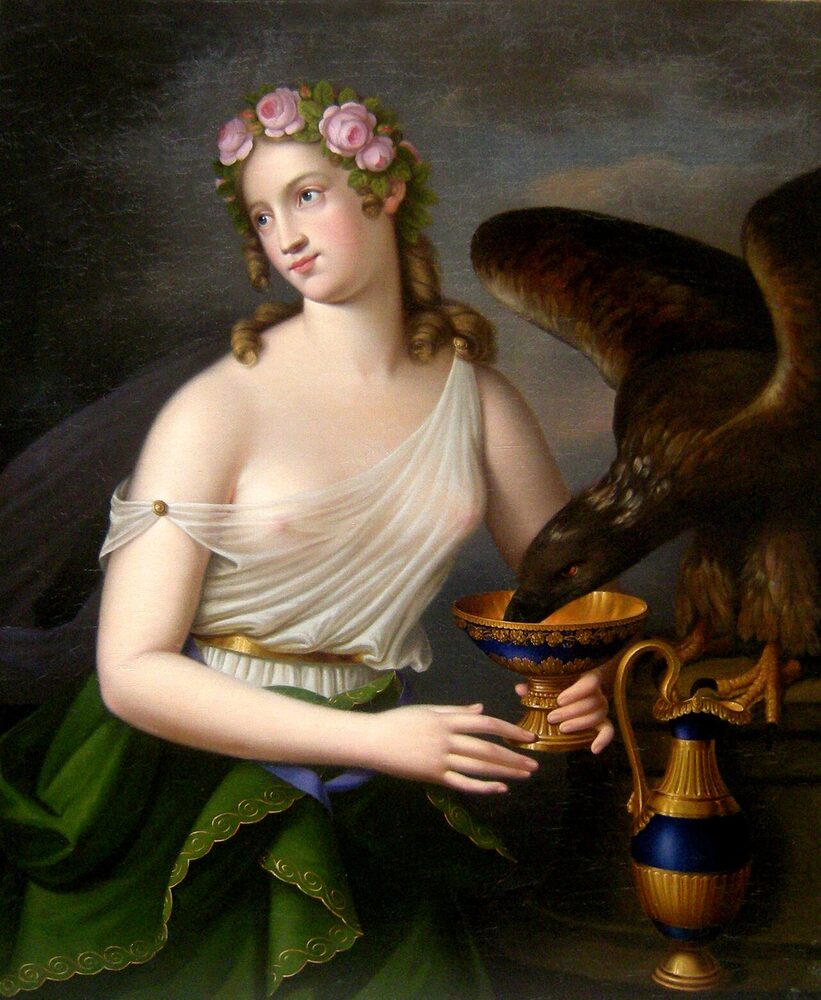
Hebe
First Appearance
Hebe first appears in early epic already at work in the two roles that define her. In Homer's Iliad she is the cupbearer of Olympus, pouring the nectar for the assembled gods (4.2–3); she fits the wheels to Hera's chariot (5.722–732), and when the war-god Ares comes home wounded from the field she bathes him and clothes him in fresh garments (5.905). Hesiod's Theogony names her as a true daughter of Zeus and Hera (922), and closes her story with her marriage: after Heracles finished his great labours and was taken up among the immortals, he wed "Hebe of the fair ankles," and lived free of pain and ageless for all his days (950–955).
— Homer, Iliad 4.2–3, 5.722–732, 5.905; Hesiod, Theogony 922, 950–955
Who They Are
Hebe (HEE-bee) is the goddess of youth — not youth as a season that passes, but youth as a divine and permanent thing, the bloom and vigour of a body at the very height of its strength. Her name is simply the Greek word for that bloom, hebe, the flower of a life just come into its prime; to the Greeks she was that quality made into a goddess. A true-born daughter of Zeus and Hera, she belongs to the inner household of Olympus, and in the oldest poems we meet her not enthroned in state but busy at the work of that household: pouring the drink of the gods, harnessing her mother's chariot, tending a wounded god when he comes home from the fighting.
Her most famous office is that of cupbearer (in Greek oinochoos, "the wine-pourer"). Before the beautiful Trojan boy Ganymede was carried up to Olympus to hold that place, it was Hebe who went round the feast of the immortals filling their cups with nectar, the drink that keeps the gods deathless. That she was later replaced in the role — the reasons the storytellers give are told below — never diminished her; it simply freed her for the destiny the earliest poets already knew was hers.
For Hebe's story has a happy ending as clean and complete as any in Greek myth. When Heracles, the greatest of heroes, finished his labours and his mortal suffering and was raised up to become a god, it was Hebe he married. Their wedding is the seal set on his whole life of toil — the sign that the pain is over and the reward is everlasting youth. In her the Greeks kept a gentle and hopeful idea: that youth restored, strength renewed, and old wrongs pardoned are gifts the gods can give, and that even the hardest life can end not in death but in the bloom that never fades.
Mythology
Daughter of Zeus and Hera
Hebe is one of the few Olympians who is the child of both Zeus and Hera together — a legitimate daughter of the divine marriage, sister to Ares the war-god and to Eileithyia, the goddess of childbirth. Hesiod's Theogony (922) lists her plainly among the children Hera bore to Zeus, and this clean, high birth matters to her character: she is not the fruit of one of Zeus's countless affairs but a true daughter of the royal house of heaven, at home in its inmost circle. One obscure and charming strand of tradition even makes her a child of Hera alone: Hera, it was said, conceived Hebe without any father after eating wild lettuce (thridax) at a feast of the gods. It is a minor and late-attested variant, but it fits her: a goddess of pure bloom, brought forth by her mother from a growing green thing.
The cupbearer of the gods
In the oldest picture we have of Olympus, the one duty that is Hebe's above all others is the pouring of the drink. At the feasts of the immortals it was Hebe who carried the jug of nectar — the sweet, deathless drink of the gods — around the company and filled their cups. Homer shows her at it in the Iliad (4.2–3): "the gods sat by Zeus and held assembly on the golden floor, and among them the lady Hebe poured the nectar." It is an office of trust and of grace, the work of the household's daughter waiting on her elders, and it made her the very image of youthful service — fresh, graceful, unwearying.
She does more in these early scenes than pour. When Hera makes ready to drive down from Olympus to the war at Troy, it is Hebe who fits the bronze wheels to the axle of her mother's chariot (Iliad 5.722–732), a small vivid glimpse of the daughter's hands at work. And when Ares, her own brother, comes back to heaven wounded and howling from the battlefield, it is Hebe who bathes him and dresses him in fair clothing (Iliad 5.905), so that he takes his seat again beside Zeus restored. In each case she is the one who tends, renews, and sets right — the youthful goddess whose touch makes a thing fresh again.
Replaced by Ganymede
Hebe did not keep the cup forever. The tradition tells that she was succeeded as cupbearer by Ganymede, the beautiful young prince of Troy whom Zeus, struck by his beauty, had an eagle carry up to Olympus (or whom Zeus himself, in eagle-form, seized) to live among the gods and pour their wine. Why Hebe gave up the office the sources handle in different ways. The simplest and oldest sense is just that Ganymede was brought up to be the gods' cupbearer, and so the role passed to him. Later storytellers, wanting a reason, supplied one: a much-repeated tale (found in scattered late sources) says that Hebe was set aside from the duty after she stumbled and fell while serving, tumbling in an unseemly way before the assembled gods and baring more than was decent — a slight and rather unkind anecdote, and clearly a late attempt to explain a change the early poets simply stated as fact. The truer point is that losing the cup cost Hebe nothing: it released her for her marriage, which the earliest poetry already names as her real destiny.
The marriage to Heracles
The crown of Hebe's story is her wedding. Heracles — the son of Zeus by the mortal woman Alcmene, the strongest and most enduring of all the heroes — spent his mortal life in labour and pain, hounded from birth by the anger of Hera, Hebe's own mother. He performed the Twelve Labours, wandered the world clearing it of monsters, and at the last died in agony on the pyre atop Mount Oeta, his mortal part burned away. But the immortal part of him, the son of Zeus, was taken up alive into heaven and made a god. And there, Hesiod tells us (Theogony 950–955), his reward was made complete: "in Olympus, home of snows, he married Hebe of the fair ankles, daughter of great Zeus and gold-sandalled Hera — happy hero, who finished his great work and lives among the immortals, untouched by pain and ageless all his days." Homer too knows the marriage (Odyssey 11.601–604), where the shade of Heracles in the underworld is only a phantom, for the hero himself "feasts among the immortal gods and has fair-ankled Hebe to wife."
The meaning of the match is written plainly in who the bride is. To give the deified hero the goddess of youth as his eternal wife is to say that his toil is over and his reward is endless bloom — no more ageing, no more suffering, only the vigour of the prime made permanent. And there is a deeper reconciliation in it. Heracles had been Hera's lifelong enemy, the object of her relentless hatred; his very name means "glory of Hera," a bitter irony in his mortal life. But by marrying her daughter he becomes Hera's son-in-law, welcomed at last into the family of the goddess who had persecuted him. The wedding heals the oldest quarrel in his story: the hero and the queen of heaven are made kin, and the enmity is dissolved in the marriage of youth.
Alexiares and Anicetus
From the union of Hebe and the deified Heracles the tradition gives two divine sons, minor gods of a martial cast: Alexiares ("he who wards off war," or "defender of a city") and Anicetus ("the unconquerable," "the invincible"). Apollodorus records their birth (Bibliotheca 2.7.7), and they were honoured with their father at the gates of Athens, fitting guardian-figures whose very names promise protection and unbroken strength — a soldier's blessings passed down from the strongest of heroes and the goddess of unfading vigour.
Goddess of restored youth
Beyond her marriage, Hebe kept a power that made her precious to mortals in a way few of the gods were: she could give youth back. Where other divinities might grant favour, victory, or wealth, Hebe's gift was the renewal of the body itself, the turning-back of age. The clearest myth of this is her restoring of youth to Iolaus, Heracles's old companion and charioteer. When the aged Iolaus prayed for one more day of his former strength to face Heracles's enemy Eurystheus in battle, it was Hebe — at the asking of Heracles, or of Iolaus himself — who granted it, making the old man young again for that single day so that he could win the fight. The story is told by Euripides in his Children of Heracles (Heracleidae 849–858) and mentioned by Pindar (Pythian 9.137). In it we see the whole warm promise of the goddess: that the bloom of youth is not gone forever, and that the gods can, for love or for justice, give it back.
Worship — Ancient
An Olympian of the household
Hebe was worshipped across the Greek world as a true Olympian, though rarely on the grand civic scale of the great gods. Her cult tended to be tender and particular rather than monumental — she belonged to weddings, to the coming-of-age of the young, to the household and the family, and she was often honoured alongside her husband Heracles, the two of them together standing for toil rewarded and youth restored. In Athens an altar of Hebe stood in the grove of the Cynosarges, the great sanctuary of Heracles just outside the city, where she was honoured together with him and with their protective sons Alexiares and Anicetus.
The sanctuary at Phlius
By far her most important cult was at Phlius, a small city in the northern Peloponnese, where Hebe had a sanctuary so revered that our traveller-guide Pausanias (2.13.3–4) singles it out. There she was worshipped under two older names: Ganymeda ("the feminine of Ganymede," the pourer of the cup) and Dia ("the bright one," "the divine"). Her temple stood within a sacred grove of cypress trees, and — a striking detail — the Phliasians kept no public statue of the goddess on show, holding her image or her rites too holy for open display. Nearby Sicyon shared in her honours, and the cult seems to have belonged to this whole corner of the Peloponnese.
A goddess of pardon and release
What made the Phliasian cult remarkable was its mercy. Hebe's sanctuary held the sacred right of asylum (asylia): a suppliant who fled there for refuge could not be taken, and — most memorably — prisoners who were freed would hang up their fetters, the broken chains and shackles, among the cypresses of her grove as thank-offerings for their release. Here the goddess of youth becomes a goddess of second chances, of pardon and fresh beginnings: as she could give the body its youth again, so at Phlius she gave the prisoner his freedom and his life again. Pausanias records that in his own time her yearly festival there bore the name Kissotomoi, "the ivy-cutters," which ties her rites to the ivy — an evergreen plant of unfading green, a fitting emblem for a goddess whose whole meaning is life that does not wither.
Manner of her honours
As an Olympian, Hebe received the ordinary sweet gifts of the sky-gods rather than the darker offerings of the dead: libations of wine, garlands (of ivy above all), bloodless first-fruits, and the vows of the young and of brides. Her association with weddings made her a natural presence at marriage-rites, where the bloom of youth she embodied was exactly what a bride and groom hoped to keep, and her pairing with Heracles made her a figure of the good end that crowns a life of effort.
Worship — Modern
A gentle goddess of renewal
In the modern revival of Hellenic worship (often called Hellenismos), Hebe is honoured as a quietly beloved figure — not among the loudest of the Olympians, but treasured by those drawn to what she stands for: youth, freshness, healing, second chances, and the reward that waits at the end of hard toil. A devotee might turn to Hebe at the thresholds of life — a coming-of-age, a wedding, a recovery from illness, a fresh start after a long trouble — as the goddess who makes things new and gives the bloom back. Her marriage to Heracles makes her, too, a patron of endurance rewarded, honoured by those who have carried a heavy burden and long for its end.
Offerings and remembrance
Following the ancient shape of her cult, offerings to Hebe are the sweet, life-giving gifts of an Olympian: a libation of wine poured out in her honour (fitting for the goddess who poured the cup of the gods), sprigs or garlands of ivy with its evergreen leaves, spring flowers and first-fruits, and fresh clean water. Because her Phliasian sanctuary was a place of pardon and release, acts of mercy and forgiveness — letting go of an old grievance, freeing oneself or another from some long-held burden — sit especially well as living tributes to her. A candle lit for a new beginning, or a few words of thanks at the mending of something long broken, honour her in her own key.
What she keeps alive
More than through elaborate rite, Hebe endures as an idea worth keeping: that youth is not only a thing that slips away but a thing that can, by grace, be given back; that the deepest quarrels can be healed by love and kinship, as hers healed the ancient enmity of Heracles and Hera; and that a life of labour can end not in loss but in unfading bloom. Her Roman name, Juventas, survives faintly in our own word "juvenile" and its kin, and her image — the graceful young goddess with her jug and cup — still stands for the freshness of the world's morning. In her the ancients kept their most hopeful promise: that the prime of life, once thought to fade forever, is in the gift of the gods to restore.
Epithets & Cult Titles
- Ganymeda (Γανυμήδα) — The feminine counterpart of Ganymede, the boy cupbearer — the name under which Hebe was worshipped at Phlius, marking her as the divine pourer of the gods' cup
- Dia (Δία) — The Bright / Divine one — the older cult-name of the goddess honoured in the sacred grove at Phlius, whom the Phliasians identified with Hebe
- Cupbearer of the gods (οἰνοχόος θεῶν, oinochoos theon) — A descriptive title for her original office on Olympus: the goddess who poured out the nectar for the immortals at their feasts before that duty passed to Ganymede
- Bride of Heracles — A descriptive title marking her place in his story — the youth-goddess given as wife to the deified hero, the sign of his everlasting reward among the gods
Sources & Variants
- Homer, Iliad 4.2–3 (Hebe pours the nectar for the gods on the golden floor of Olympus); 5.722–732 (she fits the wheels to Hera's chariot); 5.905 (she bathes and clothes the wounded Ares)
- Homer, Odyssey 11.601–604 (the phantom of Heracles in the underworld, while the hero himself feasts among the gods with fair-ankled Hebe as his wife)
- Hesiod, Theogony 922 (Hebe named as daughter of Zeus and Hera); 950–955 (the marriage of the deified Heracles to Hebe on snowy Olympus)
- Pindar, Pythian 9.137 and Nemean 10.17–18 (Hebe as the fairest of goddesses, wife of Heracles beside her mother Hera; the youth she restored to Iolaus)
- Euripides, Heracleidae (Children of Heracles) 849–858 (Hebe restores the aged Iolaus to youth for a single day of battle)
- Apollodorus, Bibliotheca 2.7.7 (the deified Heracles marries Hebe and fathers Alexiares and Anicetus)
- Pausanias, Description of Greece 2.13.3–4 (the sanctuary of Hebe at Phlius: her cult-names Ganymeda and Dia, the cypress grove, the right of asylum, the freed prisoners' fetters hung in the grove, and the festival called Kissotomoi)
- Ovid, Metamorphoses 9.394–401 (Hebe's rejuvenation of Iolaus at Heracles' request) — Roman retelling
Gallery