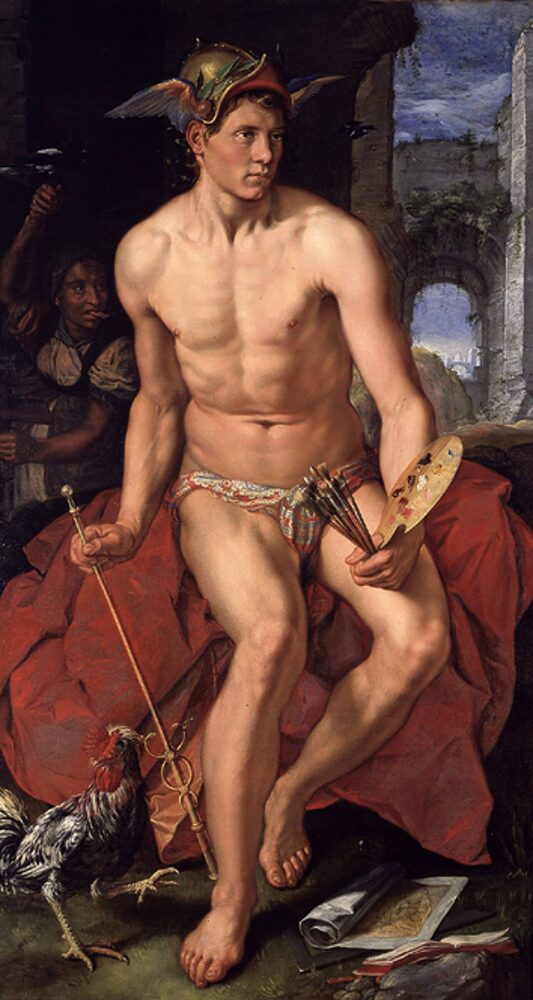
Hermes
First Appearance
Hermes first appears as the newborn son of Zeus and the shy mountain-nymph Maia, daughter of Atlas, born in a deep shadowy cave on Mount Cyllene in Arcadia. Hesiod names him plainly as the child Maia bore to Zeus, "the herald of the deathless gods"; but it is the long Homeric Hymn that gives him his character in full — born at dawn, "of many shifts, blandly cunning, a robber, a cattle-driver," who by that same nightfall had invented the lyre and stolen a god's herd.
— Homeric Hymn 4 to Hermes 1–19 (birth and first day); cf. Hesiod, Theogony 938–939
Who They Are
Hermes is the swift and quick-witted god of the Greek pantheon — herald and messenger of the gods, guide of travellers and of the dead, patron of trade and thieves alike, and the great crosser of boundaries. Where Zeus is enthroned and Apollon radiant, Hermes is always in motion: sandalled with gold, wand in hand, darting between Olympus and earth and the shadowed halls of Hades. He is the god you meet on the road, at the door, in the marketplace and at the moment of death — wherever one world gives way to another.
His name is bound up with the herm (herma), the heap of stones and later the carved pillar that marked boundaries and roadsides, and this is the key to him: he is the god of thresholds and passages. A lucky find on the road was a hermaion, "a gift of Hermes"; a sudden silence in company was said to fall because "Hermes has come in." He presides over exchange in all its forms — the honest bargain of the trader and the sly theft of the robber, the messenger's true word and the trickster's false one, the persuasion of the orator and the wheedling of the cheat.
In myth his character is set on the very first day of his life: born at dawn, he invents the lyre from a tortoise-shell before noon, and by evening has stolen the cattle of his elder brother Apollon and talked his way out of the crime before Zeus himself. He is the most disarming of the Olympians — a thief who charms his victims into friendship, a boundary-god who honours no boundary, and, for all his mischief, the gentlest of the gods to mortals: the one who leads Priam safely through the enemy camp and the souls of the dead gently down to rest.
Mythology
Born at dawn: the first lyre and the theft of Apollon's cattle
The whole nature of Hermes is compressed into the story of his first day, told at length in the fourth Homeric Hymn. Maia bore him at dawn in a cave on Mount Cyllene, and he was no ordinary infant: by midday he had climbed from his cradle, found a tortoise at the cave's mouth, killed it, and stretched strings across its hollow shell to make the first lyre, singing as he played. By evening the appetite for greater mischief was on him. He slipped out to Pieria and stole fifty cattle from the herd of far-shooting Apollon, and — the cleverest of tricks — drove them backwards so that their hoofprints seemed to lead the other way, muddling the trail. On the road he is also credited with striking the first fire from kindling. When Apollon, for all his prophetic art, at last tracked the theft to the cave, he found only a baby feigning sleep in his swaddling-clothes, wide-eyed with innocence. The two brothers were hauled before Zeus on Olympus, where the newborn's brazen denials made even the king of the gods laugh aloud. In the end Hermes charmed his way to reconciliation: he took up the lyre and played, and Apollon — god of music — was so enchanted that he let the cattle go and gave Hermes the golden herald's staff (the kerykeion, the caduceus) in exchange for the instrument. So on a single day Hermes invented the lyre, stole a god's herd, and won both his brother's friendship and his own emblem of office.
The slaying of Argus
Hermes' oldest title, Argeiphontes, "Slayer of Argus," comes from his service to Zeus in the affair of Io. When Zeus's love for the girl Io was discovered, he turned her into a white heifer to hide her; but the jealous Hera claimed the cow and set over it Argus Panoptes, "the all-seeing," a giant with a hundred eyes of which only ever some slept while the rest kept watch. At Zeus's command Hermes came to free her. In Apollodorus's telling he killed the watchman with a well-flung stone; in the fuller tradition he first lulled all hundred eyes to sleep with the drone of his pipes and a spell of drowsy words, then struck. From that deed he carried his name ever after, the god who could close even sleepless eyes.
Guide of souls
Hermes' most solemn office is that of psychopompos, the guide of souls. With the same golden wand "wherewith he lulls the eyes of men, or wakes them as he wills," he leads the dead down the long road to Hades. The Odyssey shows him at this work in its final book, summoning the ghosts of the slain suitors: they follow him gibbering like bats that squeak and flutter in the depths of a cave, down past the streams of Ocean to the meadow of asphodel where the dead dwell. Alone among the Olympians he passes freely between the living world and the dead one, and in this gentle guiding role the mischievous trickster becomes a figure of great tenderness.
Helper and herald: Priam, Odysseus, and Pandora
As Zeus's messenger Hermes moves through the great epics. In the Iliad's final book he is sent to bring the aged king Priam by night through the Greek camp to the tent of Achilles, to ransom the body of his son Hector — taking the form of a young Myrmidon, he lulls the sentries, guides the old man safely in, and rouses him again before dawn to slip away: one of the most humane scenes in all Homer. In the Odyssey he is sent skimming over the waves to the nymph Calypso to command Odysseus's release, and elsewhere gives the hero the herb moly against the witchcraft of Circe. But his gifts are double-edged: in Hesiod's account of Pandora, the first woman, it is Hermes who at Zeus's bidding puts into her "lies and wheedling words and the treacherous ways of a thief," gives her a voice, and then leads her down to earth as a beautiful ruin for mankind.
His children and the herms
Among the children ascribed to Hermes are two who share his boundary-crossing nature. Pan, the goat-legged god of the wild, the shepherd's pastures and sudden "panic" fear, is called his son in the Homeric Hymn to Pan. Hermaphroditus, whose body was fused with that of the nymph Salmacis into a single being both male and female, was reckoned his child by Aphrodite in later tradition. Hermes' presence in daily Greek life, though, was felt above all through the herms: square stone pillars topped with the god's bearded head and bearing an erect phallus, set up at house-doors, city gates and crossroads as guardians of the threshold and bringers of luck and fertility. To pass a herm was to greet Hermes himself; the notorious mutilation of the herms of Athens in 415 BCE, on the eve of the Sicilian expedition, was felt across the city as a terrible omen.
Worship — Ancient
The god of the threshold
Hermes was worshipped less in great temples than in the small daily crossings of Greek life. His herms stood everywhere a boundary was passed — at the door of the house, the edge of the field, the gate of the city, and above all at the crossroads and along the highways, where travellers heaped stones at their base and left them a greeting. As Agoraios he presided over the agora, the marketplace, watching over trade, weights, bargains and the fair (and unfair) exchange of goods; the merchant prayed to him for profit and the traveller for a safe road. A windfall or lucky find belonged to him — the hermaion, "gift of Hermes." He received a peculiar share of the sacrifice, too: at the close of a feast the tongues of the victims were cut out and burnt for Hermes, the god of the last word and the messenger who carries speech.
The gymnasium and the games
As Enagonios Hermes was, with Heracles, the patron of the gymnasium and the palaestra, and so the special god of the young. His festivals, the Hermaia, were athletic contests celebrated by boys and ephebes with foot-races and wrestling — lively, unruly affairs; ancient sources report that they were rowdy enough for the lawgiver Solon to try to keep grown men out. At Cydonia in Crete the Hermaia took a Saturnalian turn, with masters serving their own slaves for the day.
Kriophoros and the underworld
In his aspect as Kriophoros, the ram-bearer, Hermes was honoured as a saviour: Pausanias records that at Tanagra he had once carried a ram about the city walls to avert a plague, and his image there showed him with the ram upon his shoulders. In his darker aspect as Chthonios and Psychopompos he belonged to the rites of the dead: he was invoked at the graveside and in libations to the departed, the escort who leads the soul on its final journey. Arcadia, and Mount Cyllene above all, claimed him as their own, remembering him as the child born in its cave.
Worship — Modern
Honouring Hermes today
A modern Hellenic devotee can honour Hermes simply and in keeping with his ancient character as the god of thresholds and the road. A small shrine near the door of the home is especially fitting — a place for an image of the caduceus, the winged sandals, or a small herm or standing stone, with a lamp or candle. Because Hermes is the god of coming and going, many keep him at the entrance and greet him on leaving and returning. Cleanliness of hands and a few sincere words matter more than any elaborate rite. Travellers may ask his protection before a journey; those setting out on a new venture, trade, negotiation or study may ask for his quickness of wit and persuasive speech.
Offerings
Where the ancients burnt the tongues of their sacrifices for him, a modern household most naturally offers a libation and a share of food. Pour a libation of wine — or of milk, honey-water or spring water — into a bowl set aside for the god or onto the earth. Honey and honey-cakes, incense (frankincense is traditional), and a little olive oil are all fitting; a small coin left at his shrine suits the god of luck and trade. Present the offering with a few words of thanks and afterward pour it out or set it aside, so that it is truly given.
Prayer & epithets
Call on Hermes by the name that fits the moment. Ask Hermes Diaktoros, the Guide, for a safe road and a swift errand. Invoke Hermes Agoraios over trade, a bargain or a fair dealing, and Hermes Logios, god of eloquence, before speaking, writing or persuading. Thank Hermes for the hermaion, the lucky find and the unlooked-for windfall. And in grief, or when accompanying the dying and the dead, turn to the gentle Hermes Psychopompos, the guide of souls, who leads each shade with kindness down the road that all must travel.
Epithets & Cult Titles
- Argeiphontes (Ἀργειφόντης) — Slayer of Argus — his oldest Homeric title, won for killing the hundred-eyed guard set over Io
- Diaktoros (Διάκτορος) — The Guide, the Conductor — Homer's standing epithet for Hermes the swift messenger who conducts and leads
- Psychopompos (Ψυχοπομπός) — Guide of souls — he who leads the shades of the dead down the road to Hades
- Dolios (Δόλιος) — The Wily, of tricks — patron of cunning, sleight of hand, thieves and the crafty word
- Logios (Λόγιος) — Of eloquence — god of speech, oratory and the persuasive tongue
- Enagonios (Ἐναγώνιος) — Of the contests — patron of the games, the gymnasium and the palaestra
- Agoraios (Ἀγοραῖος) — Of the marketplace — overseer of the agora, of trade, weights and fair dealing
- Kriophoros (Κριοφόρος) — Ram-bearer — the saviour who carried a ram about the walls of Tanagra to turn aside a plague
- Chthonios (Χθόνιος) — Of the underworld — his solemn aspect, invoked at the grave and in the rites of the dead
Sources & Variants
- Homeric Hymn 4 to Hermes (birth on Cyllene, invention of the lyre, theft of Apollon's cattle, exchange for the kerykeion)
- Hesiod, Theogony 938–939 (Maia bears Hermes to Zeus, herald of the gods)
- Hesiod, Works and Days 67–80 (Hermes gives Pandora lies, wheedling words and a thief's nature, and leads her to earth)
- Homer, Iliad 24.334–469 (Hermes escorts Priam through the Greek camp to Achilles)
- Homer, Odyssey 24.1–14 (Hermes leads the souls of the suitors to Hades); 5.43–54 (sent with golden sandals and wand to Calypso); 10.275–308 (the herb moly against Circe)
- Apollodorus, Bibliotheca 2.1.3 (Hermes slays Argus, whence Argeiphontes); 3.10.2 (birth of Hermes to Zeus and Maia)
- Homeric Hymn 19 to Pan (Pan as the son of Hermes)
- Pausanias, Description of Greece 9.22.1 (Hermes Kriophoros and the ram at Tanagra); on the square Athenian form of the herm
- Thucydides 6.27 (the mutilation of the herms at Athens, 415 BCE)
Gallery