Pan
First Appearance
Pan enters Greek song in the nineteenth Homeric Hymn, which calls him the goat-footed, two-horned, noise-loving son of Hermes — the god who haunts the wooded glens and snowy crests of Arcadia, ranging the hills with the nymphs at his heels and playing his reed-pipe at dusk. The hymn tells of his birth: Hermes served as a herdsman among mortals, loved the daughter of Dryops, and she bore him a child so strange to look on — goat-legged, horned, bearded, and laughing — that the frightened nurse fled, but Hermes wrapped the baby in a hare-skin and carried him up to Olympos, where all the gods (and Dionysos most of all) took delight in him and named him Pan.
— Homeric Hymn 19 (to Pan), 1–47
Who They Are
Pan (PAN) is the goat-legged, goat-horned god of the wild — the shepherd's god, the mountain god, the piping voice of the lonely places. He is the son of Hermes, born (the oldest hymn says) in the high pastures of Arcadia, and he keeps to that rough, upland country all his life: the god not of the tilled field or the ordered city but of the uncleared hillside, the pinewood, the goat-track, and the flocks that graze where the roads give out. From the waist up he is a bearded, laughing man with a goat's horns pushing through his hair; from the waist down he is a goat, cloven-hoofed and shaggy, and he moves through his mountains with the sureness of the animal he half is.
His name sounds in Greek exactly like the word pan, "all," and the ancients could not resist the pun — they told stories that he pleased "all" the gods, or that he was the spirit of "all" nature. It is a lovely idea and a false etymology: the name is far older than the word-play, and really belongs with the herdsman's world, a title of the god who guards the grazing flock. But the pun stuck, and it is part of why a small Arcadian goat-god came, in later ages, to be imagined as something vast — the whole living world piped into being.
Two things Pan gave the world that outlasted his worship, and both are in this page. He gave it the panpipe, the syrinx — the ranked reeds bound side by side that shepherds have played ever since — and the sorrowful story of how he came to make it. And he gave it the word panic: the sudden, groundless, overmastering terror that falls on a person alone in a wild place, or on a whole army in the night, with no cause anyone can point to. The Greeks knew that feeling and gave it his name, because they believed it was the god himself, unseen, that they were afraid of.
Mythology
The son of Hermes, born in Arcadia
The oldest and fullest account of Pan's birth is the nineteenth Homeric Hymn, and it makes him the son of Hermes. The story goes that Hermes, in the manner of the gods, came down to serve for a season as a herdsman among mortals in Arcadia, and there he loved a nymph — the daughter of a man named Dryops, the hymn says (other poets make the mother the nymph Penelope of Arcadia, not to be confused with the wife of Odysseus, and this variant is noted only in later tellings). She bore Hermes a son, and when the baby came into the world goat-footed and two-horned, bearded already and laughing aloud, his nurse took one look at him and fled in fright. But Hermes was delighted with his strange child. He wrapped the infant warmly in the skin of a mountain hare and carried him up to Olympos, and set him before the gods — and they were charmed, every one of them, and Dionysos most of all. Because he gave joy to them all, the story says, they called him Pan. (This is the pun on pan, "all"; his name is really older and means the herdsman's god, but the tale is old and much-loved.) So from the first Pan belongs to two worlds at once — Olympian by his father, but never truly of Olympos; his home is the Arcadian mountainside, and there he stays.
The god of the mountain and the flock
Pan is the god of the uncultivated wild and of the men and beasts that live in it. He ranges the high country of Arcadia — its bare peaks, its pinewoods, its cold springs and echoing caves — hunting, dancing with the mountain nymphs, watching over the goats and sheep and the herdsmen who follow them. He makes the flocks fertile and the hunt successful, and the shepherds pay him for it: a share of the milk, the firstborn of the herd, a portion of their own rough meal left at the mouth of his cave. When the hunting failed, the young Arcadians would even take his image down and scourge it with squills to shame the god into doing better — a rough intimacy no one would dare with an Olympian. He loves music above all, and the still hours: at noon, when the heat lies heavy and every creature rests, Pan sleeps, and it is dangerous to disturb him — the shepherds fell silent at midday for fear of waking the god. And at dusk he plays, and the sound of his pipe comes down off the mountain, and the herdsmen know he is near.
Syrinx, and the making of the pipe
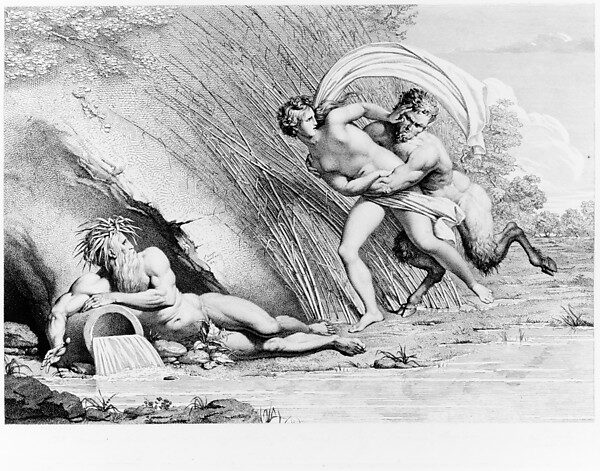
(Content note: this story turns on unwanted pursuit — a god chasing a woman who is trying to escape him.) The instrument Pan is never without, the ranked reed-pipe, has a sorrowful origin, and Ovid tells it best. Among the wood-nymphs of Arcadia was one named Syrinx, a follower of the virgin huntress Artemis, who wanted no lover and kept herself free. Pan saw her coming down from a mountain one day and desired her, and he came after her with soft words; but she would not stay to hear them, and she ran, and he chased her through the wild country toward the river Ladon. At the water's edge she could go no further, the river barring her way, and she cried out to her sisters, the water-nymphs, to change her form and save her. So when Pan reached out at last and closed his arms on her, he found he was holding not the nymph but a handful of marsh reeds — she had been turned to reeds at the river's brink, and slipped away into them. And as he stood there, sighing his disappointment into the reeds he held, the wind of his own breath passing over the cut stems made a thin, sweet, mournful sound. Pan was struck by it. He would not lose her wholly: he cut reeds of different lengths, bound them side by side with wax, and made of them the pipe he plays ever after — and he named it the syrinx, after the nymph, so that in playing it he keeps her voice with him always. Every panpipe since is her memory.
Pan and Echo, Pan and Pitys
Syrinx is not the only nymph in Pan's story, and the others end no more happily. There is Echo, the nymph who could only repeat the words of others and could speak none of her own — Pan loved her, and she would not have him, and in the cruellest version he sent his madness on the shepherds so that they tore her apart, and the scattered pieces of her, hidden in the earth, still answer any voice that calls, repeating the ends of words for ever. And there is Pitys, another nymph he pursued, who to escape him was changed into a pine tree — which is why Pan wears a wreath of pine, and why the pine is his: he crowns himself with the tree she became. These are dark little tales, and they say something true about how the Greeks imagined him — a god of the wild who is himself half-wild, closer to appetite and instinct than the ordered gods of the city, beautiful and dangerous both.
The origin of "panic"
From Pan the Greeks took a word we still use: panic — from panikon (deima), "the Pan-fear," the terror that belongs to the god. They knew a particular kind of dread: the sudden, causeless fright that seizes a person alone in the hills, or in a wood at night, or in the dead stillness of noon, when there is nothing there to fear and yet the whole body floods with terror and the urge to run. And they knew it could take not just one person but a whole crowd at once — above all an army camped in the dark, where a single unexplained noise, a snapped branch or a startled animal, could send thousands of armed men stampeding in blind terror against no enemy at all. This groundless mass-panic the Greeks credited squarely to Pan: it was the god himself, unseen in the dark, that they were afraid of, his shout out of the wild places that emptied a man's courage in an instant. It fits him exactly — the god of the lonely mountain, whose own presence at noon or midnight is a thing to fear, made the patron of fear itself. Pan-fear, panikon, panic.
Marathon, and the friendship of Athens
The most famous instance turned the tide of a battle and won Pan a home in the greatest city of Greece. When the Persians landed at Marathon in 490 BC and Athens sent for help, the long-distance runner Philippides (or Pheidippides) raced across the mountains toward Sparta — and somewhere in the wild Arcadian-bordered highlands, Herodotus says (6.105), Pan met him. The god called the runner by name and gave him a message for the Athenians: why did they neglect him, who was their friend, and had done them good service before, and would again? Philippides carried the word home, and after the astonishing Athenian victory — a victory some credited to a Pan-fear that broke the Persian line — the grateful city took the hint. They gave Pan a cave-shrine on the north-west slope of the Acropolis, the first foothold of this rustic outsider-god in the heart of urban Athens, and honoured him thereafter with yearly sacrifices and a torch-race. So the little goat-god of the Arcadian sheep-walks became, by way of a battlefield terror, a saviour of Athens.
"The Great God Pan is dead"
One late and haunting story must be told carefully, because it is later than almost everything else on this page and stands apart from the classical myth. The writer Plutarch, in his essay On the Obsolescence of Oracles (De defectu oraculorum, written around AD 100 — many centuries after the hymns and the classical cult, and told by him as a strange report, not a myth), records a tale that had been going round in the reign of the emperor Tiberius. A ship was becalmed off the western coast of Greece one evening, near the Echinades islands, its passengers awake in the dusk, when a great voice came across the water calling the name of the Egyptian pilot aboard, one Thamus. Twice he did not answer; the third time he did, and the voice commanded him: when you come opposite Palodes, announce that the Great God Pan is dead — "Πὰν ὁ μέγας τέθνηκε," Pan ho megas tethnēke. When the ship drifted level with that place, Thamus called the message out over the still water — and there came back from the shore a great sound of wailing and lamentation, as of many voices mourning at once. The story spread and troubled people, and they brought it to the emperor. Plutarch offers it as a curiosity, a puzzle about whether the lesser divine powers can die; later ages made far more of it — Christian writers read the cry as marking the passing of the old gods and the coming of a new faith, and poets have returned to it ever since for its eerie beauty. But it should be held at arm's length from the classical Pan: it is a single late anecdote, wonderful and strange, and not part of the god the Arcadian shepherds knew.
Worship — Ancient
Arcadia, his true home
Pan is, before he is anything else, the god of Arcadia — the wild, mountainous, herdsman's country in the middle of the Peloponnese, poor in cities and rich in flocks, where his worship is older than the written record and where he was reckoned the chief god of the land. The Arcadians did not treat him as a distant Olympian but as a near and working god, the guardian of the grazing and the hunt, honoured at caves and mountain-tops rather than in grand temples. His great seats were Mount Lykaion and Mount Mainalon, on whose slopes, the poets said, you could hear his pipe; there were shrines and a sacred precinct, and races run in his honour. The intimacy of the cult is striking — this is the god whose statue the young men would scourge with squills when the hunting went badly, as one might chivvy a lazy herdsman, a familiarity that tells you how close to daily life he stood.
The manner of his honours
Pan's offerings match his world: not the great burnt sacrifices of the city altars but the simple, pastoral gifts of the mountain — libations of milk and honey, the first-fruits and firstlings of the flock, a share of the shepherds' own bread and cheese, grapes and wild herbs left at the mouths of his caves. His holy places were the caves and springs and high pastures themselves. And a rule of his cult was silence at noon: because the god slept in the heat of the day and woke dangerous, the herdsmen kept quiet at midday and would not so much as play a pipe, for fear of rousing him. He was worshipped alongside the nymphs, his companions of the wild, and the two go together constantly in dedications — "to Pan and the Nymphs" is among the commonest of all rustic offerings.
Out of Arcadia: Marathon and the wider world
Pan's worship spread out of his mountain homeland comparatively late, and the great turning-point was Marathon. When the Athenians credited him with a hand in that victory (and with the "Pan-fear" that helped break the Persians), they installed him in a cave on the Acropolis slope and gave him an annual sacrifice and a torch-race — and from Athens his cult travelled more widely, so that cave-sanctuaries of Pan and the Nymphs are found across the Greek world in the following centuries. Herodotus (6.105) is our source for the Marathon story and the founding of the Athenian cult. In the Hellenistic age the pastoral poets — Theocritus above all — made Pan and his Arcadia into a whole literary landscape, the imagined countryside of shepherds and pipes and easeful shade that later Roman and European poetry would inherit as "Arcadia," the very name of the pastoral ideal.
Worship — Modern
A god of the wild, honoured again
Pan has had a strange and vivid afterlife, and among modern pagans and Hellenic polytheists he is one of the most beloved of the old gods — precisely because of what he is. In an age anxious about its distance from the natural world, a god of the wild, the mountain, the animal, and the untilled land speaks with unusual force. Devotees drawn to Pan honour him as the divine presence in wild nature, the patron of animals and of the places human order has not tamed, and as a god of music, of the body, of instinct and joy. His caves and mountains have their modern echo in the woods, hills, and open country where those who keep his cult prefer to meet him.
Offerings and remembrance
The old pastoral gifts still fit him best. A libation of milk or honey (or of wine) poured out onto the earth in a wild place, a little of one's food shared with him at a hilltop or beside a spring, a few notes played on a pipe, a wreath of pine — these follow the ancient shape of his worship and need no temple. Because Pan is the god of the flocks and the wild creatures, care for animals and for wild land sits well as a living tribute to him; and because he is the god of music and unforced joy, so does the simple keeping of his festivals in the open air.
Pan in the modern imagination
Beyond formal worship, Pan may be the most culturally alive of all the minor gods. He gave the English language the word panic, used every day by people who have never heard of him. He gave it the panpipe, the syrinx, still played and still bearing the nymph's name. His pipe-playing goat-god shape lies behind the horned wild-man of a thousand later images, and (by an unlucky accident of iconography) behind the horns-and-hooves picture of the Christian Devil — a slander on a joyous god. The Romantic poets took him up as the spirit of Nature herself; the Edwardians made him the piping figure at the heart of children's books; and Plutarch's eerie cry, "the Great God Pan is dead," has echoed through poetry and essay for two thousand years as the image of an older, wilder holiness passing out of the world. Few gods so minor have left so long a shadow.
Epithets & Cult Titles
- Aigipan (Αἰγίπαν) — Goat-Pan — the god in his most animal form, goat from the waist down and goat-horned above; a separate figure sometimes, but really Pan under his oldest name, the goat that walks upright
- Lykaios (Λυκαῖος) — Of Mount Lykaion — Pan of the great wolf-mountain in Arcadia, one of the oldest seats of his worship, where his mountain sanctuary stood
- Nomios (Νόμιος) — Of the pastures — Pan as the guardian of grazing land and the flocks that feed on it, the herdsman's protector who keeps the sheep and goats fruitful and safe
- Aigokeros (Αἰγόκερως) — Goat-horned — the byname carried into the sky as the constellation and zodiac sign Capricorn, the sea-goat, tied in one story to Pan's leap into the Nile in flight from the monster Typhon
Sources & Variants
- Homeric Hymn 19 (to Pan), 1–47 (Pan the goat-footed, two-horned, noise-loving son of Hermes, born in Arcadia; his birth and reception on Olympos)
- Herodotus, Histories 6.105 (Philippides meets Pan on the way to Sparta; Pan's help at Marathon and the founding of his Athenian cave-cult)
- Ovid, Metamorphoses 1.689–712 (the story of Syrinx: her flight from Pan, her transformation into reeds, and the making of the panpipe) — Roman retelling
- Theocritus, Idylls 1.15–18, 123–130, and 7 (Pan of Arcadia in pastoral poetry; the noonday silence, the scourging of his image with squills, the world of shepherds and pipes)
- Apollodorus, Bibliotheca 1.6.3 (Aegipan's part in the war against Typhon — recovering Zeus's sinews — and the origin of the goat-fish form of Capricorn)
- Plutarch, De defectu oraculorum (Moralia 419b–e) (the tale of the pilot Thamus and the cry 'the Great God Pan is dead') — a late report, c. AD 100, told by Plutarch as a curiosity and not part of the classical myth
- Pausanias, Description of Greece 8.36–8.38 and 8.53–8.54 (the sanctuaries and mountain-cult of Pan in Arcadia, on Lykaion and Mainalon)
- Longus, Daphnis and Chloe 2.23–2.29 (Pan, the Nymphs, and a later panic; the pastoral world of his worship) and 3.23 (the tale of Pan and Echo — the shepherds driven mad to tear her apart) — Roman-era romance
Gallery