Semele
First Appearance
Semele appears already in the oldest Greek theogonic poetry as the mortal mother of Dionysus by Zeus. Hesiod names her in the Theogony (940–942): "Semele, daughter of Cadmus, bore him a splendid son, Dionysus the giver of joy, when she had lain with Zeus — a mortal woman who bore an immortal; and now the two of them alike are gods." The first of the Homeric Hymns, addressed to Dionysus, opens on the dispute over his birthplace and names Semele as the mother who bore him, fixing from the start the two strands that every later telling keeps: that she was mortal and died, and that through her son she did not stay dead.
— Hesiod, Theogony 940–942; Homeric Hymn 1 to Dionysus
Who They Are
Semele (SEM-uh-lee) is the Theban princess who became the mortal mother of a god — the woman who loved Zeus, who asked to see him as the gods see him, and who was burned to ash by the sight. She is the daughter of Cadmus, the hero who founded Thebes, and of Harmonia, the daughter of Ares and Aphrodite; and out of all the mortal women whom Zeus loved, she is the one whose story runs furthest, because it does not end with her death. Her child, snatched unborn from the fire, was Dionysus, the god of the vine and of divine madness; and in the fullest form of her myth Semele herself is drawn up out of the land of the dead by that same son, made deathless, and given a place and a new name among the immortals. Hers is the rare Greek story in which a mortal love for a god destroys the lover and then, against all the ordinary rules, gives her back.
What the Greeks fixed on in Semele is the terrible double edge of being loved by a god. Zeus came to her as a man, and she, deceived into a fatal curiosity, asked to see him as he truly is — and no mortal body can hold the sight of a god in full divine form and live. The jealousy of Hera stands behind her ruin, turning the goddess's own gift of an unbreakable promise into the instrument of her death; and so Semele dies not of any wrong she has done but of the very love that singled her out, consumed by the lightning of the god she loved. The thunderbolt that kills her is the same power that fathered her child, and the Greeks never lost sight of that bitter symmetry: the fire that destroys the mother is the fire out of which the god is born.
(Content note: Semele's story turns on a god's love for a mortal woman, on deception, and on a violent death by fire.) And yet she is, almost uniquely, a mortal lover of Zeus who is not simply left behind. Because the child she carried was himself a god, her story could not close in the grave. This page follows her through both halves of it — the Theban princess and her death in the lightning, and the twice-born son and the mother brought up from the dead — and keeps its eye on Semele herself: the woman at the centre of the fire, and the goddess, Thyone, she became.
Mythology
Hera's trick and the lightning
(Content note: this turns on a god's love for a mortal, on deception, and on a death by fire.) Semele was a princess of Thebes, one of the daughters of Cadmus, the city's founder-king, and of Harmonia. Zeus loved her, and came to her secretly as a lover, and she conceived a child by him. But nothing of Zeus's stayed hidden from his wife, and when Hera learned that a mortal woman of Thebes was carrying the king of the gods' child, her jealousy turned, as it so often did, upon the woman. Hera's revenge was not force but cunning: she worked not to kill Semele outright but to make Semele destroy herself, and to turn the girl's own trust against her.
In the Greek tradition (Apollodorus, Bibliotheca 3.4.3) the account is spare: Semele, "deceived by Hera," was moved to make a fatal request of her lover. So when Zeus next came and, in the fullness of his love, promised to grant her whatever she might ask, Semele held him to it: she asked him to come to her exactly as he came to Hera when he wooed her, in his full divine form, as the gods behold one another. Apollodorus does not spell out how Hera worked the deceit — only that she worked it; the vivid machinery of the trick belongs to the later Roman telling below. Zeus, bound by a promise he could not take back, begged her to ask for anything else; but she would not be moved, and he could not refuse. He came to her then as the god he is — in his chariot amid the thunder and the lightning — and the mortal body that could not bear the sight of a god unveiled was consumed on the instant, burned to ash by the blaze of his own thunderbolt. So Semele died of the very love that had chosen her, killed by the thing she had asked to see.
The richest and most familiar form of the scene is the later Roman one, in Ovid (Metamorphoses 3.253–315), and it should be flagged as such: there Hera takes on the shape of Beroe, Semele's aged nurse, and sits beside her in a trusted voice sowing the specific doubt that her unseen lover might not be Zeus at all but some ordinary man deceiving her — goading Semele to put him to the test; and there Zeus is bound specifically by an oath sworn on the Styx, the one oath no god may break. These vivid touches — the disguised nurse, the Stygian oath — belong to the elaborated Roman telling; but the heart of the story, Hera's deceit and the fatal request to see the god in full, is already firmly Greek.
The twice-born son
Semele was in the sixth month of her pregnancy when she died, and the child within her was the as-yet-unborn Dionysus. As the lightning consumed the mother, Zeus snatched the unborn infant from the fire, and — so that the child Semele had died carrying should not die with her — he sewed the infant into his own thigh to carry it the rest of its term. When the months were complete, Zeus loosed the stitches and brought the child forth a second time, now fully formed, from his own body. From this Dionysus takes one of his oldest titles: he is dithyrambos and, in the plainest Greek phrase, twice-born — once of his mortal mother before her death, and once of his divine father after it. The Homeric Hymns and Euripides' Bacchae (1–9, 286–297) make this the keynote of the god's identity; the lightning that killed Semele is, in the same stroke, the fire out of which her son was saved, and he carries the mark of both his births.
The mother brought up from the dead
Here Semele's story breaks the ordinary rule for the mortal loves of the gods, who are simply left behind in death. Because her son was himself a god, he would not leave her among the dead. When Dionysus had grown and come into his divinity, in the fullest tradition he went down into the underworld to find his mother and bring her back — the Greeks pointed to more than one place as the spot where he made the descent, chief among them the bottomless Alcyonian lake at Lerna, through which Pausanias (2.37.5) says he went down after her, and the shore at Troezen (2.31.2) which made the same claim. He drew Semele up out of death, and rather than return her to a mortal life that would only end again, he raised her to Olympus and made her immortal among the gods.
Semele made goddess — Thyone
Restored and deified, Semele took a new name to mark her new nature: she became Thyone (Θυώνη), and under that name she dwelt among the immortals as the mother of a god rather than the dead princess of Thebes (Apollodorus 3.5.3; Diodorus Siculus 4.25). Pindar fixes the glory of it in the early Greek tradition: Semele, he says, "though she died in the roar of the thunderbolt, lives now among the Olympians" (Olympian 2.25–27). The woman consumed by Zeus's fire is given back by Zeus's son — the only one of the god's mortal loves to be lifted, body and name and all, out of death and into heaven. It is why Semele stands apart: her story holds, at once, the harshest warning about loving a god and the single great exception to its usual price.
Worship — Ancient
A heroine remembered within her son's cult
Semele was not a goddess of the ordinary Olympian kind, and she received no great independent cult of her own; where she was honoured, it was first of all as the mother of Dionysus, remembered within his worship rather than apart from it. This is honest to the shape of the evidence: she had little in the way of separate temples or priesthoods, and her name is kept chiefly where her son's is kept. But her double destiny — mortal death and divine apotheosis as Thyone — gave her a standing higher than most heroines, hovering between the honoured dead and the immortals, and some rites of Dionysus drew her in directly: the ecstatic women of his worship, the thyiads (whose very name echoes her divine name Thyone and the thyein, the "raging," they shared), carried the memory of the god's mother into the mountain-rites.
Thebes and the sealed ground
Her cult, such as it was, centred on Thebes, her birthplace and the scene of her death. The Thebans kept her tomb among the monuments of the city, and more strikingly they kept the very chamber struck by the lightning as sacred and forbidden ground: Pausanias, travelling Greece in the second century AD, reports (9.12.3) that the Thebans pointed out the bridal-chamber of Semele, which no one was permitted to enter, fenced off and holy because the fire of Zeus had fallen there. Euripides opens the Bacchae on exactly this spot — Dionysus stands before his mother's tomb, the smouldering ruin still smoking with the "living flame of Zeus," and claims the city that had doubted her. So Thebes held both halves of her in its landscape: the grave of the woman who died, and the burning ground that marked how she died.
Festivals of mother and son
Beyond Thebes, Semele was carried wherever Dionysus was carried. Certain Dionysiac observances honoured her by name as part of the god's rites, and local traditions at Lerna and Troezen, which claimed to be the place of his descent after her, kept the memory of the mother brought up from the dead. Hers was a cult of association and remembrance rather than of grand sacrifice — a mortal woman kept holy because the god she bore never let her be forgotten.
Worship — Modern
A heroine, honoured in remembrance
Semele is a heroine and a deified mortal rather than one of the great gods, and modern Hellenic practice honours such a figure in a distinct key: not as a power petitioned for the ordering of the world, but as a remembered figure whose story is kept and whose name is spoken with her son's. A devotee drawn to Semele honours her much as the ancients did — within the worship of Dionysus, as the mother who gave him his mortal half and who was herself lifted out of death — keeping her memory as the thing her own story turns upon: that love of a god cost her everything, and then gave it back.
Offerings and remembrance
Following the ancient shape of heroine-honours, offerings to Semele are fittingly poured at ground level rather than raised to the sky: a libation of wine — her son's own gift — poured out onto the earth is the simplest and most apt, uniting the mother with the vine that came of her child. A candle or lamp lit in her memory, a few words recalling her story, or the reading of Pindar's lines on the woman who died in the thunder and now lives among the Olympians, keep her present. Because her tale holds both a terrible loss and a deliverance out of it, she sits well with anyone keeping faith through grief, or holding to the hope that what was lost may yet be restored.
Legacy in art and word
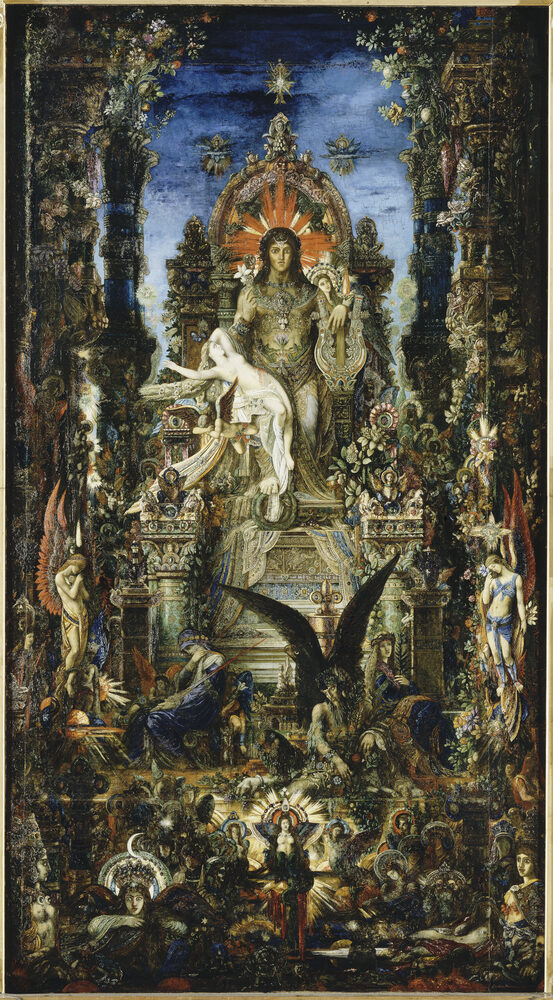
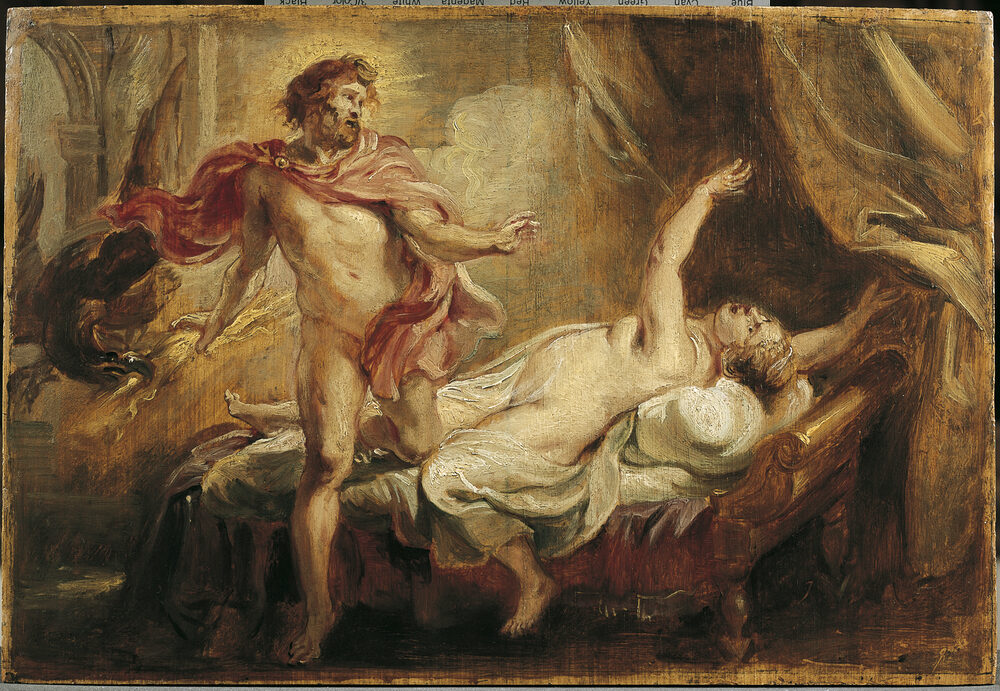
More than through any formal cult, Semele lives on through art and music. Her death in the lightning — the mortal woman and the blaze of the god — drew the great painters, among them Gustave Moreau and Rubens, whose canvases of the scene survive; and her story became an opera, Handel's Semele (1744), which fixed her tale for the English stage and gave it one of its most famous arias. Her name endures in the sky as well, in the asteroid 86 Semele. Above all she lives wherever the twice-born god is told of: the mother at the heart of the fire remains one of the indispensable figures of the Dionysian myth, the mortal beginning of an immortal god.
Epithets & Cult Titles
- Thyone (Θυώνη) — Her divine name — the name Semele bore once her son had drawn her up out of death and set her among the immortals. Where 'Semele' is the mortal Theban princess who died, 'Thyone' is the goddess she became; the word is linked to thyein, the ecstatic 'raging' or rushing of divine frenzy, and so names her as mother and sharer of her son's rapture
- Mother of Dionysus (μήτηρ Διονύσου) — Her defining title — the mortal woman who bore the god of the vine to Zeus, the one role in which every ancient source names her, and the reason a daughter of Thebes is remembered at all beside the immortals
- Kadmēis — the daughter of Cadmus — A descriptive title marking her royal Theban birth: daughter of Cadmus, founder-king of Thebes, and of Harmonia, and so a princess of the house whose fortunes the Greeks told as a long chain of glory and grief
- Keraunia — 'she of the thunderbolt' — A descriptive epithet (not a fixed cult-title) for the one mortal woman who asked to see Zeus as the gods see him and was consumed by his lightning; the poets return again and again to the thunderbolt as the sign of both her death and the strange glory of it
Sources & Variants
- Hesiod, Theogony 940–942 (Semele, daughter of Cadmus, bears Dionysus to Zeus — 'a mortal who bore an immortal; and now the two alike are gods')
- Homeric Hymn 1 to Dionysus (the birth and the dispute over his birthplace, naming Semele as mother); Homeric Hymn 7 to Dionysus
- Pindar, Olympian 2.25–27 (Semele, slain by the thunderbolt, now lives among the Olympians); and the Dithyrambs on the twice-born god
- Euripides, Bacchae 1–9, 88–98, 286–297 (Dionysus at his mother's still-smoking tomb; the thigh-birth and the 'twice-born' god; Hera's jealousy and the lightning)
- Apollodorus, Bibliotheca 3.4.3 (Hera's deceit, the fatal request to see Zeus in full form, the thunderbolt, and the sewing of the infant into Zeus's thigh); 3.5.3 (Dionysus brings Semele up from Hades and she is named Thyone)
- Diodorus Siculus, Bibliotheca Historica 4.2; 4.25 (the birth, and Dionysus' descent to raise his mother, deified as Thyone)
- Pausanias, Description of Greece 9.12.3 (the forbidden lightning-struck bridal-chamber of Semele at Thebes); 2.37.5 (the descent at the Alcyonian lake of Lerna); 2.31.2 (Troezen's claim to the descent)
- Ovid, Metamorphoses 3.253–315 (Hera disguised as the nurse Beroe, the oath sworn on the Styx, and the death in the lightning) — later Roman retelling, to be flagged as such and distinguished from the earlier Greek tradition
Gallery