Kadmos
First Appearance
Cadmus is already a fixed point of the heroic past in the earliest Greek poetry. Homer calls the Thebans "Cadmeans" after him and knows his daughter Ino, "she of the fair ankles," who was once a mortal woman and became the sea-goddess Leukothea (Odyssey 5.333–335). Hesiod names Harmonia as Cadmus's wife and lists their children — Ino, Semele, Agave, Autonoe, and the son Polydorus — sealing the house of Cadmus at Thebes as one of the great and doomed mortal lineages of myth (Theogony 975–978).
— Homer, Iliad 4.385 and Odyssey 5.333; Hesiod, Theogony 937 and 975–978
Who They Are
Cadmus (KAD-mus; Greek Kadmos) is the great culture-hero and city-founder of Greek myth — the Phoenician prince who came west in search of a stolen sister, gave up the search at the god's command, and founded Thebes, the seven-gated city of central Greece. He is remembered less as a warrior than as a bringer of order and civilization: it was Cadmus, the Greeks said, who carried the alphabet from Phoenicia to Greece, so that the very letters they wrote were called "Cadmean." Around him gathers one of the oldest and most tightly woven of all the heroic sagas, the house of Cadmus at Thebes, whose glory and long curse would run down through his daughters and grandsons to Dionysus, to Actaeon, to Pentheus, and beyond.
His story begins in loss and obedience. When Zeus, in the form of a bull, carried off his sister Europa across the sea, their father Agenor sent Cadmus and his brothers to find her and forbade them to return without her. The search was hopeless, and Cadmus turned at last to the oracle at Delphi, which released him from it with a strange instruction: to follow a certain cow, and to build a city wherever she lay down to rest. Obeying, he founded Thebes on the spot — but the founding was bought with blood, for the site was guarded by a monstrous dragon sacred to Ares, and from the sowing of that dragon's teeth sprang the first Thebans.
Cadmus's life is framed by the serpent at both ends. He wins his city by killing the dragon of Ares and pays for the killing with years of servitude to the war-god; he is given the goddess Harmonia in a wedding attended by all the gods, one of only two unions of mortal and divine ever celebrated openly on earth (the other the marriage of Peleus and Thetis, generations later); and at the very close of his long life, exiled and grieving among the Illyrians, he and Harmonia are themselves changed into serpents and carried gently to the Islands of the Blessed. Founder, culture-bringer, and finally serpent, Cadmus stands at the head of Theban myth as the man who brought both letters and a lasting doom into the Greek world.
Mythology
The search for Europa and the following of the cow
The saga opens far to the east, in the Phoenician city of Tyre (or Sidon), where Cadmus was a son of King Agenor and brother to the beautiful Europa. When Zeus took the form of a gentle white bull and carried Europa away over the sea to Crete, Agenor, stricken, sent his sons out to search for her, laying on them a hard command: they were not to come home again unless they brought their sister back. So Cadmus wandered the world in a search that could not succeed, for no mortal could wrest back what Zeus had taken. Worn out and unwilling to return empty-handed to face his father, he came at last to Delphi and put his trouble before the oracle of Apollo. The god told him to abandon the search for Europa altogether. Instead he was to follow a certain cow — one bearing a moon-shaped mark on each flank, that he would meet as he left the sanctuary — and to found a city on the spot where she, wearied, lay down in the grass. Cadmus obeyed. He fell in with the cow in the land of Phocis and drove her on through Boeotia until, at last, she sank down to rest. There he resolved to build his city, the citadel that would be called the Cadmea and the town that would grow into Thebes.
The dragon of Ares and the sowing of the teeth
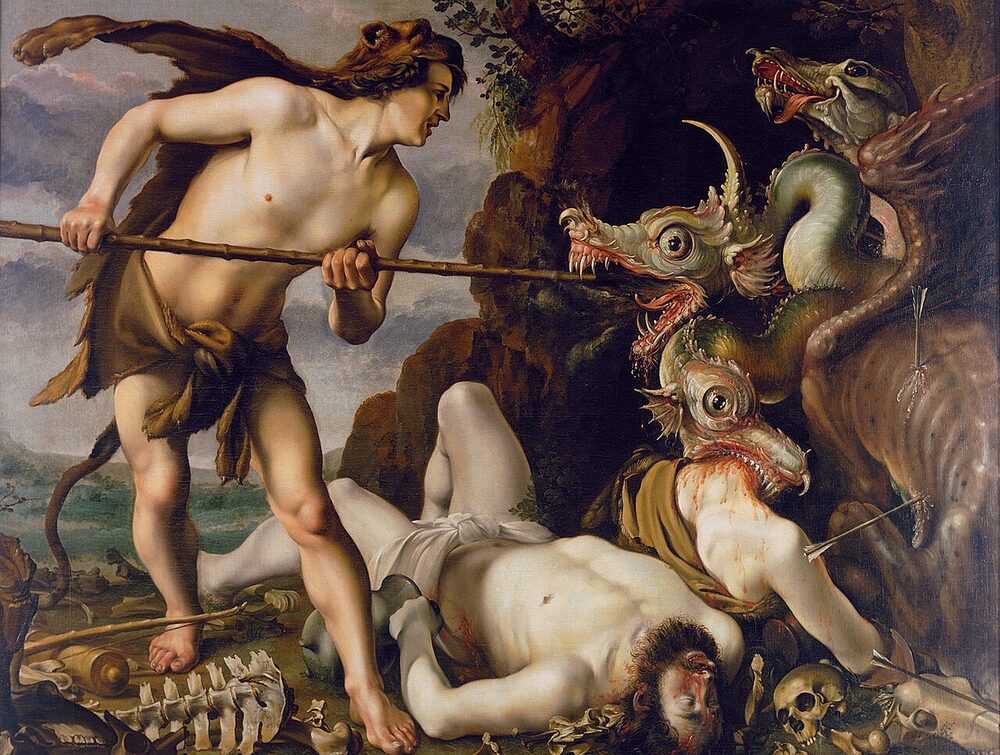
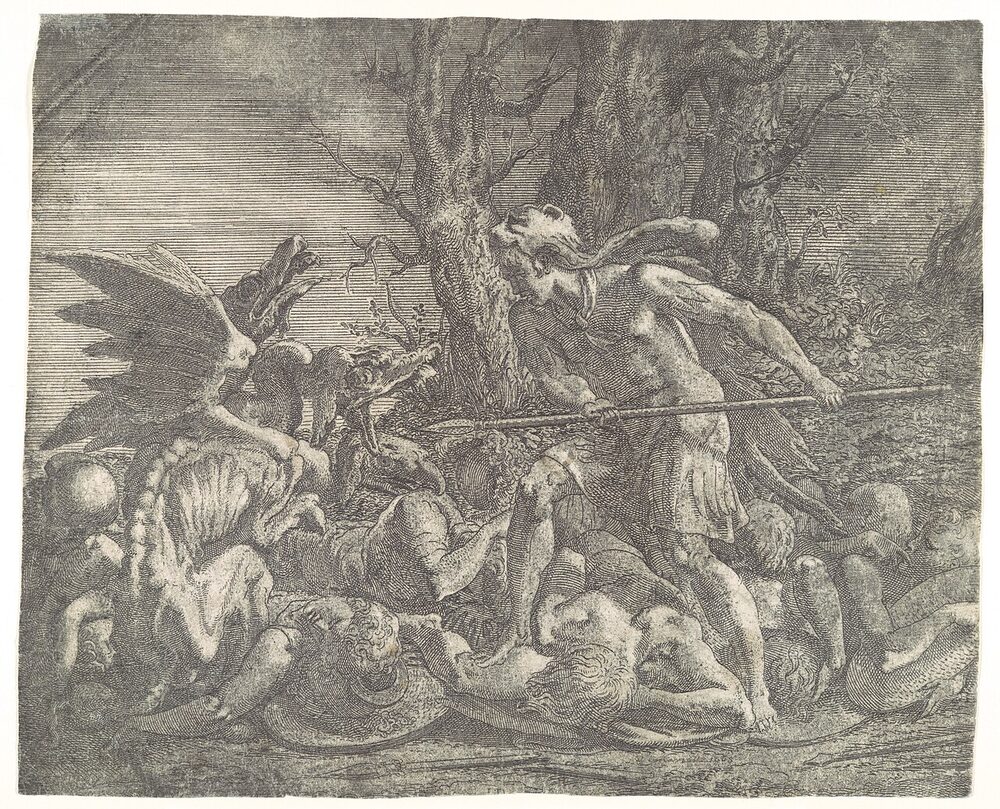
Wishing to sacrifice the cow to Athena, who had guided him, Cadmus sent his companions to fetch pure water from a nearby spring — the spring of Ares. But the spring was guarded by a great dragon (a serpent-monster) sacred to the war-god, some said his very offspring, and it fell upon the men and killed them. When they did not return, Cadmus went himself, found the beast coiled over his slain companions, and after a hard fight killed it — crushing its head, in the fullest tellings, with a great stone, or driving his spear through it as it reared against a rock. (Content note: the fight is bloody, and Cadmus's whole company is destroyed before he prevails.) As he stood over the dead dragon, the goddess Athena appeared to him and gave him strange counsel: he was to draw the dragon's teeth and sow half of them in the earth like seed. Cadmus ploughed the ground and cast the teeth into the furrows — and at once armed men rose up out of the soil, a whole crop of warriors sprung fully grown from the dragon's teeth. These were the Spartoi, the "Sown Men." Cadmus, alone against a host, flung a stone into their midst; not knowing where the blow had come from, the Sown Men turned on one another and fought until only five were left standing. These five — Echion, Udaeus, Chthonius, Hyperenor, and Pelorus — made peace and became the ancestors of the noble houses of Thebes, so that the Theban aristocracy traced its blood not to gods or settlers but to the teeth of a dragon sown in the earth. (Athena and Ares kept the other half of the teeth, which passed in a later saga to Colchis and the labours of Jason.)
The servitude to Ares and the wedding of Harmonia
The dragon had been sacred to Ares, and its killing was a blood-guilt that even a founder-hero had to purge. For this Cadmus was bound to serve the war-god in penance — an "eternal year," reckoned as eight ordinary years of servitude, the traditional term of expiation in the old law. When the long service was done and the debt paid, the gods gave Cadmus a reward beyond any other mortal's: the hand of Harmonia, daughter of Ares and Aphrodite herself, so that the founder of Thebes was joined to the child of War and Love. Their wedding was the divine wedding of myth — the one marriage of a mortal at which all the Olympian gods came down openly to the mortal world, seating themselves at the feast and bringing gifts, the Muses singing, as they would again only for the marriage of Peleus and Thetis. But among the wedding-gifts was one that carried a shadow into the house of Cadmus forever: the necklace of Harmonia, a marvel of gold wrought (the tradition held) by Hephaestus, so beautiful that no woman could refuse it — and cursed, so that it brought ruin, betrayal, and death upon every woman who wore it down the generations. Through the necklace the doom of Thebes was seeded at the very moment of its greatest joy; it would pass to Semele, and on through the tragic saga of the Seven against Thebes, drawing its wearers each toward destruction.
The house of Cadmus and its griefs
Cadmus and Harmonia had four daughters and a son, and the story of Thebes is very largely the story of what befell them. Semele, loved by Zeus, was persuaded by a jealous Hera to ask her divine lover to appear in his true form, and was consumed by his lightning — but the child in her womb was saved, and that child was the god Dionysus, Cadmus's own grandson. Autonoe was the mother of Actaeon, the young hunter who chanced upon Artemis bathing and was turned into a stag and torn apart by his own hounds. Agave became, in the most terrible of the family's stories, the mother of Pentheus, the king who scorned the new god Dionysus and was torn to pieces on the mountain by the maddened women of Thebes — his own mother among them, carrying home her son's head in the belief that it was a lion's. Ino nursed the infant Dionysus and, driven mad, leapt into the sea, where she became the kindly sea-goddess Leukothea who saves drowning sailors (it is she who rescues Odysseus in the Odyssey). And the son Polydorus carried the royal line onward toward Laius and Oedipus. Cadmus, watching grief after grief fall upon his children and grandchildren, is one of the great figures of tragic old age in Greek myth: the founder who gave Greece its letters and its city, and lived to see the curse woven into his marriage devour his house.
The serpent transformation and Elysium
In his old age, worn down by the sorrows of his family, Cadmus at last gave up the throne of Thebes and went into exile with the faithful Harmonia, wandering north and west into the land of the Illyrians, where he ruled for a time among a people called the Encheleans, "the eel-men." There the saga returns to the serpent with which it began. Remembering the dragon of Ares that he had killed to found his city, and half-believing the gods still held its death against him, Cadmus is said to have prayed that if a serpent's life weighed so heavily he might become a serpent himself — and his prayer was answered. In the fullest and most moving telling, Ovid's (Metamorphoses Book 4 — flagged here as the later, Roman elaboration of an older tradition, though the transformation itself is far older than Ovid), Cadmus feels the change come over him, scales spreading across his skin, and calls to Harmonia to touch him once more while he is still partly a man; she, unwilling to be parted from him, prays to share his fate, and the two are changed together into a pair of gentle serpents that glide away side by side, remembering their human life and harming no one. The gods, in pity, did not leave them to die as beasts: Cadmus and Harmonia were carried away to the Islands of the Blessed (Elysium), granted a peaceful immortality together after all the griefs of their mortal reign.
The bringer of letters
Beyond the myths of dragon and serpent, the Greeks credited Cadmus with a gift that touched their whole civilization: the alphabet. Coming from Phoenicia, the tradition held, Cadmus brought with him the Phoenician letters and taught them to the Greeks, who adapted them into their own writing; the historian Herodotus, examining the question, calls the old Greek characters "Cadmean letters" (Kadmeia grammata) and reports that he had seen archaic inscriptions in the temple of Apollo at Thebes written in what he took to be this early script (Histories 5.58–59). Whatever the historical truth of the alphabet's coming to Greece — and Herodotus's instinct that Greek writing descended from a Semitic source has been broadly confirmed by modern scholarship — the myth made Cadmus not only the founder of a city but the founder of Greek letters, the culture-hero who gave the Greeks the very means of recording their gods and their past.
Worship — Ancient
The Cadmea and the cult sites of Thebes
At Thebes, Cadmus was remembered above all as the city's founder-hero, and his memory was fixed in its very stones. The acropolis of Thebes was called the Cadmea after him, and the Thebans styled themselves "Cadmeans" — a name so old that Homer already uses it. The traveller Pausanias, walking the ruins of Thebes in the second century CE, was shown the physical relics of the saga: the foundations of the house of Cadmus on the citadel; the ruined bridal-chamber of Harmonia and the spot where, the Thebans said, the Muses had sung at the wedding; the place where the dragon's teeth were sown; and the sanctuaries of the deities entangled in the family's story (Description of Greece, Book 9). Founder-heroes in Greece were commonly honoured with offerings at a tomb or hero-shrine as the protecting spirits of the cities they had made, and Cadmus held this place at Thebes as the origin of the whole line — the man from whom the citadel, the nobility (through the Spartoi), and the royal house all descended.
The tomb among the Encheleans in Illyria
The cult of Cadmus reached beyond Thebes to the far northwest, into Illyria, where the saga placed his exile and death. Among the Encheleans — the Illyrian people he was said to have led to victory and ruled in his last years — a tradition located the tomb (or shrine) of Cadmus and Harmonia, and pointed to the stones set up in their memory. Greek and Roman writers knew of these Illyrian monuments, and the region kept alive the story of the founder-king who ended his days and his transformation there, far from the city he had built. The double geography of his cult — honoured at the Theban Cadmea as founder, and remembered at the Illyrian tombs as the exiled serpent-king — mirrors the shape of his whole myth, which begins with a journey from the East and ends with a journey into the West.
Worship — Modern
Honouring Cadmus today
Cadmus is not a god but a hero — a founder and culture-bringer — and modern devotees of the Greek tradition honour him accordingly, in the way the ancients honoured their founding heroes: with respect and remembrance rather than the worship owed to the Olympians. He is a fitting figure to call on at any beginning — the founding of a home, a project, an institution, or a body of learning — as the patron of well-made beginnings raised out of hardship and obedience to good counsel. As the mythic bringer of the alphabet he is a natural hero for writers, scholars, students, teachers, and anyone whose work is bound up with letters and the written word.
Offerings and remembrance
Where the Olympians received burnt sacrifice, a founder-hero like Cadmus is most naturally honoured with libations and offerings of remembrance — a pouring-out of wine, water, or honey, and a portion of food, first-fruits, or cakes set aside in his name, together with a few words recalling what he founded and what he gave. Because his story is bound to the serpent and the city, some who honour him keep on his shrine a token of the founder's work — a stone, a written word, a first letter carefully made — and remember, in honouring him, the whole doomed and glorious house of Thebes that sprang from him.
In memory and reflection
Cadmus rewards reflection as much as ritual. His myth holds together the great human themes the Greeks returned to again and again: the obedience that turns a hopeless search into a founding; the blood-guilt that must be paid even for a necessary killing; the marriage that is both the summit of joy and the seed of ruin; and the long endurance of old age under griefs one cannot prevent. To keep Cadmus in mind is to remember that the founders of things pay for them, that letters and cities are hard-won gifts, and that even a story shadowed by a curse can close, at the last, in peace and transformation.
Epithets & Cult Titles
- Founder of Thebes (descriptive) — The culture-hero who traced the first furrow of the seven-gated city and raised its citadel, the Cadmea
- The Spartos-Sower (descriptive) — Descriptive — he who slew the dragon of Ares and sowed its teeth, from which sprang the Spartoi, the 'sown men' and ancestors of Theban nobility
- Bringer of Letters (descriptive) — Descriptive — credited in Greek tradition with carrying the Phoenician alphabet, the 'Cadmean letters', from the East to Greece
- The Serpent-Ancestor (descriptive) — Descriptive — the founder who in old age was himself transformed into a serpent, closing his story with the beast he had killed
Sources & Variants
- Homer, Iliad 4.385–398 (the Cadmeans of Thebes); Odyssey 5.333–335 (Ino / Leukothea, daughter of Cadmus)
- Hesiod, Theogony 937 and 975–978 (Harmonia the wife of Cadmus, and their children Ino, Semele, Agave, Autonoe, Polydorus)
- Apollodorus, Bibliotheca 3.1.1 (the rape of Europa and Agenor's command), 3.4.1–2 (Delphi, the cow, the dragon, the sowing of the teeth, the Spartoi, the servitude to Ares, and the wedding of Harmonia)
- Herodotus, Histories 4.147 (Cadmus in the founding traditions); 5.58–59 (the 'Cadmean letters' and the coming of the Phoenician alphabet to Greece)
- Euripides, Bacchae (Cadmus in old age; the destruction of Pentheus and the fate of Agave; the prophesied serpent transformation, esp. 1330–1339)
- Ovid, Metamorphoses 3.1–137 (the following of the cow, the dragon, and the Spartoi) and 4.563–603 (the transformation of Cadmus and Harmonia into serpents) — the fullest Roman retelling
- Pausanias, Description of Greece 9.5, 9.10, 9.12 (the Cadmea, the house and bridal-chamber of Harmonia, and the Theban cult sites of the founder)
Gallery