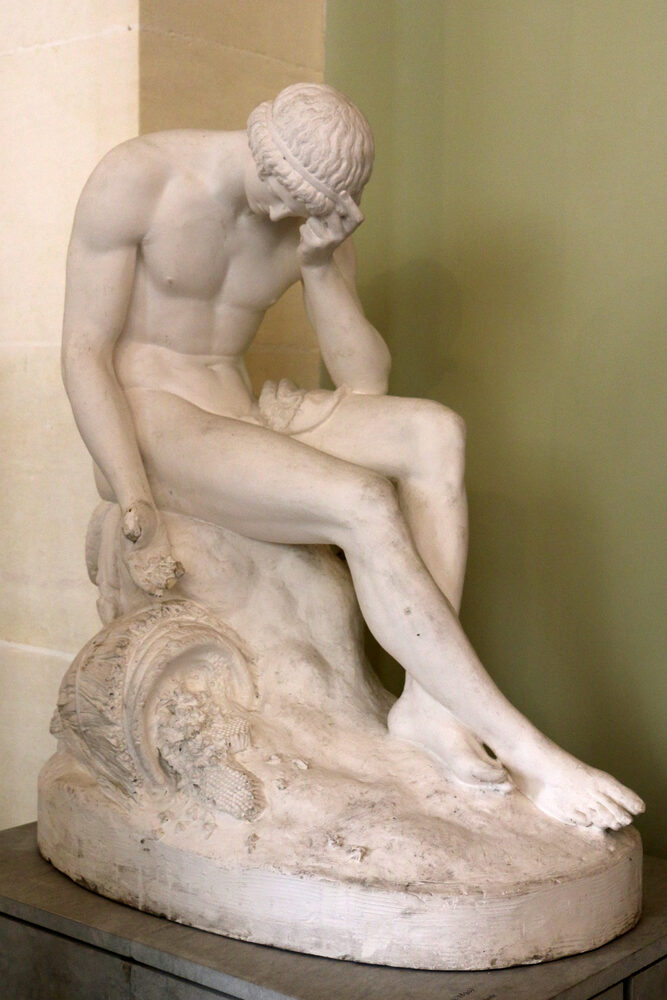
Aristaios
First Appearance
Aristaeus enters Greek poetry in the ninth Pythian ode, where Pindar sings how Apollo, catching sight of the huntress-nymph Cyrene as she wrestled a lion barehanded on the slopes of Pelion, desired her and carried her off in his golden car over the sea to Libya. There she bore him a son, and Hermes took the newborn and gave him to the Horai (the Seasons) and to Gaia (the Earth) to rear, who set nectar and ambrosia on his lips and made him deathless — "a Zeus and a holy Apollo, a delight to men and a guardian of flocks, Agreus and Nomios some would call him, and others Aristaios." From his first appearance he is the divine child of the country: the hunter, the herdsman, and the bringer of the good things of the fields.
— Pindar, Pythian 9.5–65 (c. 474 BC)
Who They Are
Aristaeus (ar-ih-STEE-us) is the gentle rustic god of the Greek countryside — the giver to mankind of beekeeping, of the making of cheese and the curdling of milk, of the cultivation of the olive and its oil, of the arts of herding and of hunting. He belongs among the minor gods: not an Olympian seated at the high table, but a divine benefactor who moved among men teaching them the useful crafts of field and pasture, and who was honoured in return as a god across many lands — in Thessaly and Boeotia, in Arcadia, in Libya and Sardinia, and above all on the island of Keos.
He is the son of the god Apollo and the Thessalian huntress-nymph Cyrene, whom Apollo loved and carried across the sea to the Libyan land that took her name. Reared not by his mother but by Gaia the Earth, by the Horai (the Seasons), and by the wise centaur Chiron, Aristaeus was fed on nectar and ambrosia and schooled in healing, prophecy, and the keeping of flocks, so that he grew into a kind of culture-hero of the countryside — one who gathered the scattered knowledge of the wild and gave it to men as settled craft.
His most famous and most moving story, told fully only by the Roman poet Virgil, is the tale of how he lost his bees. For his part in the death of Eurydice, the wife of Orpheus, his whole swarm sickened and died; and to win them back he was taught, by his mother and by the shape-shifting sea-god Proteus, the strange rite of the bugonia — the generating of a new swarm of bees out of the carcass of a sacrificed ox. In that story the quiet god of the hives stands at the heart of one of antiquity's most haunting meditations on loss, labour, and the renewal of life out of death.
Mythology
Apollo and Cyrene: the birth in Libya
Aristaeus was the son of Apollo and Cyrene, a nymph of Thessaly famous as a huntress who loved the chase more than the loom. Pindar tells (Pythian 9.5–65) how Apollo, passing over Mount Pelion, saw her wrestling a lion with her bare hands and was seized with love; he caught her up in his golden chariot and bore her across the sea to Libya, to the place that would be named Cyrene after her, and there she bore his son. The child was taken by Hermes and carried to be reared by the goddesses of the wild — Gaia the Earth and the Horai, the Seasons — who dropped nectar and ambrosia upon his lips to make him immortal, and gave him his names: Agreus the Hunter, Nomios the Herdsman, and Aristaios, the Best. So the god of the country arts was born of the bright Olympian of order and prophecy and of a nymph who was herself a creature of the mountain hunt.
Reared by Chiron and the Muses
In the fuller telling of Apollonius of Rhodes (Argonautica 2.500–527) the boy was given to the centaur Chiron to raise in his cave — the same wise teacher who schooled Asclepius, Achilles, and Jason — and the Muses themselves completed his education, teaching him the arts of healing and of prophecy and setting him as keeper of their sheep that grazed the Phthian plain and the slopes of Mount Othrys. From this upbringing among the powers of the wild Aristaeus drew everything he would later give to men: the lore of herbs and healing, the knowledge of the flocks, and the patient crafts by which the countryside is made to yield its good.
The giver of the country arts
Grown to manhood, Aristaeus became a wanderer and a benefactor, moving from land to land and teaching mortals the useful arts he had learned. Diodorus of Sicily preserves the fullest Greek catalogue of his gifts (Library of History 4.81–82): he taught men the keeping of bees and the gathering of honey; the curdling of milk into cheese; the cultivation of the olive and the pressing of its oil; and the setting of snares and nets for the hunt. He is said to have learned, too, how to heal the sicknesses of the vine and of the fruiting trees, and how to meet the blights that fall on growing things. In all this he is less a god of raw nature than a god of nature mastered and made fruitful — the divine teacher who turned the wild gifts of the earth into the settled crafts of the farm.
Keos and the Dog Star
One of the oldest stories of his benefaction is set on the island of Keos (Ceos) in the Cyclades. Apollonius tells (Argonautica 2.516–527) that the land was wasting under the scorching heat and pestilence that came with the rising of Sirius, the Dog Star, in high summer. Summoned by the islanders, Aristaeus raised a great altar to Zeus Ikmaios — "Zeus of the Moisture" — and offered sacrifice to the Dog Star and to Zeus; and in answer the god sent the cool Etesian winds that blow across the Aegean for forty days each summer and break the fever of the season. Ever after the Keans kept his cult and watched for the Dog Star's rising, honouring the god who had taught them to endure its heat. The story binds Aristaeus to the farmer's calendar and to the anxious midsummer season when the harvest and the flocks are most at risk.
The death of Eurydice and the loss of the bees
The story for which Aristaeus is best remembered is told in its full form only by the Roman poet Virgil, in the fourth book of the Georgics (4.315–558) — a late and Roman telling, though it draws on older Greek threads, and it should be read as the Roman shaping of the tale. In it, Aristaeus one day found his beloved bees all dead, his hives empty, his craft undone, and in grief he went down to the river to his mother Cyrene, who dwelt in the waters among her sister nymphs. She told him the cause lay with a wrong he had done and sent him to the old sea-god Proteus, the shape-shifter who knows all things, bidding him seize the god and hold him fast through all his changings until he gave up the truth.
Mastered at last, Proteus revealed it: Aristaeus had pursued Eurydice, the wife of Orpheus, through a meadow, and as she fled from him headlong she trod upon a serpent hidden in the long grass and was bitten and died. For that death — and for the grief of Orpheus, whose vain descent into the underworld to bring her back Proteus then recounts in the poem's famous inset — the nymphs had sent the plague upon Aristaeus's bees in punishment. The quiet god of the hives is thus drawn, in this telling, into the orbit of the greatest of all love-and-loss stories, made the unwitting cause of Eurydice's death and so the occasion of Orpheus's sorrow.
The bugonia: bees reborn from the ox
To win his bees again Aristaeus was given, by his mother and the sea-god, a strange remedy — the rite the ancients called the bugonia (Greek bougonia, "the birth of bees from the ox"). He was to make appeasement to the nymphs and to the shade of Orpheus and Eurydice, and then to take oxen, sacrifice them, and leave the carcasses in a close-shut place; and from the rotting flesh, after nine days, a new swarm of bees would arise of itself, humming and pouring out like a cloud, to fill his empty hives once more (Virgil, Georgics 4.528–558). The ancient belief that bees could be generated spontaneously from the body of a dead ox is an old and widespread one, and this myth is its great poetic enshrining. In Virgil's hands the bugonia becomes a parable of the whole countryman's hope — that labour and loss are never final, and that life, rightly tended and rightly atoned-for, rises again even out of death and corruption. So the god who lost his swarm for the death of Eurydice recovers it through a mystery of renewal, and the Georgics close on the humming of reborn bees.
His marriage and his son Actaeon
By the Greek genealogies Aristaeus married Autonoe, a daughter of Cadmus the founder of Thebes, and so entered the ill-starred Theban royal house (Apollodorus, Bibliotheca 3.4.4; Diodorus 4.81). Their son was the hunter Actaeon — the youth who, trained like his father in the arts of the chase, came by misfortune upon the goddess Artemis bathing and was turned by her into a stag and torn apart by his own hounds. It is a dark inheritance: the god who gave men the hunt fathered the most famous of all the hunt's victims, and the line of Aristaeus runs straight into the long tragedy of the house of Cadmus.
Worship — Ancient
A god of the working countryside
Aristaeus was worshipped not in the great marble temples of the cities but across the working countryside of the Greek world — in Thessaly where his mother was born, in Boeotia through his Theban marriage, in Arcadia and on the islands, and far off in the Libyan Cyrene named for Cyrene his mother. He was the god a farmer or herdsman or beekeeper would thank for a good swarm, a healthy flock, a sound olive crop; his "temples" were the apiary, the sheepfold, and the oil-press, and his honours were the first-fruits of those labours — honey, cheese, oil, the firstlings of the herd.
The cult on Keos
His firmest and most famous cult was on the island of Keos, where he was remembered as the god who had broken the deadly heat of the Dog Star by raising an altar to Zeus Ikmaios and calling down the cooling Etesian winds (Apollonius, Argonautica 2.516–527). There his worship was bound to the midsummer rising of Sirius, and the islanders are said to have kept a yearly watch and sacrifice at that anxious season. Keos thus honoured Aristaeus as a true saving-god — not a distant power but the author of the very winds that made their summers survivable.
Honoured as a benefactor made divine
Diodorus records (4.81–82) that wherever Aristaeus went teaching his crafts, the peoples he helped honoured him with divine honours as a benefactor, "even as they honoured Dionysus" — the pattern of the culture-bringer rewarded with worship for his gifts. He was often invoked alongside the other rustic and pastoral powers — Pan, the nymphs, the satyrs, and his own father Apollo Nomios in his herdsman's aspect — a god of the same green world of flocks and fields and wild honey, standing a little apart from the grand Olympian cult but close to the daily hopes of country people.
Worship — Modern
Patron of the hive and the harvest
Aristaeus speaks naturally to anyone whose devotion is bound up with the land and its keeping — the beekeeper above all, but also the gardener, the herder, the maker of cheese, the tender of olive trees. A modern honouring of him sits easily at the apiary and the garden: a dish of honey left out, the first comb of the season offered rather than wholly taken, a libation of milk poured at the edge of a field. He is a fitting patron for the small, patient, seasonal crafts — the work that asks care and waiting and gives its reward slowly — and for the ethic of gratitude toward the creatures and plants that feed us.
The bees, the ox, and the renewal of life
His great myth gives him a deeper modern resonance than his rustic office alone might suggest. The loss of the bees and their rebirth through the bugonia make Aristaeus a figure of renewal out of loss — of the faith that labour undone can be begun again, that even death and failure can be the ground of new life. Read beside the story of Eurydice and Orpheus, his tale holds a hard honesty too: that we may be, without meaning it, the cause of others' sorrow, and that atonement and patient re-making are the way back. The humming swarm rising from the sacrifice at the close of Virgil's Georgics is one of the oldest images of hope in Western poetry, and it belongs to this quiet god of the hives.
A name in the fields of science
Aristaeus endures, fittingly, in the language of the very crafts he gave. His name survives in the vocabulary of beekeeping and natural history, and he is a recurring presence in the literature of agriculture and apiculture, where the bugonia of the Georgics is still cited as the great myth of the bee. Wherever hives are kept and the honey-bee is tended, the god who first taught men the craft is, in a manner, still at work.
Epithets & Cult Titles
- Agreus (Ἀγρεύς) — The Hunter — one of the two names the Horai and Gaia gave the child in Pindar (Pythian 9), marking his lordship over the hunt and the taking of wild game
- Nomios (Νόμιος) — Of the Pastures / the Herdsman — his other given name in Pindar, naming him keeper of flocks and lord of the grazing-lands; a title he shares with his father Apollo in his own pastoral aspect
- Aristaios (Ἀρισταῖος) — The Best / the Most Excellent — the name under which he came to be honoured among men once he grew and gave them his gifts, from aristos, 'best'
- Melisseus / lord of the bees — A descriptive honour rather than a fixed cult-title — 'the bee-man', the giver and guardian of the honey-bee and of the craft of keeping hives, the work most bound up with his name
Sources & Variants
- Pindar, Pythian 9.5–65 (Apollo's love for Cyrene and her rape to Libya; the birth of Aristaeus; his rearing by Gaia and the Horai; the names Agreus, Nomios, Aristaios)
- Apollonius of Rhodes, Argonautica 2.500–527 (Aristaeus son of Apollo and Cyrene, reared by Chiron and the Muses, taught healing and prophecy; the cult on Keos, the altar to Zeus Ikmaios, and the breaking of the Dog Star's heat by the Etesian winds)
- Diodorus Siculus, Library of History 4.81–82 (the fullest Greek account of his gifts to mankind — beekeeping, cheese-making, the olive, the hunt; his wanderings and divine honours; his marriage to Autonoe and fatherhood of Actaeon)
- Apollodorus, Bibliotheca 3.4.4 (Aristaeus marries Autonoe daughter of Cadmus; their son Actaeon)
- Hesiod and the poets on Cyrene and Aristaeus (the Thessalian huntress-nymph and her divine son) — early Greek tradition behind Pindar
- Virgil, Georgics 4.315–558 (the fullest surviving telling of the loss of the bees for the death of Eurydice, the descent to Cyrene, the wrestling of Proteus, and the bugonia — the generating of a new swarm from the carcass of a sacrificed ox) — later Roman source, drawing on older Greek threads
Gallery