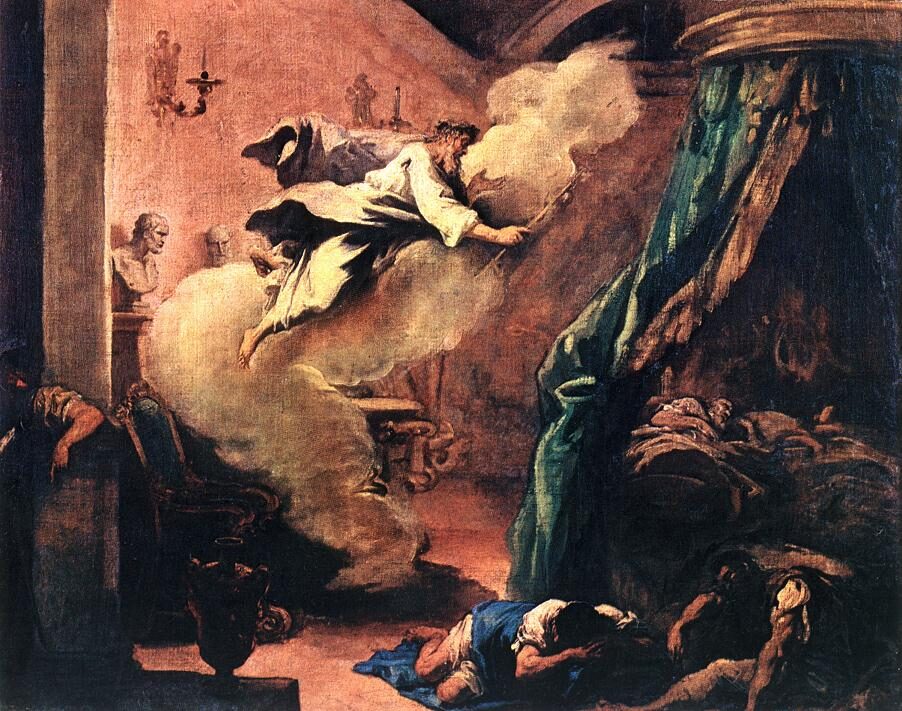
Asklepios
First Appearance
Asclepius first appears in Homer not yet quite a god but a mortal master of medicine, "the blameless physician," whose two sons Machaon and Podalirius lead men from Thessaly to Troy and serve the Greek army as healers — Machaon called in by name to draw the arrow from the wounded Menelaus and treat him with the soothing drugs Asclepius had learned from the centaur Chiron (Iliad 4.193–219; 11.518). The story of his birth and death is told most fully in the archaic tradition — in the Hesiodic Catalogue and, above all, in Pindar's third Pythian ode, which sets out the union of Apollo and the mortal Coronis, the snatching of the child from the funeral fire, the raising of the dead, and the thunderbolt of Zeus that struck the healer down.
— Homer, Iliad 2.729–733, 4.193–219, 11.518; Hesiod fr. 50–60 M-W (the Catalogue and the Coronis story); Pindar, Pythian 3
Who They Are
Asclepius (as-KLEE-pee-us) is the Greek god of healing and medicine — the divine physician to whom the sick came in their thousands, and the ancestor and patron of every doctor after him. He stands a little apart from the great Olympians: a god who began, in the oldest stories, as a mortal man, the finest healer who ever lived, and who was raised to godhood only after death. That double nature — man made god, healer who overreached and was struck down and then honoured forever — is the heart of his story, and it made him one of the most beloved and most personally worshipped divinities of the ancient world.
Where Zeus ruled and Apollo shone, Asclepius simply helped. His cult was not about the ordering of the cosmos but about the aching body and the frightened patient: a farmer with a wasting sickness, a woman who could not conceive, a soldier with a wound that would not close. To his sanctuaries — above all the great healing-shrine at Epidaurus — people came sick and went home well, or believed they did, and they left behind them a flood of little carved offerings shaped like the eyes, the legs, the ears, the wombs that the god had mended. No other Greek god has left such a warm and human archaeological record: not statues of triumph, but the small, grateful thank-offerings of ordinary people who had been afraid and were afraid no longer.
His emblem is the single serpent coiled about a plain wooden staff — the Rod of Asclepius, which to this day marks hospitals, ambulances, and medical societies the world over. (It is worth guarding against a common modern mix-up: the true medical emblem is Asclepius's single-snake staff, not the caduceus of Hermes, the herald's wand with two snakes and a pair of wings, which properly belongs to commerce and messengers and only wandered into medical use by later error.) To tell the story of Asclepius is to tell how the Greeks imagined healing itself: a gift descended from Apollo, taught by a wise centaur, powerful enough to cheat death — and, for that very reason, dangerous enough that even a god of mercy had to be checked by the thunderbolt.
Mythology
The pyre birth
(Content note: this origin turns on an act of unfaithfulness or slander, a killing, and the burning of the dead — told frankly but without dwelling on the horror.) Asclepius was the son of the god Apollo and a mortal woman, Coronis, a princess of Thessaly. While she was carrying Apollo's child, Coronis gave her love to another man, a mortal named Ischys — either faithless to the god, as the older poets say, or (in gentler tellings) wrongly accused. Apollo had left a white crow (or raven) to watch over her, and the bird flew to him with the news of her betrayal. In his anger the god cursed the bird that had brought the tale, scorching its once-white feathers black forever — which is why crows and ravens are black to this day — and Coronis was killed for the wrong, struck down by Apollo's own arrows or, in some versions, by his sister Artemis.
But the child within her was innocent and was Apollo's own. As Coronis's body was laid on the funeral pyre and the flames rose, Apollo could not bear to let his son die with her. At the last moment he snatched the unborn infant living from his mother's burning body (Hermes performs the rescue in some accounts) — the child drawn out of the fire, out of death itself. The very name Asclepius was sometimes read by the ancients as meaning "cut out" or "unfallen," a memory of this birth out of the flames. So the god of healing entered the world already marked by the theme that would define him: life pulled back from the edge of death.
Chiron the centaur, his teacher
Apollo carried the rescued child up into the wooded slopes of Mount Pelion and gave him to be raised and taught by Chiron — the wise centaur, gentlest and most learned of all his kind, the tutor who trained so many of the great heroes (his story is told in his own place). Chiron was himself the master of the healing arts, of herbs and drugs and surgery and the soothing of pain, and he taught the boy everything he knew. Under the centaur's care Asclepius grew into the greatest physician the world had seen — surpassing even his teacher. Pindar paints him going out among the sick: those who came to him with ulcers grown into the flesh, or limbs wounded by grey bronze or by a far-flung stone, or bodies wasting with summer fever or winter chill — he freed them all from their sufferings, treating some with gentle spells and soothing songs, some with healing draughts, some with salves laid on the wound, and some by the knife, setting them upright again. The healing goddess Athena, it was said, had given him two vials of the Gorgon's blood: the blood from the left side was a deadly poison, but the blood from the right had the power to raise the dead.
The raising of the dead, and the thunderbolt of Zeus
And this is where the greatest of healers went too far. Asclepius grew so skilled that he passed beyond the proper bounds of a mortal's art: he learned to bring the dead back to life. The tradition names several men he was said to have restored — among them Hippolytus, the son of Theseus, torn apart by his own chariot-horses and given back his life by the physician's hand. For a fee of gold, one bitter version says, he was persuaded to draw a man up out of death.
This could not be allowed to stand. If the dead could be recalled at will, the ancient boundary between mortal and immortal — the whole order of the world, in which men die and gods do not — would dissolve. Hades, lord of the dead, complained (some say) that his kingdom was being emptied; and Zeus, to guard the fixed order of things, struck Asclepius down with a thunderbolt, killing the healer who had defeated death. It is one of the most morally charged deaths in all Greek myth: Asclepius did nothing cruel or wicked — he saved a life — and yet he had to die for it, because mercy itself, past a certain point, threatens the difference between the human and the divine.
Apollo could not strike back at his own father, the king of the gods. But he could avenge his son upon the makers of the weapon: in his grief and fury Apollo went and killed the Cyclopes, the one-eyed smith-giants who had forged the thunderbolt in the workshop of Hephaestus. For that killing Zeus punished Apollo in turn, sentencing the god to a year of servitude to a mortal man — so that the death of the healer set off a whole chain of divine grief and reckoning that reached up to the highest gods.
Set among the stars, and made a god
Yet the story does not end in the ashes of the pyre or the ruin of the thunderbolt — for Asclepius, uniquely, death was not the end. Because his fault was only an excess of his own goodness, and because Apollo pleaded for him, Zeus relented after his justice was done. The healer who had been a mortal man was raised to the ranks of the gods, given a share of honour among the immortals and a worship of his own that would in time outgrow that of many an older god. And he was set among the stars as the constellation Ophiuchus, the Serpent-Bearer — the figure who stands in the sky grasping a great snake, the same sacred serpent that was the emblem of his healing. So the god born out of a funeral fire and killed by the lightning ended neither dead nor merely mortal, but glorified: a healer in the heavens, and, on the earth below, the most personally loved of all the helping gods.
Worship — Ancient
The healing sanctuaries
Asclepius was worshipped above all at his Asclepieia — healing sanctuaries that were part temple, part hospital, part place of pilgrimage. The greatest was at Epidaurus in the Argolid, the mother-shrine from which his cult spread; but famous Asclepieia also stood on the island of Kos (home of the physician Hippocrates and his school), at Pergamon in Asia Minor, at Athens on the south slope of the Acropolis, at Corinth, and at scores of lesser sites. From the fifth and fourth centuries BC onward his cult grew explosively, until there was hardly a Greek city without its shrine of the healer. These were places set in clean air near springs, with a temple, a great altar, porticoes for the sick to lodge in, baths, and — at Epidaurus — a theatre and a stadium for the festival games.
Incubation: sleeping for a cure
The heart of his worship was incubation (Greek enkoimesis), the dream-cure. A sick pilgrim would purify themselves, offer sacrifice, and then lie down to sleep in a special hall, the abaton or enkoimeterion, within the sanctuary. In the night the god was believed to come to the sleeper in a dream or vision — sometimes to perform the cure directly, laying his hands on the sick part, or letting his sacred snakes or dogs lick the wound; sometimes to prescribe a treatment (a diet, a drug, an exercise, a bath) that the temple attendants would then carry out by day. The walls of Epidaurus were carved with iamata, testimonial inscriptions recording the cures: the blind who woke seeing, the barren who conceived, a man who swallowed leeches healed in his sleep, a spear-point drawn from a jaw. Whatever their literal truth, these records are a moving witness to how completely people trusted the god with their bodies and their fear.
Snakes, offerings, and thank-you gifts
The snake was the god's living emblem, kept tame in his sanctuaries — non-venomous serpents gliding through the precinct, thought to embody his healing presence (the snake's skin-shedding read as a sign of renewal and recovery). Sacred dogs were kept too, and a cock was closely tied to him — the philosopher Socrates, dying, famously asked that a cock be offered to Asclepius, the customary thank-offering for a cure, as though death itself were the healing of life's long sickness. Grateful patients dedicated votive offerings shaped like the healed body-part — little terracotta or marble or metal models of eyes, ears, hands, feet, legs, breasts, wombs, and other organs — hung up in the sanctuary as thanks and as advertisement of the god's power. Honey-cakes, libations, and the first-fruits of recovery were brought as well. The overwhelming survival of these humble offerings makes Asclepius's cult one of the best-attested and most human in the whole Greek world.
His divine household
Around Asclepius the Greeks gathered a family of healing-powers, worshipped alongside him as the personified faces of his art. Chief among them was his daughter Hygieia ("Health," from whose name we have "hygiene"), often shown feeding the sacred snake from a bowl and honoured almost as widely as her father; with her stood Panacea ("All-Heal," the cure of every ill), Iaso ("Healing"), Aceso ("the healing process"), and his physician sons Machaon and Podalirius, the surgeons of the Iliad. To pray to Asclepius was to pray to a whole household of gentleness and recovery.
Worship — Modern
The god of the doctors
Of all the Greek gods, Asclepius has kept the firmest and most literal grip on the modern world — not as a figure of faith for most, but as the presiding emblem of medicine itself. His single-snake staff, the Rod of Asclepius, is the symbol printed on hospitals, ambulances, pharmacies, and the badges of medical associations across the globe; the World Health Organization carries it on its flag. The old Hippocratic Oath, still echoed in the vows new doctors take, opens by swearing "by Apollo the Physician, and by Asclepius, and by Hygieia and Panacea" — so that the god born out of a funeral pyre still stands, three thousand years on, at the head of the medical profession he fathered.
Guard against the two-snake mix-up
Here a genuine and very common error is worth correcting, because it is everywhere. The true and ancient emblem of healing is Asclepius's single snake wound about a plain staff. It is frequently confused with the caduceus of Hermes — the herald's wand with two snakes twined about it and a pair of wings at the top — which properly belongs to Hermes as messenger, and to trade, negotiation, and travellers, not to medicine at all. The mix-up spread especially in the United States (partly through a nineteenth-century military printer's mistake) and is now so widespread that many medical logos wrongly show the winged two-snake caduceus. The rule of thumb is simple: one snake, no wings, is the healer's staff of Asclepius; two snakes with wings is the herald's wand of Hermes.
Living devotion
For modern Hellenic polytheists and others drawn to the old gods, Asclepius is a beloved and approachable divinity — the god one turns to in sickness, before surgery, or on behalf of a sick loved one, and the god one thanks in recovery. Devotion to him tends to keep the ancient shapes: a small shrine with an image of the snake-staff or of the god leaning on it, offerings of honey and libations, a candle lit for a person who is ill, and prayers of thanks when health returns. His daughter Hygieia is often honoured beside him as the patron of well-being and prevention. Fittingly for the god who taught that the body should be cared for gently, worship of Asclepius today is quiet, kind, and practical — bound up with the ordinary human hope of getting better, which is exactly the hope the ancients brought to his sanctuaries. And on a clear summer night the god is still overhead, in the great constellation Ophiuchus, the Serpent-Bearer, holding his snake across the southern sky.
Epithets & Cult Titles
- Soter (Σωτήρ) — Saviour — the god who saves the sick and delivers them from illness, a title he shares with the greatest gods but earns through healing rather than battle
- Paian / Paion (Παιάν) — Healer — the old word for the physician-god and for the hymn of healing and thanksgiving sung to him; it names his very function, the one who soothes and mends
- Epidaurios (Ἐπιδαύριος) — Of Epidaurus — the god as worshipped at his great sanctuary in the Argolid, the mother-shrine from which his cult spread across the Greek world
- Asklepios Ophiouchos (Ὀφιοῦχος) — The Serpent-Bearer — the god who holds the sacred snake, remembered in the sky as the constellation Ophiuchus, the Serpent-Bearer, into which he was set
Sources & Variants
- Homer, Iliad 2.729–733 (the sons of Asclepius lead the Thessalians to Troy); 4.193–219 (Machaon treats the wounded Menelaus with drugs Asclepius learned from Chiron); 11.518 (Machaon, 'son of Asclepius,' the healer worth many men)
- Hesiod, Catalogue of Women / Ehoiai fr. 50–60 M-W (the birth from Coronis, her unfaithfulness with Ischys, and the raising of the dead) — fragmentary
- Pindar, Pythian 3.1–58 (the fullest early narrative: Apollo and Coronis, the crow's news, the snatching of the child from the pyre, Chiron's teaching, the raising of the dead for gold, and Zeus's thunderbolt)
- Apollodorus, Bibliotheca 3.10.3–4 (the birth, the list of those he raised from the dead including Hippolytus, the thunderbolt, and Apollo's killing of the Cyclopes)
- Pausanias, Description of Greece 2.26–2.27 (Epidaurus, the god's birth-legend, the sanctuary, the sacred snakes, and the cures); 2.11.6 (the Asclepieion near Titane)
- Homeric Hymn 16 (To Asclepius) — a short hymn naming him son of Apollo and Coronis, 'healer of sicknesses'
- The Epidaurian iamata (temple inscriptions, IG IV².1 121–124) — testimonial records of cures by incubation at Epidaurus
- Plato, Phaedo 118a (Socrates' dying words, 'we owe a cock to Asclepius')
- Ovid, Metamorphoses 2.542–632 (the raven scorched black and the death of Coronis); 15.622–744 (the god's serpent-form journey to Rome as Aesculapius) — Roman retellings
- The Hippocratic Oath (opening invocation of Apollo, Asclepius, Hygieia, and Panacea) — for the god as patron of physicians
Gallery