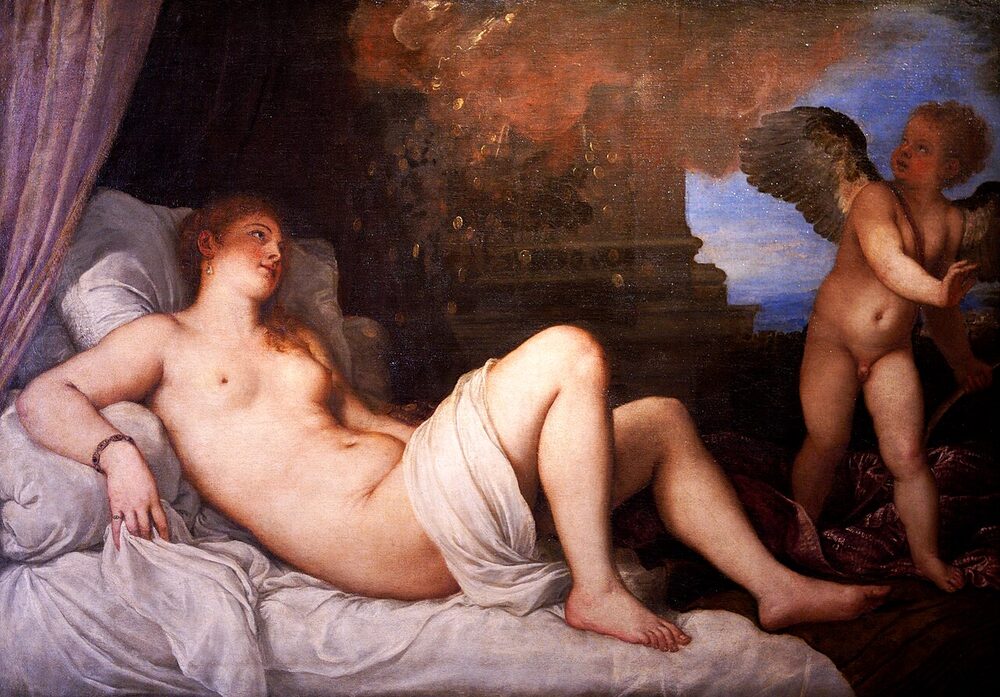
Danaë
First Appearance
Danaë appears already in the oldest Greek epic as the mother of Perseus by Zeus. In the Iliad (14.319–320) Zeus himself names her in his catalogue of loves, "the daughter of Acrisius, Danaë of the fair ankles, who bore Perseus, the most renowned of men." The Hesiodic Catalogue of Women set her in the great Argive genealogy as the daughter of Acrisius; and the lyric poet Simonides (fr. 543 PMG) preserves her most famous moment — her lament as she sings over her sleeping infant in the wooden chest adrift on the night sea, one of the loveliest surviving fragments of early Greek song.
— Homer, Iliad 14.319–320; Hesiod, Catalogue of Women (fragments); Simonides fr. 543 PMG
Who They Are
Danaë (DAN-uh-ee) is the Argive princess who became the mother of Perseus, and one of the most quietly powerful figures in all of Greek myth — a woman to whom things are done, again and again, and who endures each one and comes through it with her child alive. She is the daughter shut in a bronze prison by a frightened father; the mortal woman whom Zeus reaches as a shower of golden rain; the mother cast out to sea in a sealed chest with her newborn; and the refugee who, years later, must flee to the sanctuary of an altar to escape a king who wants her against her will. Around her turns one of the great hero-legends of Greece, and yet the story is, at heart, hers as much as her son's: it begins with her imprisonment and it does not end until her son comes home to set her free.
What the Greeks remembered most about Danaë is not power but endurance — the courage of the one who cannot fight back and refuses to break. The lyric poet Simonides caught this once and for all in the single most beloved image of her myth: Danaë in the dark of the pitching chest, the salt sea breaking over the boards, singing a lullaby over her sleeping baby so that he sleeps on untroubled through the terror while she keeps watch. It is one of the tenderest moments in Greek literature, and it fixed her forever as the type of the mother who shields her child with nothing but her own body and her own steadiness. She is not a warrior or a schemer; her heroism is the heroism of holding on.
(Content note: Danaë's story turns on imprisonment, on a god's union with a mortal woman, and on the unwanted pursuit of a woman by a powerful man.) Because her tale is bound so tightly to her son's, this page keeps its focus on Danaë herself — her chamber, the gold, the chest, and the king of Seriphos — and leaves the long quest for the Gorgon's head to Perseus's own story. Here the eye stays on the mother: what was done to her, how she bore it, and the one thing she never lost through all of it, which was her son.
Mythology
The prophecy and the bronze chamber
(Content note: this origin turns on imprisonment and on a god's union with a mortal woman.) Danaë was the only child of Acrisius, king of Argos, who had daughters but longed for a son to inherit his throne. When he went to the oracle at Delphi to ask how he might get a male heir, the god gave him an answer worse than silence: he would have no son of his own, and the son that his daughter Danaë bore would one day kill him. To a Greek this was a doom, and Acrisius set himself to cheat it in the only way he could imagine — if Danaë never bore a child, the prophecy could never come true. So he shut his daughter away where, he believed, no man could ever reach her. The tellings differ on the prison: in some it is a chamber roofed and walled with bronze; in others an underground vault sunk into the courtyard of the palace, sealed over with bronze and set under guard. Either way the meaning is the same — a young woman locked out of the whole world by her own father, not for any wrong she had done, but for a prophecy she had no part in making.
The shower of gold
But the walls that shut out every mortal man could not shut out Zeus. In the single most famous image of her myth — one that painters and poets have returned to for two and a half thousand years — the king of the gods came to Danaë not as a man and not as a beast but as a shower of golden rain, pouring down through the roof of the sealed chamber and falling into her lap. It is a strange and luminous picture: the dark bronze room, the one girl within it, and the light itself coming down in a stream of gold to reach her where nothing else could. From that union Danaë conceived, and in the hidden chamber she bore a son, and named him Perseus. For a while she kept him secret, a baby raised in a prison, his laughter and crying muffled behind the bronze — but a growing child cannot be hidden forever.
Mother and infant cast upon the sea
Acrisius discovered the child at last — hearing, some tellings say, the infant at play behind the sealed doors — and he was seized with fear, for here was the very grandson the oracle had promised would be his death. He would not believe Danaë's account of the golden god; and yet he dared not kill his own daughter and her baby outright with his own hand, for the blood of one's own kin brought a pollution the gods themselves would avenge. So he chose a crueller mercy, and left the killing to the sea. He had Danaë and the infant Perseus shut together into a wooden chest — a larnax, the same word used for a coffin — and had the chest carried down to the shore and cast out upon the open water, so that if they died it would be the waves and not his hand that did it, and he could tell himself he was guiltless.
Danaë's lament in the chest
It is here that the poet Simonides gives us the most beautiful moment in the whole story, and one of the loveliest fragments of early Greek song to survive (fr. 543 PMG). He imagines Danaë in the dark of the pitching chest, the wind and the salt spray breaking over the boards, terrified — and yet her whole care is not for herself but for the baby sleeping in her arms. She sings over him, a lullaby in the storm, marvelling that he slumbers on so peacefully, his little untroubled face turned up to her, knowing nothing of the deep water beneath them or the danger they are in: "You sleep, and the sea sleeps, and our trouble sleeps." She asks the child to sleep, and asks the sea to sleep, and asks their suffering to sleep, and bids Zeus himself to send them deliverance. In that image — the powerless mother keeping watch and keeping calm over the one thing she loves, so that her child at least may rest — the Greeks fixed Danaë forever as the type of maternal courage: not the strength to fight, but the strength to hold steady in the dark for another's sake.
The landing on Seriphos
The chest did not sink. It drifted across the sea and came at last to the little island of Seriphos in the Cyclades, where it was caught and hauled from the water in the net of a fisherman named Dictys — whose name means "the netter" — the brother of the island's king. Dictys opened the chest, found the young mother and her child alive within it, and took them in. He was a kind and decent man, and under his roof Danaë was safe and the boy Perseus was raised almost as a son. For the first time since the bronze chamber, mother and child had a home; and here the story of Danaë quiets for a while, through the years in which her son grew from an infant to a young man on the island that the sea had given them.
Polydectes and the unwanted suit
(Content note: what follows turns on the unwanted pursuit of a woman by a powerful man.) Dictys had a brother, and the brother was trouble: Polydectes, the king of Seriphos, who over the years came to desire Danaë and wished to take her as his own — while she wanted nothing to do with him. The one obstacle in his way was her son. The grown Perseus stood between his mother and the king as her protector, and Polydectes could not simply push him aside. So the king laid a trap to be rid of him. Giving out that he meant to seek the hand of another woman, he gathered the young men of the island to a feast at which each was to bring a gift, and goaded the proud young Perseus into rashly promising the one gift no man could bring back alive — the head of the Gorgon Medusa. Polydectes held him to the boast and sent him off after it, certain the quest would kill him and leave Danaë with no one to shield her. (Perseus's long journey for the Gorgon's head — the grey sisters, the winged sandals, the mirror-shield, and the beheading — belongs to his own story and is told there; here the thread stays with the mother he left behind.)
Refuge at the altar
With Perseus gone and, Polydectes was sure, never to return, the king dropped his pretences and pressed his suit on Danaë by force. She would not have him. Rather than yield, Danaë fled with the faithful Dictys to the one place a Greek could claim protection against even a king — the altar of the gods, where she took refuge as a suppliant, clinging to sanctuary. To drag a suppliant from an altar by force was among the gravest of impieties, an outrage the gods themselves punished; and so, cornered and defenceless, Danaë held that sacred ground and would not be moved, waiting out the king's anger with nothing on her side but the protection of the gods and the hope that her son still lived. It is the same courage as the chest at sea — the strength to endure, and to refuse, when one cannot fight.
The son's return and the rescue
And her son did live. Perseus came home to Seriphos with the Gorgon's head, exactly as he had sworn, to find his mother a suppliant at an altar and Polydectes still at his feast, still mocking the idea that the young fool would ever return. Perseus went to the palace, and before the king and all his court he lifted the head of Medusa from its wallet — the face whose gaze turned the living to stone — and turned Polydectes and the whole company to stone where they sat, a banquet-hall of grey statues frozen at their table. He set the good Dictys, who had sheltered them both, on the throne of Seriphos in the tyrant's place; and he freed his mother from the altar and from her fear at last. So the story that had begun with Danaë shut in a bronze prison ends with her delivered, and the son she had sung to sleep in the chest at sea grown into the man who came back and set her free.
Afterward
Some later tellings follow Danaë a little further. In one strand of the Argive tradition she returned with Perseus toward Argos, and the old prophecy ran on to its appointed end — but that reckoning between Perseus and his grandfather Acrisius belongs to Perseus's story. A quite separate and much later Italian tradition, known chiefly from Roman poets such as Virgil (Aeneid 7.371–372), carried Danaë all the way to Italy, where she was said to have founded the city of Ardea and become an ancestress of the Latin peoples — a local legend that grew up far from Greece and long after, and that the Romans were fond of because it tied their own soil to the great Argive myth. In the Greek imagination, though, Danaë's story is complete when her son comes home: the imprisoned daughter, the mother of the chest, the suppliant at the altar, delivered.
Worship — Ancient
A heroine, not a goddess
Danaë was not a goddess and received no Olympian cult of her own. She belonged instead to the great company of heroines — mortal women of the legendary age, mothers and daughters of the hero-lines, who were remembered and sometimes honoured at local shrines but were not worshipped as the immortals were. Honours to a figure of this kind, where they existed at all, were local and particular, attached to a place that claimed some link to her story, and they took the modest form proper to the powerful dead rather than the sky-facing sacrifices given to the gods. Danaë's memory was carried above all within the cult and legend of her son Perseus and of the Argive royal house to which she belonged.
Argos and the Danaid line
Where Danaë was remembered, it was first of all in the Argolid, her homeland — Argos, the city of her father Acrisius, whose kings and whose whole poetic identity as the Danaoi the Greeks traced back through her family. Pausanias, travelling the region in the second century AD, records the landmarks and memorials of the old Argive royal house, the house of Danaë, among the sights of Argos and its territory: the tombs, chambers, and monuments by which the city kept its legendary founders present. Danaë stood in that memory as the mother of Perseus, founder of the Perseid dynasty of Mycenae and Tiryns, and so as a crucial link in the chain of Argive kingship — the daughter through whom the whole later heroic line, down to Heracles himself, descended.
Seriphos and the memory of the landing
The little island of Seriphos, where the chest came ashore, naturally kept the memory of Danaë and Perseus as its most famous legend, and local landmarks were pointed out as tied to their story — the shore of the landing, the places of Dictys and Polydectes. Beyond such local traditions, Danaë lived chiefly in story and image: she was among the favourite subjects of the vase-painters, who loved to show the shower of gold falling into her chamber and the sealing and casting-out of the chest, and her tale was dramatised on the Athenian stage. The lost tragedies Danaë and Diktys by Euripides, and Aeschylus's satyr-play Diktyoulkoi ("The Net-Haulers," of which a substantial fragment survives showing the fishermen dragging the chest from the sea), kept her fate before the eyes of classical Athens.
Worship — Modern
A heroine, honoured in remembrance
Danaë is a heroine of legend rather than a deity, and modern Hellenic practice honours such figures in a distinct key from the gods: not as a power to be petitioned for the ordering of the world, but as a remembered ancestor-figure whose story is kept and whose example is held up. A devotee drawn to Danaë honours her much as the ancients honoured a heroine — with remembrance rather than petition, keeping her name and her story alive as the thing she herself, in the chest at sea, asked the gods to grant her: deliverance, and the safety of her child.
Offerings and remembrance
Following the ancient shape of heroine-honours, offerings are traditionally poured out at ground level rather than raised to the sky-gods: a libation of wine poured onto the earth, given wholly and not taken back, is the simplest and most fitting gift. A candle or lamp lit in her memory, a few words recalling her story, or the reading aloud of Simonides' lullaby over the chest keep her present in the way the ancients believed the honoured dead most wished — to be remembered. Because her whole tale honours the bond between a mother and the child she shields, acts of care and steadfastness within one's own family sit well as a living tribute to her; she is a fitting patron for anyone keeping watch over someone they love through a hard and frightening time.
Legacy in art and word
More than through any formal cult, Danaë lives on today through the extraordinary afterlife of her image. The shower of gold became one of the most painted subjects in the whole Western tradition: Titian painted Danaë several times, and Rembrandt, Klimt, and countless others returned to the scene of the golden light falling into the shut chamber, so that hers is among the most familiar images in European art even to those who do not know the story behind it. Her name endures in the sky and the sciences too — the asteroid 61 Danaë is named for her — and in language, where "a shower of gold" still carries the echo of the myth. And she lives in words: Simonides' lament, the mother singing over her sleeping child in the dark of the sea, remains one of the most quoted and most translated fragments of Greek lyric, keeping alive across the centuries the image of Danaë's particular, enduring, unbreakable courage.
Epithets & Cult Titles
- Mother of Perseus (μήτηρ Περσέως) — Her defining title — the mother of the Gorgon-slayer, the role in which every ancient source names her; her whole story is told as the frame of his
- The Argive princess (Ἀργεία) — Daughter of Acrisius, king of Argos, and sole heir of that house — a descriptive title marking her royal Argive birth and the kingdom whose prophecy set her fate in motion
- Chrysopatōr — 'she of the golden father' — A descriptive epithet (not a fixed ancient cult-title) for the woman Zeus reached as a shower of gold; the poets return again and again to the image of the god who came to her as falling gold
- The castaway of Seriphos — A descriptive title for the woman cast adrift in the chest and washed ashore on the little island of Seriphos, where she and her infant son found refuge
Sources & Variants
- Homer, Iliad 14.319–320 (Zeus names Danaë, daughter of Acrisius, who bore Perseus, 'most renowned of men')
- Hesiod, Catalogue of Women frr. 129–135 M-W (Danaë in the Argive genealogy as daughter of Acrisius)
- Simonides fr. 543 PMG (Danaë's lament as she sings over her sleeping infant in the chest at sea) — the most famous treatment of the scene
- Pindar, Pythian 12.17–18 (Danaë and the conception of Perseus); Nemean 10.11 (Danaë in the Argive tradition)
- Pherecydes fr. 10–12 (the fullest early narrative of the Perseus legend, framing Danaë's imprisonment, the chest, and Seriphos; source for Apollodorus)
- Apollodorus, Bibliotheca 2.4.1–3 (the complete story: Acrisius' prophecy, the bronze chamber, the shower of gold, the chest and the landing on Seriphos, Dictys, and Polydectes' unwanted suit)
- Aeschylus, Diktyoulkoi ('The Net-Haulers'), fragmentary satyr-play (the fishermen haul the chest with Danaë and the infant Perseus from the sea); Euripides, Danaë and Diktys, both lost tragedies (their subject was Danaë's fate)
- Horace, Odes 3.16.1–11 (Danaë in the bronze tower and the shower of gold, moralised on the corrupting power of gold) — Roman
- Ovid, Metamorphoses 4.610–611; 6.113 (Danaë and the golden shower, in passing) — Roman retelling
- Virgil, Aeneid 7.371–372, with Servius' commentary (the late Italian tradition making Danaë the founder of Ardea) — Roman, and to be flagged as a local legend far removed from the Greek myth
- Pausanias, Description of Greece 2.16, 2.23 (memorials of the Argive royal house of Danaë at Argos)
Gallery