Hestia
First Appearance
Hestia first appears as the eldest of the six children born to the Titans Cronus and Rhea: "Hestia, Demeter, and gold-shod Hera, and strong Hades, and the loud-crashing Earth-Shaker, and wise Zeus." As the firstborn she was the first that Cronus swallowed as each child came forth from the womb, for fear that one of them would strip him of his kingly office; and when Zeus at last forced him to disgorge them in reverse order, she came up last — so that the ancients called her both the eldest and the youngest of that generation.
— Hesiod, Theogony 453–458
Who They Are
Hestia is the goddess of the hearth — of the household fire, the family, and the fixed, sacred centre of every Greek home and city. Alone among the great gods she is barely a character at all: she has no adventures, fights no battles, takes no lovers, and almost never leaves Olympus. Her divinity is her constancy. Where the other Olympians are known by their deeds, Hestia is known by her presence — the flame that must never go out on the hearthstone at the heart of the house.
She is the eldest child of Cronus and Rhea, and so the first of her siblings to be swallowed by their father and the last to be brought back into the light. The ancients delighted in this paradox: first-born and last-returned, she is at once the oldest and the youngest of the Olympian generation, and for that reason she receives honour both first and last. Every sacrifice opened with a portion for Hestia and closed with a libation to her; "to begin from Hestia" became a proverb for doing anything rightly from its foundation.
When Poseidon and Apollo both sought to marry her, Hestia refused them and swore a great oath upon the head of Zeus to remain a virgin forever. In place of a husband, Zeus gave her the middle of the house and the richest portion of every offering — a share of honour in all the temples of the gods and first place among mortals at every hearth. She is thus the quietest and the most universally worshipped of the Olympians: the goddess no Greek could eat, pray, or found a city without.
Mythology
The first swallowed and the last returned
Hestia's place in myth is fixed at the very start of the divine order. Hesiod names her first of Rhea's children (Theogony 453ff), which made her the first that Cronus, dreading a prophecy that his own child would overthrow him, swallowed as she came from the womb. When Zeus grew up and forced Cronus to bring the swallowed children back up, they emerged in reverse — the stone first, then the youngest, and Hestia, the eldest, last of all. The Greeks read this order as meaning: she is both the senior and the junior of the Olympians, and so is owed honour at the beginning and the end of every rite. It is a genealogical fact turned into a theology of the hearth — the fire that is lit first and banked last.
The oath of virginity
Hestia's one true "myth" is a refusal. The Homeric Hymn to Aphrodite (5.21–32) tells that both Poseidon and Apollo courted her, but she was wholly unwilling; touching the head of father Zeus, she swore a great oath to be a maiden all her days. Zeus granted her, in place of marriage, an honour higher than any wedding: her seat in the middle of the house and the fat, rich portion of every sacrifice, with a share of worship in all the temples of the gods. Her virginity is not withdrawal but stability — the hearth cannot wander, cannot be given away in marriage, cannot belong to one house against another. Because she is unmoved, she can belong to every household equally.
The goddess without a story
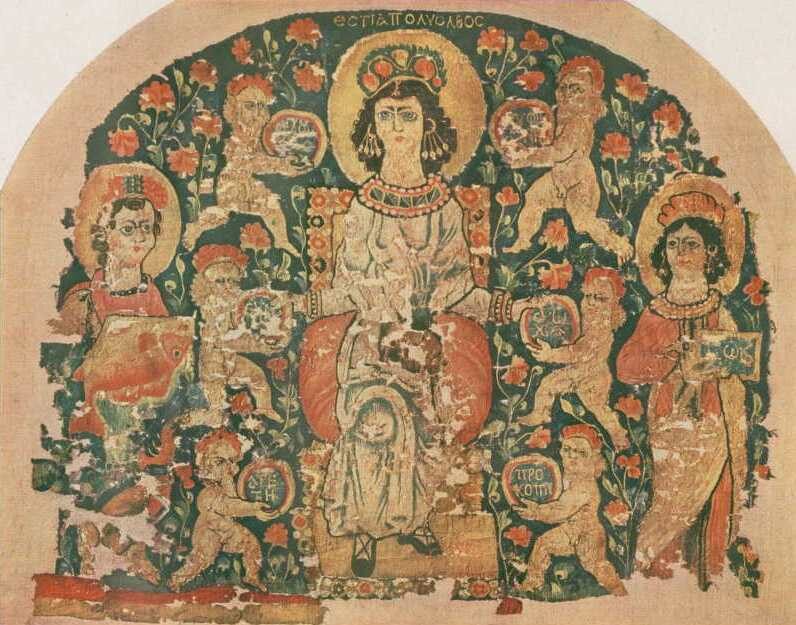
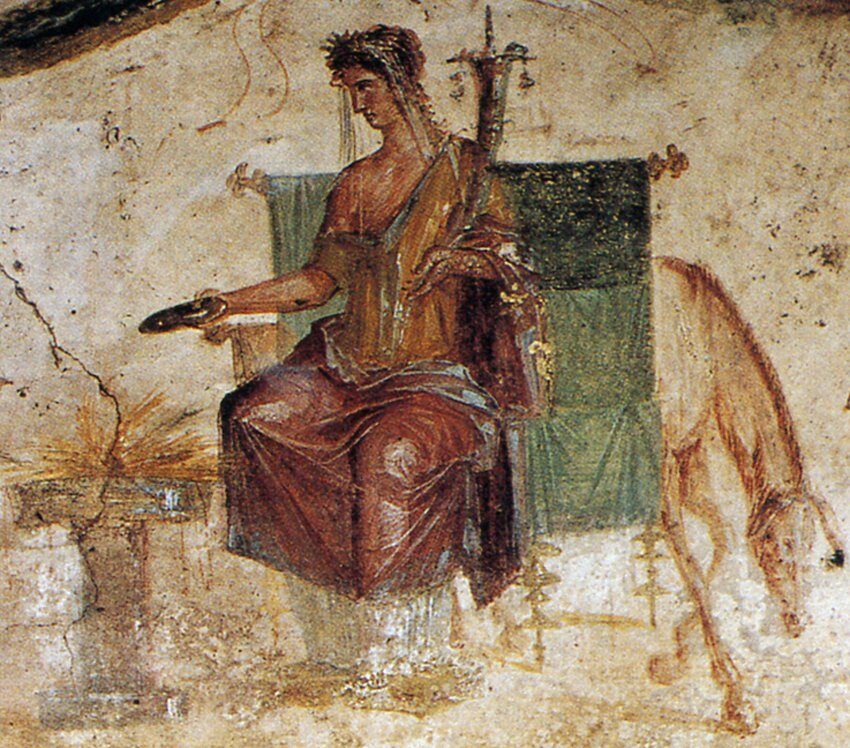
Hestia's near-total absence from narrative is not a gap to be filled but the point of her. She takes no side in the quarrels of the gods, joins no war, pursues no vengeance, and is scarcely ever depicted in the dramas of myth or the great vase-paintings. Her "action" is to remain: to keep the fire on Olympus while the others go out into the world of story. In art she is rarely shown, and when she is she stands veiled and still. A goddess who never leaves home is hard to tell tales about — but she is the one god present in every telling, since no feast at which those tales were sung could begin without a libation poured to her.
The disputed twelfth seat (a late, non-classical tradition)
A widely repeated modern claim holds that Hestia gave up her place among the Twelve Olympians to Dionysus, choosing to tend the divine hearth rather than sit in council. This should be flagged clearly: it is a late, post-classical notion with no basis in Homer or Hesiod, who never fix a single canonical list of Twelve that pits the two against each other. The uncertainty over whether Hestia or Dionysus "counted" as the twelfth reflects the fluidity of such lists — different cities and periods reckoned the Twelve differently — and the tidy story of a gracious abdication appears to be a later, largely modern narrativisation, popularised in handbooks, rather than an archaic myth. Hestia's dignity in genuine ancient cult never depended on a seat in any list; it rested on the hearth, which was everywhere.
Worship — Ancient
Cult centres: everywhere and nowhere
Hestia's worship inverts that of the other gods. She had few great temples, because she did not need them: her sanctuary was the hearth itself, and every hearth was hers. In the home she was the round hearthstone at the centre of the house, honoured at every meal. In the city she was the public hearth of the Prytaneion, the town-hall, where an undying fire was tended on behalf of the whole community; the Prytaneion of Athens held such a flame, as did that at Olympia (Pausanias 5.15.9). When Greeks founded a colony overseas, they carried fire kindled from the mother-city's public hearth to light the new one, so that the daughter-city's civic life was quite literally lit from Hestia's flame. At Delphi was kept a "common hearth of the Greeks," a shared centre for the whole Hellenic world. Temples with a cult-image of Hestia were rare — Pausanias notes one at Hermione with an altar but no statue — because the fire, not a figure, was the goddess.
Rites: the first and the last
Because she was the hearth, Hestia received a share in every sacrifice made to any god. The rite began with an offering to her and ended with a libation of wine in her name — "both first and last," as the Homeric Hymn 29 puts it — and at Olympia the Eleans are recorded sacrificing first to Hestia, before even Olympian Zeus (Pausanias 5.14.4). Her offerings were the plain, domestic gifts of the hearth: the first pour of wine, olive oil, barley, and the firstling portion drawn from whatever was being burnt for the greater gods. Two civic titles fixed her at the centre of the polis: Hestia Boulaia, honoured at the hearth of the council-chamber, and Hestia Prytanitis, of the common civic hearth. The household rite of the Amphidromia carried each newborn around the family fire to make it, formally, a member of the house.
Worship — Modern
Honouring Hestia today
For a modern Hellenic devotee, Hestia is the most natural of the gods to keep, because her shrine is simply the home. A clean hearth, a fireplace, a stove, or even a single candle set in a safe place can serve as her focus — the point is a tended flame at the centre of the household. Many begin and end their daily devotions with a brief word to Hestia, honouring the old rule that she comes first and last, before turning to any other god. Nothing elaborate is required: to keep a clean home, to light a flame with care and attention, and to acknowledge the hearth as sacred is already to honour her.
Offerings
Where the ancients gave Hestia the first portion of a burnt sacrifice, a modern devotee offers the same in gentle, domestic form — never literal slaughter. A small libation of wine or of water poured out for her, a little olive oil, some barley or a piece of bread, and a lit candle or lamp are wholly fitting. A fine and historically-grounded practice is to give her the first share: before a meal, set aside or pour out a little for Hestia, and let the last cup of the evening be hers as well, keeping the ancient rhythm of first and last.
Prayer & epithets
Call on Hestia by the aspect you need. Honour Hestia Prytanitis and Hestia Boulaia, of the common and the council hearth, when praying for the wellbeing of a community, a household, or a shared undertaking. Invoke her as the goddess of the first and last libation to open and close any act of worship rightly — the living meaning of "to begin from Hestia." Above all keep her as the Tender of the Sacred Fire: the quiet, unwandering presence at the centre of the home, who asks not for adventures in her honour but only that the flame be kept, the door be open to the guest, and the hearth be treated as holy.
Epithets & Cult Titles
- Prytanitis — Of the Prytaneion — goddess of the city's common hearth, the town-hall where the polis kept an undying public fire (alongside the well-attested Boulaia)
- Boulaia — Of the Council — worshipped at the hearth of the Athenian council-chamber (Bouleuterion), the fixed sacred centre around which the citizens deliberated
- Koine — The Common — the single shared hearth of a whole community, and the 'common hearth of the Greeks' kept at Delphi
- Prote kai Hystate — First and Last — a descriptive honorific, not a temple-title: she receives the first and the last libation at every feast (Homeric Hymn 29 to Hestia)
- Tender of the Sacred Fire — descriptive honorific — she who keeps the undying flame of hearth and temple and takes the first offering of every sacrifice (Homeric Hymns 24 and 29; Pausanias 5.14.4)
Sources & Variants
- Hesiod, Theogony 453–458 (Hestia eldest of Cronus and Rhea's children; swallowed first)
- Homeric Hymn 5 to Aphrodite, lines 21–32 (Poseidon and Apollo woo Hestia; her oath by the head of Zeus; her honour of the midst of the house and the first offering)
- Homeric Hymn 24 to Hestia (she tends the holy house of Apollo at Pytho / Delphi)
- Homeric Hymn 29 to Hestia (and Hermes) (highest honour in every dwelling; the first and last libation)
- Pindar, Nemean 11.1–9 (Hestia, keeper of the prytaneia, warden of the civic hearth)
- Pausanias, Description of Greece 5.14.4 (first sacrifice at Olympia made to Hestia); 5.15.9 (the Prytaneion and its perpetual fire); 2.35.1 (altar of Hestia at Hermione)
- Plato, Cratylus 401b–d (Hestia and the ritual of beginning; 'apo Hestias archesthai')
- Diodorus Siculus, Library of History 5.68.1 (Hestia and the founding of the household hearth; her honour in every home)
Gallery