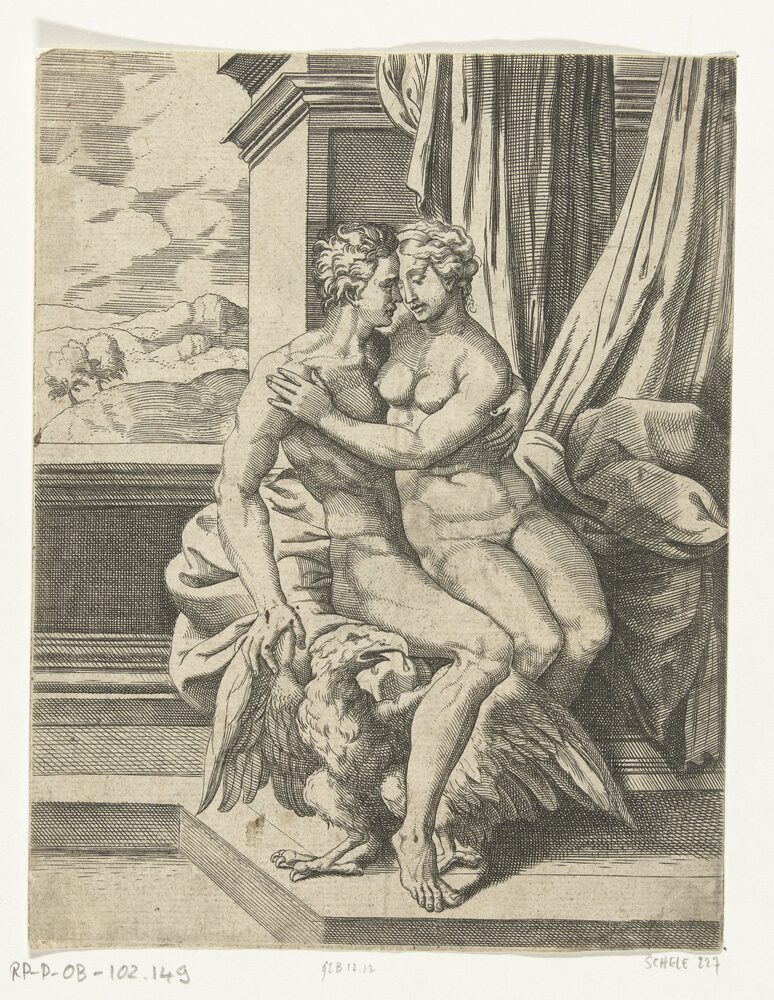
Alkmēnē
First Appearance
Alcmene enters Greek poetry already as the archetype of the virtuous mortal woman whom Zeus desired. The Shield of Heracles (ascribed to Hesiod) opens with her (lines 1–56): Alcmene, daughter of Electryon, who surpassed all women in beauty, stature, and wisdom, left her father's house with Amphitryon and came to Thebes; and there, on a single night, she lay with two — with Zeus who came in her husband's likeness, and with Amphitryon her true lord returned from war — and so conceived two sons at once, Heracles the mightier by Zeus and Iphicles by Amphitryon. Homer too knows her: in the Iliad (14.323–324) Zeus numbers "the wife of Amphitryon, who bore Heracles" among his loves, and in Book 19 (95–133) tells how Hera's cunning over Alcmene's childbed robbed her son of his birthright.
— Hesiod, Shield of Heracles 1–56; Homer, Iliad 14.323–324 and 19.95–133
Who They Are
Alcmene (alk-MEE-nee) is the mortal mother of Heracles, the greatest of the Greek heroes — a princess of the royal Perseid line, the faithful and beautiful wife of Amphitryon, and the woman whom Zeus desired above all others of her age. Her story stands at the hinge between the world of men and the world of the gods: an ordinary human wife caught up, through no fault of her own, in the designs of the king of heaven and the jealousy of his queen, and made by that the mother of a son who would himself become a god. She is counted here among the heroes because she belongs to the heroic age by blood and by motherhood, a mortal woman whose life the gods entered and never afterward left.
Her fame rests on two great scenes the Greeks never tired of telling. The first is her conception of twins by two fathers on a single extraordinary night — Heracles begotten by Zeus, who came to her disguised as her own husband, and Iphicles begotten by Amphitryon himself, returned from war. The second is the birth, and the long agony Hera forced upon it: the jealous queen of heaven, cheated of the honour Zeus had sworn for the child, held back Alcmene's labour to delay the birth, until a quick-witted servant broke the spell with a lie. Around these two scenes gather the themes that make Alcmene one of the most human figures in myth — faithfulness tested, suffering undeserved, and a mother's lifelong care for the children of her mighty son.
In the oldest tellings she is praised not only for her beauty but for her virtue: Hesiod sets her wisdom and her honour beside her loveliness, and the tradition holds her up as a model of the good wife — the woman who, deceived by a god wearing her husband's face, is yet guiltless, and whose faithfulness is never truly broken. Her later life as the protectress of Heracles' hunted children, and the honours paid her after death, complete the portrait of a mortal lifted, at the last, almost to the company of the blessed.
Mythology
Daughter of the Perseid house
Alcmene was born into the greatest royal line of the Argolid. Her father was Electryon, king of Mycenae and a son of Perseus and Andromeda; through him she was of the house of Perseus, the stock from which Zeus meant the ruler of the age to come. The Shield of Heracles names her Ēlektryōnē, "daughter of Electryon" (Hesiod, Shield 16), and praises her as surpassing "the tribe of women in beauty and in stature; and in wisdom none could vie with her of those whom mortal women bore to mortal men" (Shield 4–5). She was betrothed, and then wedded, to Amphitryon, likewise of the Perseid line — but a shadow lay over the marriage from the start. In a quarrel (in the fullest account, Apollodorus, Bibliotheca 2.4.6) Amphitryon had caused the death of Electryon, her father, whether by accident or in anger over the cattle of the sons of Pterelaus; and so the pair went into exile from Mycenae and came to Thebes, to the court of King Creon, who purified Amphitryon of the blood-guilt.
The vow that would not be broken
Alcmene had made a vow, and she held to it with the firmness that marks her character: she would not consummate the marriage until Amphitryon had avenged the deaths of her brothers, slain in the same cattle-war against the Teleboans (the people of Taphos, under Pterelaus). So Amphitryon went to war on her behalf, and while he was away at the fighting the designs of heaven bent toward her. Her refusal to yield until her kin were avenged is the mark the sources set on her — a woman of honour who would not be moved even by love, and whose faithfulness becomes the very thing the god must counterfeit in order to deceive her.
The long night: twins of two fathers
This is the heart of Alcmene's myth. On the night before Amphitryon's true return, Zeus came to her in the shape of her own husband — wearing Amphitryon's face and form, bearing (in the telling) tokens of the victory as proof, and recounting the war as though he had fought it — and Alcmene, believing she lay with her returning lord, received him without suspicion or fault. In the most famous version of the tale Zeus lengthened that single night threefold, bidding Night and the Sun hold back the dawn, so that the begetting of the hero he intended should have its full and leisurely measure; the long night became proverbial for the greatness of what was conceived in it. Then Amphitryon himself returned, that same night or the next, and lay with his wife in his own person. And so Alcmene conceived two sons at once, of two fathers — a superfetation, twins of divided seed: Heracles, the mightier, begotten by Zeus, and Iphicles, begotten by Amphitryon the mortal man (Hesiod, Shield of Heracles 48–56; Apollodorus, Bibliotheca 2.4.8). When Amphitryon afterward learned from the seer Teiresias that a god had been before him, he did not rage against his wife, for he saw she was guiltless of any faithlessness; the deceit had been the god's, not hers.
Hera's jealousy and the binding of the birth
When Alcmene's time drew near, Zeus in his pride proclaimed among the gods that on that day a child of his own blood, of the line of Perseus, would be born who should rule over all those around him. Hera, hearing the boast and knowing its cause, turned his own oath against him. She made Zeus swear the prophecy unbreakably — then went down and worked her cunning upon the birth-chamber. This is the scene Homer gives in the Iliad (19.95–133), where Agamemnon tells it to explain how even Zeus was once deceived by Delusion (Atē): Hera hastened the birth of Eurystheus, son of Sthenelus and grandson of Perseus, bringing him forth early at seven months, while she held back Alcmene's labour and kept the birth-goddesses from her. So Eurystheus was born first, and by Zeus's own unbreakable word gained the precedence meant for Heracles — the lordship for which Heracles would afterward have to labour as Eurystheus's servant, performing the famous Labours at that lesser man's command. In Zeus's rage at the trick he seized Delusion by the hair and cast her out of heaven forever; but the oath stood, and Hera had her way.
The crossed legs and the weasel: Galanthis
The cruelty of Hera's delay fell hardest on Alcmene herself, who lay in the pangs of labour unable to bring forth her child. In the fuller version of the scene the queen of heaven set Eileithyia, the goddess of childbirth (in some tellings the Moirai, the Fates, or the birth-goddesses together), outside the chamber door, where the goddess sat with her legs crossed and her fingers locked together, knotting the birth shut by sympathetic magic and so binding Alcmene fast in her pains. For seven days and nights (in the telling) Alcmene labored and could not deliver. Then a quick-witted servant-girl of the house, Galanthis (also called Galinthias), seeing her mistress in torment, ran out and cried aloud to the seated goddess that Alcmene had already given birth — that the child was born and the spell had failed. Startled, the birth-goddess sprang up and unlocked her hands in surprise; and the moment her clenched hands and crossed knees came apart, the binding broke, and Alcmene was delivered of Heracles. In anger at being tricked the goddess seized Galanthis by the hair and changed her into a weasel (Greek galē) — the beast whose name echoed the girl's own — and in some tellings doomed her to bring forth her young through her mouth, since it was by her mouth that she had deceived the goddess. (The transformation of Galanthis into a weasel is told most fully by the Roman poet Ovid, Metamorphoses 9.281–323 — a late and Roman retelling — but the trick of the crossed legs and the deceiving cry belongs to the older Greek tradition recorded by Pausanias (9.11.3), who at Thebes knew the servant as Historis, daughter of Teiresias, and tells how she tricked the birth-goddesses with a false cry of victory.)
The birth of the twins, and the serpents
So Heracles was born, and after him his half-brother Iphicles, the mortal twin — the two sons of the long night brought into the light together. The divided fatherhood showed itself at once in the famous scene of the cradle: when Hera, still unappeased, sent two great serpents into the nursery to destroy the infant Heracles, it was the child of Zeus who throttled them, one in each hand, laughing, while Iphicles, the mortal boy, screamed and scrambled from the cradle in terror. Thus the two natures Alcmene had conceived in one night were revealed — the god-begotten and the man-begotten — and Alcmene, rushing in at Iphicles' cry, found her stronger son already triumphant over Hera's first assault.
Protectress of the Heraclidae
Alcmene's story did not end with the birth of her son. She outlived Heracles himself, and in his death became the guardian of his persecuted children, the Heraclidae (Heracleidae), whom the same Eurystheus — the man whose early birth had robbed Heracles of his kingdom — hunted from city to city, fearing the vengeance of the hero's line. In Euripides' tragedy the Heracleidae, it is the aged Alcmene who stands at the center of the children's refuge at Athens, and who, when Eurystheus is at last taken prisoner after his defeat, demands his death with the fierce resolve of a mother and grandmother who has seen her family hounded for a lifetime. The old enmity of the birth-chamber is thus carried through to its end: the woman whose labour Hera bound lives to see the downfall of the rival whom that binding had raised.
Death and translation
In her great age Alcmene died at last — by one tradition on the road through Megara, journeying from Argos to Thebes, where the Megarians showed her tomb (Pausanias 1.41.1). But a strange and beautiful story attached itself to her passing. As her body was being carried out for burial, it was said, Hermes (at Zeus's bidding) stole it away, substituting a stone in the bier; and Alcmene herself was carried off to the Isles of the Blessed, the paradise at the world's edge where the favoured heroes dwell, and there given in marriage to Rhadamanthys, the just judge of the dead and son of Zeus. So the mortal mother of the greatest hero was spared the common lot of the dead and granted, at the end, a place among the blessed — a mortal woman translated, like her son, almost into the company of the immortals. (The tale of the stone in the bier and the removal to the Isles of the Blessed is preserved in the antiquarian tradition, among others by the mythographers drawing on Pherecydes.)
Worship — Ancient
A heroine honoured in Boeotia and the Argolid
Alcmene was never a goddess with temples and a priesthood of her own, but she received the honours proper to a heroine — a mortal of the great age revered after death at a tomb and hero-shrine. Her cult clustered where her son's did, above all in Thebes, the city of Heracles' birth, and in Boeotia more widely. Pausanias, travelling Greece in the second century AD, found competing claims to her resting-place: the Megarians showed her tomb on the road from Argos (Description of Greece 1.41.1), while at Haliartus in Boeotia and at Thebes the people likewise honoured her memory, and a disputed grave was pointed out and even, in one antiquarian story, opened in later centuries. Her honours were those of remembrance and libation rather than great public festival — the quiet reverence paid to the human ancestress of a divine line.
The mother at the heart of the Heracles cult
Because Heracles rose from hero to god — worshipped across the Greek world, and at Thebes above all as the city's own — the figures of his birth shared in his sanctity. Alcmene, Amphitryon, and the twin Iphicles belonged to the sacred story of Thebes, and the house of their dwelling and the place of the serpent-strangling were shown to visitors as holy ground. To honour the mother was to honour the origin of the god; and so Alcmene was kept in memory wherever the Theban Heracles was revered.
In poetry and the tragic stage
Alcmene's suffering and virtue made her a favourite of the poets. Beyond the Hesiodic Shield and Homer's account of the birth-delay, she was the subject of lost tragedies (an Alcmene is ascribed to several of the dramatists), and she stands as a living character on the surviving stage in Euripides' Heracleidae, where the aged mother guards her son's children and at last confronts their persecutor. Through these works she passed into the common imagination of the Greeks as the type of the good and faithful wife wronged by the gods through no fault of her own — her guiltlessness in the deception a point the tradition is careful always to affirm.
Worship — Modern
The faithful wife and the wronged mother
Alcmene is remembered today less through formal devotion than as one of the most sympathetic human figures in all of Greek myth — the mortal woman whom the gods used for their purposes and who bore the cost of it with dignity. A modern reader or devotee drawn to her finds in her story the virtues the Greeks themselves praised: faithfulness held firm even under deception, suffering endured without bitterness, and a mother's unbroken loyalty to her children and her children's children. She stands for the countless mortals of myth who are swept into the designs of the powerful and judged, rightly, as guiltless of what was done to them.
Childbirth, and the breaking of the knot
The scene of Alcmene's bound labour and its breaking has given her a quiet place among the figures associated with childbirth and its dangers. The image of the crossed legs and locked fingers that held the birth shut, and the cry that startled them open, speaks to the real terror of obstructed labour in the ancient world and the longing for its sudden release; the weasel of Galanthis became a creature bound up in Greek birth-lore. One who honours Alcmene might hold her in mind at the hard thresholds of birth and deliverance — the places where a single word, or a single act of courage by a bystander, changes everything.
The mother of a god
Above all Alcmene endures as the human mother of a divine son — the mortal woman at the root of the hero who became a god. Her translation to the Isles of the Blessed and her marriage to Rhadamanthys the just judge make her story one of grace given at the end: the ordinary life lifted, after all its suffering, into the company of the blessed. Read this way she is a figure of the dignity of mortal endurance, and of the mercy that can, in the oldest hopes of the Greeks, crown a faithful life.
Epithets & Cult Titles
- mētēr Hēraklēos (μήτηρ Ἡρακλέους) — Mother of Heracles — her defining title through all of Greek tradition; it is as the woman who bore the greatest of the heroes that she is remembered, named, and honoured
- Ēlektryōnē (Ἠλεκτρυώνη) — Daughter of Electryon — the patronymic by which Hesiod names her in the Shield of Heracles (Ἠλεκτρυώνη, line 16, 35); she was daughter of Electryon, king of Mycenae and son of Perseus, and so of the royal Perseid line
- most beautiful and most stately of women — Hesiod's own praise of her (Shield of Heracles 4–5): she surpassed the tribe of mortal women in beauty and in height, and in wisdom none born of mortal women could rival her — a virtue the poet sets beside her loveliness
Sources & Variants
- Hesiod, Shield of Heracles 1–56 (Alcmene daughter of Electryon, her beauty and wisdom, her coming to Thebes, and the conception of twins — Heracles by Zeus and Iphicles by Amphitryon — on a single night)
- Homer, Iliad 14.323–324 (Zeus names the wife of Amphitryon who bore Heracles among his loves)
- Homer, Iliad 19.95–133 (Hera's trick: Zeus's oath that a Perseid born that day should rule; the hastened birth of Eurystheus and the holding-back of Alcmene's labour; the casting-out of Atē)
- Pindar, Nemean 10.13–17 and Isthmian 7.5–7 (Alcmene mother of Heracles by Zeus; her honour in the poetic tradition)
- Pindar, Pythian 9.84–89 (the long night; Zeus and the begetting of Heracles)
- Apollodorus, Bibliotheca 2.4.5–8 (the full narrative: Electryon, the exile to Thebes, Alcmene's vow of vengeance, Zeus in Amphitryon's likeness and the lengthened night, the twin conception, Teiresias' revelation, the serpents in the cradle)
- Pausanias, Description of Greece 9.11.1–3 (Thebes: the house of Amphitryon, the birth-chamber, and Historis daughter of Teiresias who tricked the birth-goddesses with a false cry of delivery)
- Pausanias, Description of Greece 1.41.1 (Megara: the tomb of Alcmene, who died on the road from Argos to Thebes)
- Euripides, Heracleidae (the aged Alcmene protects the hunted children of Heracles and demands the death of the captured Eurystheus)
- Ovid, Metamorphoses 9.273–323 (Alcmene's own telling of the bound birth and the transformation of the servant Galanthis into a weasel) — Roman retelling
Gallery