Dēïáneira
First Appearance
Deianira belongs to the oldest stratum of the Heracles saga: the Hesiodic Catalogue of Women (fr. 25 M–W) already names her as daughter of Oeneus and wife of Heracles, and tells how the poisoned robe destroyed him. Bacchylides (Ode 16) sings the moment she sends the fatal garment, stricken by rumour of Iole. But it is Sophocles who gives her a soul: his Women of Trachis (Trachiniai) makes her the tragedy's center — a loving, fearful, anxious wife whose single desperate act, meant to save her marriage, destroys the man she loves and then herself.
— Hesiod, Catalogue of Women (fr. 25 Merkelbach–West); Bacchylides, Ode 16; Sophocles, Women of Trachis (Trachiniai)
Who They Are
Deianira (day-ah-NY-rah) is the wife of Heracles, and the most sorrowful figure in all his long story — the gentle, faithful woman who, meaning only to keep her husband's love, becomes without knowing it the instrument of his death. Her Greek name, Dēïáneira, means "man-destroyer" or "husband-destroyer," and the tragedy of her life is that this dark name came true against everything she intended. She is counted here among the heroes as a heroine of the great tragic houses: a princess of Calydon, won in a monstrous combat, carried across a deadly river, and in the end the unwitting killer of the greatest hero of the Greeks.
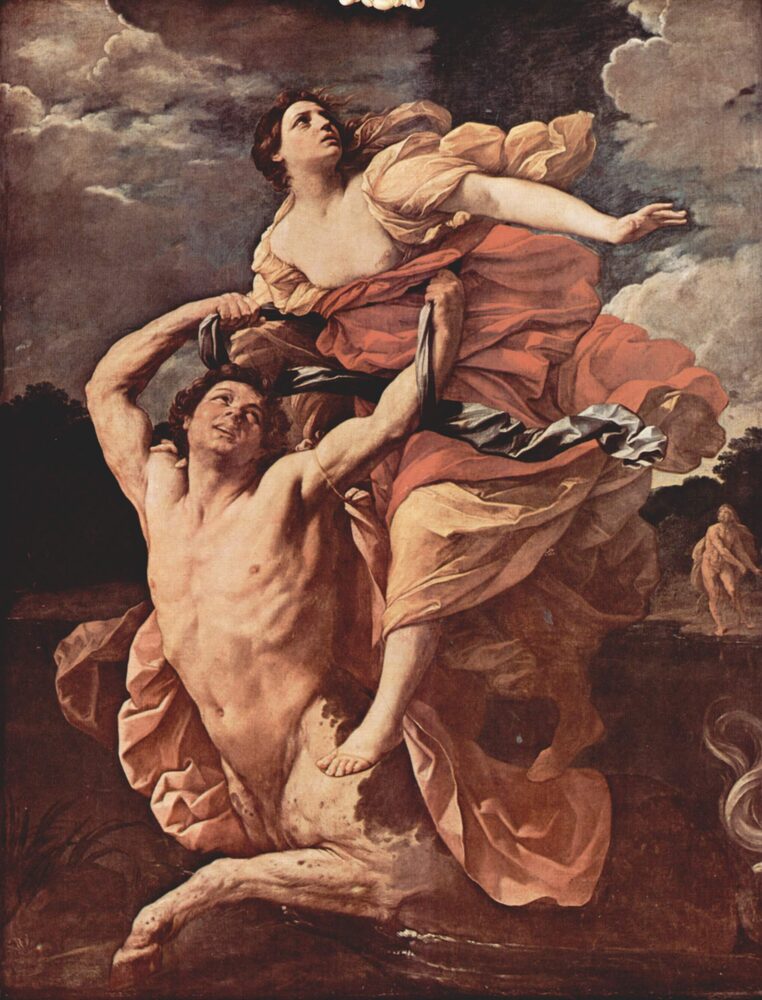
Her story moves in three great scenes. First, the winning: Heracles comes to Calydon to claim her and must wrestle the river-god Achelous, who fights in the shapes of a bull and a serpent, until the hero breaks off one of his horns and so wins the bride. Second, the river and the centaur: carrying Deianira home, Heracles entrusts her crossing of the river Euenos to the centaur Nessus, who tries to violate her midstream; Heracles shoots him with an arrow steeped in the venom of the Hydra, and the dying centaur, in revenge, tricks Deianira into saving his poisoned blood as a supposed "love-charm." Third, the robe: years later, when Heracles sends home the captive princess Iole, the frightened Deianira anoints a robe with Nessus's blood and sends it to her husband to win back his love — but the blood is Hydra-venom, and it burns Heracles to death; learning the truth, she kills herself in grief.
Hers is the purest Greek tragedy of the unwitting, loving killer — the hand that strikes meaning only tenderness. Sophocles made her the heart of his Women of Trachis, and no other figure in myth shows so sharply the terrible distance the Greeks felt between what a person intends and what fate makes of the deed.
Mythology
The princess of Calydon
Deianira was a daughter of the royal house of Calydon in Aetolia, the western Greek land famous for its tragic line. Her father was Oeneus, king of Calydon, in whose reign the great Calydonian Boar ravaged the land; her brother was Meleager, the hero who slew that boar and died by his own mother's hand. (Some ancient writers, troubled by so wild a wife for so wild a hero, whispered instead that her true father was the wine-god Dionysus, who was said to have loved Oeneus's queen Althaea — but the oldest and standard line, from the Hesiodic Catalogue of Women fr. 25 M–W onward, makes her plainly the daughter of Oeneus.) Into this house, marked already by the sorrows of Meleager, came Heracles to seek a bride.
There is a strange and tender thread in the older telling, given fullest by Bacchylides (Ode 5.165–175): when Heracles descended to the house of Hades, he met the shade of Meleager, and the dead hero begged him to marry his sister Deianira, left unprotected in Calydon. (In Homer's Underworld, Odysseus — not Heracles — meets Heracles's own shade at Odyssey 11.601 ff.; the Meleager–Deianira plea belongs to Bacchylides.) Whether moved by that plea or simply drawn by her, Heracles came for her hand.
Won by the breaking of a horn: the fight with Achelous
Deianira had another suitor, and no ordinary one: Achelous, the great river-god of the largest river in Greece, who came to woo her in monstrous forms. Heracles came against him, and the two fought for the bride. Achelous was a shape-shifter, as rivers are: he met the hero first in his own form, then as a writhing serpent, and then as a great bull — and it was in the bull's shape that Heracles at last overthrew him, wrestling him down and breaking off one of his horns (Sophocles, Women of Trachis 9–27, where Deianira herself remembers with horror the terror of being fought over; the combat is named already by Archilochus, the earliest poet to tell of Heracles and Achelous, and retold by Apollodorus, Bibliotheca 1.8.1 and 2.7.5). So Heracles won her — not with courtship but with violence, the bride looking on in dread as two powers tore at each other for her. Later writers said the broken horn became the Cornucopia, the horn of plenty; but Sophocles keeps the darker note, that Deianira's whole life began in being fought over like a prize.
The river and the centaur Nessus
Heracles took Deianira as his wife and set out for home. Their way led to the river Euenos, broad and swift, where the centaur Nessus served as ferryman, carrying travellers across on his back for a fee. Heracles crossed by his own strength, but gave Deianira to Nessus to carry over. Midstream — or as he set her down on the far bank — the centaur, inflamed by her beauty, tried to carry her off and violate her. Deianira cried out, and Heracles, though already across, turned and loosed an arrow dipped in the venom of the Lernaean Hydra, striking Nessus through (Sophocles, Women of Trachis 555–577; Apollodorus, Bibliotheca 2.7.6).
As the centaur lay dying, he worked a slow and terrible revenge. He told Deianira — gently, as a dying gift — to gather up the blood clotting about his wound (in some tellings mingled with the seed or the venom from the arrow), and to keep it, for it was a love-charm (Greek philtron): if ever Heracles's love strayed to another woman, she had only to smear this blood upon a garment he would wear, and his heart would turn to her alone and love no woman but her again. Deianira, young and fearful and not yet doubting, believed him and kept the blood hidden away, as the centaur knew she would. It was no charm. It was the Hydra's poison, carried in the centaur's own poisoned blood — a weapon left in the hands of the one who loved Heracles most, to be used exactly when her love was most afraid.
The captive Iole and the robe
Years passed, and Deianira lived as the faithful wife of Heracles, bearing his children — among them the son Hyllus — and waiting through his long absences on his labours and wars. Then came the day that undid her. Heracles, having sacked the city of Oechalia, sent home a company of captive women, and Deianira learned that among them was Iole, the young princess of that city — and that Heracles had sacked Oechalia for love of her, and meant to bring her into his own house not as a slave but as a second bride (Sophocles, Women of Trachis 248–334, the recognition of Iole; the war for Iole is old, named in the Hesiodic tradition and in Apollodorus 2.7.7).
Deianira did not rage. This is the heart of Sophocles's portrait: she pities the captive girl, and she pities herself, and she will not strike at either of them. But she is afraid — afraid of growing old beside a husband whose love has gone to a younger woman — and she remembers the centaur's blood, kept all these years. Thinking it a charm to win back love and harming no one, she takes a fine robe, anoints it in secret with Nessus's blood, seals it in a casket, and sends it by her herald to Heracles, that he may wear it when he makes his thank-offering to the gods. She sends it as a gift of love. It is the Hydra's death.
The burning of Heracles
A sign warned her too late. The tuft of wool with which she had spread the blood on the robe, cast carelessly into the sunlight, hissed and crumbled into dust and foamed upon the ground (Sophocles, Women of Trachis 672–704) — and Deianira understood, with horror, that what she had sent was no love-charm but poison. Already it was done. When Heracles put on the robe and the warmth of his body and the altar-fire woke the venom, it clung to his flesh and burned like fire, eating into him, tearing his skin when he tried to rip it away, so that the strongest of men was brought down in agony by a thing he could not fight (Women of Trachis 749–812; Apollodorus 2.7.7). In his torment he had himself carried to Mount Oeta, and there he built — or had built — his own funeral pyre, and lay down upon it, and was burned; and from the pyre, in the version that crowns the saga, he was taken up to the gods and made immortal, reconciled at last with Hera and wedded to Hebe. But that apotheosis belongs to Heracles's story; in Deianira's it is only the fire that matters, and the knowledge of whose hand had lit it.
The death of Deianira
When Deianira learned the full truth — that she had killed her husband, that the centaur's dying gift had been a trap, that her love had been made the weapon of her love's destruction — she said almost nothing. In Sophocles (Women of Trachis 874–946) she goes silently into the house, past the marriage-bed, and takes a sword (in some accounts a noose), and kills herself — dying before Heracles dies, before she can be accused, before her son Hyllus, who first cursed her and then learned she was guiltless, can reach her. Hers is the quietest death in tragedy and one of the most terrible: the faithful wife who harmed no one on purpose, destroyed by her own tenderness and her own fear, taking her life not in guilt but in the unbearable knowledge of what she has unknowingly done. The dying centaur's revenge is complete: through the one who loved Heracles best, he has destroyed them both.
Worship — Ancient
A figure of tragedy, not of cult
Deianira had no temples, priesthood, or civic festivals of her own; she was not a goddess but a heroine of saga and of the tragic stage, honoured in memory and in poetry rather than in any formal rite. Her life belonged to the great cycle of Heracles, the most widely worshipped of all heroes, and to the tragic legend of the house of Calydon; wherever those stories were told, she was remembered as the sorrowful wife whose love proved fatal.
The Women of Trachis and the stage
Her true home in the ancient world was the theatre. Sophocles's Women of Trachis (Trachiniai), probably of the mid fifth century BC, is the great monument of her story and the fullest ancient portrait of her character — a drama built entirely around the gap between her loving intention and its monstrous result, and around the slow approach of a fate set in motion long before, at the river crossing. Before Sophocles the tale was already old: the Hesiodic Catalogue of Women (fr. 25 M–W) told of the poisoned robe, Bacchylides (Ode 16) sang the moment of its sending, and Archilochus, earliest of all, told of the wrestling-match with Achelous. Through tragedy above all, Deianira became for the Greeks the type of the well-meaning hand that works ruin.
In the mythographers
The prose handbooks preserved her story for later ages. Apollodorus (Bibliotheca 1.8.1 names her among the children of Oeneus; 2.7.5–7 gives the fight with Achelous, the killing of Nessus, the charm, the robe, and the deaths) set the standard connected narrative, and it is largely through such summaries, beside Sophocles, that the full shape of her tragedy came down.
Worship — Modern
The tragedy of the unwitting hand
Deianira speaks to the modern reader as perhaps the clearest image in all myth of a terrible truth the Greeks felt deeply — that love and fear can make us the instruments of the very harm we most dread, and that intention and outcome can part ways with ruinous completeness. She is no villain and no fool; she is a faithful, frightened, loving woman who reaches for a charm to save her marriage and finds she has reached for poison. For anyone who has ever done harm while meaning only good, hers is the patron story: the hand that strikes in tenderness, the gift that kills.
Patron of the betrayed and the self-blaming
A reader drawn to Deianira might remember her at the hearth of a marriage, or in grief for love gone wrong, or in the particular anguish of those who blame themselves for an outcome they never willed. She stands for the faithful who are not spared by their faithfulness, and for the grief that comes not from guilt but from consequence. Her restraint — that she pities the captive Iole, that she will not rage, that she dies in silence rather than defend herself — gives her a dignity that outlasts the horror of her act.
On the stage and the page
Above all Deianira lives wherever Sophocles's Women of Trachis is read or performed, a play that modern audiences have come to see as one of the subtlest studies of character in Greek tragedy. She endures too in the long afterlife of the Heracles legend — in painting and poetry the river crossing and the treacherous centaur recur again and again — and in the proverbial power of her story: the "shirt of Nessus" has become, in many languages, a byword for a fatal gift, a destruction one cannot tear away from one's own flesh.
Epithets & Cult Titles
- the Calydonian (ἡ Καλυδωνία) — Of Calydon — the Aetolian city of her father Oeneus, the royal house into which she was born and from which Heracles won her; her whole story carries the mark of that western land and its tragic line
- ill-fated bride — A reader's title for her defining situation — the woman won by a hero through a monstrous combat, courted in blood and carried across a deadly river at the very threshold of her marriage
- the unwitting destroyer — The heart of her tragedy — she who, meaning only to win back her husband's love, becomes the instrument of his agonizing death; the name Dēïáneira, 'man-destroyer,' turned true against her own intention
Sources & Variants
- Hesiod, Catalogue of Women fr. 25 Merkelbach–West (Deianira daughter of Oeneus, wife of Heracles, and the poisoned robe that destroyed him — the oldest stratum of the tale)
- Bacchylides, Ode 16 (Deianira sends the fatal garment, stricken by the rumour of Iole; the earliest surviving lyric treatment of the robe)
- Sophocles, Women of Trachis (Trachiniai) — the central source: the wrestling with Achelous (9–27), the killing of Nessus and his charm (555–577), the arrival of Iole (248–334), the warning of the hissing wool (672–704), the burning of Heracles (749–812), and Deianira's silent suicide (874–946)
- Apollodorus, Bibliotheca 1.8.1 (Deianira among the children of Oeneus of Calydon); 2.7.5 (the fight with Achelous for her hand); 2.7.6 (Nessus at the river Euenos and his dying deceit); 2.7.7 (the sack of Oechalia for Iole, the robe, the death of Heracles on Oeta, and Deianira's suicide)
- Archilochus (fragments; the earliest poet to tell of Heracles wrestling the river-god Achelous for Deianira)
- Bacchylides, Ode 5.165–175 (Heracles meets Meleager's shade in Hades, who begs him to wed his sister Deianira); Homer, Odyssey 11.601 ff. (Odysseus meets Heracles's shade — the Underworld context)
- Ovid, Metamorphoses 9.1–272 (Achelous's own account of the fight, the death of Nessus, the robe, and the burning and apotheosis of Heracles) — Roman retelling
- Ovid, Heroides 9 (the verse letter of Deianira to Heracles, lamenting Iole before she learns the robe's effect) — Roman
Gallery