Europa
First Appearance
Europa first appears in Homer as one of the loves Zeus recalls to Hera on Mount Ida: the "daughter of far-famed Phoinix," who bore him Minos and godlike Rhadamanthys (Iliad 14.321–322) — here her father is Phoinix rather than Agenor, one of the oldest variants. The pseudo-Hesiodic Catalogue of Women (fr. 140–141 M–W) already tells the shape of the myth: Zeus in the form of a bull carrying her over the sea to Crete, the sons she bore, and her marriage to the Cretan king Asterion. The fullest early narrative, however, is the Hellenistic epyllion (little epic) of Moschus, the Europa (2nd century BCE), which lingers on her dream, her flower-gathering, the gentle bull, and the wondrous crossing of the sea.
— Homer, Iliad 14.321–322; Hesiod (Catalogue of Women, fr. 140–141 Merkelbach–West); Moschus, Europa (Hellenistic)
Who They Are
Europa (yoo-ROH-puh) is the Phoenician princess whom Zeus, in the shape of a gentle white bull, carried across the sea to Crete — one of the best-loved and most-painted of all the god's love stories, and one of the gentlest. Where many of Zeus's unions are told as seizures, this one is remembered as a scene of wonder: a girl gathering flowers in a seaside meadow, a beautiful tame bull that kneels for her among her father's cattle, the garland she winds about his horns, and the marvel of the crossing, when the bull takes to the waves and bears her over a sea that grows calm to carry them, the sea-gods rising around to escort the strange procession to the far shore.
She matters far beyond that one enchanted morning, for almost everything downstream of it became foundational. On Crete she bore Zeus three sons — Minos, Rhadamanthys, and Sarpedon — and so became the ancestress of the whole Cretan royal house: Minos the great king and lawgiver of Knossos, Rhadamanthys the byword for justice, and both of them, for their fairness in life, made judges of the dead in the world below. Married afterward to the Cretan king Asterion, who raised her sons as his own, she stands at the head of Crete's kings as their honoured foremother, and Crete kept her memory in cult long after.
And her name outgrew her story altogether. Her brother Cadmus, sent from Phoenicia to find her and forbidden to come home without her, searched in vain, and in his wandering founded the city of Thebes — so that the search for Europa seeded one of the great cities of Greece. Meanwhile her own name drifted onto the map: the land mass west and north of the Aegean came, in time, to be called Europe, after her. A girl's name from the Phoenician coast now belongs to a continent, and few in the modern world who use the word know they are speaking the name of a princess and a bull.
Mythology
The maiden of Tyre and the dream
Europa was a princess of the Phoenician coast — of Tyre or Sidon, the great seafaring cities of what is now Lebanon — and a daughter, the commonest tradition says, of King Agenor (though Homer and some early poets make her father Phoinix instead, from whom Phoenicia takes its name; the two are tangled in the old genealogies, sometimes father and son, sometimes the same figure under two names). Her brothers were Cadmus, Cilix, and Phoinix — princes who would give their names to Cilicia and Phoenicia — and it is her bond with Cadmus that shapes the second half of her story.
The Hellenistic poet Moschus, whose Europa is the loveliest telling we have, opens not with the god but with a dream. On the night before, Europa dreams that two lands, two continents in the shape of two women, are struggling over her — one the Asian land of her birth, the other a nameless land across the sea — and the stranger-land wins her and carries her off, saying that Zeus has fated her to be hers. She wakes troubled but shakes the dream away, and goes down with her companions to the meadows by the sea to gather flowers in the fresh morning, filling her basket with narcissus and hyacinth, violet and rose. It is the picture the painters loved: a girl among flowers at the water's edge, unknowing, on the last ordinary morning of her old life.
The white bull among the herds
Zeus saw her there and was overcome with love — and, the story tells gently, would not come to her as the thunder-god, which would only have frightened her. Instead he took a shape that could walk unremarked among her father's cattle grazing near the shore: he became a bull, but such a bull as no herd ever held. His hide was white as fresh snow or new milk, his horns small and curved and gleaming like a crescent moon, a silver circle shining on his brow; and about him hung a sweetness, a fragrance sweeter than the meadow itself. Above all he was gentle. Where the other bulls were beasts to keep clear of, this one came softly across the grass and knelt, mild as a lamb, at Europa's feet.
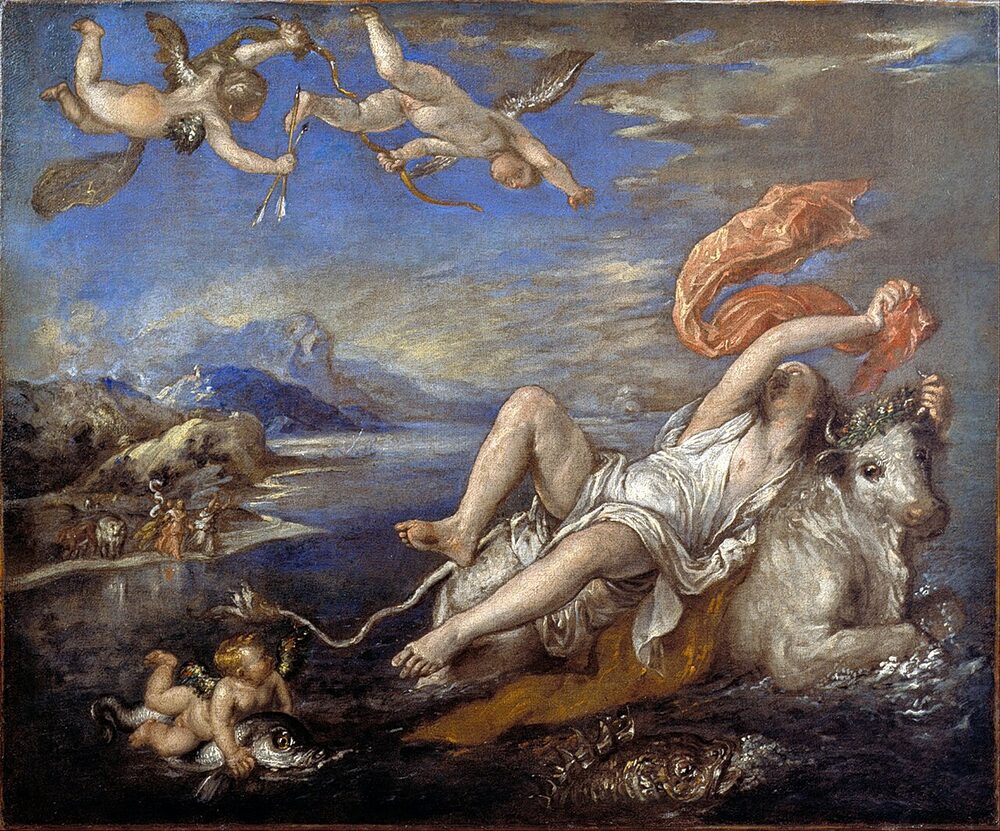
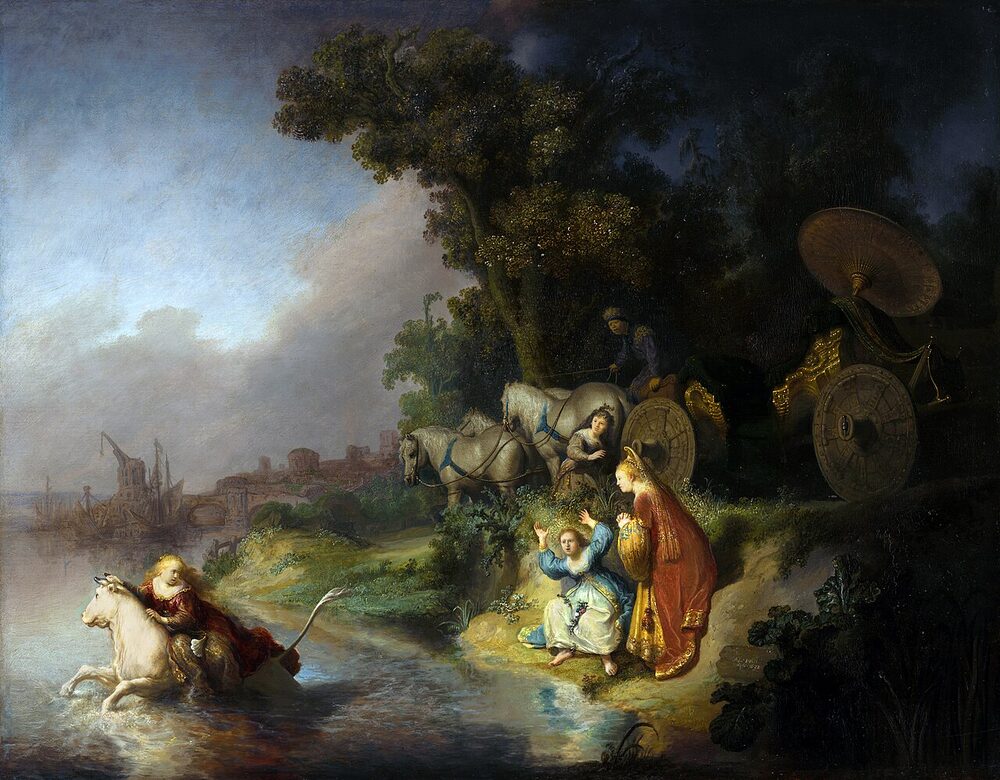
She was charmed, not afraid. She stroked his flanks and wiped the foam gently from his mouth; she wound a garland of her gathered flowers about his horns; she played with him as with a great tame pet. And when the kneeling bull seemed to invite her — offering his broad white back — she climbed up and sat astride him, laughing, calling to her friends to come and ride too, never dreaming what she rode. That is the moment art fixes above all others: Europa on the bull's back, one hand on a horn and one gathering her wind-blown robe, garlanded, delighted, the instant before the sea.
The crossing of the sea
For the bull rose from his knees and walked — first slowly, then quickening — down toward the water, and stepped into the waves, and swam. By the time Europa understood, the shore was already sliding away behind her and there was nothing to do but hold fast to the horn and to the streaming garland, her feet drawn up from the water, her robe billowing behind her like a sail. And here the story turns from alarm to marvel. The sea itself grew smooth to carry the god and his rider; the waves lay down; and out of the deep rose an escort of wonder — dolphins arching alongside, the Nereids, the sea-nymphs, riding on the backs of sea-beasts, and Poseidon himself going before to still the water for his brother, and the trumpeter Triton blowing his conch-shell horn to lead the strange sea-procession on. Europa, borne over the waves by a bull that no longer troubled to hide the something more than beast in him, at last spoke to him across the water — begging to know who he was and where he was carrying her — and the bull, or the god within it, answered gently: fear nothing; he was Zeus; she was crossing to Crete, where she would bear him famous sons and be the wife of a great king. So the fear passed, and the crossing became a kind of triumph, and the white bull brought her at last to the shore of Crete.
Crete, the sons of Zeus, and the marriage to Asterion
On Crete the god put off the bull and lay with Europa — under a great plane tree near Gortyn, the Cretans said, a tree that in memory of the union was ever after evergreen, never shedding its leaves as other planes do (a local wonder the ancients recorded, and one the coins of Gortyn pictured: Europa seated in the branches of her plane). Of that union she bore three sons: Minos, who became the mighty king of Knossos, the lawgiver whose sea-power ruled the Aegean and in whose palace stood the Labyrinth; Rhadamanthys, so just that his name became a proverb for fairness; and (in the tradition Hesiod and later writers follow) Sarpedon. For their justice in life, Minos and Rhadamanthys were remembered as judges of the dead in the world below, weighing the souls that came before them — so that the sons of the flower-gathering girl became the arbiters of the underworld. (Homer, it should be said, gives Sarpedon a different mother and makes him a Lycian ally of Troy; the mythographers reconciled the two by counting more than one Sarpedon across the generations.)
Zeus did not stay, as gods do not; but he did not leave Europa unprovided. He gave her in marriage to Asterion (also called Asterius), the king of Crete, who took her to wife and, having no children of his own, raised her three sons by the god as his own heirs — which is how Minos came to inherit the Cretan throne. Zeus gave her, too, three wedding-gifts that guard the island in story: the bronze man Talos, who strode round Crete's shores to keep off raiders; a hound that never lost its quarry; and a javelin that never missed. So the Phoenician princess became a queen of Crete and the mother of its royal line, and Crete honoured her ever after as its foremother.
Cadmus's search and the founding of Thebes
Back in Phoenicia her loss struck grief into her house, for no one had seen a god — only a lost girl and a vanished bull. Her father sent her brothers out to find her, and above all Cadmus, with a hard charge laid on them: they were not to return home unless they brought Europa back. It was a command impossible to obey, for how does one find a girl carried off by Zeus over the sea? The brothers searched and could not find her, and one by one, unable to face their father empty-handed, they settled in the foreign lands where their searching had brought them.
Cadmus's search became one of the great foundation-journeys of Greek myth. Wandering in his hopeless quest for his sister, he came at last to Delphi to ask the oracle where she was; and the god told him to give up the search — he would never find Europa — and instead to follow a certain cow, and where she lay down to rest, there to found a city. Cadmus obeyed, followed the cow across Boeotia, and where she sank down he founded the citadel that became Thebes, sowing the famous dragon's teeth from which the first Thebans sprang. So the search for Europa, which failed in its own object, seeded one of the greatest cities of Greece — the city of Oedipus and of the Seven — and Cadmus, who set out to bring his sister home, never went home at all. (His own story, and all that grew from the founding of Thebes, is told on his page.)
The name that became a continent
There remains the strangest afterlife of all: her name became the name of a continent. Just how this happened the ancient writers could not really say, and Herodotus frankly puzzles over it — noting (4.45) that no one knows why three land masses should bear three women's names, and that Europe in particular seems to be called after a woman of Asia who never even set foot in the land now called Europe, but stopped at Crete. He tells elsewhere (1.2) a coolly rationalised version in which Europa's carrying-off was simply one raid in a tit-for-tat of Greek and Phoenician kidnappings that the Persians blamed for the long enmity of East and West — a striking, unromantic reading of the flower-strewn myth. However it truly came about, the name stuck and spread, until the word that began as a girl's name — perhaps "broad-face," perhaps "wide-eyed" — settled over the whole western land as Europe. It is her quietest and largest monument: a princess who was carried west across the sea, and whose name went on travelling west long after she had stopped.
Worship — Ancient
A foremother honoured, chiefly on Crete
Europa was honoured less as a goddess in her own right than as the revered foremother of the Cretan kings — the mortal woman a god had loved, from whom the island's whole royal house descended. Her worship therefore clustered where her myth came to rest: on Crete, and above all at Gortyn, where the great plane tree of her union with Zeus was shown and where her cult was kept. The Cretans, who traced their kings back through Minos to her, had every reason to keep the memory of the woman at the root of their line, and they did.
The Hellotia and the myrtle wreath
Her chief festival was the Hellotia, kept in her honour under her Cretan cult-name Hellotis. Our best notice of it comes from Athenaeus (Deipnosophistae 15.678a–b), quoting the local writer Seleucus: at the festival the Cretans carried in procession an enormous wreath of myrtle, some twenty cubits across, which was itself called the hellotis — and, the tradition held, the bones of Europa herself were bound up within it. Whether or not any relics were truly carried, the detail tells us how the festival was understood: as the honouring of a real ancestress whose remains the island claimed, gathered into a green crown of myrtle and borne through the streets. (The same title Hellotis attached at Corinth to Athena, whose Hellotia were celebrated with a torch-race; the ancients themselves debated whether the two festivals shared more than a name.)
The plane tree and the coins of Gortyn
Cult and story were anchored in the land itself. At Gortyn stood the evergreen plane, the tree beneath which the god and Europa were said to have lain, kept green (the ancients believed) by that union when every other plane went bare in winter — a living local wonder that Theophrastus and Pliny both note. The city put her on its money: coins of Gortyn show Europa seated in the branches of her plane tree, sometimes with the bull or with Zeus's eagle beside her, a civic emblem proclaiming the town's foundational myth. Between the festival, the tree, and the coinage, Europa was for the Cretans not a distant tale but a presence woven into their landscape and their civic identity.
Worship — Modern
An ancestress, honoured differently
Europa is a mortal heroine and foremother rather than an Olympian, and a modern devotee honours her in that key: not as a goddess who orders the world, but as a beloved ancestral figure whose story is cherished and whose memory is kept. She sits naturally at the heart of any honouring of Crete and its old royal line, and of the wider theme her myth carries — the crossing into a new life, the leaving of one shore for another, the wonder and fear of being borne somewhere one did not choose to go and finding it become home.
Offerings and remembrance
The offerings that suit her are the gentle ones her story is full of: flowers — the narcissus and violet, hyacinth and rose she was gathering when the god came — laid or scattered in her memory; a libation of wine or of water poured out; a garland of myrtle in remembrance of the great hellotis wreath the Cretans carried for her. A candle lit and her story told keeps her name alive; and because her tale turns on the bond of a brother who searched the world for her and never gave up until an oracle forced him to, acts of steady loyalty to family sit well as a living tribute — as they do for so many of these figures.
Her name on every map
More than through any formal cult, though, Europa lives on in the one place the ancients could not have foreseen: on every map and in every atlas of the world. The continent of Europe carries her name still — spoken countless times a day by people who have never heard of the bull or the crossing — so that a Phoenician girl gathering flowers by the sea has become, without anyone quite deciding it, one of the most-named human beings who ever lived. She endures too in art, where the "Rape of Europa" (an old title for what the Greeks told as a scene of wonder more than terror) has been painted by Titian, Veronese, Rembrandt, and countless others, and where her image on the bull was chosen, in our own time, for the common face of the euro and the seal of European institutions — the ancient princess pressed once more into the service of naming the continent that is hers.
Epithets & Cult Titles
- Hellotis (Ἑλλωτίς) — Her Cretan cult name — under this title she was honoured at Gortyn and Crete with the festival called the Hellotia, in which a huge wreath of myrtle, itself named the hellotis, was carried in procession
- Europe the Continent (Εὐρώπη) — 'Europe' — descriptive of the way her name outgrew her story: the third part of the known world, the land mass west and north of the Aegean, came in time to be called after her, so that a Phoenician girl's name now belongs to a continent
- the Phoenician Maiden (Φοίνισσα) — 'The Phoenician woman' — a descriptive byname marking her birth in Tyre or Sidon on the eastern (Phoenician) coast, from where she was carried west to Crete
- Mother of the Judges — A descriptive honour drawn from her children — the mother of Minos and Rhadamanthys, who for their justice in life were made judges of the dead in the world below
Sources & Variants
- Homer, Iliad 14.321–322 (Zeus recalls loving the daughter of Phoinix, mother of Minos and Rhadamanthys)
- Hesiod, Catalogue of Women fr. 140–141 Merkelbach–West (Zeus as bull carries Europa to Crete; her sons; her marriage to Asterion)
- Moschus, Europa (Hellenistic epyllion, 2nd century BCE — the fullest early narrative: the dream, the flower-gathering, the gentle bull, and the sea-crossing)
- Bacchylides and Aeschylus: Aeschylus, Carians or Europa fr. 99 Radt (Europa speaks of her union and her sons) — a fragmentary tragedy
- Herodotus 1.2 (Europa's carrying-off rationalised as one of a chain of Greek–Phoenician abductions); 4.45 (Herodotus' puzzlement over why the continent bears her name)
- Apollodorus, Bibliotheca 3.1.1–2 (Europa, Zeus as bull, Crete, the three sons, the marriage to Asterion, and Zeus's gifts of Talos, the hound, and the javelin); 3.4.1 (Cadmus's search and the founding of Thebes)
- Ovid, Metamorphoses 2.833–875 (Jupiter as the bull and the abduction) and 3.1–5 (Cadmus sent to seek her, never to return without her) — Roman retelling
- Athenaeus, Deipnosophistae 15.678a–b (the Cretan Hellotia and the myrtle wreath called the hellotis, said to hold Europa's bones)
- Theophrastus, Enquiry into Plants 1.9.5 and Pliny, Natural History 12.11 (the evergreen plane of Gortyn, kept green by the union of Zeus and Europa)
Gallery