Ganymēdēs
First Appearance
Ganymede enters Greek poetry already famous, in Homer's roll-call of the kings of Troy (Iliad 20.231–235): born to Tros, he was "the most beautiful of mortal men," and for that beauty "the gods caught him up to be Zeus's wine-pourer, and to dwell among the immortals." The Homeric Hymn to Aphrodite (202–217) tells the same tale more tenderly: wise Zeus snatched golden Ganymede away for his loveliness that he might live with the gods and pour their drink, and — to comfort his grieving father — gave in recompense a team of storm-swift immortal horses, and had Hermes explain that the boy would be deathless and ageless, spared the sorrows of men; and the father rejoiced.
— Homer, Iliad 20.231–235; Homeric Hymn to Aphrodite (5) 202–217
Who They Are
Ganymede (GAN-ih-meed) is the beautiful Trojan prince whom Zeus loved and carried up to Olympus to be the cup-bearer of the gods — the youth who pours the nectar for the immortals at their feasts, the loveliest mortal who ever lived, and, in the end, a figure set among the stars. He is counted here among the heroes because he began as a mortal man, a prince of the royal house of Troy; but he is a hero with a destiny unlike any other, for his story is not one of quest or monster or war, but of being chosen, taken up, and made deathless for the sake of his beauty alone.
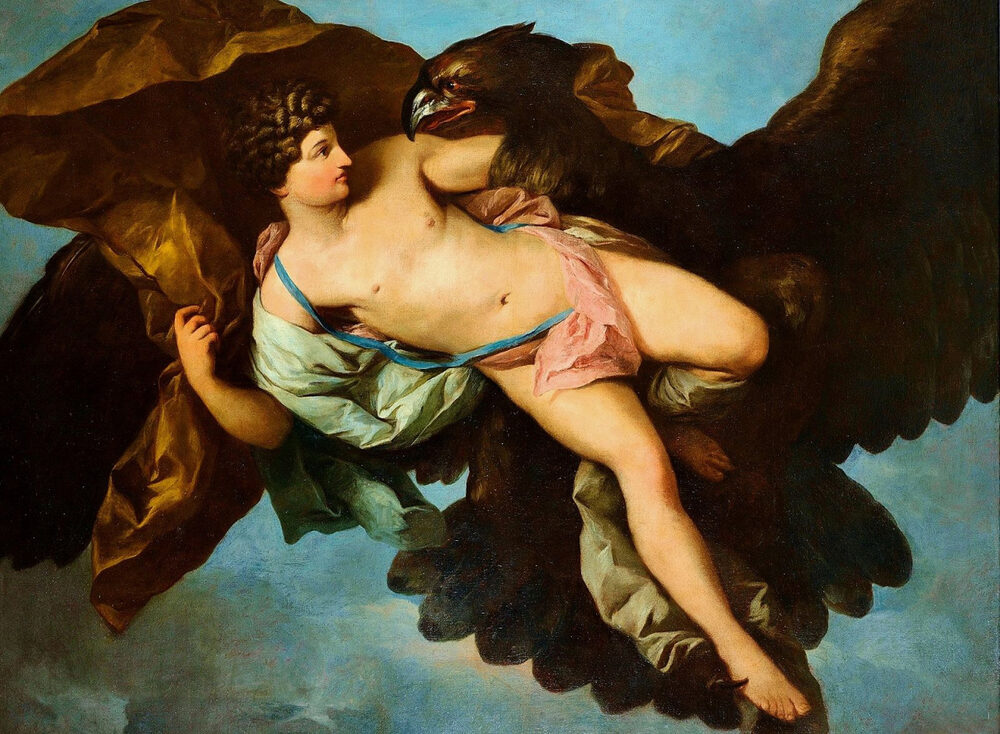
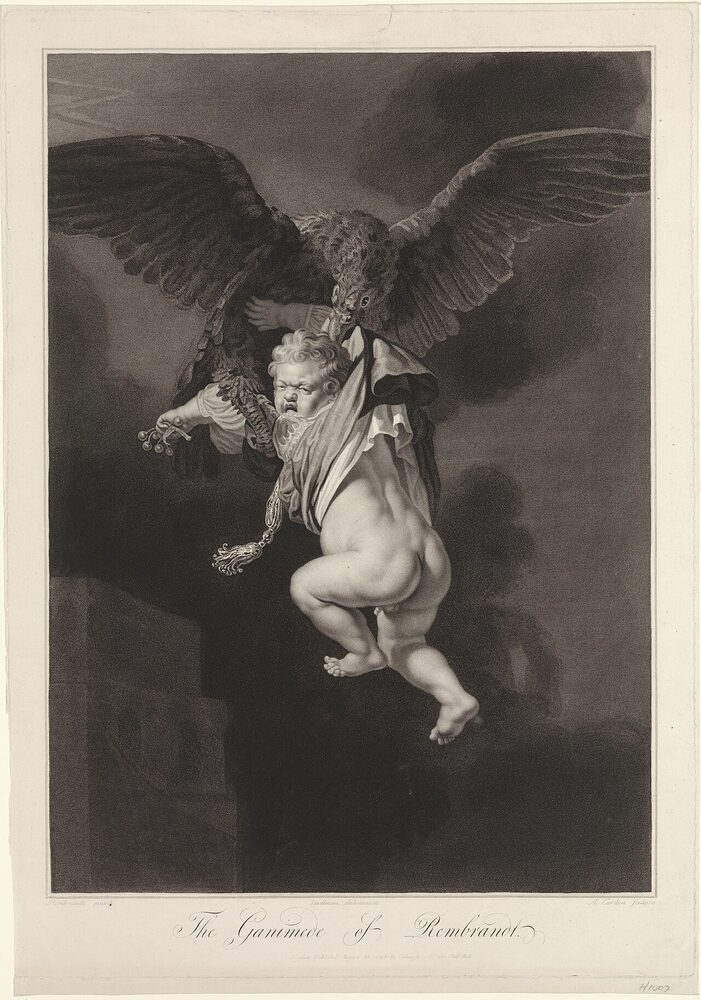
His myth is short and strange and much-loved: a boy tending his father's flocks on the slopes of Mount Ida above Troy is seen from heaven by Zeus, who desires him and sends down an eagle — or comes himself in the eagle's shape — to bear him aloft into the sky. There Ganymede takes the wine-jug from the hand of the goddess Hebe and becomes the pourer of the gods' cup forever, ageless and undying among the immortals. It is a tale the Greeks told to explain three things at once: why the fairest of mortals vanished young, where the poured cup of the gods came from, and what the bright youth with the water-jar in the sky was doing there.
(Content note: the ancient Greeks understood this myth through their own custom of the love of an older man for a youth, and treated Zeus and Ganymede as its divine pattern. That framing carries an age and power difference that a modern reader will rightly notice. This page follows the ancient sources plainly but with restraint, and keeps to the dignity the Greeks themselves gave the story — Ganymede taken up not to be used and discarded, but to be honoured, made immortal, and set among the gods and the stars.)
Mythology
The prince on Mount Ida
Ganymede was a son of the royal house of Troy — in the oldest and fullest telling (Homer, Iliad 20.231–235) the son of Tros, the king who gave the city its name, though later writers sometimes make him the son of Laomedon, or of Ilus or Assaracus, the other kings of that same Trojan line. (These differing fathers are all names within one royal family, and the ancient sources do not agree on which generation he belonged to.) He was, by every account, the most beautiful of all mortal men who ever lived — a loveliness so great that it drew the eyes of heaven itself. In the familiar picture he is a boy or a young man tending the flocks on the high pastures of Mount Ida, the mountain above Troy, when his fate came down out of the sky.
Caught up by the gods
Zeus, greatest of the gods, saw Ganymede and desired to have him among the immortals. In the earliest sources it is simply "the gods" who catch him up (Homer says the gods snatched him away for his beauty, to be Zeus's wine-pourer); in the version that became standard, Zeus sends down a great eagle — his own sacred bird — to seize the boy in its talons and carry him gently up to Olympus, and in some tellings Zeus takes the eagle's shape himself and descends as the bird. Either way the eagle bears Ganymede aloft from the mountain into the sky, and the boy is set down among the gods, deathless and unaging, to live with them forever. It is one of the very few Greek myths in which a mortal is taken up bodily into heaven, not in death but in life — a rapture, not a dying.
The love of Zeus, in the Greek understanding
(Content note: the following describes the ancient framing of the story.) The Greeks did not hide that Zeus took Ganymede out of love, and they understood that love through a custom of their own society — the bond, honoured especially in the aristocratic world, between an older man (the erastēs, the lover) and a youth (the erōmenos, the beloved). In their eyes the love of Zeus for Ganymede was the divine archetype of that custom, its highest and first example, the pattern in heaven of a bond they knew on earth. This is said here plainly because the sources say it plainly, and because without it the myth cannot be honestly understood; but it is said with restraint. The Greeks themselves stressed not appetite but honour and elevation — the beloved boy raised up, made immortal, and given a place of dignity at the gods' own table. That is the note the best of the ancient tellings hold, and it is the note kept here.
The cup-bearer of the gods
Ganymede's place on Olympus was a settled office: he became the cup-bearer (Greek oinochoos, "wine-pourer") of the gods, the one who fills the immortals' cups with nectar, their drink, at the divine feast. In this he took over the duty that had belonged to Hebe, the goddess of youth and daughter of Zeus and Hera, who had poured the gods' cup before him. (Later tellers liked to say Hebe gave up the office when she married Heracles; the plain fact the myth records is that the beautiful Trojan youth now held it.) The image of Ganymede lifting the jug to fill a waiting cup became one of the most beloved in Greek art, painted again and again on the very drinking-vessels that carried wine at human feasts — the mortal drinker meeting, on the cup at his lips, the divine pourer himself.
The recompense: the immortal horses
One of the tenderest strands of the myth is that Zeus did not simply take the boy and forget the grieving father. To console Tros, who mourned his vanished son, Zeus sent word (by Hermes, the messenger) of what had become of Ganymede — that he was now deathless and ageless, spared the aging and sorrow of mortal men, a cup-bearer among the gods — and gave the father a princely recompense. In the Homeric Hymn to Aphrodite (202–217) and in the Iliad (5.265–267; 20.232–235) the gift is a team of storm-swift immortal horses, "such as carry the gods," the finest that ever ran; some later writers speak instead of a golden vine, wrought by Hephaestus, given in exchange for the boy. Either way the point is the same — the loss was answered with a gift beyond price, and the father, hearing his son would never die, "rejoiced," and mourned no more. It is a rare grace-note in Greek myth, where the gods so often simply take.
Hera's jealousy
Not everyone on Olympus welcomed the newcomer. Hera, the wife of Zeus, resented Ganymede — both as a rival for her husband's affection and as a slight to her daughter Hebe, whose honoured office he had taken. Her displeasure runs quietly beneath several tellings, and some ancient writers counted it among the many Trojan grievances that would one day incline her against the city of Troy in the great war. In this Ganymede shares the fate of many whom Zeus loved: to be caught between the king of the gods' desire and the anger of his queen.
Set among the stars: Aquarius and Aquila
In the end Ganymede was given the highest of honours — a place in the sky. He was set among the stars as the constellation Aquarius, the Water-Bearer (Greek Hydrochoös, "the water-pourer"), shown as a youth tipping a great jar from which a stream of water falls — the celestial image of the cup-bearer forever pouring. And the eagle that bore him aloft was set beside him as the neighbouring constellation Aquila, the Eagle, so that the two figures of the myth, the boy and the bird that carried him, still stand together in the heavens. Thus the story that began on a mountain above Troy ends in the stars, and the pourer of the gods' cup pours out water from the sky above the earth he left.
Worship — Ancient
A figure of the feast, not the temple
Ganymede was not, in the ordinary sense, a god with his own temples, priesthood, and civic festivals; he was a beloved figure of myth and of the drinking-feast rather than an object of great public cult. His true "worship," if it may be called that, lived in the symposion — the Greek drinking-gathering — and in the rite of the libation, the pouring-out of wine to the gods before men drank. As the divine cup-bearer, the archetype of the one who pours, he belonged to that moment by nature; the very act of lifting and pouring the cup recalled him.
The cup that bore his image
If Ganymede had a shrine, it was the drinking-cup itself. Greek potters and painters returned to him constantly, and vases from the sixth and fifth centuries BC show the eagle bearing the boy aloft, or Ganymede standing with his cockerel (a courting-gift) and his hoop, or the youth pouring at the feast. The drinker who raised such a cup met the image of the perfect cup-bearer on the vessel in his own hand — a quiet, everyday devotion of a kind, the god's pattern present at the human table.
In philosophy and allegory
Later Greek thinkers took the rapture of Ganymede as more than a love-story. Some read the boy "caught up to the gods" as an image of the soul's ascent — Plato names him in the Phaedrus (255c) in the context of love and the soul, and later Platonist and, still later, Christian allegorists read the taking-up of Ganymede as a figure of the mind lifted toward the divine. In this reading the myth became a symbol of elevation itself: the mortal drawn up out of the earthly and made to dwell among things immortal. The name even reached the sky twice over, for the largest moon of Jupiter — the planet named for the Roman Zeus — bears the name Ganymede to this day.
Worship — Modern
A youth honoured at the poured cup
Ganymede is remembered today less through formal cult than through the two places the ancients set him — the feast and the sky. A modern devotee drawn to him might honour him exactly where the Greeks did: at the moment of the libation, the pouring-out of wine or drink. To pour a measure and give it wholly — onto the earth, or into a cup lifted and not drained for oneself — is to stand for a moment in the office Ganymede holds forever, the pourer who gives the gods their share. He sits well as a patron of the shared table, of hospitality and the graces of the feast, and of youthful beauty raised to something lasting.
The dignity of the story
Because his myth carries the ancient frame of the love of an older man for a youth, a thoughtful modern honouring of Ganymede holds to the dignity the best of the old tellings gave him — not the note of appetite, but the note of elevation: a mortal chosen, made deathless, and given an honoured place. Read this way his story speaks of being lifted beyond the losses of ordinary life, of grief answered by grace (the mourning father consoled with an immortal gift), and of a beauty that is not used up but taken up.
Aquarius, Aquila, and a moon
Above all Ganymede lives on in the sky, where anyone may find him. He is the zodiac constellation Aquarius, the Water-Bearer, pouring his endless stream; the eagle that carried him stands beside him as Aquila; and far out among the planets the greatest moon of Jupiter bears his name, the largest moon in the whole solar system — larger even than the planet Mercury. The Trojan boy taken up for his beauty is written across the heavens three times over, and every account of the winter sky or of Jupiter's moons keeps his name alive, the cup-bearer still pouring, still aloft, still among the immortal things.
Epithets & Cult Titles
- oinochoos theōn (οἰνοχόος θεῶν) — Cup-bearer / wine-pourer of the gods — his defining office on Olympus, where he fills the cups of the immortals with nectar, the post he took over from the goddess Hebe
- Aquarius / Hydrochoös (Ὑδροχόος) — The Water-Pourer — his name as a constellation, the zodiac sign shown as a youth tipping a jar of water from the sky; the Greek Hydrochoös ('water-pourer') answers the Latin Aquarius
- kallistos thnētōn (κάλλιστος θνητῶν) — Most beautiful of mortal men — Homer's own phrase for him (Iliad 20.233), the reason the gods desired to have him among themselves
- Catamitus — His Latin name, a Roman reshaping of 'Ganymēdēs' — the form from which, by a long and unhappy road, the English word 'catamite' descends; used here only to note the Roman line of the name, not to lead with it
Sources & Variants
- Homer, Iliad 20.231–235 (Ganymede son of Tros, most beautiful of mortals, caught up by the gods to be Zeus's wine-pourer)
- Homer, Iliad 5.265–267 (the immortal horses given to Tros in recompense for the boy)
- Homeric Hymn to Aphrodite (5) 202–217 (Zeus snatches golden Ganymede for his beauty; the gift of storm-swift horses; Hermes' comfort that the boy is deathless and ageless; the father's joy)
- Pindar, Olympian 1.43–45 and Olympian 10.104–105 (Ganymede taken up to Zeus)
- Plato, Phaedrus 255c (Ganymede named in the discourse on love and the soul)
- Apollodorus, Bibliotheca 2.5.9 and 3.12.2 (Ganymede carried off by Zeus to be cup-bearer; his Trojan parentage and the recompense to his father)
- Theognis 1345–1348 (the love of Zeus for Ganymede named as an example)
- Virgil, Aeneid 1.28 and 5.252–257 (the rape of Ganymede by the eagle, and Hera's/Juno's resentment) — Roman
- Ovid, Metamorphoses 10.155–161 (Zeus as the eagle carries off Ganymede; he still pours Jove's cup against Juno's will) — Roman retelling
- Eratosthenes/Hyginus, on the constellations (Ganymede as Aquarius the Water-Pourer and the eagle as Aquila)
Gallery