Io
First Appearance
Io steps fully into literature in the tragedies of Aeschylus. In Prometheus Bound (561–886) she comes onstage still in torment, horned and stung, and the chained Titan Prometheus foretells the whole long road of her wandering — the seas and mountains she must cross before she finds rest in Egypt and her descendants win their freedom. The Suppliants (291–315, 531–589), whose chorus are Io's own descendants the Danaids, retells her transformation, the watch of Argus, the gadfly, and the gentle touch by which Zeus restores her by the Nile. Behind Aeschylus lie older accounts: the pseudo-Hesiodic Catalogue of Women handled Io and the slaying of Argus, and the lyric poet Bacchylides (Ode 19) sang of Io, Argus, and Hermes for an Athenian audience.
— Aeschylus, Prometheus Bound 561–886 and Suppliants 291–315, 531–589; pseudo-Hesiod, Catalogue of Women / Aegimius frr.; Bacchylides 19
Who They Are
Io (EYE-oh) is one of the great wanderers of Greek myth — a mortal princess and priestess whose story is a single long journey of suffering that ends, against all expectation, in rest and honour. She was a daughter of the Argive royal house, of the ancient line of the river-god Inachus, and she served as priestess of Hera at the goddess's great temple near Argos. That nearness to Hera was her undoing, for it was there that Zeus saw her and desired her, and the jealousy of his wife fell on Io with terrible weight.
What happens to Io is not a hero's quest that she chooses but a punishment she is made to endure: (Content note: her story turns on a god's unwanted attention, a forced transformation, and a long torment.) She is changed into a white heifer, set under the watch of a monster who never fully sleeps, and then driven half-mad across the whole known world by the sting of a maddening fly. She has no weapon, no divine gifts lent to her, no companions — only her endurance. In this she is the mirror-image of a hero like Perseus: where he is carried through danger by the favour of the gods, Io is hunted through it by the anger of one, and her greatness is measured not by what she conquers but by what she survives.
Her wandering left its mark on the map of the Greek world itself. The Ionian Sea and the Bosporus — the "ox-ford," the ford of the cow — were said by the poets to be named from Io's crossings, so that her journey is written into geography. And her ending redeems the whole ordeal: restored to herself by a touch of Zeus's hand on the banks of the Nile, she settles in Egypt, bears a son named Epaphus, and becomes the founding mother of a mighty line — a line that runs down through Danaus and the Danaids to Perseus and, in time, to Heracles. The Greeks came to identify the settled Io with the horned Egyptian goddess Isis, so that the tormented heifer finds her final home as a queen and a goddess in a foreign land.
Mythology
The priestess at Argos
Io was a daughter of Inachus, the river-god who was the first king and eponymous river of Argos, at the head of the oldest of all Argive genealogies. (Some early accounts made her father Iasus or Peiren instead, but the Argive tradition that Aeschylus follows makes her the child of Inachus, the river itself.) She grew up to serve as priestess of Hera at the goddess's great sanctuary, the Heraion, that stood between Argos and Mycenae — the most honoured woman's office in the land, and the very heart of Hera's worship. It was in this role, close to the goddess she served, that Io drew the eye of Zeus.
The god's desire and the white heifer
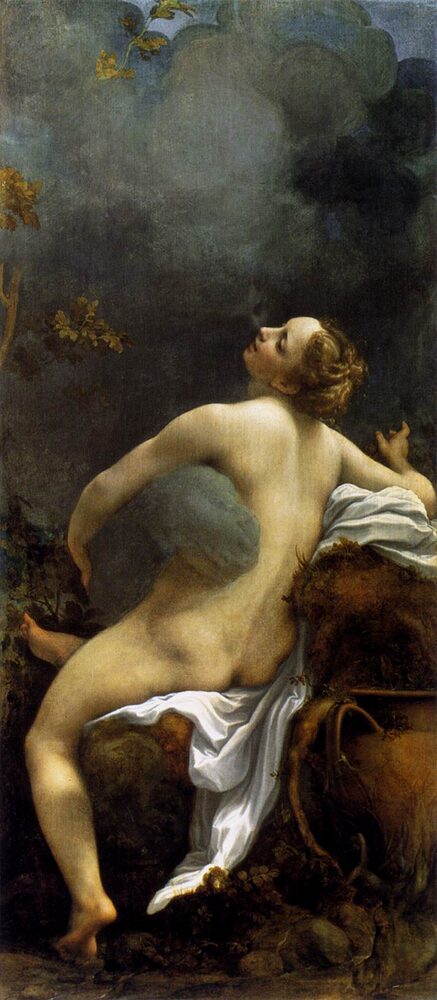
(Content note: the transformation that follows is a violation worked on Io against her will, whichever version is told.) Zeus desired Io, and to hide her from the ever-watchful jealousy of his wife he wrapped the land of Argos in a thick cloud by day and came to her under its cover. But Hera was not deceived: seeing a strange darkness on the plain at noon, she came down to it, and Zeus — caught, and desperate to conceal what he had done — changed Io in an instant into a gleaming white heifer, a cow, hoping to pass her off as an innocent beast of the fields.
Hera was not fooled by that either. In the fullest telling she praised the lovely heifer and asked Zeus to give it to her as a gift — and he, unable to refuse without confessing everything, had to hand Io over to the very goddess who hated her. (In another strand of the tradition it is Hera herself who works the transformation, in punishment; the poets differ, but in every version Io ends as a cow in Hera's power.) So the maiden became a dumb animal, unable to speak her grief, penned in the possession of her enemy.
Argus of the hundred eyes
To make certain the heifer could never be stolen back or restored, Hera set a guard over her: Argus Panoptes — "Argus the All-Seeing" — a giant herdsman with a hundred eyes set all over his body, of which only ever a few closed in sleep at once while the rest kept watch. No creature could be more perfectly kept, for Argus could see in every direction at all hours, waking and sleeping by turns and never wholly blind. He tethered the white cow to an olive tree in the sacred grove of Mycenae and watched her without rest, and Io — a princess and a priestess trapped in a beast's body — grazed and suffered under his unsleeping eyes, able only to low where once she had spoken.
Hermes and the slaying of Argus
Zeus could not bear to leave her so, and he sent his son Hermes — the cleverest and most persuasive of the gods, and for this deed given the byname Argeiphontes, "Slayer of Argus" — to free her. Hermes came down disguised as a wandering herdsman, sat beside the hundred-eyed giant, and set to lulling him: he played long and drowsily upon the reed-pipe, the syrinx, and told him slow, unending stories (in the famous version, the tale of how the pipe itself was made from the nymph Syrinx), until one by one, eye after eye, all hundred of Argus's eyes at last fell shut in sleep. Then Hermes struck and killed him. Hera, in grief for her faithful watchman, gathered up the hundred eyes of the dead Argus and set them into the tail of her sacred bird, the peacock, where they shine to this day — which is why the peacock's tail is spangled with a hundred watching eyes. (This last touch — the eyes in the peacock's tail — is first found in the Roman poet Ovid, and is a later flowering of the story.)
The gadfly and the endless wandering
Io was loosed from the olive tree, but she was not yet free. In her fury Hera sent against her one last torment — a gadfly, the biting fly the Greeks called the oistros, whose maddening sting drives cattle into a frenzy. (The word oistros came to mean a goad of frenzy or mad desire, and this is its root.) Stung again and again and half-crazed with pain, the heifer Io broke into a headlong run and could not stop, driven on and on with no rest across an enormous stretch of the world. In Aeschylus's Prometheus Bound the chained Titan foretells her whole route: over the mountains and rivers of the north, past the edge of the Scythian lands, by the country of the fierce Amazons, and on through region after region of strange and dangerous peoples, the frantic cow running always ahead of the sting.
Her crossings named the world she fled through. When she swam the strait that divides Europe from Asia, that water was called ever after the Bosporus — the "ox-ford," the ford of the cow — from Io's passage; and the Ionian Sea, the poets said, took its name from Io as well, from the shore where she first plunged into its waters. So the map of the Greek world still carries, in its place-names, the track of one tormented woman's flight.
Prometheus and the promise of an end
A crucial meeting comes in the middle of her wandering. Driven to the crag at the edge of the earth where Prometheus hangs chained for his gift of fire to mankind, the two sufferers meet — he bound and unmoving, she unable to stop moving — and each recognises a fellow victim of the gods' cruelty. Prometheus, who knows what is to come, lays out for Io the long road still ahead of her, names the seas and lands she must yet cross, and then gives her the one thing she has lacked: hope. He foretells that her wandering will end at last in Egypt, by the Nile; that Zeus will restore her there with a gentle touch and no more terror; that she will bear a son; and that from her line, many generations on, will come the hero who frees Prometheus himself. Her private ordeal, he shows her, is a thread in a much longer story with an appointed and better end.
Egypt, the touch of Zeus, and the birth of Epaphus
So it came to pass. Io's flight ended at last on the banks of the Nile in Egypt, at the very edge of the inhabited world. There Zeus came to her — no longer in the darkness of concealment, but openly — and, as the poets tell it, restored her to her own human shape by the touch of his hand and a breath, quieting the madness and lifting the beast-form from her. (Aeschylus makes much of the gentleness of this restoring touch, as the opposite of all the violence Io has endured; from that touch her son takes his name.) In Egypt Io bore a son, Epaphus — whose name the Greeks heard as "Touch," from the touch by which she was healed and by which he was conceived. Settled and safe at the journey's end, Io lived out her life in Egypt as a queen, and there she was honoured; the Greeks identified her with the great Egyptian goddess Isis, who was likewise shown crowned with a cow's horns and a disk, so that the horned wanderer became, in her final country, a horned goddess.
The line of Io: Danaus, Perseus, and Heracles
Io's true importance to Greek myth is what came after her. From her son Epaphus descended a great and branching family: Epaphus fathered Libya, and Libya bore to Poseidon a son, Belus, whose twin sons were Danaus and Aegyptus. Danaus and his fifty daughters, the Danaids, fled Egypt and came back across the sea to Argos — the very city Io had been driven from — as suppliants seeking refuge (the subject of Aeschylus's Suppliants, whose chorus of Danaids call Io their ancestress). From the line of Danaus at Argos came, in time, Danaë, and from Danaë and Zeus came Perseus, the Gorgon-slayer and founder of Mycenae (whose story is told on his own page). And from the Perseid house descended Alcmene, who bore Heracles to Zeus. So the greatest heroes of the Argive world — Perseus and, through him, Heracles — trace their ancestry back across the sea to a single Argive priestess turned into a cow and driven to Egypt. Io's wandering, which looked like nothing but suffering, was in truth the founding journey of a whole heroic line: the thread runs unbroken from the heifer at the olive tree to the hero among the stars.
Worship — Ancient
An ancestress remembered, not a goddess worshipped in Greece
In the Greek world Io was honoured less as a deity in her own right than as a founding ancestress — the mythic mother of the oldest Argive royal line, and a figure woven into the charter-legends of Argos. Her home in cult was the shadow of the great sanctuary of Hera near Argos, the Heraion, where she had served as priestess before her ordeal; her story explained and adorned that most Argive of holy places, and the Argives kept her name in the genealogies by which they traced their kings back to the river Inachus. Travellers to the Argolid, such as Pausanias, recorded the local memory of Inachus, Io, and their descendants as part of the deep past of the land.
The Egyptian identity: Io as Isis
Io's most striking cult afterlife lay abroad. Because her wandering ended in Egypt and she settled there, Greek writers from Herodotus onward identified her with the Egyptian goddess Isis — an identification made natural by the fact that Isis was depicted crowned with cow's horns framing a sun-disk, exactly the horned form Io wore as a heifer. Through this equation the honours paid to Isis in Egypt (and later throughout the Graeco-Roman world) could be understood by Greeks as continuing the story of Io: the maiden who came to the Nile as a hunted cow was worshipped there as a great goddess. In this way Io belongs to the wider ancient habit of matching Greek and foreign divinities, and she became one of the principal bridges by which Greeks made sense of Egyptian religion.
Story as her true monument
More than through altars of her own, Io lived in the ancient world through the retelling of her tale — sung by lyric poets, dramatised on the Athenian stage by Aeschylus, and carved and painted in scenes of Argus, Hermes, and the horned girl. The moment of Hermes and the hundred-eyed Argus was a favourite of vase-painters, and the image of the horned Io kept her story before the eyes of ancient audiences. Her cult, such as it was, was inseparable from her narrative: to keep Io was to tell her.
Worship — Modern
A figure of endurance
Io is not an Olympian to be petitioned but a mortal sufferer transformed and finally redeemed, and those drawn to her today honour her much as the ancients honoured a great ancestress — by keeping and telling her story, and by holding her up as a figure of endurance through undeserved suffering. A devotee moved by Io might set a small remembrance of her — an image of a white heifer, a crescent of horns, a single peacock feather with its watching eye — and honour her as a patron of those who must simply outlast a long ordeal, and of exiles and wanderers who are far from home and hoping for rest.
Offerings and remembrance
Fitting gifts for Io follow the gentle shape of her own story's ending. A libation of clear water poured out in memory of the Nile that received her, or of milk in token of the heifer, sits well; so does a candle lit and a few words that carry her from the olive tree to the touch of restoration by the river. Because Io's tale ends not in triumph over an enemy but in healing and homecoming, acts of patience and of kindness to those who are lost or displaced make a living tribute to her. Where a devotee also honours Isis, Io's Egyptian identity offers a natural point of continuity between the two.
Written in the sea and the sky
Io's clearest memorial in the modern world is the one the ancients left in the map and the heavens. The Ionian Sea and the Bosporus still carry, in their names, the track of her wandering, so that anyone who crosses those waters passes along Io's road. And her name was given to one of the four great moons of Jupiter — Io, the innermost of the Galilean moons discovered by Galileo, forever circling the planet the Romans named for Jupiter, the Zeus who loved her. The tormented heifer of Argos now orbits, small and bright, around her god among the stars — a fitting last image of a wanderer who never stopped moving.
Epithets & Cult Titles
- Priestess of Hera at Argos (ἱέρεια τῆς Ἥρας) — The keeper of Hera's great temple, the Heraion, near Argos — Io's first station in life before her ordeal, and the reason the jealous goddess's eye fell on her
- Bous / the Heifer (βοῦς) — The Cow — Io in her transformed shape, the white heifer watched by the hundred-eyed Argus and driven across the world by the gadfly; her horned form is the emblem of her whole story
- Isis (identified with the Egyptian Ἶσις) — In her final home Io was identified by the Greeks with the great Egyptian goddess Isis, who was likewise shown crowned with cow's horns and a disk; the wandering heifer becomes, at journey's end, a goddess of Egypt
- Phoroneia / the Argive maiden — A daughter of the oldest Argive royal house, of the line of the river Inachus and of Phoroneus — a descriptive title marking Io as a founding ancestress of Argos
Sources & Variants
- Aeschylus, Prometheus Bound 561–886 (Io onstage, horned and stung; Prometheus foretells her wandering and her end in Egypt and the birth of Epaphus)
- Aeschylus, Suppliants 291–315, 531–589 (the Danaids retell Io's transformation, Argus, the gadfly, and the gentle restoring touch by the Nile)
- Bacchylides, Ode 19 (Io, Argus, and Hermes — a lyric treatment for Athens)
- Pseudo-Hesiod, Catalogue of Women / Aegimius frr. (early handling of Io and the slaying of Argus; source behind later accounts)
- Herodotus 1.1–1.5 (the abduction of Io from Argos as a cause of quarrel between Greeks and barbarians); 2.41 (the identification of Io with Egyptian Isis, horned like a cow)
- Apollodorus, Bibliotheca 2.1.3 (the full narrative: Io priestess of Hera, the transformation, Argus Panoptes, Hermes Argeiphontes, the gadfly, the wandering, Egypt, and Epaphus)
- Pausanias, Description of Greece 1.25.1; 2.16.1; 3.18.13 (Argive traditions of Inachus, Io, and Argus)
- Ovid, Metamorphoses 1.583–750 (the fullest surviving narrative of the whole tale — the cloud, the heifer, Argus and his hundred eyes, Hermes and the pipe, the gadfly, and the restoration in Egypt) — Roman retelling, late and elaborated
- Moschus, Europa 44–62 (Io depicted on Europa's basket, wandering as a heifer and restored on the Nile) — Hellenistic
Gallery