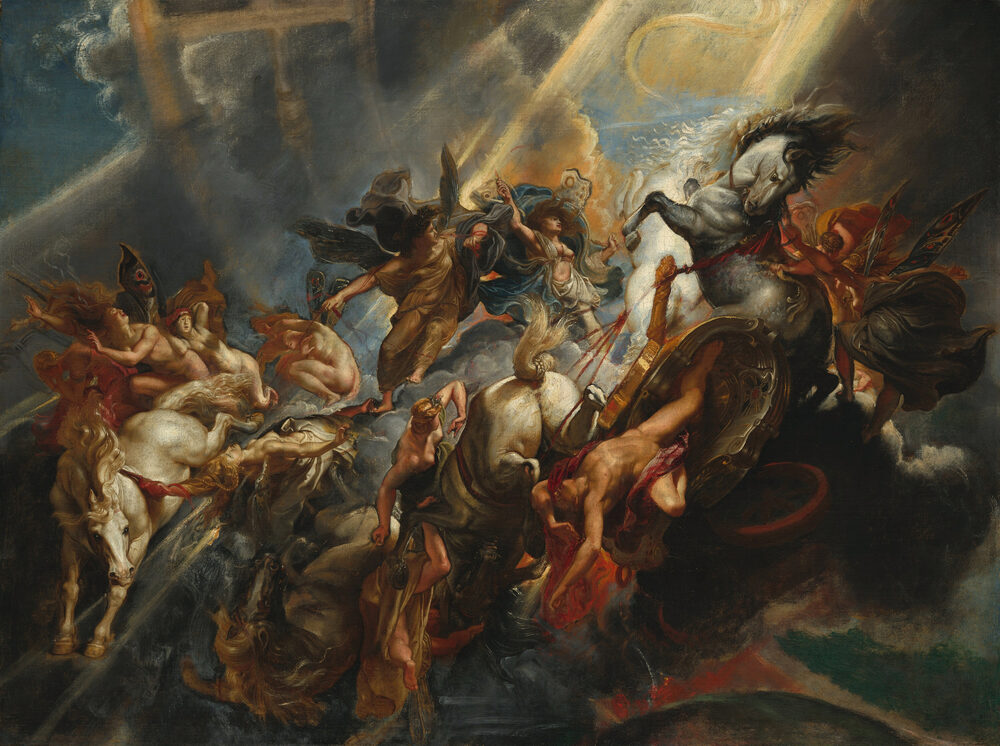
Phaethōn
First Appearance
Phaethon enters Greek poetry early but in scattered and overlapping forms. The Hesiodic Theogony (986–991) names a Phaethon ("the shining") caught up by Aphrodite, a figure of radiant youth not yet fixed to the Sun. The fuller tragic shape — the Sun's child who drives and falls — was given its great Greek treatment by Euripides in his lost tragedy Phaethon (frr. 771–786 Kannicht), set at the palace of the Sun and turning on the boy's doomed demand. Apollonius of Rhodes preserves the aftermath the Greeks knew best (Argonautica 4.597–611): the Argonauts pass the mouth of the river Eridanos, where Phaethon "half-consumed" still smokes in the deep water where he fell from the chariot of Helios, and the daughters of the Sun, the Heliades, stand on the banks as tall poplars weeping tears of golden amber into the stream.
— Hesiod / Pseudo-Hesiod, Theogony 986–991 (a Phaethon son of Eos and Cephalus); Euripides, Phaethon (lost tragedy, frr. 771–786 Kannicht); Apollonius of Rhodes, Argonautica 4.597–611
Who They Are
Phaethon (FAY-eh-thon) is the boy who drove the chariot of the Sun for a single day and fell from the sky in flames — the child of Helios the Sun-god whose longing to prove his heavenly father nearly burned the world to ash. His name means "the Shining One," and it is the Sun's own epithet; he is radiance itself made mortal, a boy who carries his father's light in his name and is destroyed by reaching for the thing that light is. He is counted here among the heroes because he began as a mortal youth, the son of Helios by the Oceanid Clymene; but his is a hero's story turned inside out — not a quest completed or a monster slain, but a child who asked for too much and could not hold it.
His myth is one of the most famous cautionary tales the Greeks and, after them, the Romans ever told. Taunted that Helios was not truly his father, Phaethon journeys to the blazing palace of the Sun at the edge of the world. There Helios, overjoyed to see his son, swears a dread and unbreakable oath — to grant whatever the boy asks. Phaethon asks for the one thing his father would refuse him: to drive the solar chariot across the heavens for one day. The oath binds Helios; the boy mounts the car; and the immortal horses, feeling an unfamiliar and trembling hand upon the reins, bolt from the ordained path. The chariot scorches the high heavens — the Greeks saw the scar in the Milky Way — and plunges low to sear the earth, burning the lands of Libya into desert and, in one ancient telling, scorching the peoples of Ethiopia dark. To save the whole world from burning, Zeus strikes the boy down with a thunderbolt, and Phaethon falls blazing from the sky into the river Eridanos.
What the Greeks remembered most tenderly was the mourning that followed. His sisters, the Heliades — daughters of the Sun — came to the riverbank and wept for their brother until the gods changed them into poplar trees, their endless tears hardening into amber that the river still carries. His close companion Cycnus, grieving on the water, was turned into a swan. So the story of the boy who flew too near his father's fire ends not in fire but in weeping wood and golden tears and a white bird on the river — grief transmuted into the gentlest things.
Mythology
The disputed father
Phaethon was the son of Helios, the Sun who drives his blazing chariot across the sky each day, and of the Oceanid Clymene, a daughter of Ocean, who raised the boy among mortals. Because he grew up far from his heavenly father's house, his descent could be doubted — and it was. In the account that drives the whole tragedy, Phaethon boasted of his divine parentage to a companion (in some tellings Epaphus, the son of Zeus and Io) and was mocked for it: anyone might claim the Sun for a father, the taunt ran, with no way to prove it. Stung to the heart, the boy went to his mother Clymene and begged her for proof. She swore by the Sun's own light that Helios had indeed begotten him, and told him that if he wished to hear it from the god's own mouth, he had only to travel east to the palace of the Sun, which stood at the far edge of the world where Helios begins his daily course. So Phaethon set out to find his father — a journey undertaken not for glory but to be told that he was loved and claimed.
The palace of the Sun and the rash oath
The heart of the story, and the scene Euripides set upon the Athenian stage in his lost tragedy Phaethon (frr. 771–786 Kannicht), is the boy's arrival at his father's house. Helios, seated in radiance, knew his son at once and welcomed him with joy, and in his gladness — wishing to remove every shadow of doubt from the boy's mind — he swore the most binding oath a god can swear, by the river Styx, that he would grant Phaethon whatever he asked, as proof that he was truly his father. It was a vow made in love and sworn too soon. For Phaethon asked for the one gift Helios would have withheld above all others: to drive the chariot of the Sun across the heavens for a single day, to take the reins of the immortal horses and guide the daylight himself. Helios was stricken, and begged his son to choose anything else — warning him that not even Zeus, mightiest of the gods, could hold that car; that the path runs fearfully steep and high; that the horses breathe fire and will not obey a mortal hand. But the oath by Styx could not be unsaid, and the boy would not be turned. Here the myth sets its great lesson: a father's love, pledged without limit, becomes the instrument of his child's destruction.
The ride and the ruin of the world
At dawn Phaethon mounted the chariot, took up the reins, and the gates of the east were opened. For a moment all went as it should; but the immortal horses — Pyroeis, Eous, Aethon, and Phlegon in the names a later tradition gave them — soon felt that the car ran light and the hand upon the reins was weak and trembling, unlike the steady grip of their master. They swerved from the ancient, ordained track and ran wild through the sky. Driven too high, the chariot scorched the vault of heaven, and the Greeks pointed to the long pale scar of the Milky Way (the galaxias) as the burn-mark left by the Sun's car gone astray. Driven too low, it set the earth itself ablaze: mountains caught fire, rivers shrank and seas drew back, and whole lands were ruined. In the ancient aetiology the ride explained features of the known world — the great deserts of Libya were burned barren that day, and the peoples of Ethiopia (whose name the Greeks heard as Aithiopes, "the burnt-faced") were scorched dark by the Sun passing too near. The terrified boy, seeing the world afire beneath him and the sky's monstrous shapes around him, dropped the reins in panic, and the runaway Sun threatened to consume creation entire.
The thunderbolt and the fall
To save the world from burning, Zeus acted. Rising, he hurled a single thunderbolt at the boy, striking Phaethon from the chariot to halt its ruinous course — a terrible mercy, the death of one child to spare all living things. Phaethon fell blazing from the heavens like a shooting star, his hair streaming fire, and plunged into the waters of the river Eridanos — a great river at the edge of the western world, which later geographers tried to fix as the Po or an amber-bearing river of the far north, but which the earliest poets left as a mythic stream beyond the known lands. There his burning body was quenched. Apollonius of Rhodes, in the Argonautica (4.597–611), tells how the Argonauts sailing by still found the deep pool where Phaethon fell smoking and steaming, the water heavy with the smell of his burning, and the very air above it heavy with lament. So the shining boy came to rest in the one element that could put out the Sun's fire — water — fallen as far below the sky as he had climbed above the earth.
The Heliades and the tears of amber
The most beloved strand of the aftermath is the mourning of Phaethon's sisters, the Heliades — "the daughters of the Sun," born like him to Helios. They came to the banks of the Eridanos and wept for their fallen brother without ceasing, until the gods, in pity or in the working-out of fate, changed them into trees — poplars (the black poplar in the common telling) rooted along the river. Even as trees they did not cease to grieve: their tears, still falling, hardened as they dripped into the stream and became amber (Greek ēlektron), the golden, sun-coloured resin the Eridanos was famed for carrying. Apollonius preserves this image exactly (Argonautica 4.603–611): the Heliades stand as tall poplars by the water, "wailing piteously," and let fall gleaming drops of amber upon the ground, which the sun dries and the river sweeps into its dark flood. So the Greeks explained where amber came from — not from any mine, but from the frozen tears of the Sun's daughters weeping for the brother who flew too high.
Cycnus the swan
A gentler transformation closes the tale. Cycnus — in the tradition a kinsman and dear friend of Phaethon, in some accounts a Ligurian king — came to the river to mourn the boy, wandering its banks and the groves of the Heliades in such grief that he too was changed: into a swan (Greek kyknos, which means "swan," so that the man became the very thing his name foretold). Ever after, it was said, the swan keeps to the water, loving the rivers and pools, and sings its saddest and most beautiful song at the end — a memory, the Greeks felt, of the mourning that first made it. Thus the whole aftermath of Phaethon's fall is a landscape of grief made lovely: sisters turned to weeping trees, their tears to amber, and a friend turned to the white singing bird of the river.
Rationalizing the fire: Plato's reading
Even the ancients felt the myth might carry a buried truth about the world. In Plato's Timaeus (22c), an Egyptian priest tells the Athenian Solon that the Greek story of Phaethon — "who yoked his father's chariot, and because he could not drive it along his father's course burnt up all that was upon the earth and was himself destroyed by a thunderbolt" — though it is told "in the form of a legend," in fact preserves the memory of a real catastrophe: a periodic shifting of the heavenly bodies and a destruction of things on earth by great fire, recurring over long ages. It is one of the earliest attempts to read a Greek myth as the dim record of an actual event, and it shows how seriously the story of the burning of the world was taken — not as idle wonder, but as a warning drawn from the deep past.
Worship — Ancient
A myth of warning, not a temple cult
Phaethon was not a god and had no established civic cult in the manner of the Olympians — no temple, priesthood, or Panhellenic festival was his. He lived in Greek life as a story: one of the great cautionary tales of hybris, the overreaching pride that grasps beyond a mortal's measure and is destroyed for it. His name was proverbial. To be a "Phaethon" was to be the rash youth who seized what he could not hold, and the image of the boy flung from the Sun's chariot was carried everywhere Greek stories were told — a lesson pressed on the young about the ruin that follows when ambition outruns strength and good sense is overruled by pride.
The stage: Euripides' Phaethon
The story's deepest hold on the Greek imagination came through the theatre. Euripides made it a tragedy, the lost Phaethon, of which substantial fragments survive (frr. 771–786 Kannicht). His version set the action around the gleaming palace of the Sun and the house of Clymene, and wove the cosmic catastrophe together with a human drama of a mother's secret, a son's doubt, and a marriage interrupted by disaster. That a figure with no cult could carry a full Athenian tragedy shows how the Greeks honoured Phaethon — not with altars, but with the highest art of the city, as a mirror held up to pride and grief.
Amber, the Eridanos, and the edges of the map
Phaethon's myth also did real work in the Greek understanding of the physical world. It was the standing explanation of amber (ēlektron) — the beautiful golden resin, prized for ornament and for its strange power to attract (the Greek word gives us "electricity") — which was said to be the hardened tears of the Heliades weeping along the Eridanos. Since amber in fact reached the Mediterranean by long trade routes from the far north, the myth attached itself to the dim, half-known rivers at the edges of the Greek map, and geographers argued over where the Eridanos truly lay. So the fall of Phaethon was not only a moral tale but a piece of the world's explained furniture: why there are deserts in Libya, why the peoples of the south are dark, why the sky bears the pale scar of the Milky Way, and where the sun-coloured amber comes from.
Worship — Modern
The patron of the beautiful overreach
Phaethon endures as one of the most recognizable figures in the whole treasury of myth — the archetype of the glorious, doomed attempt, the child who flies the Sun's own chariot and falls. A modern reader or devotee drawn to him meets not a god to petition but a story to reckon with: the warning against hybris, certainly, but also something more sympathetic, for Phaethon's fault began in a wholly human wish — to be claimed by his father, to prove he was who he said he was. He is a patron, if of anything, of the beautiful failure undertaken for love and recognition; of the young who reach past their strength; and of grief answered not by vengeance but by transformation into something tender.
Grief made lovely: amber, poplar, and swan
What a thoughtful honouring of Phaethon holds onto is the strange gentleness of his aftermath. The myth does not end in the fire of the thunderbolt but in weeping — the sisters turned to poplars, their tears to amber, the friend to a singing swan. To hold a piece of amber is, in the old understanding, to hold the frozen tears of the Sun's daughters, grief hardened into something that outlasts and beautifies the sorrow that made it. For anyone who has lost someone young and bright too soon, the story offers that image as consolation: that mourning, given time, can crystallize into something golden and lasting, a light carried down the river of years.
A name still shining
Phaethon's name has never gone dark. It survives in the language of science and story alike — carried by the long luminous trail of Phaethon the asteroid that sheds the Geminid meteors each December, by the "Phaethon" tradition in art from antique sarcophagi to the great painters of the Renaissance and Baroque, who loved to show the boy tumbling from the chariot amid plunging horses and scattering sun. Wherever the warning is needed — against the reach that exceeds the grasp, the gift given without limit, the child allowed to drive what no child can hold — the shining boy and his single catastrophic day are summoned again, and the Sun's radiant, ruined son goes on shining in the memory of the world.
Epithets & Cult Titles
- pais Hēliou (παῖς Ἡλίου) — Child of the Sun — his defining identity, the son of Helios whose disputed paternity sets the whole tragedy in motion; it is to prove this descent that he goes to his father's house
- Phaethōn (Φαέθων) — The Shining / Radiant One — the name is itself a title, the very epithet Homer and the poets give to Helios (Iliad 11.735, Odyssey 5.479); the boy is named for the blaze that will both exalt and destroy him
- hēniochos (ἡνίοχος) — The charioteer / rein-holder — the office he seizes for a single day, the driving of the Sun's four-horse car across the sky, a task no hand but Helios's own can hold
Sources & Variants
- Hesiod / Pseudo-Hesiod, Theogony 986–991 (an early Phaethon, 'the shining,' caught up by Aphrodite — a radiant youth not yet fixed as the Sun's charioteer)
- Euripides, Phaethon (lost tragedy, frr. 771–786 Kannicht) — the great Greek dramatic treatment: the palace of the Sun, Clymene's secret, the fatal oath and the fall
- Apollonius of Rhodes, Argonautica 4.597–611 (the Argonauts pass the Eridanos where Phaethon fell smoking into the water; the Heliades as poplars weeping amber)
- Plato, Timaeus 22c (the Egyptian priest reads the Phaethon myth as the memory of a real periodic destruction of the earth by fire)
- Apollodorus, Bibliotheca (Phaethon son of Helios and the Oceanid; his death and the mourning of the Heliades turned to poplars dripping amber)
- Lucretius, De rerum natura 5.396–405 (the ride of Phaethon cited in a cosmological argument about the world's fragility) — later Roman
- Ovid, Metamorphoses 1.750–2.400 (the fullest surviving telling: Epaphus' taunt, the journey to the Sun's palace, the oath by Styx, the ride and the burning of the world, Zeus's thunderbolt, the Heliades and the amber, Cycnus the swan) — later Roman retelling
- Hyginus, Fabulae 152–154 and 250 (the chariot of the Sun, Phaethon's fall, the Heliades, Cycnus) — later Roman compilation
- Virgil, Eclogue 6.62–63 (the Heliades, sisters of Phaethon, ringed about with the moss of the bitter bark as alder-trees) — Roman
Gallery