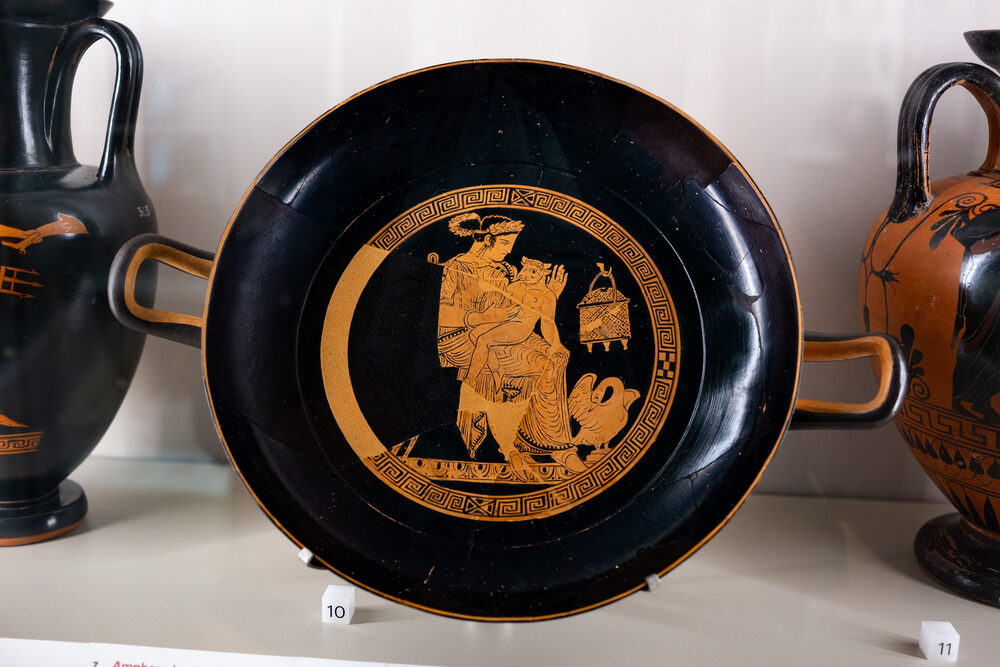
Pasiphaē
First Appearance
Pasiphae is named already in the early Greek tradition — Hesiod counts her among the shining children of Helios, and Bacchylides knows her as the Cretan queen — but her story is told most fully by Apollodorus (Bibliotheca 3.1.2–4): daughter of the Sun, wife of Minos king of Crete, and mother of his children; and, when Minos withheld from Poseidon the bull that rose from the sea, afflicted by the god with a passion for that bull, from which, by the craft of Daedalus, she bore the Minotaur. Diodorus (4.77) and Pausanias (3.26.1) preserve the surrounding tradition — the one the Cretan dynasty, the other the far older oracular goddess of the same name.
— Hesiod and Bacchylides (the early tradition); fullest in Apollodorus, Bibliotheca 3.1.2–4
Who They Are
Pasiphae (pass-IF-uh-ee) is the queen of Crete, the wife of King Minos and the mother of the Minotaur — but she is also something stranger and older than that terrible role. Her name means "all-shining," and she was a daughter of Helios the Sun himself, born to him and the Oceanid Perseis, which makes her sister to the enchantress Circe and to Aeetes, the sorcerer-king of Colchis who kept the Golden Fleece. She comes, in other words, of the brightest and most witch-blooded line in all of Greek myth: the children of the Sun, radiant and dangerous, versed in drugs and binding charms. She is counted here among the heroes as a mortal queen of the heroic age, though her blood is divine and in one ancient place she was worshipped as a goddess outright.
The story for which she is best remembered is a hard one, and it is told here plainly but with dignity. When Minos failed to sacrifice to Poseidon the magnificent bull the god had sent up from the sea, Poseidon took his revenge not on the king but on the king's wife, afflicting Pasiphae with an unnatural and unwilling passion for the animal — a punishment laid upon her for a fault that was not hers. To answer that torment the great craftsman Daedalus built her a hollow wooden cow in which she might approach the bull, and from that union she conceived the Minotaur, the bull-headed child whom the Cretans named Asterion, "the starry one." Pasiphae is thus caught, like so many women in these myths, between the quarrels of gods and the pride of men, and made to bear in her body the cost of another's offence.
Yet beneath the monstrous tale there survives a wholly different Pasiphae — a shining, kindly goddess. At Thalamae in Laconia she had an oracle of her own, where people lay down to sleep in her sanctuary and received prophecy in dreams (Pausanias 3.26.1), and there her name was heard in its first and simplest meaning: the one whose light falls upon all. Many have seen in this older figure a moon-goddess, a divinity of light and of dreams far more ancient than the story of the bull, and it is worth holding both Pasiphaes in view at once — the wronged Cretan queen of the famous myth, and the bright prophetic power honoured long before and apart from it.
Mythology
Daughter of the Sun, sister of enchanters
Pasiphae was a child of Helios, the Sun, born to him by the Oceanid Perseis (also called Perse), and so she belonged to the most luminous and most sorcerous family in Greek myth. Her brother was Aeetes, the fierce king of Colchis at the eastern edge of the world, keeper of the Golden Fleece and father of the witch Medea; her sister was Circe, the enchantress of the island of Aeaea who turned men to swine. In this company Pasiphae's own reputation for the working of drugs and binding charms (Greek pharmaka) is no accident but an inheritance: the children of the Sun were held to be masters of such arts. The very brightness her name proclaims — "all-shining" — is the radiance of her father's fire passed down into his daughter. When she came to Crete and married its king, she brought that double nature with her: royal and divine, luminous and dangerous.
The queen of Crete and the charm upon Minos
Pasiphae became the wife of Minos, the great king of Crete who ruled the Aegean from his palace and gave his name to an age. She was queen at the height of Cretan sea-power, and mother of his royal children. But the marriage carried a shadow of her own witch-craft: when Minos proved faithless, straying after other women, Pasiphae is said to have laid a charm upon him — a binding spell of the kind her kindred knew — so that the fault turned back upon him and his unfaithfulness was punished. It is a glimpse of the enchantress beneath the queen, a woman who met a king's betrayal not with helplessness but with the drugs and bindings of her sun-born line.
The bull from the sea
The central and most painful strand of her story begins not with Pasiphae at all, but with her husband's pride. Minos, to prove his right to the throne of Crete, prayed to Poseidon to send a bull up out of the sea as a sign, vowing to sacrifice the animal to the god in return. Poseidon sent a bull of surpassing beauty, white and magnificent, rising from the waves — but Minos, seeing how fine it was, kept it for his own herds and sacrificed a lesser beast in its place, breaking his vow (Apollodorus 3.1.3–4). The god's anger fell, as it so often does in these tales, not on the man who had sinned but on those around him. Poseidon made the bull savage, and — to punish the king through his house — afflicted Pasiphae with an overwhelming and unnatural passion for the animal. This is the heart of her tragedy, and it must be said clearly: the desire was not her own wish or her own fault but a torment laid upon her by an angry god, the price of her husband's broken promise, carried in her body against her will.
Daedalus and the hollow cow
In her torment Pasiphae turned to Daedalus, the master-craftsman who had taken refuge at the Cretan court — the most ingenious maker in all the myths. To answer the affliction Poseidon had set upon her, Daedalus built a hollow wooden cow, covered it with a real hide, and set it on wheels in the meadow where the bull grazed; within it Pasiphae could be concealed (Apollodorus 3.1.4; Diodorus 4.77). The ancients told this detail soberly, as one more instance of Daedalus's uncanny skill, the same genius that would later raise the Labyrinth and fashion wings of wax and feather. By this device the god's curse was fulfilled, and Pasiphae conceived.
The birth of the Minotaur
From that union Pasiphae bore a child of two natures: a creature with the body of a man and the head of a bull, whom the Cretans called Asterion, "the starry one," but whom all the world remembers as the Minotaur — "the bull of Minos." He could not be kept in any ordinary place, and so Minos had Daedalus build the great Labyrinth, the maze from which none could find the way out, and shut the Minotaur within it. There the creature was fed, in the grim later tradition, on the tribute of youths and maidens sent from Athens, until the hero Theseus came to kill him with the help of Pasiphae's own daughter. Pasiphae herself bore the child without blame — she was the vessel of a god's revenge, not its author — and the horror of the tale belongs properly to Poseidon's wrath and Minos's pride, not to the queen who suffered them.
Her children and the house of Crete
Besides the Minotaur, Pasiphae was mother by Minos of a line of famous children, among them the daughters Ariadne — who would give Theseus the thread to escape the Labyrinth and so undo her mother's monstrous son — and Phaedra, later the tragic wife of Theseus himself, together with sons such as Androgeos, Deucalion, and Glaucus. Thus from one queen's house came both the Minotaur and the very daughter whose thread destroyed him: Pasiphae stands at the root of the whole Cretan cycle, the mother of its monster and of its deliverers alike.
The older, shining goddess
Set against all this is a quite different Pasiphae, and the ancients kept her memory. At Thalamae in Laconia, far from Crete, there stood an oracle of Pasiphae, where she was honoured not as a disgraced queen but as a bright prophetic goddess who gave answers in dreams (Pausanias 3.26.1). Here her name was understood in its plain and lovely sense — "she who shines upon all" — and many have taken this Pasiphae to be a moon-goddess, a divinity of light and dream older by far than the tale of the bull. It is likely that the luminous goddess came first, and that the dark Cretan story gathered later around a name that had always meant radiance. Both should be held together: the wronged mortal queen of the famous myth, and behind her the all-shining light that the people of Thalamae still prayed to in their sleep.
Worship — Ancient
The dream-oracle at Thalamae
Pasiphae's one true cult stood at Thalamae, a town in Laconia on the road toward Messenia, and it preserves a figure utterly unlike the queen of the Cretan legend. There she had an oracle of dreams: those who sought her guidance would lie down to sleep within the sanctuary and receive their answers in the visions that came to them (Pausanias, Description of Greece 3.26.1). This was a serious and respected shrine — the Spartans themselves are said to have consulted it, and later writers report that the ephors and even the kings of Sparta would sleep there to learn the god's will on matters of state. Near the sanctuary flowed a spring of sweet water, and images of bronze stood within it. In this place Pasiphae was no object of scandal but a trusted prophetic power.
"She who shines upon all"
At Thalamae her name was heard in its first meaning — Pasiphaē, "the all-shining" — and the ancients who described the cult reached for explanations that had nothing to do with Crete. Some identified her with a daughter of Atlas; others, and this is the reading many modern scholars favour, understood her as a moon-goddess, a divinity of the night's bright light whose radiance "shines upon all" and whose proper gift was therefore the clarity that comes in dreams and prophecy. On this understanding the oracular goddess of Thalamae is the oldest Pasiphae of all, a light-divinity whose worship long predates the monstrous story and stands entirely apart from it.
Two figures under one name
The Greek tradition thus carried two Pasiphaes side by side without ever quite reconciling them: the Cretan queen of the heroic legend, daughter of the Sun and mother of the Minotaur, and the shining oracular goddess of Laconia, giver of dreams. It is probable that the bright goddess came first and that her radiant name — too apt for a child of Helios to pass unused — was later drawn into the saga of Crete and attached to the queen. Whichever way the borrowing ran, the ancients honoured the goddess at Thalamae with full seriousness while telling the queen's hard story elsewhere, and both belong to any true account of her.
Worship — Modern
The light behind the legend
A modern devotee drawn to Pasiphae does well to begin where the ancients of Thalamae did — with the light in her name rather than the horror of the Cretan tale. "She who shines upon all" is, at root, a radiant and merciful figure: a goddess of the moon's light, of the clarity that visits in dreams, and of prophecy received in sleep. To honour her in that key is to keep faith with her oldest and kindest form, the bright power the Spartans trusted enough to seek her counsel lying down in her sanctuary. Those who work with dreams, with divination, or with the quiet light of the night may find in her an ancient and dignified patron.
The wronged queen
Her Cretan story, told with honesty and restraint, speaks to something else: the suffering of one made to bear the punishment for another's wrong. Pasiphae did not break the vow to Poseidon — Minos did — yet it was she whom the god's anger afflicted, and she who carried in her body the cost of a quarrel between a king and a sea-god. Read with compassion rather than scorn, her myth is not a tale of monstrousness but of a woman caught between powers she did not control and blamed for a fate imposed upon her. She stands, in this light, for all who are made to answer for faults not their own, and her dignity is best served by remembering where the blame truly lies.
Daughter of the Sun
Pasiphae belongs, finally, to the shining and sorcerous house of Helios — sister to Circe and Aeetes, an enchantress in her own right, radiant with her father's inherited fire. To honour her is also to honour that lineage of the Sun's children: luminous, knowing, versed in the old arts of herb and charm, and never quite safe. Between the all-shining goddess of Thalamae and the wronged queen of Crete she holds both brightness and sorrow together, and a thoughtful modern honouring keeps her whole — the light first, and the legend held with care.
Epithets & Cult Titles
- Pasiphaē (Πασιφάη), 'the all-shining' — Her name itself, read by the ancients as 'shining upon all' — the mark of a light- or moon-divinity older than the monstrous tale, the sense that let the people of Thalamae in Laconia keep her as a bright oracular goddess (Pausanias 3.26.1)
- daughter of Helios (Ἡλίου θυγάτηρ) — Child of the Sun himself and the Oceanid Perseis, and so sister of Circe and of Aeetes — a woman of divine, witch-blooded descent, her radiance inherited from her father's fire
- the Cretan queen (ἄνασσα Κρήτης) — Wife of Minos and queen of Crete at the height of its sea-power, mistress of the great palace from which the island's kings ruled the Aegean
- the enchantress (pharmakis) — A worker of drugs and binding charms in her own right, of the same sorcerous blood as her sister Circe — remembered above all for the charm she laid upon Minos her husband
Sources & Variants
- Hesiod (the early tradition naming Pasiphae among the children of Helios)
- Bacchylides (Pasiphae as the Cretan queen in early lyric)
- Apollodorus, Bibliotheca 3.1.2–4 (daughter of Helios and Perseis; wife of Minos; the bull from the sea withheld from Poseidon; the god's affliction; Daedalus's wooden cow; the birth of the Minotaur Asterion)
- Apollodorus, Bibliotheca 3.1.2 (Pasiphae's children and the house of Minos, including Ariadne and Phaedra)
- Pausanias, Description of Greece 3.26.1 (the dream-oracle of Pasiphae at Thalamae in Laconia; her name as 'all-shining'; the moon-goddess reading)
- Diodorus Siculus, Bibliotheca historica 4.77 (Daedalus at the court of Minos; the device of the wooden cow)
- Virgil, Eclogues 6.45–60 (the lament for Pasiphae and the bull) — Roman
- Ovid, Ars Amatoria 1.289–326 and Metamorphoses 8.131–137 and 9.735–740 (the passion of Pasiphae and the wooden cow) — Roman retellings
Gallery