Helios
First Appearance
Helios first appears in Hesiod's catalogue of the shining Titan-children, born of the union of two light-Titans: "Theia yielded to the love of Hyperion and gave birth to great Helios (the Sun) and bright Selene (the Moon) and Eos (the Dawn), who shines upon all that are on earth and upon the deathless gods who live in the wide heaven." He enters the tradition already as one of the three luminaries that measure time — the sun that rules the day, brother to the moon that rules the night and the dawn that opens each morning between them.
— Hesiod, Theogony 371–374
Who They Are
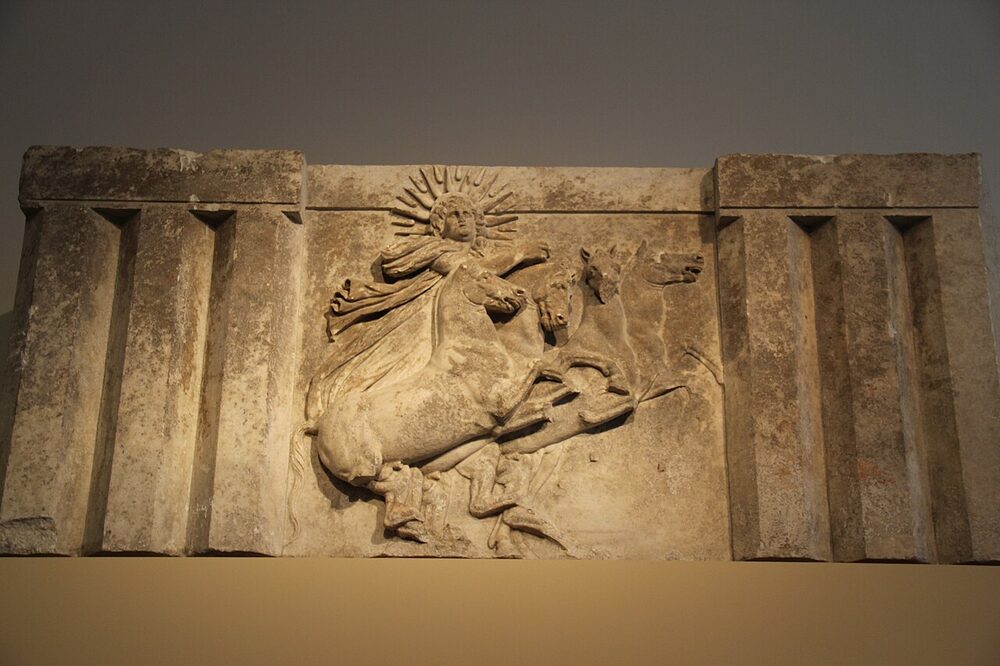
Helios (HEE-lee-os) is the Titan god of the sun — not a god who merely governs the sun from afar, but the sun itself, the blazing disc that mortals see and feel, imagined as a radiant charioteer crossing the vault of heaven. He is the son of the Titan Hyperion, the elder lord of heavenly light, and of the shining Titaness Theia, and brother to Selene the Moon and Eos the Dawn: together the three form the luminaries that order day, month, and morning for gods and mortals alike. Where his father Hyperion is light conceived as an elemental source, Helios is that light made visible and personal — crowned with rays, driving a team of fiery horses from the eastern gates to the western sea, and sinking each evening only to return.
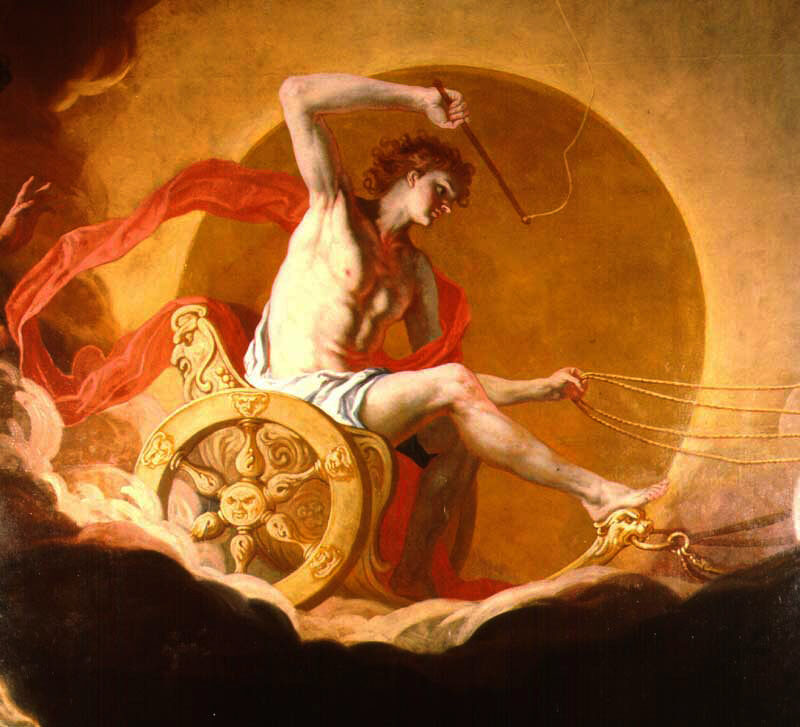
Two images define him. The first is his daily labour: at dawn he mounts a golden, four-horse chariot of fire and drives it up the arch of the sky, pouring light on the whole earth, until at evening he descends into the stream of Oceanus in the far west. The second answers the riddle the first poses — how does the sun that sets in the west rise again in the east? The old poets gave a marvellous answer: after sinking, Helios sails all night around the earth through the northern stream of Oceanus, cradled in a great golden cup or bowl, back to his rising-place in the east, so that he may begin the journey anew.
Because he rides so high and misses nothing, the Greeks made Helios the great witness of the world — the god who sees all and hears all, invoked in solemn oaths and called upon when a hidden wrong needs a heavenly eyewitness. It is Helios who tells the grieving Demeter who carried off Persephone, and Helios who catches Ares and Aphrodite in their secret love and reports them to Hephaestus. His foremost cult belonged to the island of Rhodes, which the Greeks said was his own possession, home to the Halieia festival and to the towering bronze Colossus. He must be kept distinct from Apollo, a separate Olympian who was only later identified with the sun — a syncretism this page will flag but not assume.
Mythology
The chariot of fire and the golden cup
Helios's central and unceasing myth is the daily crossing of the sky. Each morning, from the eastern land of the dawn, he rises from the deep-flowing Ocean, mounts his chariot, and drives four winged, fire-breathing horses up the steep vault of heaven, bringing light "to mortals and immortal gods" (Homeric Hymn 31 to Helios). Crowned with a gleaming aureole of rays and clad in shining raiment, he holds his course across the highest point of the sky at midday and then guides the team down the long western slope of the air. At evening he sinks beneath the horizon into the stream of Oceanus, the great river the Greeks believed encircled the flat earth, and the day is done.
But sunset raises a question, and the archaic poets answered it with one of the loveliest images in Greek myth. Having set in the west, Helios does not travel back overland through the night; instead he sails around the northern rim of the world through the encircling Ocean in a huge golden cup or bowl (Greek depas), forged for him — some said — by Hephaestus, resting as he is carried on the water from the western place of his setting to the eastern place of his rising. The seventh-century poet Mimnermus described the sun asleep in his golden bed as the waves bear him home, and the vessel is cited repeatedly by later writers (gathered by Athenaeus, Deipnosophistae 11.469). The same golden cup gave rise to a favourite side-story: when Heracles journeyed to the far west to fetch the cattle of Geryon, Helios lent him the great bowl to cross the Ocean-stream, a loan the hero won by threatening the sun with his bow until the god, amused or alarmed, gave way (Apollodorus, Bibliotheca 2.5.10). Thus chariot and cup together make a single closed circuit: fire across the heavens by day, gold across the waters by night, an endless round with no rest — fitting for the god called Akamas, "the Unwearying."
The all-seeing witness
Because he rides higher than any other god and looks down on the whole earth, Helios sees and hears everything that happens beneath the open sky, and this makes him the great divine eyewitness of Greek myth. Homer fixes the idea in the very words of an oath: when the Greeks and Trojans swear their solemn truce, they call upon "Helios, who sees all things and hears all things" (Iliad 3.277) — the god from whom no deed can be hidden and who therefore guarantees the sworn word. Two episodes turn this theme into story.
When Hades seized Persephone and carried her down into the earth, her mother Demeter roamed the world in anguish, and no god or mortal would tell her the truth. It was Helios she at last appealed to, and it was Helios who told her plainly what he alone had witnessed from on high — that Zeus had granted the girl to Hades, and that it was Hades who had snatched her away — urging the grieving goddess to cease her wrath (Homeric Hymn 2 to Demeter 62–89). Only the all-seeing sun could resolve a crime committed in secret.
The second episode is lighter but rests on the same power. When Ares and Aphrodite met in secret to become lovers, it was Helios who caught them together and carried word straight to Aphrodite's husband, the smith-god Hephaestus. Hephaestus then forged a net of unbreakable chains as fine as spider-silk, spread it over his bed, and trapped the two divine lovers fast in the act, calling the other gods to witness their shame (Homer, Odyssey 8.266–366, the song of the bard Demodocus). Here again the sun is the informer who sees what was meant to stay hidden — the eye of heaven turned reporter.
Phaethon, the son who drove the sun
Helios's most famous myth is really the tragedy of his son — and it is treated more fully on its own page, so it is given only briefly here. By a mortal-born mother the sun had a boy named Phaethon, "the Radiant," who, taunted about his divine parentage, travelled to the palace of the Sun to claim it. Helios, overjoyed, swore an unbreakable oath to grant whatever his son asked — and Phaethon asked to drive the sun-chariot for a single day. Bound by his oath and dreading the outcome, Helios yielded. But the boy could not master the fiery horses; the chariot veered wildly, scorching the heavens, burning the earth, and (the myths say) blackening the peoples of the south, until Zeus, to save the world from being consumed, struck Phaethon down with a thunderbolt and sent him falling in flames into the river Eridanus. His sisters, the Heliades, wept for him until they were transformed into poplar trees, their tears hardening into amber. The fullest telling is the Roman poet Ovid's (Metamorphoses 1.750–2.400), and the detail of Helios's binding oath and grief belongs largely to that later, elaborated version — but the core of the tale, the sun's child undone by the sun's own chariot, is genuinely Greek: it was already staged by Euripides in his lost tragedy Phaethon (late fifth century BCE), of which substantial fragments survive, and echoed by earlier poets who set the boy's fall by the western river Eridanus. Ovid's account is the fullest, but the Greek bones beneath it are old. See the dedicated Phaethon page for the full account.
The Cattle of the Sun
A second great story belongs properly to Homer's Odyssey and is only cross-referenced here. On the island of Thrinacia, Helios pastured sacred herds — seven flocks of cattle and seven of sheep, immortal and unbreeding, tended by his daughters and watched, of course, by the all-seeing eye of their owner. Warned by the prophet Tiresias and by Circe never to touch them, Odysseus bound his crew by oath to leave the herds alone; but trapped by contrary winds and driven mad by hunger, the men slaughtered the finest cattle while their captain slept. The flayed hides crawled and the roasting meat lowed on the spits — an omen of doom. Helios, enraged, demanded vengeance of Zeus and threatened to take his light down among the dead if he were not satisfied; Zeus struck the ship with a thunderbolt as it sailed, drowning every man but Odysseus alone (Homer, Odyssey 12). The tale shows the sun as an owner as watchful and unforgiving as he is all-seeing.
Helios and Apollo: two gods, one later identification
It is essential to keep Helios and Apollo distinct, because the ancient Greeks did. Helios is the physical sun — the Titan-born disc that crosses the sky, son of Hyperion, brother of Selene and Eos. Apollo is a separate and younger god, a son of Zeus and Leto, an Olympian of prophecy, music, archery, healing, and light in a broader, more abstract sense; in Homer and the classical poets he is never the sun, and the sun is never he. The two were worshipped as different deities with different parents, different myths, and different cults.
Only later did the identification arise. From the fifth century a philosophical and poetic tendency to see Apollo as the sun took hold, and in the Hellenistic and especially the Roman period the equation Helios = Apollo (and, in Latin, Sol = Apollo) became commonplace, so that the sun-god's rays and chariot were freely attributed to Apollo. But this is a secondary syncretism, not the original theology: on this page Helios is the Titan sun in his own right, and the merging of the two should be read as a later development laid over an earlier distinction.
Worship — Ancient
Rhodes, the island of the Sun
Helios's worship, though found across the Greek world, had one supreme centre: the island of Rhodes, which the Greeks held to be the sun-god's own sacred possession. Pindar tells the founding tale beautifully (Olympian 7.54–76): when the gods drew lots to divide the lands of the earth among themselves, Helios was absent on his daily course and so received no share. Rather than reopen the division, Zeus was ready to cast the lots again — but Helios asked instead for a land he had spied rising from the grey sea-depths, an island not yet born. It broke the surface as Rhodes, and became his: there he lay with the nymph Rhode (the island's eponym), who bore him seven sons, the Heliadae, from whom the Rhodian people traced their descent and their skill. Rhodes honoured him as its patron and protector, and its three chief cities kept his cult at their heart.
The Halieia and the Colossus
On Rhodes the great festival of Helios was the Halieia, celebrated with athletic and musical games in the sun-god's honour. Its most memorable rite was the yearly offering of a four-horse chariot (tethrippon) together with its team, driven or hurled into the sea — a gift returning to Helios the very vehicle of his daily journey, sent after him into the western waves where he nightly sinks. Rhodes' devotion found its grandest monument in the Colossus of Rhodes, an enormous bronze statue of Helios some thirty metres high, raised at the harbour around 280 BCE by the sculptor Chares of Lindos from the spoils of a broken siege, and counted among the Seven Wonders of the ancient world. It stood only some fifty-six years before an earthquake toppled it around 226 BCE; even fallen, its vast bronze limbs drew wondering visitors for centuries (Pliny, Natural History 34.41).
The Sun as witness, and his herds
Beyond Rhodes, Helios was honoured widely as the all-seeing witness whose eye guarantees oaths — invoked alongside Zeus and Earth in the swearing of solemn treaties (as in Iliad 3.277) — and as the god whose sacred cattle no one might harm (the herds of Thrinacia, Odyssey 12). White horses, the colour of his radiance and the kind that drew his chariot, were his fitting sacrifice, and lamps and libations of honey greeted him at dawn. At Corinth the heights of the Acrocorinth were said to be his portion, later shared with Aphrodite (Pausanias, Description of Greece 2.4.6–7; the cosmology systematized in Apollodorus, Bibliotheca 1.4). Yet everywhere his worship remained bound to the plain, daily fact of the sun in the sky: to honour Helios was to acknowledge the light that makes the day.
Worship — Modern
Honouring Helios today
A modern devotee approaching Helios honours him as the sun made visible — the radiant charioteer of heaven and the all-seeing eye of the world. His shrine belongs where the light falls: a windowsill, a balcony, or any clean place that catches the sky. An image of the sun, a solar disc or a radiate crown, and above all a lamp or candle kindled in his honour, give him a fitting seat. The natural times to turn to him are the turning-points of his course — sunrise above all, when he mounts his chariot; noon, when he stands at the height of heaven; and sunset, when he sinks to sail home in his golden cup. Face the sun (never staring into it), raise your hands in the old Hellenic posture toward the sky-gods, and greet him as the light that measures the day.
Offerings
Light and brightness are his most natural gifts. Kindle a lamp or candle for him, especially at first light. Pour a libation of honey, or of wine, milk, or clear water, and burn frankincense or another fragrant incense whose smoke rises toward the heavens. Honey and golden things — for the golden cup and the golden chariot — are especially apt. Present each offering with a word of thanks for the light of day and for the sun's faithful return, and let what is given be truly his.
Prayer & reverence
Call on Helios as the all-seeing Sun, the god from whom nothing done under the sky is hidden. Because the ancients invoked him as the great witness, he is fittingly called upon to seal a promise or an oath, or when the truth of a hidden matter is sought — mindful, as the Greeks were, that the sun sees all and forgets nothing. Greet him with thanks at dawn as Terpsimbrotos, the gladdener of mortals; honour him at noon as the tireless Akamas who never rests from his course; and bid him farewell at evening as he descends to sail the northern Ocean home. In reverencing the sun's daily journey, the modern devotee honours the oldest and most constant of the gods one can actually see.
Epithets & Cult Titles
- Panoptēs (πανόπτης) — All-seeing — the god 'who sees all things and hears all things' from on high (Iliad 3.277), the divine eyewitness of every deed done under the sun
- Hyperionidēs (Ὑπεριονίδης) — Son of Hyperion — Homer's patronymic for the Sun; in Homer 'Hyperion' is also used outright as a name of Helios himself
- Phaethōn (Φαέθων) — The Radiant, the Shining One — a poetic title of the Sun himself (not to be confused with his mortal-born son of the same name)
- Elektōr (Ἠλέκτωρ) — The Beaming, the Gleaming — Homer's word for the blazing sun 'Elektor Hyperion'
- Terpsimbrotos (τερψίμβροτος) — Gladdening mortals — the Sun who delights the race of men, an Odyssean epithet
- Akamas (ἀκάμας) — The Unwearying — the tireless one who never rests from his daily course across the sky
- Sol Invictus — The Unconquered Sun — the Roman imperial title under which the sun-god was elevated to a supreme state cult in the later Empire
Sources & Variants
- Hesiod, Theogony 371–374 (Helios born to Theia and Hyperion, brother of Selene and Eos)
- Homeric Hymn 31 to Helios (the sun-god, his chariot, his radiant course, and his parentage)
- Homer, Iliad 3.277 (Helios 'who sees all things and hears all things,' invoked in the oath)
- Homer, Odyssey 8.266–366 (Helios catches Ares and Aphrodite and reports them to Hephaestus, in the song of Demodocus)
- Homer, Odyssey 12 (the Cattle of the Sun on Thrinacia; Helios demands vengeance and Zeus destroys Odysseus's crew)
- Homeric Hymn 2 to Demeter 62–89 (Helios tells the grieving Demeter that Hades seized Persephone)
- Mimnermus fr. 12 West and Athenaeus, Deipnosophistae 11.469 (the golden cup in which Helios sails around Ocean from west to east by night)
- Apollodorus, Bibliotheca 2.5.10 (Helios lends Heracles the golden cup to cross the Ocean); 1.2.2 (Helios among the children of Hyperion and Theia)
- Euripides, Phaethon (fragmentary tragedy, late 5th c. BCE — the Greek dramatic core of the Phaethon myth that lies behind Ovid's fuller Roman telling)
- Ovid, Metamorphoses 1.750–2.400 (the myth of Phaethon and the sun-chariot — a later, Roman elaboration, flagged as such)
- Pindar, Olympian 7.54–76 (Helios wins the island of Rhodes as it rises from the sea; Rhode and the Heliadae)
- Pliny, Natural History 34.41 (the Colossus of Rhodes); Pausanias, Description of Greece 2.4.6–7 (Helios and the Acrocorinth)
Gallery