Selene
First Appearance
Selene first appears in the catalogue of the elder gods, where Theia, submitting in love to Hyperion, bears three luminous children: great Helios (the Sun), bright Selene (the Moon), and Eos (the Dawn) who shines upon all that dwell on earth and upon the deathless gods of the wide heaven. From her birth she is not a goddess who merely governs the moon but the Moon itself — one of the three lights by which the Titan line lit the sky.
— Hesiod, Theogony 371–374
Who They Are
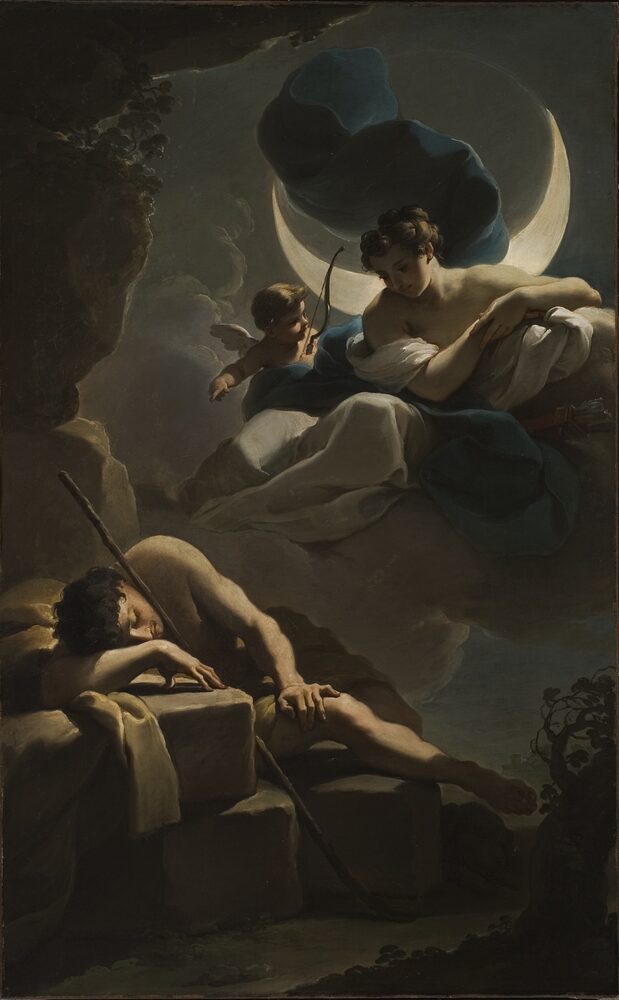
High on Mount Latmos in Caria lies a shepherd who will never wake. His name is Endymion, and he is the most beautiful of mortal men; but he sleeps a sleep without end, ageless and unchanging, breathing softly in his cave while the years pass over the world outside. Each night, when her lamp is lit above the mountain, Selene (seh-LEE-nee) — the Moon — comes down to look on him. She loved him while he waked, and rather than watch that beauty wither and die as mortal beauty must, she keeps him so: perfect, warm, and utterly beyond her reach. Here is the ache at the heart of her story — a deathless goddess bound in love to a sleeper who never answers, who cannot age toward her or wake to meet her, whom she can visit but never truly have.
Selene is the Titan goddess who is the Moon: not a deity who rules the moon from elsewhere, but the silver light itself made a person. Daughter of the Titans Hyperion and Theia, she is sister to Helios the Sun and Eos the Dawn — the three lights of heaven born of one radiant pair. When her brother's chariot sinks into the western Ocean, Selene rises from those same waters, bathes her body in the stream, wraps herself in shining garments, sets the crescent on her brow, and drives her own team up the arch of the night sky, shedding a pale light over sleeping fields and quiet seas (Homeric Hymn 32).
She should not be confused with the two goddesses later folded into her. Selene alone is literally the Moon — a Titaness of the sky. Artemis and Hecate were only assimilated to the moon by later poets and theologians, long after Selene held the office alone; in the syncretism of the Hellenistic and Roman ages the three became a single triple power — Selene in the heavens, Artemis on the earth, Hecate in the underworld — but that blending is a late development laid over an older, simpler truth: the Moon has a name, and her name is Selene.
Mythology
Endymion, the sleeping beloved
Selene's signature myth is her love for Endymion, a mortal of surpassing beauty — a shepherd in some tellings, a king in others, placed by the older tradition in Elis in the western Peloponnese (Apollodorus 1.7.5; Pausanias 5.1.4) and by the later, more famous version on Mount Latmos in Caria. The essential image is the same everywhere: Endymion lies in an eternal, dreamless sleep, and Selene loves him.
The how of that sleep varies. In Apollodorus, Zeus grants Endymion any wish he chooses, and he chooses to sleep forever, "deathless and ageless" (athanatos kai ageros), so that his beauty might never fade — a gift he asked for himself. In other tellings it is Selene who begs the sleep of Zeus, unwilling to lose him to old age and death, so that she alone might keep him unchanging. Sappho already knew the tale in the archaic age (Sappho fr. 199, preserved by the scholia to Apollonius Rhodius 4.57–58). Apollonius himself lets us overhear the goddess: in the Argonautica the rising Moon, catching sight of the lovesick Medea slipping through the dark, gloats that she is "not the only one to stray to the Latmian cave, nor alone to burn for fair Endymion" (Apollonius Rhodius 4.57–65) — one of the rare moments in Greek poetry where Selene speaks her own longing aloud. Either way the result is a strange, tender captivity: she comes to him night after night in his cave on the mountain, and he sleeps on. Some poets say she bore him fifty daughters — Pausanias reports exactly this (5.1.4) — a number the ancients read as the fifty lunar months between one Olympic festival and the next; later writers called these daughters the Menae, the "Moons" or months. Endymion, Pandia, and the Menae have no separate entries of their own; they live only in her story.
The crossing of the night
Selene's daily reality is a journey. She is the Moon in motion, and the poets gave her the same machinery of travel as her brother the Sun. When Helios has finished his course and dropped below the western rim of the world, Selene rises, freshly bathed in the stream of Oceanus, and mounts her chariot. The Homeric Hymn to Selene (32) describes the light streaming from her immortal head and filling the heavens as she drives her "long-maned horses" forward at evening, at the mid-month when her orb is full and brightest. Her team is variously given as two horses, or as a yoke of oxen or bulls — and where bulls draw her, the poets loved to note that the horns of the ox echo the horns of the crescent moon, so that the beast and the goddess wear the same shape. Crowned with that crescent and wrapped in a veil that billows behind her like a sail of cloud, she carries her silver light across the whole span of night until, near dawn, she yields the sky to Eos and Helios once more. The Romans knew this same rider as Luna, and honoured her beside Sol.
Selene, Artemis, and Hecate — the three faces of the moon
It is worth keeping the moon-goddesses apart, because the Greeks originally did. Selene is the Moon itself, a Titaness, daughter of Hyperion and sister of the Sun — her identity is astronomical and elemental. Artemis, the Olympian huntress, and Hecate, the goddess of crossroads and witchcraft, began as something else entirely and were only later drawn toward the lunar sphere by association. By the Hellenistic period this drift had hardened into a full syncretism: a single triple goddess of the moon, shown with three faces or three bodies, ruling in three realms — Selene shining in heaven, Artemis ranging the earth, Hecate in the world below. The Orphic hymns, the magical papyri, and Roman poets (who merged them all under Luna–Diana–Trivia) treat the three as one. This page keeps to the older layer: Selene is the moon in the sky, and the triple goddess is a later robe thrown over her.
The lion from the moon (a minor variant)
A rare and curious strand of tradition makes Selene the source of the Nemean lion, the monstrous beast Heracles would later strangle as the first of his labours. In this flagged, minority version the lion did not come of ordinary parents at all: it fell to earth from the moon — either as Selene's own offspring or as a creature she loosed upon the land of Nemea. Aelian records the belief that the Nemean lion dropped from the moon (On the Nature of Animals 12.7); Plutarch mentions those who told the same tale (On the Face in the Moon), and it surfaces in the scholia and in Hyginus (Astronomica 2.24). It is a strange note, far from her gentle lunar image, and the mainstream genealogies make the lion a child of Typhon and Echidna instead — but the moon-lion story was told, and it is hers when it is told at all.
Worship — Ancient
A goddess more sung than templed
Selene had comparatively few temples of her own, for the Greeks tended to honour her as a visible power in the sky rather than through great civic cult. Pausanias notes altars and images here and there — she shared honours with Helios in several places, as befits the sister of the Sun, and the pair were sometimes invoked together as the all-seeing lights of heaven, witnesses to oaths and to deeds done under sky. Her presence was felt most strongly not in a single sanctuary but in the rhythm of the calendar itself: the Greek month was a moon (mene), and every observance of the new and full moon was, in effect, a reckoning by Selene's own body.
The moon in the household
The clearest ancient devotion to the moon was domestic and monthly. At the Noumenia, the first day of each lunar month, households marked the return of the new crescent with small offerings and honoured the domestic gods; the moon's renewal was a monthly grace observed in the home rather than the temple. Milk, honey, and cakes were fitting gifts for a gentle night-goddess, and white flowers suited her pale light. Because her light was thought to touch growth, dew, and the tides of women's lives, she was quietly invoked in matters of fertility and childbirth, and — through her later blending with Hecate — in the moonlit rites of magic, where the full moon's power was called down for spells and charms.
Rome and Luna
Under her Roman name Luna she received more formal cult than she often did in Greece. Rome kept a temple of Luna on the Aventine and honoured her alongside Sol, the Sun; the imperial cult of Sol et Luna set the two heavenly lights at the head of the cosmos as guarantors of time itself. The crescent that crowns her in art became one of the most enduring of all divine emblems.
Worship — Modern
Honouring Selene today
A modern devotee of Selene keeps her rites simple, quiet, and nocturnal — for she is a goddess best met under an open sky. Her worship follows the moon rather than the calendar of the state: the new moon (echoing the ancient Noumenia) and the full moon are her natural holy days. A small altar bearing a crescent, a white or silver candle, a bowl of clear water to catch the moonlight, and a few white flowers is enough to give her a place. Where the sky-gods are addressed standing with hands raised, Selene invites something stiller — a moment at a window or in a garden, looking up, letting her light fall on you.
Offerings
Give her the gentle things of the night. Pour a libation of milk — or of clear spring water — into a bowl set out under the moon. Honey, honey-cakes, and pale or white foods are traditional and fitting; incense (a soft resin or a floral scent) suits her better than the heavy smoke of the sky-altars. White flowers, moonstone, or silver may be laid on her shrine. Present each gift with a few words of thanks for her light, and afterward pour out or set aside what was offered, so that it is truly hers.
Prayer & devotion
Turn to Selene at the turning of the moon. Greet the new crescent as a return and a fresh beginning; keep vigil at the full moon, when her light is strongest, for reflection, for rest, or simply for her company. Call her Mene, the measurer of months, when you mark the passing of time; call her Pasiphaessa, the all-shining, when you give thanks for her light in the dark. And remember Endymion when you pray to her — for in her love for the sleeper is the whole tenderness of the moon: a light that watches over the sleeping world all night and asks nothing of it but to be looked upon.
Epithets & Cult Titles
- Mene (Μήνη) — The Moon herself, she who measures out the months — the same word the Greeks used for a lunar month
- Pasiphaessa (Πασιφάεσσα) — The all-shining, the far-illuminating — an Orphic title for her light poured over the whole earth
- Euplokamos (εὐπλόκαμος) — Rich-tressed, lovely-haired — the Homeric Hymn's word for the bright-haired goddess
- Nyktos agalma — 'Glory of the night' — the moon as the ornament and pride of the dark sky
- Titanis — The Titaness — marking her, unlike Artemis or Hecate, as a goddess of the elder divine race
Sources & Variants
- Hesiod, Theogony 371–374 (birth of Selene, with Helios and Eos, to Hyperion and Theia)
- Homeric Hymn 32 to Selene (her radiance, the moon-chariot and long-maned horses, her rising from Oceanus, and the daughter Pandia she bore to Zeus)
- Apollodorus, Bibliotheca 1.7.5 (Endymion, beloved of Selene, granted eternal sleep — deathless and ageless — placed in Elis)
- Sappho fr. 199 (Selene and Endymion, via the scholia to Apollonius Rhodius 4.57–58)
- Apollonius Rhodius, Argonautica 4.57–65 (the rising Moon confesses her love for Endymion and the Latmian cave while mocking the lovesick Medea)
- Pausanias, Description of Greece 5.1.4 (Selene's love for Endymion; the fifty daughters)
- Aelian, On the Nature of Animals 12.7; Plutarch, On the Face in the Moon; scholia and Hyginus, Astronomica 2.24 (the flagged variant that the Nemean lion fell from the moon / was Selene's offspring)
- Orphic Hymn 9 to Selene; Greek Magical Papyri; Roman cult of Luna (the later Selene–Artemis–Hecate triple moon-goddess and Luna–Diana–Trivia syncretism)
Gallery