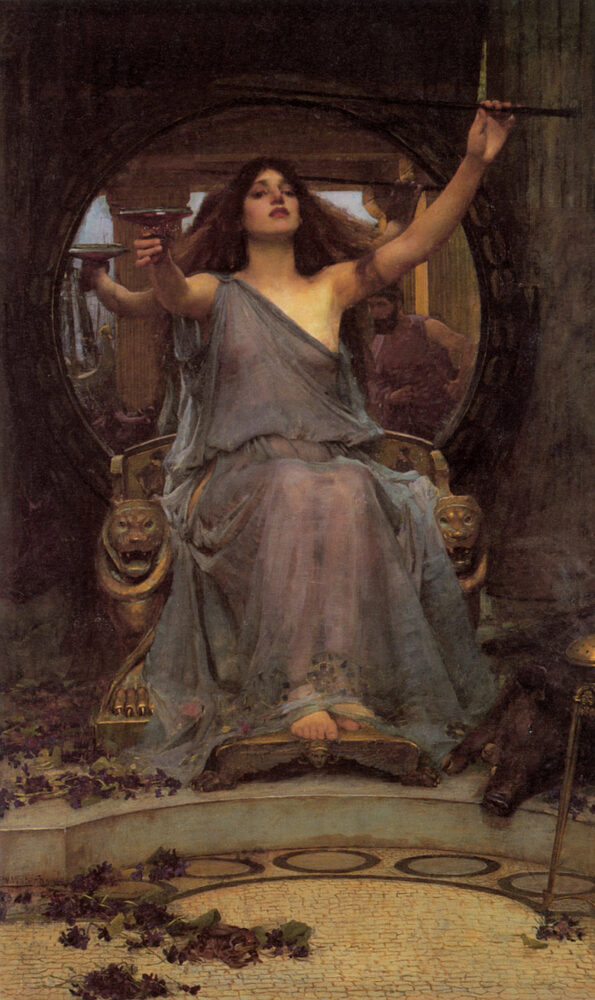
Circe / Kirke
First Appearance
Circe first appears in Homer's Odyssey, when Odysseus and his crew, worn from their wanderings, come to the island of Aiaia. There she dwells in a hall of polished stone in a forest clearing, ringed by wolves and lions strangely tame, singing at her great loom — "a dread goddess with a human voice," the daughter of Helios the Sun and the Oceanid Perse, and sister of Aeetes, keeper of the Golden Fleece. Homer calls her polypharmakos, "she who knows many drugs," and it is her cup and her wand, not any weapon, that make her feared.
— Homer, Odyssey 10.133–574 (and 12.1–150)
Who They Are
Circe (SUR-see; in Greek Kírkē, "hawk") is the great enchantress of Greek myth — but she is, first and most importantly, a goddess, not a mortal "witch." She is the immortal daughter of Helios the sun-god and the Oceanid nymph Perse, which makes her a granddaughter of the Titans and sister to Aeetes, the king who guarded the Golden Fleece, and to Pasiphaë, the queen of Crete. From that shining, uncanny family Circe inherited her defining gift: a mastery of pharmaka — herbs, drugs, and potions — and of the wand and the word of power, with which she can change the very shape of living things. The Greeks did not think of her as a frightened village sorceress but as a deathless divinity of the earth's hidden virtues, keen-eyed and dangerous as the hawk she is named for.
Her home is the mythical island of Aiaia, where she lives in a hall of dressed stone in the middle of a forest, ringed not by guards but by wolves and lions — men she has transformed, gone strangely gentle, who fawn on visitors like dogs. She spends her days at a great loom, singing, weaving the shining, unearthly cloth that only goddesses weave. Into this quiet and beautiful place come Odysseus and his weary crew on their long way home from Troy, and the most famous of all her stories begins: the cup that turns men into swine, and the one herb, moly, that can undo the spell.
Circe is a figure of doubled nature throughout her myth — hostess and threat, healer and poisoner, lover and jailer. She turns men into pigs and then, won over, turns them lovingly back; she keeps Odysseus a year in ease and then sets him freely on his road, giving him the sailing-directions no one else could — even the way to the land of the dead and back. And in the darker, later strand of her legend she is the goddess whose jealousy remakes the world in monstrous forms: it is Circe, the tradition came to say, who turned the nymph Scylla into the six-headed horror of the strait, and Circe who turned the Italian king Picus into a woodpecker. To meet her is to be changed — that is the whole meaning of Circe.
Mythology
The island of Aiaia and the beasts at the door
When Odysseus and his men reached the island of Aiaia (Aeaea), they were at the end of their strength, having just escaped the man-eating Laestrygonians with a single ship. Odysseus split the survivors into two parties and drew lots; the lot fell on his lieutenant Eurylochus to go inland with two-and-twenty men and scout the smoke they had seen rising from the forest. In a clearing they found a hall of polished stone, and around it, prowling, wolves and mountain lions — but the beasts did not spring. They came up wagging and fawning, gentle as house-dogs greeting their master, for they were men whom Circe had already drugged and transformed. Inside, the men could hear a beautiful voice: Circe at her great loom, singing as she wove the fine, glimmering weaving of a goddess. All but the wary Eurylochus called out to her, and she came to the door and welcomed them in.
The cup and the swine
Circe seated the men and mixed for them a kykeon — the barley-and-wine posset of the Greeks — but into it she stirred her pharmaka, her baleful drugs, so that they would forget their homeland entirely. When they had drunk it down, she struck them with her wand (rhabdos), and in that instant they were changed: they had the heads and bristles and grunting voices and bodies of swine, though (Homer is careful and cruel about this) their minds within stayed human and unchanged, aware of everything. Weeping, Circe drove them out into the sties and threw them acorns and mast to root at, the food of pigs. Only Eurylochus, who had hung back outside and watched, escaped — and he fled back to the ship in terror to tell Odysseus that the others were simply gone.
Hermes and the herb called moly
Odysseus took up his sword and bow and set out alone to save his men, though he knew no way to fight a goddess. On the path through the woods the god Hermes met him in the form of a young man and stopped him. It was folly, Hermes said, to walk into Circe's spell unarmed against it — but he would give Odysseus the one protection that worked. He pulled from the ground a plant the gods call moly: black at the root, with a milk-white flower, hard for mortal hands to dig but easy for a god. Carrying moly, Hermes told him, Circe's drug would have no power over him; and he taught Odysseus exactly what would happen next and what to do. When Circe struck him with her wand and the drug failed, Odysseus must rush at her with his sword drawn as though to kill her; she would shrink back and invite him to her bed, and he must not refuse — but first he must make her swear the great oath of the gods to plan no further harm against him, lest, once he was disarmed, she unman him and strip his courage away.
The trick undone, and the oath
It happened just as Hermes had foretold. Circe mixed the cup, Odysseus drank, she struck him with the wand and cried "off to the sty with the others!" — and nothing happened. He did not change. Amazed, she looked at him and knew: no one had ever withstood her drug, and she guessed at once that this must be Odysseus, the man Hermes had long ago told her would come. Odysseus drew and rushed her as Hermes had said; Circe ducked away, caught his knees, and asked in wonder who he was that her pharmaka could not touch. Then, as instructed, Odysseus made her swear the binding oath of the gods to work him no more harm — and only then did the two become lovers. And now Circe's whole nature turned about: the enchantress became the perfect host. At Odysseus's insistence she led the transformed crew out of the sties, smeared each one with another, kindlier drug, and the bristles fell away — they stood up men again, younger and taller and handsomer than before, and wept for joy, and even Circe herself was moved to pity.
The year on Aiaia
What was to have been a rescue became a long rest. Circe welcomed the whole crew into her hall and kept them there in comfort — feasting, drinking, and healing from all they had suffered — for one full year. Odysseus shared her bed and her table, and for a while, in the ease of the goddess's island, the memory of Ithaca grew dim. It was his own men, at the year's end, who came to him and reminded him of home, and Odysseus went to Circe's knees and begged her to keep her sworn promise and send them on their way. She did not hold him. But she told him a hard thing: before he could sail home to Ithaca, he must first make a stranger voyage still.
The road to the land of the dead
(Content note: this passage concerns a journey to the realm of the dead.) No living man knew the way home, Circe told Odysseus, until he had gone down to the house of Hades and Persephone to consult the ghost of the blind Theban prophet Teiresias, the one dead man who keeps his wits and his power of prophecy among the shades. It is Circe, and only Circe, who gives Odysseus the sailing-directions to the edge of the world — how to cross the deep Ocean-stream to the grey shore where the dead throng, what pit to dig, what black ram and ewe to sacrifice so that the ghosts will come and drink and speak. When he returned from that terrible errand (and Homer has him come back to Aiaia to bury a crewman and receive her last counsel), Circe gave him one more gift no one else could: a chart of the very dangers ahead. She warned him of the Sirens and how to pass them with wax and rope; of the clashing rocks; of the terrible strait he must run between the whirlpool Charybdis and the six-headed Scylla, and which of the two to steer nearer; and of the cattle of the Sun, her own father's herds, which his men must not touch on pain of death. Only with the goddess's knowledge could Odysseus have survived the road home at all.
Circe and Scylla — the making of a monster
In Homer, Scylla is simply a horror that has always been. But a strong later tradition made Circe her origin, and it is a story of jealousy. Scylla had been a beautiful sea-nymph, and the sea-god Glaucus loved her, though she fled from him. Glaucus came to Circe to beg for a love-charm to win Scylla — but Circe, hearing him, fell in love with Glaucus herself and pleaded with him to leave the nymph and turn to her. When he refused, saying he would love Scylla though seaweed grew on mountaintops, Circe turned her fury not on the god she could not have but on the girl he wanted. She poured her poisonous pharmaka into the little cove where Scylla liked to bathe; and when Scylla waded in to the waist, her lower body erupted into a ring of savage, baying dog-heads and serpent-necks — she was made the barking, six-mouthed monster of the strait, who from then on snatched sailors from passing ships. (This origin-tale is a later, Roman telling, given its fullest form by Ovid in the Metamorphoses; in the earliest Greek tradition, by contrast, Scylla is simply born a monster — the child of Phorcys and Ceto or of Crataeis — with no transformation at all. Her monstrous form is treated more fully on her own page.)
Circe and Picus — the woodpecker king
(This episode is late and Roman, found in Ovid.) In Italy, the tradition ran, there lived a handsome young king named Picus, a lover of horses and of the woodland nymph Canens, whom he was to marry. Out hunting one day he crossed the path of Circe, and the goddess, struck with sudden desire, conjured a phantom boar to lure him deep into the forest and away from his companions. There she declared her love; and when Picus, faithful to Canens, refused her, Circe struck him with her wand and her herbs and changed him into a woodpecker — the bird the Romans called picus, which keeps his name and, in the story, still wears the purple of his royal cloak in its plumage, drumming forever on the trunks of the trees. His men, coming to accuse her, she scattered into beasts as well. The tale belongs to Ovid's Roman gallery of transformations and is not part of the older Greek Circe; but it shows how completely she had become, by Roman times, the goddess of the unwilling transformation.
After Odysseus
Later poets, reaching beyond Homer, gave Circe and Odysseus children — most often a son, Telegonus ("born far away"), whose own story (in the lost epic the Telegony) circles back tragically to his father. Homer himself says nothing of this; the Odyssey leaves Circe on her island, the goddess who changed men into beasts and then, uniquely, changed them back, and who set the great wanderer on the last and strangest legs of his road home.
Worship — Ancient
A goddess of myth more than of the altar
Circe is, in the surviving record, a goddess known overwhelmingly through story rather than through organized cult. Unlike an Olympian with temples and a festival calendar, she does not appear to have received widespread public worship in the classical Greek world; there is no great sanctuary of Circe, no attested Panhellenic festival in her honour. What she had instead was a powerful and enduring place in the imagination — as the archetype of the divine enchantress, invoked in poetry, painted on pottery (the swine-transformation was a favourite vase-painting scene from early times), and named as the patroness-figure behind the whole Greek art of pharmakeia, the working of herbs and drugs.
The geography of Circe
The ancients did, however, locate her firmly in the landscape. Her mythical island of Aiaia was placed by later Greeks and Romans in the western sea, off the coast of Italy, and identified with the promontory of Monte Circeo (the "Circean height," Latin Mons Circeius) in Latium, south of Rome — a bold headland that looks like an island from the sea. There a cult-memory of Circe did attach: the Roman geographer and antiquarians record local traditions and shrines associating the place with her, and nearby communities claimed descent or connection with her line. The Romans, who through the legend of Aeneas and the wider tradition made Italy the scene of so much Greek myth, took a particular interest in Circe as a presence rooted in their own land.
Circe and the family of the Sun
Where she was honoured or feared, it was as a member of the uncanny solar family — daughter of Helios, sister of Aeetes and of Pasiphaë, and aunt of the great mortal sorceress Medea. This whole lineage was associated in the Greek mind with potent, dangerous knowledge of drugs and magic, and Circe stood at its head as the immortal exemplar. In magical and literary contexts of later antiquity her name was invoked as a byword and patroness of the herb-craft, one of the powers a practitioner of pharmaka might call upon — the goddess who, more than any other, embodied the power to transform.
Worship — Modern
Honouring a goddess of transformation
In modern Hellenic polytheist practice, Circe has found a devoted following far larger than her thin ancient cult would suggest — precisely because she speaks so directly to those drawn to herb-craft, folk magic, and the work of personal transformation. A devotee today typically honours her as a goddess of magic, herbs, and change: one who governs the hidden virtues of plants, the turning of one state into another, and the deep, sometimes frightening work of being remade. She is approached with the respect owed to a deathless daughter of the Sun, not as a storybook villain.
Offerings and observance
Fitting offerings follow the shape of her myth and her domain: libations of wine (sweetened with honey, in the manner of the kykeon she herself mixed), fresh or dried herbs and aromatic plants, flowers, and clean water. A small working-space might hold an image of the goddess at her loom or with her wand and cup, a candle, and living herbs kept and tended in her honour. Because she is a goddess of the earth's growing things and its secret powers, many devotees pour her libations onto the ground or give them at a garden or hearth. As with any of the old gods, the surest offerings are attention and remembrance — learning her herbs, telling her story truly, and honouring the twofold nature that makes her what she is.
Circe in the modern imagination
Beyond formal devotion, Circe may be the most vividly alive she has ever been. She has been reclaimed in the last century as a figure of female power, knowledge, and self-possession, and retold from her own point of view — most famously in Madeline Miller's novel Circe (2018), which reintroduced her to millions of readers as a fully-drawn person rather than a hazard on Odysseus's route. She remains a favourite of painters (John William Waterhouse's Circe Offering the Cup to Ulysses is the enduring image) and of poets, and her name still means what it always meant: the power to change, and the danger and promise bound up in it. For those who honour her, that continuing life is itself a kind of worship — the goddess of transformation, endlessly transformed and never forgotten.
Epithets & Cult Titles
- polypharmakos (πολυφάρμακος) — "Of many drugs" or "knowing many potions" — Homer's own word for her (Odyssey 10.276), naming the vast herb-craft and drug-lore that is the heart of her power
- deine theos audeessa (δεινὴ θεὸς αὐδήεσσα) — "Dread goddess with a human voice" — Homer's recurring formula for Circe (and for her kinswoman Calypso): an immortal who nonetheless speaks with the voice of a mortal woman, uncanny and near at once
- euplokamos (ἐϋπλόκαμος) — "With lovely braids" / "fair-tressed" — Homer's epithet for Circe at her loom (Odyssey 10.220), the goddess singing at her weaving before the men ever guess her danger
- daughter of Helios / of the Sun's line — A descriptive title marking her divine, immortal descent — child of the sun-god Helios, sister of Aeetes and Pasiphaë, and so of the great sorcerous family of the Sun
Sources & Variants
- Homer, Odyssey 10.133–574 (Aiaia; Eurylochus' scouting party; the cup, the wand, and the swine; Hermes and moly; the undoing of the spell and the oath; the year on the island; Circe's instructions for the voyage to the dead)
- Homer, Odyssey 11.1–22 (Circe's sailing-directions carry Odysseus to the land of the dead) and 12.1–150 (his return to Aiaia; her warnings of the Sirens, Scylla and Charybdis, and the cattle of the Sun)
- Hesiod, Theogony 956–957, 1011–1014 (Circe as daughter of Helios and the Oceanid Perseïs, sister of Aeetes; her children by Odysseus)
- Apollonius of Rhodes, Argonautica 4.559–591, 4.659–752 (Circe on Aiaia purifies Medea and Jason; her kinship as Aeetes' sister and Medea's aunt; her transformed beasts). Note: at 4.828–829 Apollonius gives Scylla the standard inborn parentage — born to Phorcys and night-wandering Hecate-Crataeis — NOT made by Circe; the Circe-transforms-Scylla story is Ovid's alone
- Ovid, Metamorphoses 14.1–74 (Glaucus, Circe, and the making of Scylla) — Roman retelling
- Ovid, Metamorphoses 14.320–434 (Circe and Picus, transformed into a woodpecker) — Roman retelling
- Ovid, Metamorphoses 14.242–307 (a Roman retelling of the swine episode, from the crew's point of view)
- Eugammon of Cyrene, Telegony (lost; summarized by Proclus) — Telegonus, son of Circe and Odysseus
- Strabo, Geography 5.3.6, and Virgil, Aeneid 7.10–24 (the localization of Circe at Mons Circeius / Monte Circeo on the coast of Latium)
Gallery