Odysseus
First Appearance
Odysseus is already a fixture of the earliest Greek poetry, prominent throughout the Iliad before he becomes the hero of his own epic. He rallies the panicking Achaeans back from their ships, silences the rabble-rouser Thersites, and stands at Agamemnon's council as the great persuader; from the walls of Troy the old counsellor Antenor recalls how, when Odysseus rose to speak, he seemed at first an unimpressive, stolid man — until the words poured from him 'like winter snows', and no mortal could rival him. Homer already knows him as polymētis, the man of many counsels, and as the raider whose night-mission with Diomedes (Iliad 10) turns on stealth and slaughter in the dark.
— Homer, Iliad 2.169–335 (the mustering of the army) and 3.191–224 (Helen and Antenor describe him on the Trojan wall)
Who They Are
Odysseus (oh-DISS-ee-us; the familiar Latin form is Ulysses) is the most human of the Greek heroes and the hardest to sum up in a single word — king of the rocky little island of Ithaca, sacker of Troy, and the great wanderer whose ten-year struggle to come home gave its name to every long, testing journey after it. Where Achilles is defined by strength and rage and an early death, Odysseus is defined by mind: he is polymētis, "of many counsels," and polytropos, "of many turns," the man who survives not by force but by wit, patience, and an endless supply of stratagems. His weapons are the lie well told, the disguise, the ambush, the plan that no one else could have thought of — above all the wooden horse that finally took the city ten years of fighting could not.
But the Greeks never agreed on whether to admire him, and the honest telling holds both sides at once. In one light he is the ideal survivor: resourceful, self-controlled, polytlas — "much-enduring" — a man who loses every ship and every companion and still claws his way back to his wife, his son, and his father's land, refusing even the immortality Calypso offers him because it would not be home. In another light the very cleverness that saves him curdles into something colder — the liar, the trickster, the man who wins by deceit. The tragedians and, later, the Romans saw this darker Odysseus clearly: in Sophocles and Euripides he can be a cynical manipulator, and in Virgil's Aeneid he is dirus and scelerum inventor, "the dread deviser of crimes," remembered from the losing side as the author of Troy's ruin. Both portraits are ancient, and both are true to something in him.
He is, in the end, the hero of nostos — of homecoming — and of mētis, the practical, cunning intelligence the Greeks both prized and mistrusted. To follow him is to follow a man through the Cyclops's cave and the Sirens' song, past Scylla and down into the land of the dead, through seven years on Calypso's island and a final, bloody reckoning in his own hall, and to ask the whole way whether his brilliance is a virtue or a warning — a question Greek literature never stopped turning over.
Mythology
The reluctant recruit: feigned madness and the muster
Odysseus did not want to go to Troy at all. Bound like the other suitors of Helen by the oath of Tyndareus to defend her marriage, he was called up when Paris carried her off — but an oracle had warned him he would be gone twenty years and return alone and destitute, and he had a new wife, Penelope, and an infant son, Telemachus. So when Agamemnon's recruiters came, he feigned madness: he yoked an ox and a donkey together, put on a peasant's cap, and ploughed his fields sowing them with salt. The stratagem was undone by a stratagem — Palamedes snatched the baby Telemachus from Penelope's arms and laid him in the path of the plough, and when Odysseus turned the team aside to spare his son, his sanity stood exposed. He never forgave Palamedes, and later engineered his death by a forged letter and planted gold, a piece of ruthless treachery the tragedians did not let him forget. Once committed, he became the army's indispensable man, and it was Odysseus who in turn exposed Achilles, hidden in women's clothes among the daughters of Lycomedes, by laying out gifts with a spear and shield among them and sounding a war-alarm — the one "girl" who reached for the weapons was the hero the Greeks could not win without.
The taker of Troy: the Palladium and the Wooden Horse
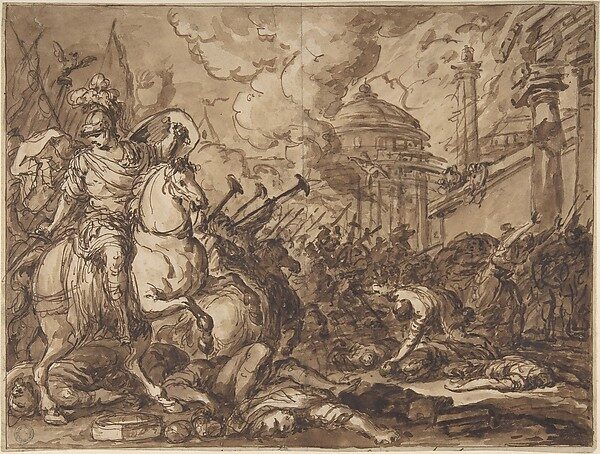
Odysseus is, before all else, the mind that finally broke Troy — his signature is not a duel but a stratagem. Two feats stand out. First, with Diomedes, he crept into the besieged city by night and stole the Palladium, the ancient wooden image of Athena on which, prophecy said, the safety of Troy depended; some tellings have him slip in first alone, disguised in rags and self-inflicted wounds as a beaten beggar, scouting the city (Helen recognised him but kept his secret). And then, at the last, the Wooden Horse. When ten years of war had taken neither the walls nor the will of Troy, it was Odysseus who devised the trick that did: a great hollow horse of wood, built by Epeius, left on the empty plain as a pretended offering to Athena while the Greek fleet sailed out of sight to wait behind the island of Tenedos. Inside, in the dark and the cramped silence, sat Odysseus and the best of the Greeks. He held them steady when Helen walked around the horse calling out in the voices of their own wives to lure them into answering, and he throttled the impulse of the man who nearly cried out. The Trojans, deceived by Sinon's false tale and heedless of Laocoön's and Cassandra's warnings, dragged the horse inside their own walls; in the night the hidden men climbed down, opened the gates, and let in the returning army, and Troy that had stood for ten years fell in one. It is the purest emblem of Odysseus: the city that could not be stormed was talked and tricked into destroying itself.
The homecoming begins: the Cicones, the Lotus-Eaters, and the Cyclops
(Content note: the wanderings that follow include the deaths of all Odysseus's companions, cannibalism, and, at the end, mass killing.) Homer's Odyssey tells the ten-year nostos — the homeward voyage — mostly through Odysseus's own mouth, as a tale he spins for his hosts. Sailing from Troy his men first sacked the city of the Cicones and, drunk on plunder, refused to leave until a counter-attack cut them down; then a storm drove them to the land of the Lotus-Eaters, whose honeyed fruit made the men who tasted it forget all thought of home, so that Odysseus had to drag them weeping back to the ships and bind them under the benches. Worst and most famous was the island of the Cyclopes. (Cross-reference to come — Polyphemus.) Odysseus led a scouting party into the cave of the one-eyed giant Polyphemus, son of Poseidon, who trapped them behind a boulder no man could move and began eating them two at a time. Odysseus's answer was pure mētis: he gave the giant strong wine and told him his name was Outis, "Nobody"; when Polyphemus was drunk and asleep, they drove a sharpened, fire-hardened stake into his single eye. Blinded, the Cyclops roared for help, but when his neighbours called through the door who was hurting him he bellowed "Nobody!" — and they went away. Odysseus and the survivors escaped at dawn lashed beneath the giant's rams. But here his cunning shades into the flaw that dooms the voyage: safely aboard, he could not resist shouting back his true name, and Polyphemus prayed to his father Poseidon to curse the homecoming — that Odysseus reach Ithaca late, alone, in a stranger's ship, and find grief in his house. The sea-god heard.
Aeolus, the Laestrygonians, and Circe's island
Given the bag of winds by Aeolus, keeper of the winds, Odysseus came within sight of Ithaca's very shore — his men could see the fires — before his crew, suspecting he was hoarding treasure, opened the bag and loosed the storm that blew them all the way back. The cannibal Laestrygonians then smashed and speared all his ships but one. That single ship reached the island of Circe (cross-reference to come), the witch-goddess who turned his scouting party into swine with a stroke of her wand. Warned by Hermes and armed with the herb moly against her drugs, Odysseus alone withstood the spell, forced her at sword-point to release his men, and became her lover; for a year they feasted on her island before his crew reminded him of home. It was Circe who told him what he must do first: to sail to the very edge of the world and consult the dead.
The Nekyia: the journey to the land of the dead
So Odysseus did what few living men ever did — he went down to the borders of the Underworld (the Nekyia, the "rite of the dead," Book 11 of the Odyssey). At the grove of Persephone he dug a pit, poured offerings of milk, honey, wine and water, and let the black blood of sacrificed sheep pool in it, and the thronging shades of the dead came crowding up to drink and speak. He met the blind prophet Teiresias, who foretold his hard road home, the danger of the cattle of the Sun, and a strange final journey inland with an oar; he spoke with the shade of his own mother, Anticleia, dead of grief for him, and three times tried and failed to embrace her; he saw the great heroines and heroes, Agamemnon murdered at his homecoming, and Achilles, who told him he would rather be a landless serf among the living than king over all the dead — a line that shadows the whole poem's love of life and home. The descent is the still, dark centre of the wanderings: the man of many turns turning, for once, to face what waits at the end of every road.
The Sirens, Scylla and Charybdis, and the cattle of the Sun
Returning past Circe's isle for her final sailing-directions, Odysseus faced the last great perils. The Sirens (cross-reference to come) sang from their meadow of bones a song no sailor could hear and live, for it promised knowledge of all things; Odysseus, wanting both to survive and to know, had his men stop their own ears with wax and lash him upright to the mast with orders to bind him tighter the more he begged — and so he alone heard the song and lived. Then came the strait guarded on one side by Scylla, the six-headed monster in her cliff, and on the other by Charybdis, the whirlpool that swallowed the sea three times a day (cross-reference to come). Circe had told him the cruel arithmetic: there was no way through without loss, and better to lose six men to Scylla than the whole ship to the whirlpool. He said nothing to his crew, and as they rowed past, Scylla snatched six of his best companions and ate them writhing and screaming above his head — the most helpless moment of the voyage, a horror his cunning could not prevent, only survive. On the island of the Sun-god Helios, trapped by contrary winds and starving, his men at last broke the one taboo Teiresias had warned of and slaughtered the god's sacred cattle; for that sacrilege Zeus split their ship with a thunderbolt at sea and drowned every man. Odysseus alone survived, clinging to the keel, sucked back once through Charybdis and out again.
Calypso and the raft
Washed up alone on the island of Ogygia, Odysseus fell into the hands — and the bed — of the nymph Calypso, "the Hider," who kept him there seven long years, promising him agelessness and immortality if he would stay and be her husband forever. It is one of the poem's deepest tests, and its answer defines him: offered the one thing no other mortal is offered, an endless life free of suffering, he refuses it. Homer shows him sitting on the shore day after day, weeping and looking out over the barren sea toward home, so that though he lies in Calypso's arms by night he longs only for Penelope, who is mortal and ageing and cannot compare to a goddess — and whom he chooses anyway. At last Athena won Zeus's order for his release; Calypso, grieving, taught him to build a raft, and he set out again, only for Poseidon to wreck it in a final storm that left him swimming for two days to the friendly land of the Phaeacians. There, at the court of Alcinous, he told the whole tale of his wanderings, and there at last a magic ship carried the sleeping hero home and set him, with the treasure they gave him, on the shore of Ithaca.
The return to Ithaca: the disguise and the reckoning
Ten years gone from Troy and twenty from home, Odysseus came at last to Ithaca — and found his house under siege. More than a hundred suitors had installed themselves in his hall, devouring his wealth, courting his wife Penelope, and plotting to murder his now-grown son Telemachus. Athena disguised the king as an aged, ragged beggar, and so, unrecognised, he entered his own home to take the measure of it. The recognitions that follow are among the most moving scenes in all Greek poetry. His old hound Argos, whom he had raised as a puppy before sailing for Troy, now lay neglected and dying on a dung-heap; the dog alone knew his master through the disguise, pricked his ears and wagged his tail, and — his master unable to acknowledge him without betraying himself — died in that instant of recognition. His old nurse Eurycleia, washing the beggar's feet, felt the scar on his thigh from a boyhood boar-hunt and knew him at once, nearly crying out before he gripped her throat and swore her to silence. He endured, polytlas, insult and a thrown stool from the suitors in his own hall, keeping his fury banked.
Then Penelope — whether guessing the truth or simply exhausted of hope — announced a contest: she would marry the man who could string the great bow of Odysseus and shoot an arrow through the sockets of twelve axe-heads set in a row, a feat only her husband had ever done. One after another the suitors strained and failed even to bend the bow. The ragged beggar asked to try; over the suitors' jeers he strung it as easily as a bard fits a new string to his lyre, and sent the arrow clean through all twelve axes. Then he threw off his rags, leapt to the threshold with Telemachus and two loyal herdsmen at his side, and turned the bow on the men who had eaten his house. (Content note: the slaughter that follows is deliberate and total.) He shot the ringleader Antinous through the throat, and then, the doors barred and no escape possible, he and his small band killed the suitors to the last man, and hanged the twelve serving-women who had gone over to them. It is the reckoning the whole poem has been driving toward — justice and massacre in the same act, the returning king washing his hall in blood.
The recognition by Penelope: the secret of the bed
One recognition remained, and it is the most famous test in the poem — for Penelope is Odysseus's equal in cunning, and she would not take a stranger's word, or even her own hope, for proof. Though he stood washed and restored before her, she remained coolly unconvinced, and to test him she ordered the servant Eurycleia to move their marriage-bed out of the bedchamber to make it up for the stranger. At that Odysseus flared: the bed could not be moved, he said, for he had built it himself around a living olive-tree still rooted in the ground, its trunk one of the bedposts, and no man could shift it unless he had cut it free. Only the two of them and one servant had ever known that secret. Hearing him name it, Penelope's knees went weak and her defences broke at last; she ran to him and threw her arms around his neck, and Homer says they wept, holding each other, the way shipwrecked sailors weep at the sight of land. The sign of their marriage is a bed rooted like a tree — a homecoming built, quite literally, on something that cannot be moved. In a coda, Odysseus went out to the country farm to reveal himself to his aged father Laertes, proving himself with the boyhood memory of the trees Laertes had once given him; and the poem closes with Athena imposing peace between the king and the vengeful kin of the slain suitors.
Worship — Ancient
Hero, not god
Odysseus was not a god but a hero in the technical Greek sense — a powerful mortal of the age of legend who received cult after death, honoured at a tomb or shrine with offerings poured into the earth rather than burnt on a high altar. Hero-cult was local and grounded, tied to a place that claimed the hero's bones or presence, and it is in that key that the historical honouring of Odysseus must be understood: real, but modest and regional, nothing like the Panhellenic worship of an Olympian.
Ithaca and the cave at Polis Bay
His natural home was Ithaca, and there archaeology has given the tradition a striking anchor. At the cave sanctuary at Polis Bay on the island, excavators found dedications spanning centuries, among them a number of bronze tripod-cauldrons of the Geometric period — and readers of the Odyssey remember that the Phaeacians sent Odysseus home with exactly such a hoard of tripods and cauldrons, which he hid in a cave of the nymphs on landing. A later inscribed fragment from the site reading a prayer or dedication "to Odysseus" strongly suggests a functioning hero-cult on his own island, where he was honoured at the very kind of shrine the poem describes. Whether the tripods inspired the poem or the poem shaped the cult, Ithaca kept his memory as a living devotion.
Aetolia, Epirus, and the wider cult
Beyond Ithaca, traces of Odysseus in cult and legend cluster in the northwest of Greece — in Aetolia and Epirus — regions bound up with the traditions of his later wanderings. Some accounts, following the prophecy of Teiresias that he must journey inland carrying an oar until he met a people who knew nothing of the sea, took him far from the coast to found cults and die at peace far from Ithaca; others attached his name to sanctuaries and founding-legends along the western seaboard and even in Italy, where his fame ran deep. The picture is genuinely patchy — a scatter of local claims rather than one great shrine — and honesty requires saying so: Odysseus's true monument in antiquity was less any single temple than the poem itself, recited across the whole Greek world.
The afterlife of his story: Sophocles, the tragedians, and the Telegony
Odysseus lived on most powerfully in literature, and there his darker side came to the fore. On the Athenian stage he is often the cynical politician and manipulator — most memorably in Sophocles's Philoctetes, where he coldly schemes to trick the wounded, abandoned archer out of his bow for the sake of the war, the very embodiment of ends-justify-the-means cunning; his Ajax shows a more thoughtful, even compassionate Odysseus, but the tragic tradition on the whole distrusts him. The lost early epic the Telegony carried his story past the end of the Odyssey, telling of further wanderings and of his death at the hands of Telegonus, his own son by Circe, who came to Ithaca not knowing his father and killed him with a spear tipped with the sting of a stingray — the death "from the sea" that Teiresias had darkly foretold. Roman poets, above all Virgil, remembered him from Troy's side as the arch-deceiver, so that "Ulysses" carried a shadow the Greek Odysseus only half bore. Across all these afterlives runs the same double image the tradition never resolved: the enduring survivor and the ruthless trickster, held together in one restless, unforgettable man.
Worship — Modern
Honouring Odysseus today
Odysseus is honoured today less as a god to be petitioned than as a hero to be remembered and drawn on — a pattern true to his ancient standing. Modern Hellenic polytheists and admirers of the myths keep his memory in the way heroes were always kept: with respect at a small shrine, with storytelling, and by taking his example to heart. A shelf bearing an image of a ship, a bow, or an olive branch, with a lamp lit in his honour, gives him a place; and because he is the hero of the long way home, many turn to him at the start or end of a journey, or when facing a hard passage that will need patience and wit more than force.
Offerings and remembrance
Where hero-cult once poured libations into the earth at a tomb, a modern devotee most fittingly offers a libation of wine poured out to his memory, together with things that belong to his story — a sprig of olive (the wood of his marriage-bed and the tree of Athena, his patron goddess), or bread and salt for the traveller. Most characteristic of all is simply to read or tell his story: to keep a passage of the Odyssey on the shrine, to speak the tale of the homecoming aloud, is the truest honour to a hero whose immortality was always the poem itself. Honesty is part of the reverence — Odysseus is remembered whole, the liar with the survivor, the sacker of the city with the man weeping for home.
His enduring legacy
No hero of Greek myth has cast a longer shadow over later culture. His very name became a common noun: an odyssey is any long, wandering, testing journey, and to speak of a "Trojan horse," a "Siren song," being caught "between Scylla and Charybdis," or a "Penelope" faithfully waiting is to speak Odysseus's story without knowing it. He is remade in every age — as Dante's restless voyager sailing past the world's edge in pursuit of knowledge, as Tennyson's ageing king who would "strive, to seek, to find, and not to yield," as the ordinary Dubliner Leopold Bloom in James Joyce's Ulysses (his Roman name), and as the archetype, in modern storytelling and even psychology, of the hero's long road home. To honour Odysseus today is to honour endurance, ingenuity, and the pull of home — and to sit honestly with the harder question his cleverness always raises, of what a clever man will do to survive and to win.
Epithets & Cult Titles
- Polytropos (πολύτροπος) — Of many turns, of many ways — the first word Homer gives him in the Odyssey, at once 'much-travelled' and 'much-turning' in mind, the man who takes every twist and cannot be pinned down
- Polymētis (πολύμητις) — Of many counsels, of much cunning intelligence (mētis) — the standing Homeric epithet for the sharpest mind among the Greeks at Troy
- Polymēchanos (πολυμήχανος) — Of many devices, resourceful — the contriver who always has one more stratagem, the inventor of the way out
- Ptoliporthos (πτολίπορθος) — Sacker of cities — the taker of Troy, a martial title he shares with few, marking the destroyer as well as the survivor
- Polytlas (πολύτλας) — Much-enduring, the great sufferer — 'long-suffering, godlike Odysseus', the man who bears what would break another and keeps his eye on home
- Talasiphron — Steadfast of heart, patient-minded — the endurance that lets him wait, disguised and insulted in his own hall, until the moment to strike
Sources & Variants
- Homer, Odyssey (the whole poem is his; esp. 1.1–10 for the epithets polytropos/polymētis, 9 for the Cicones, Lotus-Eaters and Polyphemus the Cyclops, 10 for Aeolus, the Laestrygonians and Circe, 11 for the Nekyia and Teiresias, 12 for the Sirens and Scylla & Charybdis and the cattle of the Sun, 5 for Calypso and the raft, 17.290–327 for the dog Argos, 19.386–475 for the scar and Eurycleia, 21 for the contest of the bow, 22 for the killing of the suitors, 23.177–232 for the secret of the olive-tree bed)
- Homer, Iliad 2.169–335 (Odysseus rallies the army and silences Thersites); 3.191–224 (Antenor on his oratory); 10 (the night raid with Diomedes)
- Apollodorus, Bibliotheca 3.10.8–9 (the oath of the suitors; the feigned madness and the plough); Epitome 3.7 (exposing Achilles among the daughters of Lycomedes), 5.8–5.15 (the Palladium, the Wooden Horse, the sack of Troy), 7.1–7.40 (the wanderings and the return)
- Sophocles, Ajax and Philoctetes (the tragic-stage Odysseus, cunning and cold — and, in the Ajax, more humane)
- Euripides, Hecuba and Cyclops (the ruthless politician; the satyr-play retelling of Polyphemus)
- Virgil, Aeneid 2 (Ulysses as scelerum inventor, the 'deviser of crimes', remembered from Troy's side); Ovid, Metamorphoses 13.1–398 (the contest for the arms of Achilles)
- The Telegony (lost epic of the Epic Cycle, summarised by Proclus — Odysseus's later wanderings and his death at the hands of Telegonus, his son by Circe)
- Archaeology: the cave sanctuary at Polis Bay, Ithaca (Geometric bronze tripod-cauldrons and a probable dedication to Odysseus — S. Benton's excavations, 1930s), evidence for a local hero-cult
Gallery