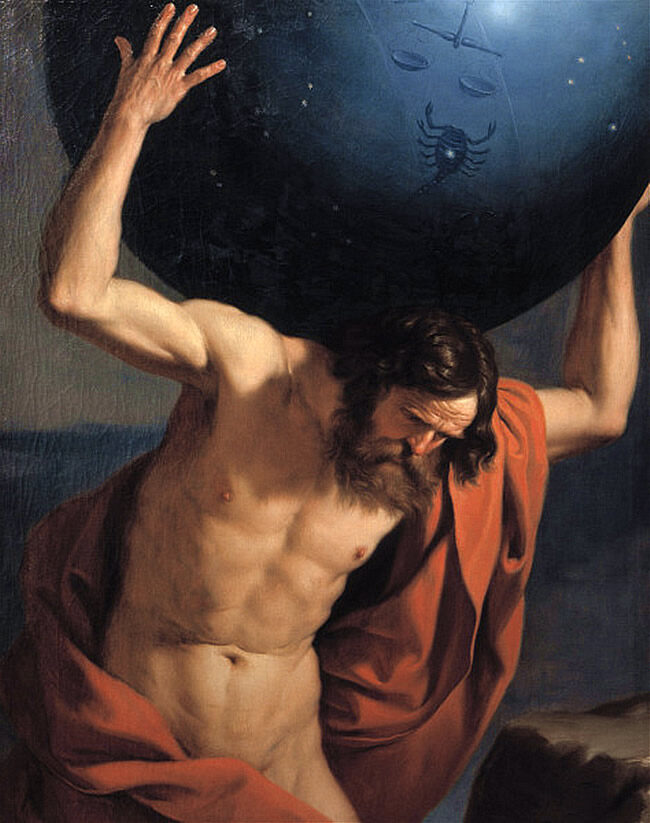
Atlas
First Appearance
Atlas first appears bearing his eternal punishment: standing at the borders of the earth before the clear-voiced Hesperides, he holds up the wide heaven with unwearying head and hands, under hard constraint. This lot, Hesiod says, wise Zeus assigned to him after the Titans' defeat.
— Hesiod, Theogony 517–520
Who They Are
Atlas (AT-luss) is the Titan condemned to hold up the sky. A son of the Titan Iapetus and the Oceanid Clymene — and so brother to Prometheus, Epimetheus, and Menoetius — he stands at the far western edge of the world, bearing the ouranos, the great vault of heaven, upon his head and shoulders so that sky and earth are kept forever apart. His name the Greeks heard as "the Enduring One," from tlēnai, "to bear, to suffer," and endurance is the whole of his myth: he does not act so much as he sustains, straining beneath a weight that will never be set down.
His punishment is political. In the Titanomachy — the ten-year war of the elder gods against Zeus — Atlas stood on the defeated side (the tradition that made him a leader of the Titans is post-Hesiodic), and where the other Titans were bound and cast into Tartarus, Zeus assigned him a different and unending sentence: to stand at the world's western bound and carry the heavens on his back. Homer knows him as the Titan "of baleful mind, who knows the depths of all the sea, and himself holds the tall pillars that keep earth and heaven apart" (Odyssey 1.52–54).
A word of caution about the most famous image of him. Atlas is popularly pictured shouldering a round globe of the earth — the pose of the Farnese Atlas statue and of countless modern logos and bookplates (the very word "atlas" for a book of maps comes from this). In Greek myth this is wrong. What Atlas bears is not the earth but the sky: the celestial dome, the roof of the world. The globe-of-the-earth image is a much later conflation, encouraged by Renaissance and early-modern art that set a terrestrial sphere on his shoulders. The authentic, ancient Atlas holds up the heavens.
Mythology
Sky, not globe — correcting the misconception
The single most important thing to know about Atlas is what he holds. The familiar picture — a straining giant with a round globe of the earth balanced on his shoulders — is not the Greek myth. It is a later image, fixed above all by the Roman Farnese Atlas (a marble copy, c. 2nd century CE, of a Hellenistic original), whose sphere is a celestial globe carved with the constellations, and then simplified by Renaissance and modern artists into a terrestrial globe of continents and seas. From that came the modern shorthand — "carrying the world on his shoulders" — and even the name of the map-book, the atlas.
In the ancient sources Atlas carries the sky. Hesiod says he "holds the wide heaven" (ouranon eurun) at the borders of the earth (Theogony 517–520). Homer describes him keeping "the tall pillars that hold earth and heaven apart" (Odyssey 1.52–54). His office is cosmological: he is the prop that stops the sky from falling onto the earth, the living pillar at the world's western edge. So while the globe-bearing image is worth recognising — you will meet it everywhere — it should be flagged for what it is: a late, inaccurate version. The true Atlas bears the heavens.
The sentence after the Titanomachy
When Zeus and the younger gods rose against Cronus and the Titans, Atlas stood on the side of the older generation and shared in its defeat; the idea that he was a leader of the Titans is post-Hesiodic (Hesiod, Theogony 517–520, records only that Zeus assigned him the burden of the sky, while the leader-tradition appears in later sources such as Hyginus, Fabulae 150). The war lasted ten years and ended in the Titans' complete defeat; most were chained and hurled down into Tartarus, as far beneath the earth as heaven is above it. Atlas alone received a distinct punishment. Zeus set him at the extreme west, beyond the daughters of the evening — the Hesperides — and laid upon him the endless labour of holding up the sky. Hesiod is explicit that this is a sentence "under hard constraint" (kraterēs hyp' anankēs), a lot assigned by Zeus (Theogony 517–520). It is not a task Atlas chose or a strength he displays for glory; it is the burden of the defeated, borne without release.
Heracles and the apples of the Hesperides — the trick
Atlas steps briefly out from under his burden in one famous story. For the eleventh of his Labours, Heracles was sent to fetch the golden apples of the Hesperides, which grew in a garden at the western edge of the world — the very region where Atlas stood, and which the Hesperides (nymphs of the evening, in many tellings Atlas's own daughters) guarded together with the dragon Ladon. On the advice of Prometheus, Heracles did not try to take the apples himself. Instead he came to Atlas and offered a bargain: he would shoulder the sky in Atlas's place if the Titan would go and gather the apples, which Atlas, as father or kin of the Hesperides, could pluck freely.
Atlas agreed gladly, glad above all to be free of his weight for a while. Heracles took the heavens onto his own shoulders, and Atlas went off and returned with three golden apples in his hands. But now, tasting freedom, Atlas had no wish to crawl back beneath the sky — he told Heracles he would carry the apples to Eurystheus himself, and meant to leave the hero holding the heavens forever. Heracles, seeing the trap, answered him with a trick of his own. He agreed pleasantly — but asked Atlas to take the sky back for just a moment, so that he might pad his shoulders with a cushion against the crushing weight. Atlas, unsuspecting, set the apples down and stooped once more under the heavens to take them up. Heracles picked up the apples from the ground, bade him farewell, and walked away — leaving Atlas exactly where he had always been (Apollodorus, Bibliotheca 2.5.11).
The starry daughters
Atlas is above all a father of stars. By the Oceanid Pleione (who has no page here) he begot the Pleiades, the seven sisters — Maia, Electra, Taygete, Alcyone, Celaeno, Sterope, and Merope — who were pursued across the sky and set among the constellations as the familiar cluster of the Pleiades. Eldest and most honoured of them was Maia, who in a cave on Mount Cyllene bore Hermes to Zeus; she alone of Atlas's many daughters has her own page here.
Atlas is likewise called father of the Hyades, the rain-bringing sisters who form the face of the constellation Taurus; of the Hesperides, the nymphs of the golden apples at the world's western edge; and, in Homer, of Calypso — "daughter of Atlas of baleful mind" (Odyssey 7.245) — the nymph of the island Ogygia who held Odysseus with her for seven years and offered him immortality if he would stay. Through these daughters Atlas, the bearer of the heavens, becomes also the ancestor of half the western sky.
How Atlas became the mountain — a later telling
A different tradition, told fully only in Roman poetry, explains the great Atlas range of northwest Africa as the Titan's own petrified body. This version should be flagged as late: it belongs to Ovid (Metamorphoses 4.627–662), not to the early Greek sources, and it recasts Atlas not as the sky-bearer under sentence but as a giant king who rules the far west and owns a garden of golden-apple trees, guarded because an oracle of Themis had warned him that a son of Zeus would one day come to plunder them. When Perseus, flying home from slaying Medusa, alighted in Atlas's country and asked for a night's rest — naming himself a son of Zeus — Atlas remembered the prophecy and tried to drive him off by force. Overpowered by the giant's bulk, Perseus turned away as if in defeat, then lifted from his wallet the head of the Gorgon and held it up. At its gaze Atlas became what he had been in the older myth in a new and literal way: his beard and hair grew into forests, his shoulders and arms into long ridges, his head into the summit, and his bones stiffened into stone, until he swelled to the size of a mountain — "and the whole sky, with all its stars, came to rest upon him" (Ovid, Metamorphoses 4.657–662). It is a neat, late fusion of two ideas the Greeks had kept separate: the Titan who holds up the heavens, and the mountain in the west that carries the name of Atlas. In the authentic Greek tradition Atlas is not turned to stone by any Gorgon; he stands, living and straining, beneath the sky.
Worship — Ancient
A figure of myth more than cult
Atlas had little in the way of organised worship in the Greek world. Unlike the Olympians, he received no great temples, no Panhellenic festivals, and no established priesthood; he lived in the imagination as a figure of cosmology and story rather than as a god to whom one sacrificed. His importance was explanatory — he accounted for why the sky stays up, where the world ends in the west, and how the Pleiades and Hyades came to shine — and geographical, since the far-western mountains beyond the known world came to bear his name (the Atlas range of northwest Africa), imagined as the petrified or towering giant himself.
Astronomy and navigation
Where Atlas came nearest to a living role, it was through his daughters and his burden. As father of the Pleiades and Hyades — clusters whose rising and setting told farmers when to plough and reap, and told sailors when the seas were safe — Atlas stood behind the practical star-lore that governed the Greek year, the kind of calendar Hesiod lays out in the Works and Days. As the Titan who holds and turns the heavens, he was also linked in later thought with astronomy itself: Diodorus Siculus reports a rationalising tradition that Atlas was a wise early astronomer who first taught men the sphere of the heavens, and that "bearing the sky on his shoulders" was a memory of this teaching. Hence the celestial globe carved on the shoulders of the Farnese statue.
Worship — Modern
Atlas as a symbol of endurance
Atlas is honoured today less as a god to be petitioned than as an image to live by — the enduring one who carries what must be carried. For a modern devotee or admirer, his meaning is the dignity of bearing a heavy burden without laying it down: responsibility shouldered, strength kept under strain, the quiet holding-up of a family, a duty, or a world. To "bear the weight of the sky" is a fitting emblem for anyone who sustains others.
A simple observance
Those who wish to mark him can do so under the open night sky, for his true burden is the heavens themselves. Find the Pleiades — his daughters, the little misty cluster near the shoulder of Taurus — and the Hyades that form the bull's face, and give a moment's thought or a few words to the Titan who fathered them and holds up their dome. A raised gaze to the stars, a word of respect for endurance freely given, is the most faithful honour to Atlas. And in keeping with the myth, picture him rightly: not stooped beneath a globe of the earth, but braced beneath the whole vault of heaven.
Epithets & Cult Titles
- Oloophron (Ὀλοόφρων) — Of baleful mind, deep-thinking — Homer's word for Atlas, the Titan who 'knows the depths of every sea' (Odyssey 1.52)
- Ouranophoros (Οὐρανοφόρος) — Sky-bearer — descriptive of his eternal office, holding up the ouranos, the vault of heaven
- Endurer at the world's edge — He who stands at the far western bound of the earth, before the Hesperides, bearing the sky 'under hard constraint' (Hesiod, Theogony 517–520)
Sources & Variants
- Hesiod, Theogony 507–520 (son of Iapetus and Clymene; Atlas bears the wide heaven at the world's edge before the Hesperides, under hard constraint)
- Homer, Odyssey 1.52–54 (Atlas 'of baleful mind,' who holds the tall pillars keeping earth and heaven apart); 7.245 (Calypso, daughter of Atlas)
- Apollodorus, Bibliotheca 2.5.11 (the eleventh Labour of Heracles: the golden apples of the Hesperides, Atlas fetches them, and the trick that returns him under the sky)
- Diodorus Siculus, Bibliotheca Historica 3.60; 4.27 (Atlas as astronomer; the sky on his shoulders as a memory of his teaching the celestial sphere)
- Ovid, Metamorphoses 4.627–662 (LATER/Roman: Atlas as a giant king of the far west with the golden-apple garden; Perseus shows him Medusa's head and turns him to stone, and he becomes the Atlas mountain that bears the starry sky)
- Note on iconography: the globe-bearing image derives from the Roman Farnese Atlas (2nd c. CE), whose sphere is celestial, later conflated with a terrestrial globe — a post-antique version, not the ancient myth, in which Atlas bears the sky
Gallery