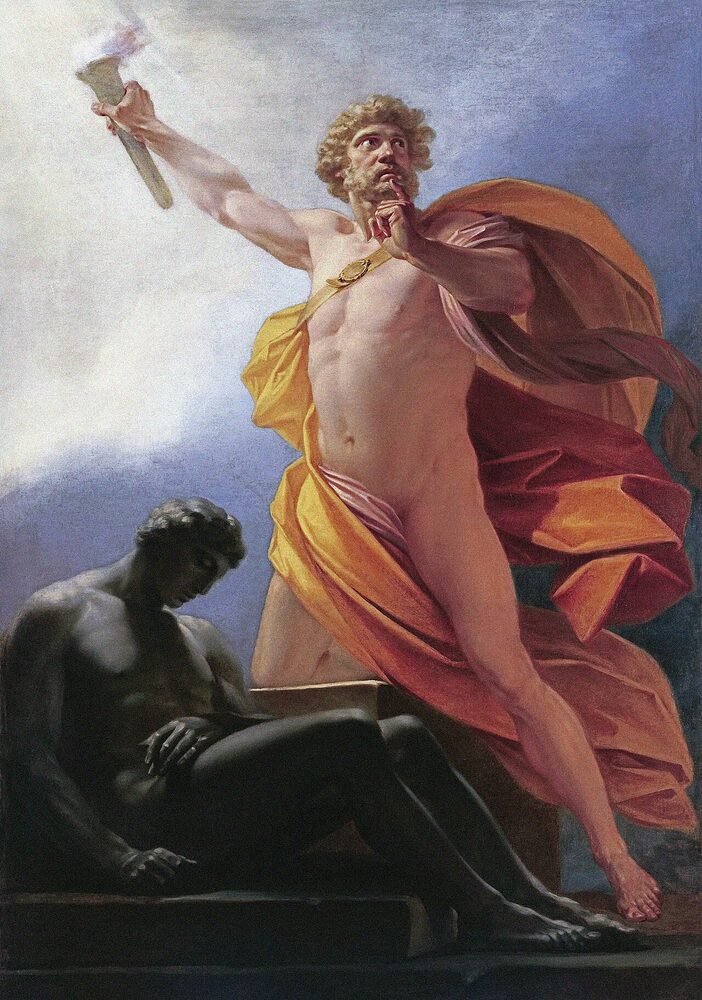
Prometheus
First Appearance
Prometheus first appears as a son of the Titan Iapetus and the Oceanid Clymene, brother of Atlas, Menoetius and Epimetheus — "crooked-counselled Prometheus, subtle and quick of mind." Hesiod introduces him already at odds with Zeus: it is he who at Mecone divides the sacrificial ox to settle what portion the gods shall receive, deceiving Zeus with the offering, and who afterward steals fire for mortals hidden in a fennel-stalk — the deeds for which Zeus binds him and sets an eagle to feed upon his liver.
— Hesiod, Theogony 507–616
Who They Are
Prometheus (pro-MEE-thee-us) is the great benefactor of humankind — the Titan whose name means "Forethought," who stole fire from heaven and gave it to a helpless mortal race, and who paid for that gift with ages of torment on a mountain crag. Where most of the older gods stand above and apart from human life, Prometheus stands with mortals and against the powers that would keep them low. He is the trickster who outwits Zeus, the culture-giver who makes civilisation possible, and, in his most enduring portrait, the defiant rebel who suffers rather than submit to a tyrant's will.
He belongs to the elder generation of the Titans, a son of Iapetus and the Oceanid Clymene, and brother to the sky-bearing Atlas and to slow-witted Epimetheus, "Afterthought," whose name is the mirror of his own. In the oldest telling, that of Hesiod, Prometheus is the crafty champion of an already-existing human race, matching wits with Zeus at the dawn of the divine order. In later tradition — the one that reaches Rome through Ovid and the mythographers — he becomes the very maker of humanity, moulding the first people out of clay and water with his own hands. Both traditions honour the same figure: the god who cares for mortals when no one else will.
His story is dark, and its centre is a punishment of extraordinary cruelty. Yet the Greeks did not remember him as a mere criminal against the gods. They remembered him as the giver of fire and of every craft that fire makes possible — of metalwork and medicine, of number and writing, of the arts by which human beings raised themselves from beasts. In the theatre of Aeschylus he became something close to a martyr for humankind, and it is that image — the chained Titan who will not bow — that has echoed through Western imagination ever since.
Mythology
The making of humankind
Two traditions stand side by side, and both were told in antiquity. In the older, Hesiodic frame, Prometheus does not create human beings at all: mortals already exist, and Prometheus is their champion and benefactor, taking their part in the great division of privileges between gods and men at the beginning of the world. In the later tradition — first clearly attested in the Aesopic fables and the mythographers, and given its most famous form by the Roman poet Ovid — Prometheus is the maker of humanity itself, shaping the first people from clay moistened with water, in the image of the gods (Apollodorus 1.7.1; Ovid, Metamorphoses 1.82–88, a Roman retelling). In some versions Athena breathes life or wisdom into the figures he has moulded. The tradition was even localised: at Panopeus in Phocis the traveller Pausanias was shown two great lumps of clay, still (he reports) giving off the smell of human skin, and told they were what remained of the earth from which Prometheus had fashioned the whole human race (Description of Greece 10.4.4). The two accounts are not easily reconciled, and the site deliberately holds them both: Prometheus the advocate of mortals, and Prometheus the potter of the human clay.
The trick at Mecone
At Mecone, where gods and mortals came together to settle their accounts, Prometheus was called on to divide a great ox and so fix, once and for all, what portion of every sacrifice would belong to the gods (Hesiod, Theogony 535–560). He butchered the beast and made two unequal portions, each disguised as its opposite. In the one he laid the good meat and the rich inner parts, and hid them inside the ox's stomach — wrapping wholesome food in an unlovely covering. In the other he set the bare white bones, and folded them cunningly in a layer of glistening white fat, so that the worthless portion looked the richer of the two. Then he invited Zeus to choose which should be the gods' due.
Zeus took the portion wrapped in shining fat — and found beneath it only bones. Hesiod is famously ambivalent about whether the king of the gods was truly deceived: at one moment the poet says Zeus "was angered in his heart" when he saw the trick, at another that Zeus "knew the trick and did not fail to see it," and chose the bones with his own designs in mind, already planning evils for mortals. Either way, the outcome became the pattern of all Greek sacrifice ever after: mortals burn the bones and fat upon the altar as the gods' share, and keep the meat for themselves. What looks like a victory for humankind is also the reason for divine anger to come.
The theft of fire
In his wrath at the deception, Zeus withheld fire from mortals — refusing them the one thing that would let them cook their meat, warm their homes, and work in metal and craft. But Prometheus would not leave humankind in the cold and dark. He stole fire back from heaven and carried it down to mortals hidden in the hollow of a fennel-stalk — the narthex, a tall plant whose dry, pithy core smoulders slowly and carries a live ember for miles without going out (Hesiod, Theogony 565–569; Works and Days 50–52). With that stolen spark, human civilisation became possible: every hearth, forge, kiln and altar-fire descends from the flame Prometheus smuggled out of the sky.
Pandora — Zeus's revenge
Zeus answered the theft not by taking fire back, but by sending a subtler evil into the world of men (Hesiod, Theogony 570–593; Works and Days 60–105). He had Hephaestus mould the first woman out of earth and water, and the gods adorned her: Athena taught her weaving and dressed her, the Graces and Persuasion hung her with gold, the Hours crowned her with spring flowers, and Hermes set within her a shameless mind and a deceitful nature. She was named Pandora, "All-gifts," for every god had given her a gift. Zeus sent her as a snare to Prometheus's slower brother Epimetheus — "Afterthought" — who, forgetting his brother's warning never to accept a gift from Zeus, took her gladly. From the great jar (the pithos) in her keeping there escaped into the world every sickness, hardship and sorrow that troubles mortals; only Hope remained behind under the rim. So the gift of fire and the coming of woman-born woe entered the world together, and the account of Pandora belongs as much to the Epimetheus page as to this one — for it was Epimetheus who received her, and paid.
The chained Titan
Fire stolen and vengeance loosed on mankind, Zeus turned at last on Prometheus himself — and here the tradition rises from Hesiod's brief, grim notice into the towering portrait of Aeschylus's Prometheus Bound. By Zeus's command, Prometheus was carried to the edge of the world, to a desolate crag in the Caucasus mountains, and there nailed and shackled to the rock by Hephaestus — who works unwillingly, pitying his victim — under the cold supervision of Might and Violence (Kratos and Bia), the enforcers of the new tyranny.
Content note: the punishment described below is one of bodily torture.
Bound and helpless, exposed to sun and frost, Prometheus was given over to a further torment: each day an eagle came and tore open his side and devoured his liver — and each night the liver grew whole again, so that the agony had no end and no release. Yet Aeschylus's Titan is not broken by it. Chained, he is defiant to the last: he denounces Zeus as a new and insecure tyrant, recounts with fierce pride all the gifts he gave to humankind — fire, yes, but also number and writing, the yoking of beasts, ships, medicine, the reading of omens, "every art that mortals have" — and refuses to grovel. This unbowed sufferer, righteous in his own cause and contemptuous of raw power, is the emotional centre of the whole myth: the champion of mortals who would rather be tortured on a rock than bend the knee to injustice. In the play he is visited by the wandering, gadfly-driven Io, another of Zeus's victims, whose sufferings mirror his own and whose distant descendant, he foretells, will one day set him free.
The secret and the release
Prometheus's defiance rests on more than pride: he holds a secret that Zeus desperately needs. He alone knows a prophecy of a marriage that would doom the king of the gods — that the sea-nymph Thetis is fated to bear a son mightier than his father. Should Zeus lie with her, that son would overthrow him, as Zeus once overthrew Cronus, and Cronus Uranus before him. Prometheus knows this and will not tell it, and so long as the secret is his, he holds a power over Zeus that no chain can take away.
In the end the two are reconciled. The story is completed beyond the surviving play, in the lost Prometheus Unbound and in the mythographers: the hero Heracles, passing through the Caucasus on his labours, shoots the eagle dead with an arrow and breaks Prometheus's bonds (Apollodorus 2.5.11). Prometheus at last discloses the secret — warning Zeus away from Thetis, who is then given in marriage to the mortal Peleus and becomes the mother of Achilles. Freed and vindicated, Prometheus is restored to the company of the gods. In one strand of the tradition his release is bought at a price: the wounded centaur Chiron, weary of an immortality he can no longer bear, agrees to die in his stead. So the champion of humankind is delivered, and the long quarrel between the Titan and the king of heaven is healed.
The flood and Deucalion
A final thread ties Prometheus to the survival of the human race he had befriended or made. When Zeus resolved to destroy mankind in a great flood, it was Prometheus who warned his son Deucalion to build a chest and ride out the waters (Apollodorus 1.7.2). Deucalion and his wife Pyrrha alone survived, and repeopled the earth by casting stones behind them that rose up as new human beings. Deucalion has no page of his own here, but his rescue belongs to Prometheus's story: even after fire and punishment, the forethinking Titan is the reason humankind endures.
Worship — Ancient
Cult at Athens
Prometheus was never a great Panhellenic god like Zeus or Apollo, but he held a real and honoured place in cult — above all at Athens, the city of craftsmen, where he was worshipped as the patron of fire and the manual arts alongside Hephaestus and Athena. He had an altar in the Academy, the grove northwest of the city, and the potters and metalworkers of the Kerameikos looked to him as a giver of their trade. Sophocles calls him Prometheus Pyrphoros, the fire-bearer, and the Athenians knew him also as Pyrkaeus, the fire-kindler.
The torch-race
His most distinctive rite was the torch-race (lampadedromia) run at his festival, the Prometheia. Runners lit their torches at his altar in the Academy and raced toward the city, each straining to reach the goal with the flame still burning; a runner whose torch went out was disqualified, and the victory went to the man who first crossed the line with living fire in his hand. The image is a ritual re-enactment of the myth itself — fire carried from its source to humankind, and kept alight against every danger of extinction. Pausanias records the altar of Prometheus in the Academy and the races run from it (Description of Greece 1.30.2), and torch-races of the same kind honoured Hephaestus and Athena, the other fire- and craft-gods with whom Prometheus was grouped.
Character of his worship
Prometheus's cult was thus bound up with fire, craft and the workshop rather than with the great civic sacrifices of the Olympians — fitting for the god who gave mortals the means of their own making. Where he was honoured, it was as the friend of human skill: the flame on the forge and the kiln, and the ingenuity that turns raw nature into the works of civilisation, were felt to be his gift.
Worship — Modern
Honouring Prometheus today
A modern devotee drawn to Prometheus honours him most naturally through fire and through craft. A simple shrine — a clean shelf bearing a candle, oil lamp or hearth-flame, perhaps a stalk of dried fennel, and some emblem of a craft you practise — gives the fire-bringer a place in the home. Because his gift is fire itself, the lighting of the flame can be the whole of the rite: kindle it mindfully, and let the act recall the spark carried down in the fennel-stalk for the good of humankind.
Offerings
Fitting offerings echo his cult of fire and skill. Light a lamp or candle in his honour; pour a libation of wine, or of water, milk or honey if wine is not wished; give barley or a barley cake, a little olive oil, and incense. Because he is the patron of the crafts, the first-fruits of your own work — something made by your hands, or the first good result of a new skill — is an especially apt gift. Present the offering with a few words of thanks for fire and for the arts of civilisation, and set aside what was given so that it is truly the god's.
Prayer & spirit
Call on Prometheus as Pyrphoros, the fire-bearer, when you kindle a flame or begin a work of craft; as Philanthropos, the lover of humankind, in gratitude for knowledge, skill and the tools of a made world; and in his aspect as the unbroken sufferer of the Caucasus, as a patron of endurance and of standing firm in a just cause against overwhelming power. His is a devotion less of awe than of solidarity — the honouring of a god who took the side of mortals, and paid for it.
Epithets & Cult Titles
- Pyrphoros (Πυρφόρος) — Fire-bearer — the bringer of stolen fire to mortals; also the title of a play in Aeschylus's Prometheus trilogy (its position in the sequence is disputed)
- Pyrkaeus (Πυρκαεύς) — Fire-kindler — the title of Aeschylus's satyr-play Prometheus Pyrkaeus (its status as an actual cult title is uncertain), honoured beside Hephaestus and Athena among the crafts
- Desmotes (Δεσμώτης) — The Bound One — the chained sufferer of Aeschylus's Prometheus Desmotes (Prometheus Bound), nailed to the Caucasus crag
- Philanthropos — Lover of humankind — the champion who took mortals' side against the gods
Sources & Variants
- Hesiod, Theogony 507–616 (parentage; the division at Mecone; the theft of fire; the binding and the eagle)
- Hesiod, Works and Days 42–105 (the hidden fire, the fennel-stalk, and the making and sending of Pandora)
- Aeschylus, Prometheus Bound (the defiant chained Titan; his gifts to humankind; the secret of Thetis; the visit of Io) — with the lost Prometheus Unbound and Prometheus Pyrphoros
- Apollodorus, Bibliotheca 1.7.1–2 (the moulding of humans from clay; Prometheus, Deucalion and the flood); 2.5.11 (Heracles slays the eagle and frees Prometheus)
- Ovid, Metamorphoses 1.82–88 (Prometheus moulds humankind from earth and water — a Roman retelling)
- Pausanias, Description of Greece 1.30.2 (the altar of Prometheus in the Academy and the Athenian torch-races); 10.4.4 (the clay of Panopeus, said to be the remnant of the earth from which Prometheus moulded mankind)
Gallery