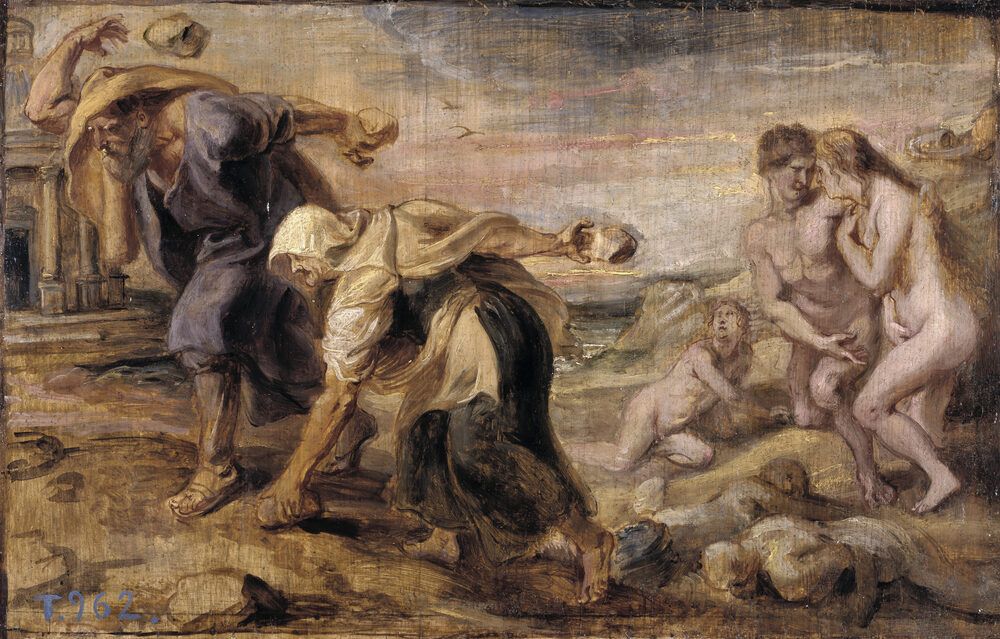
Deukaliōn
First Appearance
Deucalion enters Greek poetry at the head of a genealogy. The Hesiodic Catalogue of Women — the great early reckoning of heroic descent — began the Greek race with Deucalion's line, naming his son Hellen as the father of Dorus, Xuthus and Aeolus, from whom the branches of the Hellenes spring (frr. 2–7 Merkelbach–West). Pindar, in his ninth Olympian ode (41–56), sings the flood itself: how "the water's might" covered the dark earth, and how by Zeus's craft it drained away again, and how Deucalion and Pyrrha came down from Parnassus to make their first home and raise up a stone-born people — "a folk sprung from stones, and they were called laoi," the poet's own play on laas, "stone," and laos, "people."
— Hesiodic Catalogue of Women (Ehoiai) frr. 2–7; Pindar, Olympian 9.41–56
Who They Are
Deucalion (dyoo-KAY-lee-on) is the one man who outlived the Great Flood — the Greek survivor of the deluge, the figure who answers to the flood-heroes of other ancient peoples, and so is often called, in a modern shorthand, "the Greek Noah." He is counted here among the heroes because he was a mortal, born of the Titan Prometheus into the age of men; but his heroism is of a quiet, saving kind. He fought no monster and led no army. He survived — and because he and his wife Pyrrha survived, and were just, the whole human race was given a second beginning.
The story the Greeks told runs so: Zeus, angered by the wickedness of the men of the Bronze Age, resolved to wipe the race from the earth with a flood. Prometheus, who had made and loved mankind, warned his son Deucalion of what was coming, and told him to build a chest — an ark — and stock it. When the rains came and the waters rose and drowned the world, Deucalion and Pyrrha rode out the flood in their floating chest for nine days and nine nights, until it grounded on a mountain-top (most say Parnassus) as the waters fell. The two came down, the sole survivors of mankind, and gave thanks; and then, guided by an oracle to "throw the bones of their mother behind them," they understood that the bones of mother Earth were stones, and cast stones over their shoulders — and the stones Deucalion threw rose up as men, and those Pyrrha threw as women, and the earth was peopled again.
Their own true son, born in the ordinary way, was Hellen — and from Hellen the Hellenes, the Greeks, took their name and traced their descent. So Deucalion stands at two beginnings at once: the father of a race conjured from stone, and the forefather, through Hellen, of the whole Greek people.
Mythology
Son of Prometheus
Deucalion was the son of Prometheus, the Titan who shaped mankind from clay and stole fire for them from heaven — a parentage that places Deucalion's whole story within his father's long love for the human race (Apollodorus, Bibliotheca 1.7.2). His mother is named differently in different sources — often Clymene the Oceanid, sometimes Pronoia ("Forethought") or Hesione — and the sources do not agree, so the mother is best left as one of the Titan's consorts without pressing the point. His wife was Pyrrha, "the fiery-red" (so named, the ancients thought, for the colour of her hair or of flame), and she was the daughter of Epimetheus — Prometheus's scattered-witted brother, whose name means "Afterthought" — and of Pandora, the first woman, the one through whom sorrow first entered the world. So the two who would survive the flood were cousins of a kind, both descended from the house of Iapetus, and in Pyrrha the line of Pandora, through whom ills came, is joined to the line of Prometheus, through whom mankind was made and saved. It is a fitting pairing for the parents of the race reborn.
The wickedness of the Bronze race and the resolve of Zeus
The men of the age that Deucalion and Pyrrha lived at the end of were, in the common telling, a hard and violent breed — the Bronze Age of men in Hesiod's reckoning of the ages (Hesiod, Works and Days 143–155), a race "terrible and strong," who cared for the works of war and committed outrage, until the earth was full of their wrongdoing. Zeus, looking down upon their impiety, resolved to blot the race of men from the face of the earth. (A later telling, in Apollodorus 3.8.1 and especially in the Roman poet Ovid, ties the resolve to a single monstrous crime — the Arcadian king Lycaon, who served human flesh at the table of the gods to test whether Zeus was truly a god; but the older Greek sense is simpler, that the whole Bronze race had grown too wicked to spare.) The instrument Zeus chose was water: a great flood, to drown the world and wash it clean.
The warning and the chest
Prometheus, whose very name means "Forethought," foresaw the coming deluge — or learned of it by his old gift of knowing what was to be — and he would not let his son perish with the rest. He warned Deucalion of the flood and told him to build a chest (Greek larnax, a great wooden coffer or ark), and to store in it provisions (Apollodorus 1.7.2). Deucalion did as his father bade: he made the chest, put in what was needed, and went aboard it with Pyrrha. This is the pattern the Greeks shared with the flood-stories of many other ancient peoples — the one righteous man forewarned, who builds a vessel and rides out the destruction of the world; and it is why Deucalion is so readily called the Greek Noah. But the Greek tale keeps its own shape: it is a father's forethought, Prometheus's, that saves his son, and the vessel is not a ship but a floating chest.
Nine days upon the waters
Then Zeus poured a mighty rain out of heaven and flooded the greater part of Greece, so that all men perished except the few who fled to the high mountains. Deucalion and Pyrrha, shut in their chest, were borne upon the waters for nine days and nine nights (Apollodorus 1.7.2). On the tenth, as the waters began to fall, the chest grounded upon a mountain-top. Most of the sources — Apollodorus among them, and the Roman Ovid — set that landfall on Mount Parnassus, the great twin-peaked mountain above Delphi (Apollodorus 1.7.2; Ovid, Metamorphoses 1.316–318, a later Roman retelling); others, remembering that Deucalion was reckoned a king in Thessaly, bring the chest to rest on Mount Othrys or elsewhere in the Thessalian highlands, and the ancient geographers argued the point. Wherever it grounded, Deucalion stepped out onto the drowned world's one dry summit, and when the rains had ceased he came down and raised an altar to Zeus Phyxios — Zeus "of Escape," the god of those who flee to safety — and gave thanks for his deliverance (Apollodorus 1.7.2).
The bones of their mother
Now the two were alone — the last man and the last woman in a world washed empty — and they grieved for the solitude of a race ended in them. In the fullest tellings they come to consult an oracle; it is the oracle of Themis, the Titaness of right order and divine law, who held the Delphic seat before Apollo, and they beg her to tell them how mankind might be restored (Ovid, Metamorphoses 1.367–380, a Roman retelling of the Greek tradition that Apollodorus gives more briefly at 1.7.2). The answer comes veiled, as oracles do: they are to throw the bones of their mother behind them as they go. Pyrrha shrinks from the command in horror — it seems to bid them cast about the unburied bones of their own dead mothers, an impiety. But Deucalion reads the riddle: their great mother is Earth herself, Gaia, the mother of all living things, and her bones are the stones that lie in her body. So the two veiled their heads, loosed their garments, and as they walked they threw stones back over their shoulders — and the stones began to lose their hardness and their cold, and to take on the shape and softness of flesh, and to grow into human form.
The stone-born race
The stones that Deucalion cast rose up as men; the stones that Pyrrha cast rose up as women (Apollodorus 1.7.2; and the same marvel is sung by Pindar, Olympian 9.43–46, and retold by Ovid, Met. 1.411–415). So the earth was peopled anew, not by birth but by this strange second making — and the Greeks heard in the very word for it a proof of the tale, for laas means "stone" and laos means "a people," and the stone-sprung race were therefore called laoi, "the stone-folk," which is simply the ordinary Greek word for the common people (Pindar plays on exactly this). It is a hard and beautiful image, this second creation: a mankind made the second time from the bones of the Earth, tougher and more enduring than the first — a people, as the poets liked to say, who know toil and endure, because they were born of stone.
Hellen and the Hellenes
But Deucalion and Pyrrha were not left childless in their own right. They had sons and daughters of their own bodies, and the eldest and greatest of these was Hellen — from whom the Hellenes, the people we call the Greeks, took their very name, for "Hellene" is simply "child of Hellen" (Hesiodic Catalogue of Women frr. 2–7; Apollodorus 1.7.2–3; Thucydides 1.3 notes that it was from Hellen's line that the name spread over all Greece). Hellen in turn fathered Dorus, Xuthus and Aeolus, and from these three sprang the great branches of the Greek race — the Dorians, the Ionians and Achaeans (through Xuthus's sons Ion and Achaeus), and the Aeolians — so that every Greek, by this reckoning, traced his descent back through Hellen to Deucalion, the man who survived the flood. Other children are named too — among them Protogeneia ("First-born"), a daughter, and in some accounts Amphictyon, reckoned a king of early Athens. Thus Deucalion is the forefather at the root of the whole Greek family tree, the point from which the nations of Hellas fan out.
Worship — Ancient
A forefather remembered, not a god worshipped
Deucalion was not a god and had no cult of the kind the Olympians enjoyed; he was honoured as the great ancestor, the forefather of the race, and his memory was kept in places and rites tied to the flood and its draining-away rather than in temples of his own. His worship, so far as it existed, was a worship of remembrance — remembrance of the dead of the deluge, and of the deliverance by which mankind went on.
The cleft at Athens and the Hydrophoria
The chief seat of that remembrance was at Athens, in the precinct of Olympian Earth (Gē Olympia) near the great temple of Olympian Zeus. There, Pausanias tells, was a cleft in the ground about a cubit across, down which the waters of Deucalion's flood were said to have drained away; and it was believed that Deucalion himself had lived at Athens and had raised the first sanctuary there. Every year the Athenians threw into this cleft wheat-meal kneaded with honey — an offering to the dead of the flood (Pausanias, Description of Greece 1.18.7). This rite, the Hydrophoria ("water-carrying"), belonged to the mourning-days of the Anthesteria, the spring festival of the dead; so the flood-dead were lamented, year upon year, at the very spot where the waters were thought to have run back into the earth. Pausanias also records that the Athenians showed, near the same sanctuary, the tomb of Deucalion as proof that he had dwelt among them.
Parnassus, Lycoreia, and the Thessalian claim
Where the chest had grounded, there too his memory clung. On Parnassus, Pausanias reports the tradition that Deucalion's companions, following the howling of wolves, founded the town of Lycoreia on the heights above Delphi, and that Deucalion was remembered there as the mountain's flood-survivor (Pausanias 10.6.2). In Thessaly, where he was counted a king, the people claimed him as their own and pointed to their own highlands as the place of the chest's landing; and the great amphictyony — the league of peoples around Delphi and Thermopylae — traced its name and founding to his line through Amphictyon. So several regions competed to hold the flood-hero, each with its own local proof, as Greek cities so often did with the founders they prized.
The thank-offering to Zeus of Escape
Beyond these places, Deucalion was remembered as the man who raised the first altar to Zeus Phyxios, "Zeus of Escape" — the god invoked by all who flee danger and reach safety. In honouring that Zeus, Greeks in a sense honoured the pattern Deucalion set: the giving of thanks by the one who has come through destruction alive (Apollodorus 1.7.2). It was a fitting devotion for a figure whose whole story is deliverance.
Worship — Modern
The survivor and the second chance
Deucalion speaks, today, to anyone who has come through a destroying thing and found the world asking to be begun again. His is the archetype of the survivor — not the warrior who wins but the one who endures, is warned, takes the forethought offered, and rides out the flood. A modern devotee drawn to him might honour him exactly where his ancient worship lay: in remembrance of the dead of a catastrophe, and in thanksgiving for deliverance — the giving of thanks, like his first altar to Zeus of Escape, by one who has survived what others did not. He sits well as a patron of refuge and of starting over, of the hard grace by which life goes on past an ending.
The bones of the mother
The oracle at the heart of his story — "throw the bones of your mother behind you" — has outlived its myth as a small parable of reading rightly. It teaches that the saving answer often comes veiled, and that it asks to be understood, not obeyed in dread: the "mother" is the Earth, the "bones" are her stones, and what looked like an impiety was in truth an instruction to make life from the body of the world. The image of a mankind re-made from stone — tougher, enduring, born of the ground itself — has stayed a favourite of poets and artists, who return to the two veiled figures casting stones across a drowned and silent land.
The Greek Noah, and the root of the family tree
Deucalion is, above all, remembered now as the Greek flood-hero, set beside the flood-survivors of other ancient peoples — the figure that lets the Greek deluge be told in the same breath as the floods of the wider ancient world. And he is remembered as the forefather of the Hellenes: through his son Hellen, every branch of the Greek people traced its descent to him, so that anyone tracing the Greek family tree to its root arrives at Deucalion and Pyrrha, the two who survived. In both of these he keeps a quiet, foundational place — not a god to be petitioned, but the ancestor at the beginning, the man from whom, twice over, the human race began again.
Epithets & Cult Titles
- the righteous one (dikaios) — Deucalion and his wife Pyrrha were spared the flood because, of all the race of their age, they alone were just and god-fearing; their piety is the reason the human line continues at all (Apollodorus, Bibliotheca 1.7.2)
- the Greek Noah — A modern shorthand, not an ancient title: Deucalion is the figure in Greek myth who answers to the flood-survivors of other peoples — the one man warned of the deluge, who rides it out in an ark and begins the world again
- father of Hellen — Through his son Hellen, from whom the Hellenes (the Greeks) took their name, Deucalion stands at the head of the whole Greek people's descent — the first ancestor of the reborn race (Hesiodic Catalogue of Women frr. 2–7; Apollodorus 1.7.2–3)
Sources & Variants
- Hesiodic Catalogue of Women (Ehoiai) frr. 2–7 Merkelbach–West (Deucalion at the head of the Greek genealogy; his son Hellen the father of Dorus, Xuthus and Aeolus, ancestors of the Hellenic peoples)
- Hesiod, Works and Days 143–155 (the violent Bronze race of men, the age whose wickedness the flood ends)
- Pindar, Olympian 9.41–56 (the flood sent by Zeus and drained again; Deucalion and Pyrrha come down from Parnassus and raise a stone-born people — the laoi sprung from stones)
- Apollodorus, Bibliotheca 1.7.2 (the fullest Greek prose account: Prometheus warns his son; the chest/larnax; nine days afloat; landing on Parnassus; the altar to Zeus Phyxios; the oracle to throw the bones of their mother; the stones becoming men and women)
- Apollodorus, Bibliotheca 1.7.2–3 (the children of Deucalion and Pyrrha — Hellen, Protogeneia, Amphictyon — and the descent of the Greek peoples from Hellen)
- Apollodorus, Bibliotheca 3.8.1 (the impiety of Lycaon, in some tellings the crime that moves Zeus to the flood)
- Pausanias, Description of Greece 1.18.7 (the cleft of Olympian Earth at Athens down which the floodwaters drained; the yearly offering of honey-meal for the flood-dead; the tomb of Deucalion shown at Athens)
- Pausanias, Description of Greece 10.6.2 (Deucalion on Parnassus; his companions found Lycoreia, following the wolves)
- Thucydides, History 1.3 (the name of the Hellenes spreading from the line of Hellen, son of Deucalion)
- Ovid, Metamorphoses 1.313–415 (the Roman retelling: the flood, the chest grounding on Parnassus, the oracle of Themis, the throwing of the stones and the re-peopling of the earth) — Roman, cited as a later version, not as early Greek
Gallery