Epimetheus
First Appearance
Epimetheus first appears in Hesiod's catalogue of the sons of Iapetus, where he is named at once as a byword for folly: "scatter-brained Epimetheus who from the first was a mischief to men who eat bread; for it was he who first took of Zeus the woman, the maiden whom he had formed." Even in his earliest mention he is defined by the mistake that will follow — the Titan who accepted the gods' gift and doomed the race that received it.
— Hesiod, Theogony 511–514
Who They Are
Epimetheus (ep-ih-MEE-thee-us) is the Titan of afterthought — the one who acts first and thinks too late. His very name is his character: where his brother Prometheus is Promētheus, "Forethought," Epimetheus is Epimētheus, "Afterthought," and the two form a matched pair in Greek myth, the far-seeing planner set against the hindsight-bound fool. He is a minor figure with almost no cult and a slender body of story, yet that story is one of the most consequential in Greek mythology, for it is Epimetheus who receives Pandora and so lets loose the ills of the world.
He is a second-generation Titan, one of the four sons of Iapetus and the Oceanid Clymene, alongside Prometheus, Atlas and Menoetius — the brothers whose fates trace the boundary between the elder gods and struggling humankind. Unlike his brothers, Epimetheus is punished not by chains or a burden of sky but by the simple, human calamity of his own poor judgement.
The Greeks used him as a moral emblem rather than a god to be worshipped. To be an "Epimetheus" was to be wise only after the event, to see the danger once it has already arrived — the mind that grasps a lesson exactly one moment too late. His myth is short, but its lesson is permanent: forethought saves, afterthought only regrets.
Mythology
Afterthought and Forethought
Epimetheus is inseparable from his brother Prometheus, and the pair are best understood together as two halves of a single idea about the human mind. Prometheus, "Forethought," looks ahead, plans, and outwits even Zeus; Epimetheus, "Afterthought," reacts, blunders, and understands only in hindsight. Hesiod introduces them side by side among the sons of Iapetus (Theogony 507–516), praising the cunning of the one and lamenting the folly of the other in the same breath. Where Prometheus is the champion and benefactor of mortals, Epimetheus is repeatedly the instrument through which disaster reaches them.
Pandora and the jar of ills
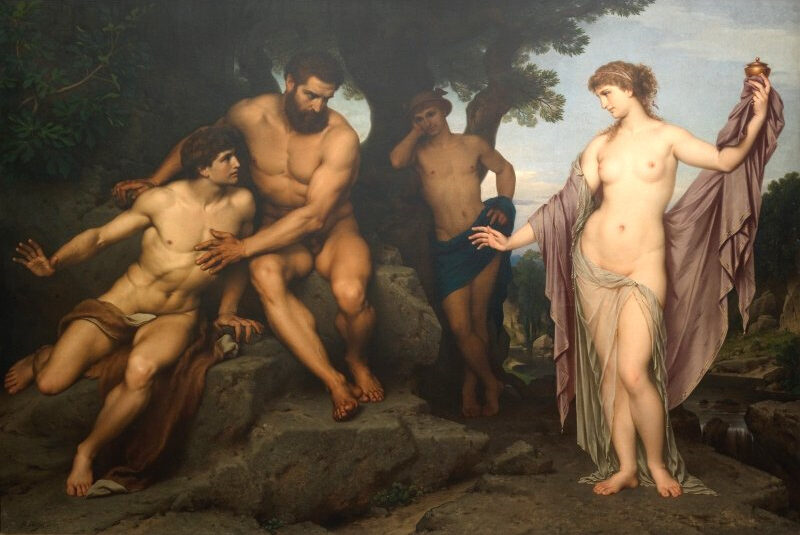
The central myth of Epimetheus is his acceptance of Pandora. After Prometheus stole fire from the gods for the benefit of humankind, Zeus devised a retaliation aimed at men: he had Hephaestus fashion from earth and water the first woman, Pandora ("All-Gifts"), and the gods adorned her with every seductive grace before sending her down as a gift. Prometheus, seeing the trap for what it was, had expressly warned his brother never to accept any gift from Olympian Zeus, but to send it back lest it prove a harm to mortals (Works and Days 86–89). Epimetheus, true to his nature, forgot the warning until the harm was already done — "he took the gift, and only when he had it did he understand the evil" (Works and Days 83–89).
With Pandora came the pithos, the great storage jar (popularly and later mistranslated as "Pandora's box"). When it was opened, out flew every grief and sickness and toil to scatter among humankind, who until then had lived free of hardship; only Elpis, Hope, remained behind under the rim of the jar. So through Epimetheus's afterthought the age of easy living ended, and mortals came to know labour, disease and death. He is thus the cautionary foil to his brother in the plainest terms: Prometheus's forethought had won fire for mankind, and Epimetheus's afterthought lost them their freedom from suffering in the same stroke.
The distribution of traits (Plato's telling)
A quite different and more sympathetic Epimetheus appears in Plato's Protagoras (320d–322a), where the sophist Protagoras recounts a myth of how the mortal races came to be equipped. When the gods moulded the living creatures out of earth and fire, they set Prometheus and Epimetheus to furnish each kind with its proper powers. Epimetheus begged to do the distributing himself, asking his brother only to inspect the work when it was done.
Being, as Plato says, "not very wise" (ou panu ti sophos), Epimetheus dealt out the protective gifts as he went — to some creatures strength without speed, to the weaker ones swiftness; claws and hooves and tough hides, warm fur against the cold, wings to the birds, burrows to the small — carefully balancing each species so that none should be destroyed. But he used up all the available powers on the beasts, and when he came at last to humankind he found he had nothing left to give: man was left "naked, unshod, unbedded, and unarmed." It was to repair his brother's oversight that Prometheus stole fire and the practical arts from Hephaestus and Athena and gave them to men, so that they might survive by craft what they could not survive by claw. Even in Plato's kindlier version, then, Epimetheus is the well-meaning bungler whose want of foresight leaves humanity defenceless — and, once more, it is Prometheus who must set things right.
Wife and daughter
In the tradition that follows Hesiod, Pandora becomes not merely a gift but Epimetheus's wife. From that union some later authors (Apollodorus, Bibliotheca 1.7.2) name a daughter, Pyrrha, who married Prometheus's son Deucalion. When Zeus sent the great flood to drown a wicked age of men, Deucalion and Pyrrha alone were preserved in an ark, and afterward remade the human race by casting stones over their shoulders — the "bones of their mother," the earth — which sprang up as new men and women. Through this line the daughter of afterthought becomes, in a strange reversal, a mother of the renewed human race.
Worship — Ancient
A figure of myth, not of cult
Epimetheus had essentially no independent worship in the Greek world. There are no temples, festivals, priesthoods or sacrificial calendars in his name; he survives almost entirely as a character in the poets and philosophers rather than as a god who received offerings. His importance was literary and moral — a figure through whom Hesiod and later writers explained the origin of human suffering and the difference between prudence and folly — not devotional.
The meaning behind the name
What the Greeks preserved instead was the lesson carried in his name. Epimetheus and Prometheus were understood as a proverbial pair, "Afterthought" and "Forethought," and to invoke Epimetheus was to point at the failure of foresight. Plato's use of him in the Protagoras is characteristic: the philosopher does not honour Epimetheus but uses him as a ready emblem of the unreflecting mind that must be rescued by the far-seeing one. His only lasting "monument" is his jar — the pithos of Pandora — which entered the language as the very image of a small heedless act with limitless consequences.
Worship — Modern
Honouring Epimetheus today
Epimetheus is not a god of blessings to be petitioned but a figure to be remembered, and a modern Hellenist is most likely to give him a place as a teacher rather than a patron. Because he received no ancient cult, there is no traditional rite to reconstruct; what can be honoured is the wisdom his failure encodes. Some who keep a household shrine to Prometheus include Epimetheus alongside him, the two brothers set together as forethought and afterthought — a reminder that the two are inseparable, and that the value of planning is measured by the cost of neglecting it.
A contemplative practice
Rather than an offering, Epimetheus invites a practice of reflection. His story rewards the habit of pausing before accepting a tempting gift or acting on impulse, of asking (as Prometheus asked in vain) what the consequence might be. A devotee might mark him by keeping a closed jar on the shrine as a symbol — sealed, in deliberate contrast to Pandora's opened one — and by taking a quiet moment before a decision to "think before, not after." In this way Epimetheus is honoured best not by libation but by the very foresight he lacked: he is the god who teaches, by his mistake, the worth of a second thought taken in time.
Sources & Variants
- Hesiod, Theogony 507–516 (the sons of Iapetus), 511–514 (Epimetheus accepts Pandora); Works and Days 86–89 (Prometheus's warning never to accept a gift from Zeus)
- Hesiod, Works and Days 83–89 (Epimetheus receives Pandora and understands the evil too late); 90–105 (the jar and the ills of humankind)
- Plato, Protagoras 320d–322a (Epimetheus distributes the traits and leaves humankind unprovided; Prometheus's theft of fire and craft)
- Apollodorus, Bibliotheca 1.2.3 (sons of Iapetus; Apollodorus names the mother as Asia, Hesiod as Clymene); 1.7.2 (Pandora, Pyrrha, and the flood of Deucalion)
Gallery