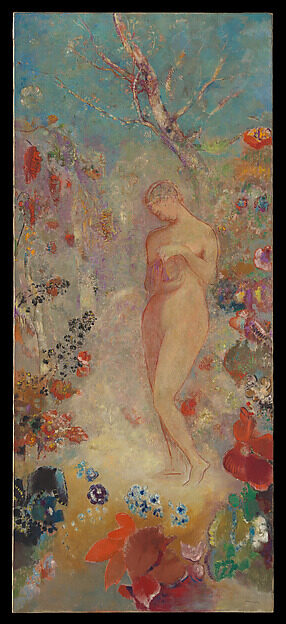
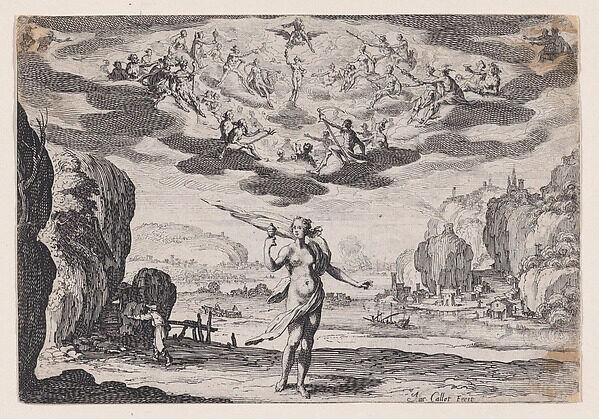
Pandora
First Appearance
Pandora is first told of in the two poems of Hesiod, around 700 BCE, and he is our earliest and fullest source for her. In the Theogony (570–593) she appears unnamed — "a beautiful evil in place of a blessing," a maiden moulded by Hephaestus at Zeus's command and crowned by Athena, from whom springs the "race of women" that lives among mortal men. In the Works & Days (60–105) Hesiod tells the fuller story and gives her name: how each god gave her a gift, how she was sent as the price of stolen fire, and how she lifted the lid of the great jar and loosed its griefs upon the world, with only Hope left inside under the rim.
— Hesiod, Theogony 570–593 and Works & Days 60–105
Who They Are
Pandora (pan-DOR-uh) is the first woman of Greek myth — moulded from earth and water at the command of Zeus, dressed and gifted by all the Olympians, and sent down among men as the beautiful answer to a theft. She is the Greek counterpart to a figure many readers will already half-know: the first woman whose single act lets sorrow into a world that had none. But her Greek story is sharper and stranger than the vague memory of it, and it turns on two things the retellings almost always get wrong — the vessel she opened, and the meaning of the one thing she kept.
She has no parents. Almost alone among the figures in these pages, Pandora was not born but made — fashioned by the smith-god Hephaestus out of clay, quickened into life, and adorned by the other gods each in turn. Her name, "all-gifts," records that moment of making: Aphrodite poured grace over her, Athena taught her weaving and dressed her, Hermes set in her the voice and the cunning mind, and so on around the circle of the gods, until she carried a portion of every one of them. That is the first sense of her name — gifted by all. The second sense — all-giving — is darker, and belongs to what she does once she reaches the world of men.
For Pandora is not, in Hesiod, an innocent. She is a weapon. Zeus made her and sent her as a punishment — the price humankind would pay for the fire that Prometheus stole from heaven and gave to mortals. She is "a beautiful evil," Hesiod's famous phrase, a lovely thing built around a ruin; and the ruin she carries is a great storage jar. When she lifts its lid, every hardship that now troubles human life escapes into the air and cannot be called back — and Hope alone is left inside, under the rim, in the single most argued-over image in all of Greek myth. To read Pandora well is to hold two things together: the wonder of a creature to whom the gods gave everything, and the grief of a gift that was also a snare.
Mythology
A world before her: the quarrel of Prometheus and Zeus
Pandora's story does not begin with Pandora. It begins with a quarrel between Zeus and the Titan Prometheus ("forethought"), the great friend of humankind — and to understand why she was made, you have to start there. In the early days, gods and mortal men were sorting out their dealings with each other, and at a place called Mekone Prometheus tricked Zeus over the division of a sacrificed ox, wrapping the good meat in the ox's ugly stomach and the bare bones in glistening fat, so that Zeus, choosing by appearance, chose the worthless part — which is why (Hesiod says) men burn only the bones for the gods and keep the meat for themselves. In anger at the trick, Zeus withheld fire from mortals: they would have the meat, but no flame to cook it or warm them. Then Prometheus stole the fire back — carrying it down from heaven hidden in the hollow of a fennel-stalk — and gave it again to men. And it is to answer that theft, that second defiance, that Zeus devises Pandora. She is, in the plainest terms, the payment exacted for fire: "I will give them an evil," Zeus says in effect, "in exchange for fire, an evil they will all take to their hearts with delight, embracing their own ruin."
The making of the first woman
So Zeus gave his orders to the gods, and each obeyed. He told the lame smith-god Hephaestus to take earth and water and mix them, and to mould from the wet clay the likeness of a modest young woman, lovely as a goddess to look at — and Hephaestus shaped her. Then the other gods adorned her, and it is here that her name is earned. Athena, the grey-eyed goddess of craft, taught her the skills of the loom and the arts of weaving, and dressed her in a silvery gown, draped a worked veil over her, and set garlands of fresh spring flowers on her head. Aphrodite, goddess of love, poured grace over her head and cruel longing and cares that gnaw the limbs. Hermes, the messenger, the guide, put into her breast a mind of lies and coaxing, wheedling words and a thief's nature — and gave her a voice. And the divine Charites (the Graces) and Peitho (Persuasion) hung golden necklaces about her, and the lovely-haired Horai (the Seasons) crowned her with spring flowers, and Athena fitted all the finery to her body. Last, Hephaestus (or Athena) set upon her head a great crown of gold that he had made with his own cunning hands, worked with the images of all the wild things of land and sea, wonderfully lifelike, a marvel to see. When they were done, they had made a thing at which gods and men alike would wonder — "a sheer, hopeless snare for men."
The gift of the name
Then, Hesiod says, the messenger-god named her: Pandora, "All-gifts," because all the gods who dwell on Olympus had each given her a gift — a gift that was a plague to men who live by bread. That is Hesiod's own gloss on the name, and it fixes the first of its two meanings: she is the girl gifted by all. (The name has a second life, too. Anesidora, "she who sends up gifts," is an old title of the Earth and of Pandora both — the giving-up of the ground's fruitfulness — and on a famous Athenian vase Pandora rises out of the earth itself with that name written beside her, half woman and half fertile soil. So even her name pulls two ways: the girl to whom everything was given, and the girl, or the earth, from whom everything is given up.)
Sent to Epimetheus
Zeus sent this finished marvel down to the world of men, and he sent her by the hand of Hermes as a gift to Epimetheus — Prometheus's slower brother, whose name means "afterthought," the one who thinks too late. Now Prometheus, the forethinker, had warned Epimetheus never to accept any gift from Zeus, but to send it straight back, in case it should turn out to be a harm to mortals. But Epimetheus did not think until he had already taken her — and only when the evil was his did he understand. So the trap closed exactly along the fault-line of the two brothers' names: forethought had warned, afterthought forgot, and the beautiful gift was in the house. Here, in prose, the tradition marries them: Pandora becomes the wife of Epimetheus, and their daughter is Pyrrha, who — with Deucalion, the son of Prometheus — will one day be the sole woman to survive the great flood and help refound the human race from stones. So the first woman is also, through her daughter, an ancestress of the world after the flood.
The jar — not a box
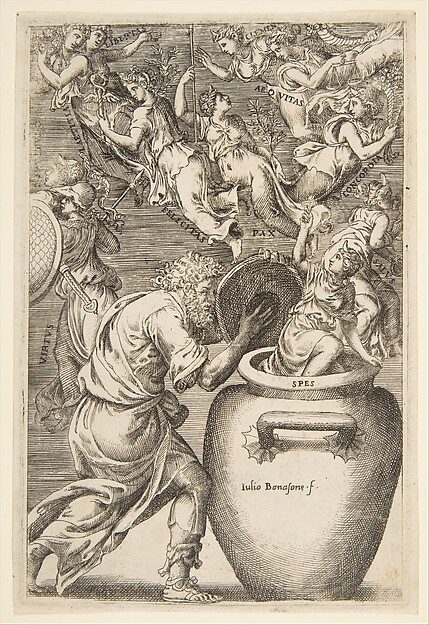
And now the heart of the story, and the place where almost every retelling goes wrong. Pandora came with a jar — in Greek a pithos (πίθος), a great earthenware storage vessel, the tall clay jar in which households kept their grain, their wine, their oil, sunk to its shoulders in the floor, tall as a person and sealed with a heavy lid. It is emphatically not a box. The "box" is a mistranslation, and a traceable one: when the Renaissance scholar Erasmus put the story into Latin in the sixteenth century, he rendered the Greek pithos with the Latin pyxis, which means a small box or casket — perhaps confusing the jar of Pandora with a box in an unrelated tale — and "Pandora's box" was born and never died. But Hesiod's word is pithos, a storage jar, and the image matters: this is not a dainty casket of trinkets but the huge clay vessel of a household's stores, the very thing a woman of the house would keep and open — and what it stored was not grain but grief.
The lifting of the lid
In the jar were sealed all the hardships that had been kept away from human life — for Hesiod says that before this, the tribes of men had lived free from evils and hard toil and the cruel sicknesses that bring death. Then Pandora lifted the great lid of the jar with her hands, and scattered its contents — and loosed upon mankind sorrows and miseries without number. Out they flew: the countless griefs that now wander the earth among men, the diseases that come upon us silently by day and by night, uninvited, bringing evils to mortals — for Zeus in his wisdom took the voice from them, so that they come without warning. Whether Pandora opened the jar from simple curiosity, or from the meddling mind Hermes had put in her, or because Zeus had planned that she should, Hesiod does not quite say; but the deed is done, the lid is up, and the world men had known — a world without hardship — is over, and can never be brought back. This is the Greek "fall": not an act of disobedience against a command, but the springing of a trap that was built to spring.
Hope under the rim — the great crux
One thing did not fly out. Hope — in Greek Elpis (Ἐλπίς) — alone remained inside the jar, under the lip, and did not fly out, because Pandora shut the lid down again before it could — "by the will of Zeus," Hesiod adds. And here Greek myth leaves us its single most argued-over image, a puzzle that has no settled answer, and the honest thing is to give you both readings, because the poet's own words support both.
On the first reading, Hope is a comfort, the one good thing left to us. All the evils escaped and scattered into the world — but Hope, humankind's consolation, was kept safe, held back in our keeping, so that whatever griefs come upon us we are never wholly without hope to endure them. On this reading the jar is half-merciful: it loosed the sorrows but preserved the one thing that makes the sorrows bearable, and Hope stays with us like a treasure kept in the household jar.
On the second reading, that comfort is an illusion, and Hope is one more affliction — the cruellest of the lot, and the one Zeus made sure to keep back where it could do its special work. On this darker view the jar was full of evils, and Hope is simply the last of them; but where the others fly free and strike and pass, Hope was trapped under the rim so that it would stay with us always, an empty and endless expectation that keeps mortals clinging to a tomorrow that never mends the present. The evils that flew out at least come and go; the one that stayed behind, on this reading, never leaves — deceitful hope, the affliction that will not let us rest.
Scholars have argued the point for two thousand years and it will not be settled, because the ambiguity is almost certainly in Hesiod himself. It is not a flaw to be fixed but the sharpest thing in the poem — is the last thing in the jar our comfort or our snare? The story hands you the question and, quite deliberately, keeps the answer under the lid.
The lesson Hesiod draws
For Hesiod, the whole of Pandora's tale is a lesson about the human condition and about labour. Because of her, "the earth is full of evils, and full the sea"; because of her, sickness walks among us unbidden and no one can outrun toil. And the moral he draws is the moral of the whole Works & Days: since the gods have hidden the means of life from men — since Prometheus's theft and Pandora's jar have made the world a place of hardship — there is no way to live but by work, honest and unremitting, the labour of the farmer's year. Pandora stands at the doorway of that hard world as the reason it is hard, "the beautiful evil," the gift you cannot give back.
Worship — Ancient
A figure of myth, not of cult
Pandora is, above all, a figure of story rather than of worship. There is no evidence of a temple of Pandora, a priesthood, a festival, or a body of ritual directed to her as there is for the Olympian gods or even for the hero-dead. She belongs to Hesiod's account of how the world came to be as it is — an explanatory, "how things got this way" figure — and her life was on the lips of poets and the walls of painted pots far more than at any altar. To honour her is a modern impulse; the ancient relationship to Pandora was to tell her story and to draw its lesson, not to petition her.
Pandora and the Earth: Anesidora
There is, however, an older and stranger layer beneath Hesiod's tale, and it is where Pandora comes nearest to worship. The name Anesidora, "she who sends up gifts," which Hesiod's Pandora shares, is elsewhere a title of the Earth-goddess — of Gaia, or of Demeter, the ground that sends its fruits up to feed us. Some scholars read Pandora as a faded or demoted earth-goddess, an "all-giving" power of the fertile soil who was rewritten by Hesiod into the "all-gifted" first woman and made the bearer of evils. The clearest trace of this older Pandora is on a red-figure Athenian cup and other vases where a female figure named Pandora or Anesidora is shown rising up out of the ground, half-emerged from the earth like a growing thing, with gods standing over her — an image far closer to a birth of the fertile Earth than to Hesiod's manufactured snare. Whether or not she was once truly a goddess of the soil, this double identity — the giver of the ground's gifts and the girl to whom the gods gave everything — haunts her name.
Depiction in Athens
Where Pandora was most vividly "present" to the ancient Greeks was in art and drama. Athenian vase-painters loved the scene of her making and her rising, and the great sculptor Pheidias carved the birth or adornment of Pandora onto the base of his colossal statue of Athena Parthenos inside the Parthenon — so that the first woman, gifted by all the gods, stood at the feet of Athena in the city's holiest image. The tragedians and the satyr-play took up her story too (Sophocles wrote a satyr-play called Pandora, or The Hammerers, now lost, on the moulding of the clay woman). She lived, in short, at the centre of Athenian visual and poetic culture — as a story endlessly retold and depicted, not as a deity served.
Worship — Modern
A story kept, more than a goddess served
Pandora is honoured today much as she was in antiquity: as a story to be told and thought about, rather than a deity to be petitioned. Modern Hellenic practice centres on the gods and, in their own key, the heroes; Pandora is neither, but she sits close to the surface of the myth all the same, because hers is the tale that explains why the human world holds both hardship and hope. A person drawn to her is usually drawn to what her story means — the double edge of a gift, the trap that wears a lovely face, and above all the unanswered question of the thing left under the rim.
Honouring the older Pandora
For those who feel the older layer of her — Pandora as Anesidora, the "sender-up of gifts," the near-double of the fertile Earth — the fitting tribute is the one given to the earth-powers: a libation poured down onto the ground, given wholly and not taken back, and an offering of first-fruits or grain, the gifts the earth sends up returned to it in thanks. In this key Pandora is honoured not as the bearer of evils but as the older giving-power beneath that story, the ground from which all gifts come up.
The jar, the box, and the lesson
More than any cult, Pandora lives on today in language and imagery — and the honest keeper of her memory does two things with that afterlife. The first is to correct the "box." "Pandora's box" is one of the most quoted phrases in the world, but it rests on a Renaissance mistranslation: her vessel was a pithos, a great clay storage jar, not a casket, and knowing that changes the picture — this is the huge household jar of grain and wine, sunk in the floor, that the woman of the house keeps and opens, and what it held was grief. The second is to sit honestly with Hope. The single most valuable thing Pandora hands the modern reader is not an answer but a question, and it should be passed on whole: when the evils flew out and Hope alone stayed under the lid, was Hope kept safe for us as our one comfort, or kept back from us as the subtlest affliction of all? To remember Pandora rightly is to keep that question open — and to remember that the first woman was not, in the beginning, a fault or a curse, but a being to whom the gods, every one of them, gave a gift.
Epithets & Cult Titles
- Anesidora (Ἀνησιδώρα) — She who sends up gifts — a title Pandora shares with the Earth herself, the giver who sends her gifts up from below. It is written beside her figure on a famous Athenian cup, and links the first woman to the fruitful ground from which she was moulded
- Kalon kakon (καλὸν κακόν) — The beautiful evil — not a cult-title but Hesiod's own famous phrase for her (Theogony 585): a thing lovely to look at and ruinous to keep, a snare wearing the face of a gift
- Pandora (Πανδώρα) — All-gifts — the name itself became her epithet, glossing the moment each Olympian bent over the newly moulded girl and gave her a gift, so that she carried the marks of every god at once
- The first woman (protē gynē, πρώτη γυνή) — A descriptive title, not a name — Pandora as the first mortal woman, the mother from whom Hesiod says the whole 'race of women' descends
Sources & Variants
- Hesiod, Theogony 570–593 (the making of the first woman, the golden crown by Hephaestus and Athena, and the 'beautiful evil' from whom the race of women springs)
- Hesiod, Works & Days 42–105 (the fullest account: Prometheus's theft of fire, Zeus's command, the gifts of the gods, the naming of Pandora, Epimetheus's folly, the opening of the jar, and Hope left within)
- Aesop / Babrius, Fable 58 (a variant in which the jar holds the good things, not the evils, and they escape and are lost when the lid is lifted — an alternate tradition worth noting)
- Theognis 1135–1146 (Elpis / Hope as the one good spirit left among men after the others departed to Olympus — a parallel meditation on hope)
- Apollodorus, Bibliotheca 1.7.2 (Pandora as wife of Epimetheus and mother of Pyrrha, who with Deucalion survives the flood)
- Pausanias, Description of Greece 1.24.7 (the birth of Pandora carved on the base of Pheidias's Athena Parthenos in the Parthenon)
- Sophocles, Pandora or The Hammerers (Πανδώρα ἢ Σφυροκόποι), lost satyr-play, frr. 482–486 Radt (the moulding of the clay woman)
- Note on 'Pandora's box': the mistranslation of Greek pithos ('storage jar') as Latin pyxis ('box') originates with Erasmus's Latin retelling in the 16th century; Hesiod's word is consistently pithos, a jar
Gallery