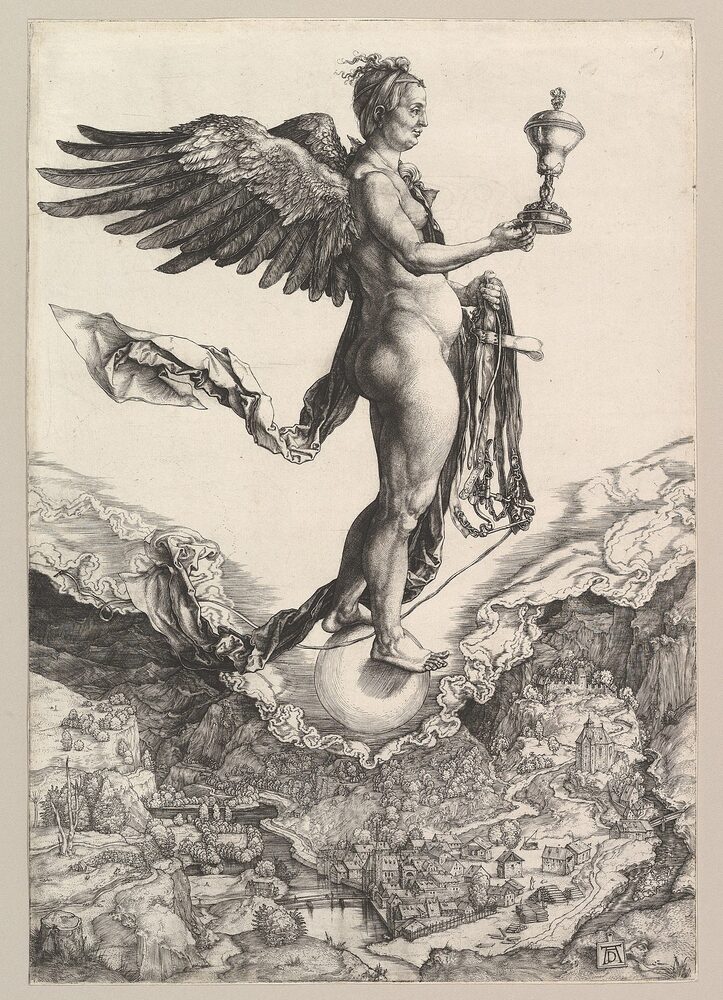
Nemesis
First Appearance
Nemesis first appears in Hesiod. In the Theogony (223–224) she is named among the grim children born of Nyx (Night) without a father — "and she bore Nemesis, a woe to mortal men" — set beside Deceit, Friendship, Old Age, and Strife as one of the dark powers that shadow human life. In the Works and Days (197–201) Hesiod gives her his most haunting image: in the last iron age of the world, when things have grown wholly evil, Aidos (Shame) and Nemesis (Righteous Indignation) will wrap their fair skin in white robes, forsake mankind, and go up from the wide-pathed earth to the deathless gods on Olympus, leaving only grief behind — so that Nemesis stands as the very conscience of the world, the last of the good powers to abandon a race that has ceased to deserve her.
— Hesiod, Theogony 223–224; Works and Days 197–201
Who They Are
Nemesis (NEM-uh-sis) is the goddess who gives to each person exactly what is owed. Her name comes from the plain Greek verb nemein, "to deal out" or "to give what is due" — the same word used of a herdsman dividing pasture or a host apportioning shares at a feast — and that root holds the whole of her: she is fair measure made into a goddess, the power that watches the scales of human fortune and keeps them level. Born of Nyx (Night) without a father, she belongs to the old, deep, moral powers of the world rather than to the bright company of the Olympians, and the Greeks feared and revered her as the guardian of a balance that no one is allowed to tip too far.
What makes Nemesis unusual — and the heart of who she is — is that she works in two directions at once, and the Greeks held both meanings together. She is the goddess of retribution against hubris: when a mortal grows arrogant, boasts against the gods, tramples the weak, or claims more than a mortal's due, Nemesis marks it and brings the proud one low. But she is also the balancer of undeserved fortune — she watches those who have been given too much, the too-lucky and the too-blessed, and checks them not always as punishment for a crime but simply because no mortal is meant to rise so high. To the Greek mind these were the same act: the levelling of anything that swells beyond its proper share. Good fortune itself, unearned and unbounded, was a kind of imbalance, and Nemesis was the goddess who set it right.
Her images make this visible. She is shown holding a measuring-rod (a cubit-rule) to mark out the exact due portion, a bridle to curb and rein in the arrogant, and a wheel at her feet — the turning wheel of fortune that lifts the low and casts down the high — and she is often winged, so that she can overtake the guilty wherever they flee. Her great home was the sanctuary at Rhamnous on the north-east coast of Attica, where she was worshipped as Nemesis Rhamnousia and where the sculptor Agoracritus made her a famous cult-statue said to have been carved, with a bitter irony her worshippers relished, from a block of marble the Persians had brought to Marathon to make a victory-monument before their own overwhelming defeat. To pray to Nemesis was to ask that the arrogant be humbled and the scales made even — and to remember, quietly, that the prayer might one day be turned on oneself.
Mythology
Daughter of Night and the moral order
Nemesis is one of the children of Nyx (Night), and the company she keeps in Hesiod's Theogony tells us what kind of power she is. She is born alongside Doom, Fate, Death, Sleep, Blame, Woeful Distress, Deceit, Old Age, and Strife — the abstract, inescapable forces that hem in mortal life. But where most of her siblings are simply grim, Nemesis is moral: she is not blind misfortune but deserved consequence, the answer the world gives back to human behaviour. Because she is older and deeper than the Olympians, her justice is not the personal, jealous anger of a Zeus or a Hera but something more impersonal and more certain — the built-in righting of any imbalance, as sure and unhurried as gravity. The Greeks came to call this quality itself nemesis (the common noun): the righteous indignation a decent person feels at seeing the undeserving prosper or the wicked go unpunished. The goddess is that feeling raised to a cosmic law.
The two faces of her justice
The Greeks held two ideas about Nemesis at once, and never felt they had to choose. In the first, she is the punisher of hubris — that untranslatable Greek word for the arrogance that forgets its mortal limits: the man who boasts he needs no gods, the victor who humiliates the fallen, the rich man who grinds down the poor, the mortal who claims to rival the immortals. Nemesis sees such swelling pride and brings it down. In the second and subtler idea, she is the checker of undeserved good fortune — and here she strikes not always at a sin but at an imbalance. The Greeks believed the gods were uneasy at any mortal who rose too high, won too much, was too happy or too blessed, because such fortune was not a mortal's proper portion and the world would sooner or later exact the difference. Nemesis is the agent of that correction. The famous story Herodotus tells of Polycrates, the tyrant of Samos so fortunate that his friend the Egyptian king warned him the gods would grow jealous — who threw his most precious ring into the sea to buy himself a loss, only to have it returned in the belly of a fish, and who came at last to a wretched death — is, in its bones, a story of Nemesis: no mortal is allowed to be that lucky for that long.
Nemesis and Tyche: the wheel and the scales
Because of this second role, Nemesis stands in a close and telling partnership with Tyche (Fortune, Chance). Tyche is the goddess who deals out luck without regard to desert — she raises the unworthy and ruins the deserving on a whim — and Nemesis is the power that follows behind her, correcting her excesses and restoring the balance Tyche disturbs. The two were sometimes shown together, and the wheel that appears at Nemesis's feet is exactly the wheel of fortune: the turning rim on which the high are carried down and the low carried up, forever. This is why Nemesis is not simply a goddess of punishment but a goddess of measure — her instruments are the measuring-rod that marks the correct portion, the balance that weighs it, and the bridle that reins in whatever runs past its bounds. She does not hate the fortunate; she simply will not let any share grow monstrous.
The pursuit by Zeus and the birth of Helen (a variant tradition)
(Content note: this variant turns on a god's pursuit of a goddess who tries to flee him, told in the older sources as an unwanted chase.)
[VARIANT — an alternative parentage of Helen.] The best-known myth attached to Nemesis herself is a striking one, and it is a genuine variant of a more familiar story: the tradition that Nemesis, not Leda, was the true mother of Helen of Troy. This telling is old — it goes back to the lost epic called the Cypria, part of the early cycle around the Trojan War — and it runs like this. Zeus conceived a desire for Nemesis and pursued her across the earth and sea. Unwilling, she fled him by changing her shape again and again, taking the form of one creature after another to escape; at last she became a goose (or in some tellings a swan or other bird), and Zeus, matching her, took the form of a swan and so caught her. From that union Nemesis laid an egg. The egg was later found — in a marsh, or a wood, or brought by a shepherd — and given to Leda, the queen of Sparta, who kept it safe until it hatched; and out of it came Helen, the most beautiful woman in the world, whom Leda then raised as her own daughter. In this version the famous image of "Leda and the swan" originally belonged to Nemesis, and Leda is Helen's foster-mother rather than her true one. (The more familiar tradition, told everywhere else, makes Leda herself the mother, visited by Zeus in swan-form — and this is the version most people know. The Golden Thread keeps Helen's parentage in prose here precisely because the sources disagree; on the family diagram Helen is not drawn as Nemesis's child.) The variant is worth knowing because it shows how close Nemesis stood to the great war-story: in this telling the whole catastrophe of Troy — the war fought over Helen — springs ultimately from the goddess of retribution herself, as though the Trojan War were the world's due come home to roost.
Narcissus and the fatal pool (a late, local telling)
[LATER TRADITION — a Roman-era and local Boeotian tale, not part of her earliest myth.] In one of the most memorable stories to gather around her, Nemesis brings about the death of Narcissus — but this belongs to the later, comeuppance side of her cult rather than to archaic myth, and it is worth flagging as such. Narcissus was a beautiful youth so proud of his own beauty that he scorned every lover who longed for him, and treated their devotion with cold contempt. One of those he had spurned prayed for justice — "may he himself love, and not be able to possess what he loves" — and Nemesis heard the prayer and granted it. She drew Narcissus to a clear, still pool in the woods; leaning to drink, he saw his own reflection in the water and fell hopelessly, helplessly in love with it, not understanding at first that the beautiful face gazing back was only himself. He could not tear himself away, could not embrace or kiss the image without shattering it, and wasted away at the water's edge, pining for a love that could never be answered, until he died there and was turned into the flower that bears his name. This is the punishment of Nemesis in its purest comeuppance form — the proud, self-loving heart repaid exactly in its own coin. The story is told most fully by the Roman poet Ovid (in the Metamorphoses), and a different, more matter-of-fact version by the mythographer Conon names Nemesis outright as the agent; both are relatively late, and the tale is rooted in Boeotia around the spring of Narcissus, so it reads best as a late and local flowering of her legend rather than as part of her oldest story.
The avenger of the field of Marathon
Nemesis had one more association the Athenians treasured, and it fused her two roles into a single national story. Her great temple stood at Rhamnous, only a short way up the coast from the plain of Marathon, where in 490 BC the Athenians turned back the invading Persians against all odds. The Persians, the Greeks said, had come in overweening pride, so certain of victory that they carried with them a great block of Parian marble to set up as a trophy of their conquest before the battle was even fought. That arrogance was exactly the hubris Nemesis exists to punish — and punished it was, in the rout at Marathon. In the telling the Athenians loved best, the very marble the Persians had brought for their victory-monument was taken after the battle and given to the sculptor Agoracritus, a pupil of Pheidias, who carved from it the great cult-statue of Nemesis for her temple at Rhamnous — so that the stone meant to celebrate the humbling of Athens became instead the image of the goddess who had humbled the invaders. Whether or not the marble was really Persian, the story shows perfectly how the Greeks understood her: Nemesis is the power that meets excessive pride with exact and fitting reversal, and Marathon was her masterpiece.
Worship — Ancient
The sanctuary at Rhamnous
The centre of the worship of Nemesis was the deme of Rhamnous, a remote and beautiful spot on the north-eastern coast of Attica, looking out across the strait toward Euboea. Here stood her sanctuary, so closely identified with her that she was known across the Greek world as Nemesis Rhamnousia, "the Nemesis of Rhamnous," and could be named by the place alone. Two temples were built there in succession; the later and larger, raised in the fifth century BC, housed her celebrated cult-statue. The remoteness suited her — a goddess of cosmic balance honoured a little apart from the busy civic gods — and the site remained an active place of pilgrimage and cult for centuries, its ruins still standing today above the sea.
The great statue of Agoracritus
The glory of Rhamnous was the marble cult-statue of Nemesis carved by Agoracritus of Paros, a favourite pupil (and, it was said, beloved) of the great Pheidias, around the 430s–420s BC. Pausanias, who saw it, describes the goddess crowned with a diadem bearing images of deer and small figures of Victory, holding in one hand an apple-branch and in the other a libation-bowl (a phiale) worked with figures of Aethiopians. He also records the famous tradition — repeated because the Greeks so loved it — that the marble was the very block the confident Persians had brought to Marathon to make a monument of their expected victory, turned after their defeat into the image of the goddess who had ensured it. The statue and its carved base (fragments of which survive) made Rhamnous one of the notable sculptural sites of Attica, and fixed the standard image of the goddess for antiquity.
Her attributes and how she was honoured
In cult and in art Nemesis carried the tools of her office: the measuring-rod or cubit-rule held to the breast, marking out the correct measure of things; the bridle, to rein in the arrogant; the wheel of fortune at her feet; and often wings, for the swiftness with which she overtakes the guilty. She was associated with the goose (from the tale of her transformation) and with the fabulous griffin, which drew her chariot in some images as a guardian of balance and a scourge of pride. Worship of her spread well beyond Attica: she was honoured at Smyrna in Asia Minor, where the city venerated two Nemeseis (a local doubling) said to have appeared to Alexander the Great in a dream, and her cult reached across the Greek and later the Roman world. Under Rome she became especially the patron goddess of the amphitheatre and the gladiatorial games — invoked over combats where fortune turned in an instant and the proud were brought low — and soldiers and gladiators set up altars to her for a fair and fated outcome.
The Nemeseia
At Athens a festival called the Nemeseia was observed, a solemn rite connected with Nemesis and with honouring and appeasing the dead — a day for setting right one's obligations to those who had gone before and averting their anger, which fits Nemesis's character as the goddess who sees that every due is paid. In keeping with her nature as an old power close to the earth and to Night, her offerings tended toward the quieter, chthonic sort — libations poured out to the ground, bloodless gifts and cakes, and prayers — rather than the great burnt sacrifices of the sky-gods.
Worship — Modern
A goddess for our own excesses
Among modern Hellenic polytheists (Hellenists) — those who have revived the worship of the Greek gods today — Nemesis holds a real and thoughtful place, though a sober one. She is honoured not as a goddess of spite or revenge but as the keeper of balance and due measure: the divine power who reminds us that no one, ourselves included, is owed unlimited good fortune, and that arrogance and cruelty draw their own correction in the end. Devotees turn to her when confronting injustice — when the arrogant seem to prosper and the decent to suffer — and ask her for the older, harder virtue her name really means: not vengeance, but fair apportionment, the setting-right of a scale that has tipped too far.
How she is honoured today
Modern practice follows the ancient shape of her cult. A small shrine to Nemesis might hold an image or symbol of her office — a pair of scales, a wheel, a measuring-rod, or a bridle — and offerings are typically the quiet, chthonic kind that suited her in antiquity: a libation of wine or water poured out onto the earth (given wholly, not shared and taken back), or bloodless gifts such as cakes, incense, and flowers. A devotee might light a candle and speak a prayer for justice, or offer a written petition when wronged — an act of handing the matter over to the goddess of due measure rather than seizing revenge oneself, which is very much in her spirit. Some mark a private observance in the manner of the old Nemeseia, a day to settle debts and obligations and to remember that accounts, in the end, are always balanced.
Her long afterlife in language and thought
Beyond formal devotion, Nemesis is the rare deity whose name has become an everyday word in English: a person's "nemesis" is their inescapable undoing, the rival or fate they cannot overcome — a direct inheritance of the goddess Adrasteia, "the inescapable." The wheel of fortune, her ancient attribute, rolled on through medieval and Renaissance art as the great image of the rise and fall of the mighty, and stands behind everything from Boethius to the phrase we still use for a run of luck. And the idea she embodies — that excess is self-correcting, that pride precedes a fall, that the too-fortunate should beware — remains one of the most durable moral instincts in Western thought, carried down from a marble goddess on a quiet Attic headland who held a measuring-rod to the world and would not let any share grow past its due.
Epithets & Cult Titles
- Rhamnousia (Ῥαμνουσία) — She of Rhamnous — her great cult-title, from the deme of Rhamnous in Attica where her most famous temple and statue stood; to many Greeks she was simply 'the goddess of Rhamnous'
- Adrasteia (Ἀδράστεια) — The Inescapable — 'she from whom none can run away'; a name often identified with Nemesis, marking her as the fate no wrongdoer can outrun (from a-drastos, 'not to be escaped')
- Erinys (Ἐρινύς) / the avenger — The avenging one — a descriptive title linking her to the punishing spirits, invoked when she pursues the guilty and the over-proud
- Ourania (Οὐρανία) — Heavenly — a cult-epithet marking her as a celestial power of divine order, attested at her worship
Sources & Variants
- Hesiod, Theogony 223–224 (Nemesis born of Nyx, 'a woe to mortal men')
- Hesiod, Works and Days 197–201 (Aidos and Nemesis forsake mankind in the iron age)
- Cypria fr. 9 (West) / Athenaeus 8.334 (the pursuit of Nemesis by Zeus, her shape-changing flight, the egg, and the birth of Helen) — the variant parentage of Helen
- Apollodorus, Bibliotheca 3.10.7 (Nemesis, Zeus, the egg, and Helen given to Leda) — the variant tradition
- Pausanias, Description of Greece 1.33.2–8 (the sanctuary and cult-statue at Rhamnous, its iconography, the Persian-marble tradition, and the myth of Helen's egg — note that Pausanias himself credits the statue to Pheidias)
- Pliny the Elder, Natural History 36.17 (the Rhamnous cult-statue attributed to Agoracritus of Paros, pupil of Pheidias — the source of the Agoracritus attribution, against Pausanias' ascription to Pheidias; the signed statue-base fragments confirm Agoracritus)
- Herodotus 3.40–43 (Polycrates of Samos and the ring — a paradigm of Nemesis correcting excessive good fortune)
- Ovid, Metamorphoses 3.339–510 (Narcissus and the pool; the prayer that he love and never possess) — Roman retelling
- Conon, Narrations 24 (Narcissus, with Nemesis named as the agent of his punishment) — later mythographer
- Mesomedes, Hymn to Nemesis (2nd c. AD; 'Nemesis, winged balancer of life,' with her wheel, bridle, and measuring-rod)
- Nonnus, Dionysiaca 48.375ff. (Nemesis, her griffins and chariot, and the punishment of over-proud beauty) — late antique
Gallery