Charon
First Appearance
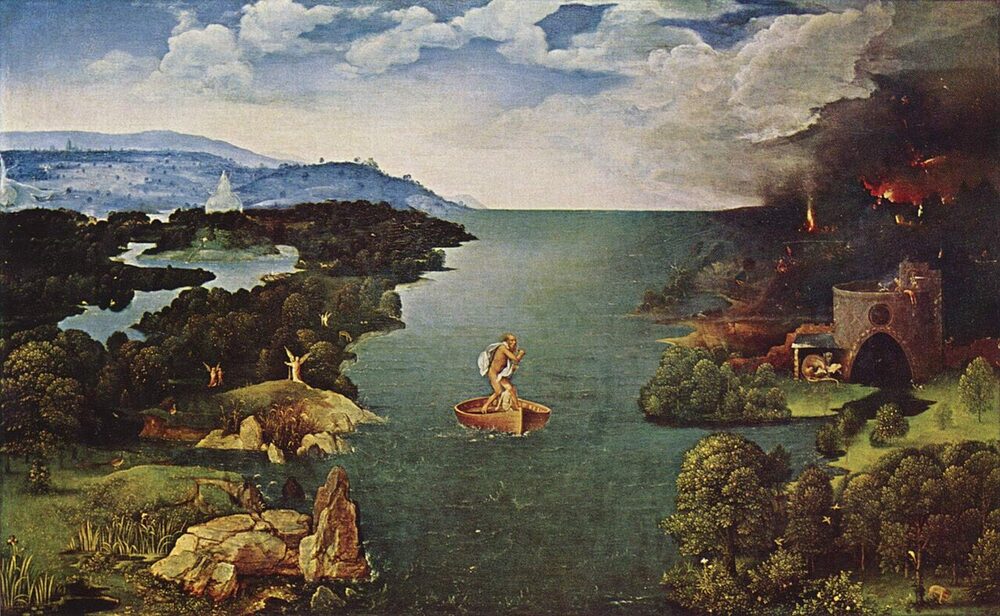
Charon is a latecomer to the surviving record: Homer's dead cross to Hades without any ferryman, and the earliest naming of Charon comes in the lost epic the Minyas, which the traveller Pausanias (10.28.2) tells us named "the boatman on the waters of Acheron" and which the great painter Polygnotus drew on for his underworld mural at Delphi. He steps fully into view on the tragic stage in Euripides' Alcestis (252–257), where the dying Alcestis, in her fever, sees him already: the ferryman with his hand on the pole, calling to her in anger — "Why do you delay? Hurry, you hold us back." Aristophanes then makes broad comedy of him in the Frogs (180–270), rowing the god Dionysus across and barking fares and orders at his passenger. The fullest portrait of all is Roman: Virgil's Aeneid (Book 6) paints the ragged, fiery-eyed boatman in unforgettable detail — flag this as a later, Roman elaboration of the Greek figure.
— The Minyas (a lost early epic, quoted by Pausanias 10.28.2); Euripides, Alcestis 252–257; Aristophanes, Frogs 180–270; Virgil, Aeneid 6.298–330 (Roman)
Who They Are
Charon (KAIR-on) is the grim ferryman of the dead — the dour, ragged old boatman who carries the souls of those who have died across the water and into the kingdom of Hades. He is not a god of the shining Olympian kind, nor exactly a monster; he is one of the sombre powers of the underworld, a working figure with a job to do, and the job never ends. Every soul that dies and is buried comes at last to his shore, and Charon takes them across — but only one at a time, only the properly buried, and only for his fee.
That fee is the heart of what the ordinary Greek knew about him. Charon takes his payment: the obol ([[obol]]), a small coin placed in or on the mouth of the dead at burial so that the soul would have the fare ready in hand for the crossing. This was not merely a story told about the underworld — it was a real burial custom, practised across the Greek world and after it the Roman, and archaeologists still lift small coins from the mouths and hands of the ancient dead. In the myth, the coin has teeth: a soul that comes to the river without its fare — the poor, the robbed, and above all the unburied, whose bodies were never given proper rites — is turned away, left to drift along the near bank of the river, unable to cross, for a hundred long years.
The river he ferries is the Acheron ([[acheron]]), the "river of woe," one of the five rivers that wind through the land of the dead. And though Charon himself is only the boatman at the water's edge, his crossing is the doorway to the whole vast country beyond — the gates guarded by the hound Cerberus, the grey meadows of asphodel where most of the dead drift on, the bright fields of Elysium kept for the good, the deep prison of Tartarus for the damned, and the throne where Hades and Persephone rule it all. To meet Charon is to stand at the threshold of that world, coin in hand, waiting to be carried over.
Mythology
Who he is, and where he came from
Charon arrives in Greek myth quietly and late. In the oldest poetry — Homer's Iliad and Odyssey — the souls of the dead simply pass down into Hades on their own; there is no ferryman waiting for them, and no fare to pay. The figure of Charon, the boatman on the river, first surfaces in the lost early epic the Minyas and then takes firm hold in the tragedies and comedies of Athens in the fifth century BC. From then on he is a fixed and familiar part of the landscape of death, so ordinary a presence that the comic poets could make jokes about him.
His parentage was worked out later still. In the systematic family trees of the gods — the shape the Romans especially loved — Charon is made the son of Nyx ([[nyx]]), Night, and Erebus ([[erebus]]), the Darkness of the underworld, born among the other grim children of Night such as Death, Sleep, and the Fates. (This genealogy is a later, tidying-up tradition rather than part of the earliest myth — it belongs with the Roman-era handbooks that gave every underworld power a parent, and should be read as a later systematization, not an old story.) It suits him well enough: a child of Night and Darkness, working the black water in the gloom.
The grim old boatman
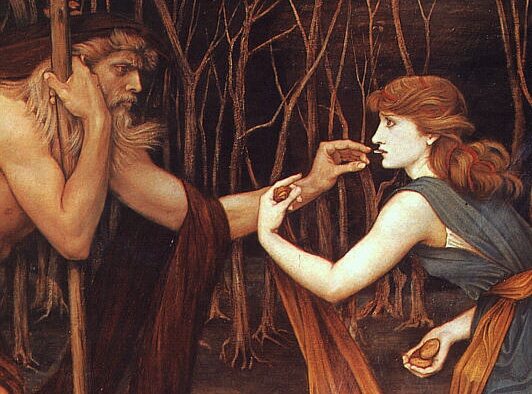
Everyone agreed on how he looked and how he behaved, and it was not flattering. Charon is old — but a hard, sinewy, tireless old age, not a frail one. He is dirty and unkempt, his cloak a filthy knotted rag hung from one shoulder, his beard grey and matted, his eyes burning. He is bad-tempered and rude, forever shouting at the crowding dead to hurry, to keep order, to get in and sit still. He poles and rows his own leaky little boat, packs the shades aboard, and takes their fare with a grasping hand. He is, in short, exactly the surly, overworked boatman you might meet at any real ferry-crossing — which is part of why the picture stuck so well. The Romans made him grimmer and more frightening; the Greeks, especially on the comic stage, made him almost funny, a grumbling old bargeman put upon by the endless traffic of the dead.
The fare: Charon's obol and the unburied
(Content note: this section concerns burial customs and the fate of the dead.) The one thing every Greek knew to do about Charon was to pay him. At burial, the family of the dead would place a small coin — most often an obol ([[obol]]), one of the least valuable coins there was — in or upon the mouth of the corpse, or sometimes in the hand or over the eyes. This was the fare for the crossing, put ready so the soul would not come to the river empty-handed. The custom was real and widespread: coins are found in the mouths and hands of the ancient dead across the Greek and Roman world, and the practice is still called "Charon's obol" today.
What made the coin matter so much was the fate of those who lacked it. A soul that came to Charon's shore without its fare could not be carried across — and worse off still were the unburied, whose bodies had been left without proper funeral rites, drowned at sea, fallen in war and never recovered, or simply denied burial. These the ferryman refused outright. In Virgil's great picture of the scene (Roman, and the fullest we have), the unburied dead crowd the near bank of the river like drifting leaves, stretching out their hands to the far shore in longing — and Charon drives them back, for the divine law forbids him to carry any soul over the water until its bones have rested in a grave. The wandering was said to last a hundred years; only then might the restless soul at last be allowed across. This is why the Greeks held the burial of the dead to be a sacred, unbreakable duty — to leave a body unburied was not only shameful but cruel, condemning the soul to a century of wandering on the wrong side of the river.
Living passengers, and the crossing forced
Charon carries the dead, and only the dead — a living passenger was a violation of the natural order, and on the rare occasions a living hero crossed his river the ferryman knew it and resisted. When the hero Heracles came down to the underworld to fetch the hound Cerberus, he forced Charon to carry him across against the rule; for ferrying a living man, the story went, Charon was punished with a year in chains. When Orpheus came down to win back his dead wife Eurydice, he did not fight the boatman but charmed him, playing his lyre and singing so sweetly that even grim Charon was moved to carry him over. And in Virgil's Aeneid (Roman), when Aeneas comes to the river, Charon challenges him angrily and refuses — until the Sibyl who guides the hero shows him the golden bough, the sacred branch that is the token of passage, and the ferryman, awed, falls silent and takes them across. The pattern is always the same: the living do not belong on that water, and only force, magic, or a god-given token can win the crossing.
A tour of the country beyond the river — the gate and the guardian
Charon's boat is only the threshold; the true kingdom lies beyond. When the soul steps ashore on the far bank, it comes first to the gate of Hades, and there waits the guardian — Cerberus ([[cerberus]]), the great hound of the underworld, most often three-headed, with a serpent for a tail. His task is not to keep the living out (though he does) so much as to keep the dead in: he fawns on the souls entering, and tears apart any that try to escape back to the light. Past the dog, the newly dead come before the judges of the dead, who send each soul on to the place it has earned.
The grey fields of asphodel
Most of the dead — the vast, ordinary run of humanity, neither greatly good nor greatly wicked — pass on into the Fields of Asphodel ([[asphodel]]), a wide, dim, grey meadow overgrown with the pale asphodel flower. Here the shades drift and murmur in a twilight of forgetfulness, keeping some faint shadow of who they were but drained of strength and joy, a colourless half-life. This is the ordinary lot of the dead, and it is the picture Homer's Odysseus meets when he calls up the ghosts: even the mighty Achilles, he is told, would rather be a poor man's living servant than king over all the withered dead.
Elysium and the Isles of the Blessed
For the few — the heroes, the favourites of the gods, and (in later belief) the good and the initiated — there was a far happier place: Elysium ([[elysium]]), the Elysian Fields, sometimes set apart as the Isles of the Blessed at the edge of the world. Here the air is bright and mild, there is no winter and no hardship, the blessed dead feast and sing and hold games in green meadows and endless soft light. Where dreary Asphodel was the fate of the many, Elysium was the reward of the few, and over the centuries the hope grew that a good life, or the right rites, might win a soul a place there rather than in the grey fields.
Tartarus, the prison of the damned
As far below Hades as the earth lies below the sky yawns Tartarus ([[tartarus]]), the deep pit of punishment — the dungeon of the underworld, walled in bronze and ringed by the flaming river, where the greatest sinners and the defeated enemies of the gods are held. Here suffer the famous damned: Tantalus, forever hungry and thirsty amid food and water that shrink from his reach; Sisyphus, endlessly rolling his stone up the hill only to watch it roll back down; Ixion bound to a turning wheel; the daughters of Danaus carrying water forever in leaking jars. Tartarus is the underworld's punishing depth, kept for those who wronged the gods themselves.
The throne of Hades and Persephone
Over the whole of it — the grey fields and the bright, the pit and the gate and the rivers — rule the king and queen of the dead: Hades ([[hades]]), the stern brother of Zeus who drew the underworld as his portion of the world, and Persephone ([[persephone]]), the daughter of Demeter whom he carried off to be his queen and who reigns beside him for the dark half of each year. Their palace stands deep in the kingdom, and to their throne the greatest matters of the dead are brought. Charon at his river is the humblest servant of that realm — but he is the one every soul meets first, the ragged doorkeeper of a country ruled by a god.
The Etruscan and Roman cousins
It is worth naming Charon's relatives to the west, because they colour the picture later ages inherited. The Etruscans of Italy had their own demon of death, Charun, whose name clearly echoes the Greek Charon but who is a fiercer, more monstrous being — a blue-skinned guardian armed with a great hammer, shown on tomb-paintings escorting or striking down the dead. When the Romans took up the Greek ferryman they gave him some of this darker colouring, and it is the Roman Charon — Virgil's ragged, terrible boatman with the burning eyes — who became the most famous version of all. The gentle warning to keep the two apart: the Greek Charon of the myth is the sombre working boatman, not the hammer-wielding Etruscan demon, though the names and the offices ran together over time.
Worship — Ancient
A figure of custom, not of cult
Charon had almost no temples, no priesthood, and no festivals — he was not a god one prayed to or sacrificed to in the ordinary way. Like the other grim powers of death, he belonged to a part of the divine world that the living did not court for favours; there was nothing to be gained by worshipping the ferryman, and much that was frightening in drawing his attention. His place in ancient religion was not on an altar but at the graveside, in the single, near-universal act performed for almost every dead person: the paying of his fare.
Charon's obol at the grave
The living honoured Charon by preparing their dead to meet him. When someone died, the body was washed, dressed, and laid out, and among the rites of burial a small coin — the obol ([[obol]]), or some low coin standing in for it — was placed in or on the mouth of the corpse, sometimes in the hand or laid over the eyes. This was the ferryman's fare, put ready so that the soul would not arrive at the Acheron unable to pay. The custom is one of the best-attested in all of ancient death-practice: coins are found again and again with the dead across the Greek world and throughout the Roman Empire that followed, and the practice — "Charon's obol" — is documented from the fifth century BC down into late antiquity, sometimes with a single coin, sometimes with coins over both eyes or a small purse of them.
The unburied and the duty of burial
Because a soul without its fare, and above all a body without burial, could not be carried across, the ancient world treated the burial of the dead as a sacred and inescapable duty. To leave a corpse unburied — an enemy's body denied the grave, a drowned sailor never recovered — was believed to leave the soul stranded on the wrong bank of the river, and this belief runs deep through Greek literature: it is the whole moral engine of Sophocles' Antigone, in which a young woman defies a king's order and gives her dead brother burial though it costs her life, because the duty owed to the dead outranks the command of the living. Even enemies killed in war were, by custom and by the law of the gods, to be given back for burial. In honouring Charon's fare and the rites of the grave, the Greeks were not so much worshipping the ferryman as keeping faith with their own dead.
Worship — Modern
Remembered at the threshold
Charon is not a god of blessings, and he is not honoured today with the warm devotion given to Olympians like Apollo or Athena. In modern Hellenic practice he keeps the place he always held: a sombre power of the threshold, named and respected rather than petitioned, remembered chiefly in connection with death, mourning, and the care of the dead. A devotee's relationship to Charon is quiet and serious — an acknowledgement of the boatman one will meet at the end, rather than a request for anything in this life.
The coin, kept as a symbol
The most natural way to honour Charon today is through the ancient token itself: the coin. Some who keep the old ways will set a single coin on a shrine to the dead, or include one among the things buried or kept with a loved one who has died, as a remembrance of the fare and of the belief that the dead should be sent on their way properly cared for. The gesture is less about literal payment than about what the custom always meant — that we owe our dead the rites of parting, and do not send them off empty-handed or unmourned. A candle lit at a death, and the simple duty of seeing the dead properly honoured, sit well as tribute to the ferryman.
A lasting image in language and story
More than through any cult, Charon lives on as one of the most enduring images the Greeks ever made. His name survives in the modern Greek figure of Charos, the folk personification of Death himself, who in later Greek song and story is no longer only a boatman but a dark rider who carries people off — the ferryman merged, over the centuries, into Death in person. He gives his name to a moon of the dwarf planet Pluto — Charon, the ferryman circling the lord of the underworld — a quiet astronomer's nod to the old myth. And the picture he anchors, of a coin for the boatman and a crossing at the end of all things, has stayed alive in poetry, painting, and story from Virgil and Dante down to the present day. To imagine death as a dark water and a ragged boatman waiting with his hand out is to think, still, in the shape Charon gave it.
Epithets & Cult Titles
- The Ferryman of the Dead (ho porthmeus tōn nekrōn) — His defining role — the boatman who carries the souls of the dead across the water to the far shore of the underworld
- The Grim Boatman (ho stygeros / the dreadful one) — A descriptive title for his harsh, forbidding manner — dour, ragged, and impatient with the crowds of the dead who press to be carried over
- Charun (Etruscan) — A later cousin rather than the same figure — the Etruscans of Italy had their own death-demon Charun, a hammer-wielding guardian of the dead whose name echoes the Greek Charon, and who fed into the Roman picture of the ferryman
- Portitor (Latin, 'the toll-keeper / ferryman') — The Roman name Virgil gives him in the Aeneid — the keeper of the crossing who takes the fare, casting the Greek boatman in Roman dress
Sources & Variants
- Pausanias, Description of Greece 10.28.1–2 (the Minyas names 'the boatman on Acheron'; Polygnotus' underworld mural at Delphi showing Charon)
- Euripides, Alcestis 252–257 (the dying Alcestis sees Charon at his pole, calling her to hurry)
- Aristophanes, Frogs 180–270 (Charon ferries Dionysus across the lake, shouting fares and orders) — comedy
- Virgil, Aeneid 6.298–330, 384–416 (the fullest portrait: the ragged fiery-eyed boatman, the unburied crowding the bank, the refusal of Aeneas, and the golden bough) — Roman
- Apollodorus, Bibliotheca 2.5.12 (Heracles compels Charon to ferry him across on the quest for Cerberus)
- Hesiod, Theogony 211–225 (Nyx and her grim children — the later genealogy that makes Charon a child of Night and Darkness draws on this family of death-powers)
- Homer, Odyssey 11 (the Nekyia — the fields of the dead, the shades, and the ordinary lot of the dead, in the older picture with no ferryman)
- Sophocles, Antigone (the sacred duty of burying the dead, and the horror of leaving a body unburied)
- Lucian, On Mourning and the Dialogues of the Dead (satirical descriptions of Charon, his fare, and the crossing)
- Diodorus Siculus 1.92, 1.96 (the fare for the ferryman and the derivation of Greek underworld belief from Egyptian burial custom, as Diodorus reports it)
Gallery