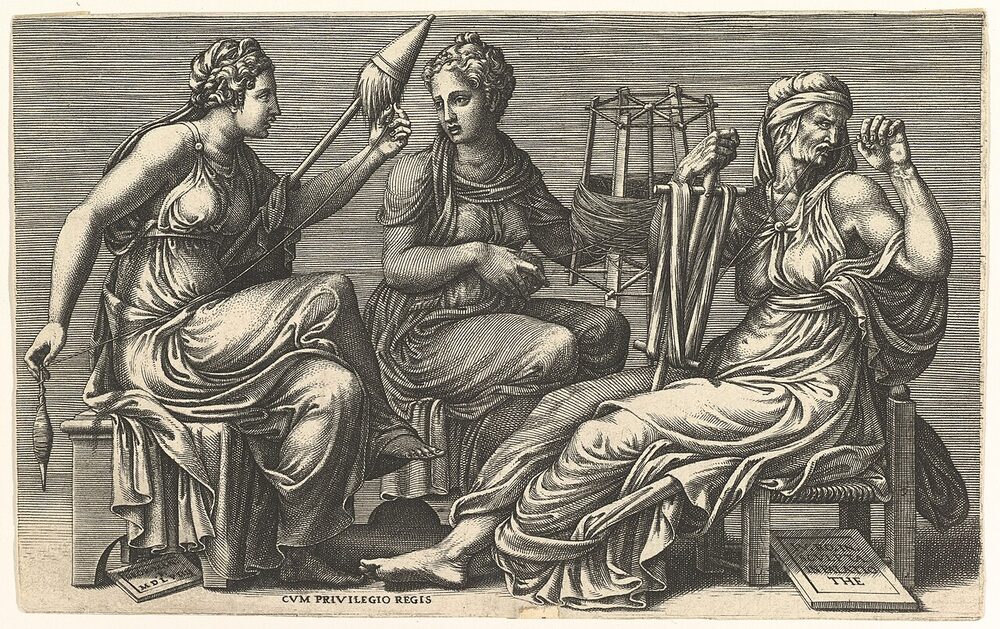
Moirai / the Fates
First Appearance
The Moirai appear twice in Hesiod's Theogony, and give two different mothers — a contradiction the poet leaves standing, and one that carries the whole theology of the Fates. At 217–222 they are born of Nyx (Night) alone, without a father, "Clotho and Lachesis and Atropos, who give to mortal men at their birth both good and ill to have," and who pursue the transgressions of men and gods and never cease from their dread anger until they punish the wrongdoer. But at 904–906 Hesiod names the same three, "Clotho and Lachesis and Atropos, who give to mortal men both good and ill to have," as the daughters of Zeus and Themis (Divine Law), sisters of the Horae (the Seasons), to whom "Zeus the counsellor gave the greatest honour." The two passages set the deepest question about the Fates side by side: are they older than the gods, primeval daughters of Night whom even Zeus obeys — or the gods' own children, an ordered destiny that Zeus himself begot and oversees?
— Hesiod, Theogony 217–222 (daughters of Nyx) and Theogony 904–906 (daughters of Zeus and Themis, sisters of the Horae)
Who They Are
The Moirai (MOY-rye; singular Moira, MOY-ra), in Greek the Μοῖραι, "the Apportioners" or "the Allotters," are the three goddesses of fate — the powers who decide, measure, and end the span of every mortal life. The English name for them, "the Fates," comes by way of their Roman counterparts the Parcae; but the Greek name is more precise and more revealing. A moira is a "portion" or "share" — your slice of the meat at a feast, your allotted piece of land, and, by extension, the share of life and death, of fortune and suffering, that is dealt out to you at birth. The three Moirai are the women who deal it. To the Greek imagination they were most often pictured not as queens on thrones but as three grave spinning-women at their work, turning the wool of a life on the spindle: what they spin is what will be.
Their three names divide the single act of fate into three motions, and each name is a job. Clotho (Κλωθώ, "the Spinner") spins the thread of a life onto her spindle, drawing it out of nothing at the moment of birth. Lachesis (Λάχεσις, "the Apportioner," from lanchanō, "to obtain by lot") measures the thread out to its length, assigning to each person the portion of days they will have. And Atropos (Ἄτροπος, "the Unturnable," the "Inflexible") — the smallest of the three and the most terrible — cuts the thread with her shears when the time has come, and against her there is no appeal. Spun, measured, cut: the whole of a human life passes through their three pairs of hands.
What makes the Moirai stand at the very centre of Greek religious thought is the question of where they stand in relation to the gods — a tension the earliest poetry raises and never resolves. Are the Fates older and higher than the Olympians, primeval daughters of Night to whose decrees even Zeus must bow? Or are they Zeus's own daughters, the ordered destiny that the king of the gods begot and administers? Hesiod gives both answers on the same scroll, and the Greeks never chose between them. Out of that unresolved tension comes the strange, characteristically Greek idea of a Zeus who is at once the servant and the steward of Fate — bound by a destiny he does not command, yet honoured as Moiragetes, "Leader of the Fates," the god who guides and voices a doom he did not decree. To understand the Moirai is to stand at the one place in Greek myth where even the greatest of the gods is not the last word.
Mythology
The three sisters and the three motions of fate
The Moirai are almost always three, and each has her office, so that between them they perform the single act of allotting a life in three stages. Clotho ("the Spinner") holds the distaff and the spindle and spins the thread of a mortal life into being; she is the beginning, present at the birth. Lachesis ("the Apportioner" or "she who assigns the lot") measures the spun thread and determines its length — how long the life will run, and, in the deeper tellings, the shape of the fortune allotted to it. Atropos ("the Unturnable," "she who cannot be turned") is the end: with her shears she snips the thread, and the life is over. The Greek poet's image is domestic and unhurried — three women at the oldest of women's crafts, spinning and measuring and cutting wool — and that very ordinariness is the horror and the comfort of it: your death is not a monster or a battle but a length of thread already measured, a small snip already scheduled by a working woman who does not hurry and cannot be hurried. The name most bound up with the whole picture is spinning; already in Homer the Fates are called simply Klothes, "the Spinners," and a man's death is "the thread the Fates spun for him with his life-strand when his mother bore him" (Iliad 24.209–210; Odyssey 7.197–198).
Two mothers, one question — Nyx or Zeus and Themis?
The single most important thing the myths say about the Moirai is said twice, and the two versions disagree — deliberately, and to the point. In one and the same poem, Hesiod's Theogony, the Fates are given two different parentages, and the contradiction is not a mistake to be tidied away but the very heart of what the Greeks thought about fate.
In the first passage (Theogony 217–222), the Moirai are the daughters of Nyx (Night) alone, brought forth without a father, in the company of her other grim children — Doom, Death, Sleep, Blame, Woe, Nemesis, and the rest. Here they are primeval, older than the Olympian order, children of the oldest darkness; they belong to the first powers of the cosmos, and the gods themselves are younger than they are. On this reckoning the Fates stand above the gods: a destiny woven into the world before Zeus was ever born, which he can no more revoke than a mortal can.
In the second passage (Theogony 904–906), Hesiod names the very same three — Clotho, Lachesis, and Atropos — as the daughters of Zeus and Themis ("Divine Law" or "Right Order"), and so the sisters of the Horae, the Seasons (Eunomia, Dike, and Eirene — Good Order, Justice, and Peace). Here the Fates are the youngest and best-honoured children of the reigning king, and destiny is no longer something older than Zeus but something he fathered: an ordered, lawful apportioning of life that flows from his own union with Right itself, and to which "Zeus the counsellor gave the greatest honour."
The two accounts pose the deepest question in Greek theology in the plainest possible form. Are the Fates older than the gods, or the gods' own daughters? Is destiny a brute, impersonal law that binds even heaven — or is it the just governance of the world by its king? The Greeks never resolved this, and it is a mark of their honesty about a hard thing that they did not. The Golden Thread keeps both parentages in view, as Hesiod did, because the tension is the teaching: fate is felt at once as something no one, not even Zeus, can overrule, and as something bound up with the justice and order the highest god upholds.
Zeus Moiragetes — the god who bows to Fate and guides it
Out of that tension the Greeks built one of their subtlest ideas: that Fate stands above all the gods, and yet Zeus is its overseer. On the one side, the poems are full of Zeus deferring to a destiny he cannot change. In the Iliad he watches his own son Sarpedon go to his death and longs to save him, but the other gods remind him that a doom long fated cannot be undone without unravelling the world, and he yields, weeping tears of blood; when he weighs the fates of Hector and Achilles in his golden scales (Iliad 22.209–213), he does not decide the outcome but reads it — the pan that sinks tells even Zeus which man must die. Here the king of the gods is Fate's servant.
On the other side, the Greeks gave Zeus the cult-title Moiragetes (Μοιραγέτης), "Leader of the Fates," and worshipped him — and Apollo with him — as the god who guides the Moirai and speaks their decrees. Pausanias saw altars of Zeus Moiragetes and Apollo Moiragetes beside the sanctuary of the Moirai at Delphi, and the Fates honoured together with Zeus the Leader at Olympia (Description of Greece 5.15.5, 10.24.4). The title marks the paradox exactly: Zeus does not make fate, but he leads it — he is the point at which a blind, impersonal destiny is given order, justice, and a voice. Apollo's whole oracular office depends on this: the god of prophecy at Delphi does not invent the future but announces what the Moirai have spun, "Leader of the Fates" because he leads their decrees out into the light where mortals can hear them. So the Greek answer to "who is greater, Zeus or Fate?" was never a simple one. Fate is greater; and Zeus is its steward — bound by it, and yet the one who administers it.
The Fates at the birth of every child
For all their cosmic weight, the Moirai touched Greek life most nearly at its beginning, for they were believed to come to every birth and spin there the thread of the new life. This is their most constant role in the poets: what the Fates "spun for a man with the thread at his birth, when his mother bore him," is the phrase that recurs whenever a death or a destiny is spoken of. Because of this the Fates were present, in the popular imagination, at the cradle — a belief that runs straight down through folk memory into the fairy-tale of the three fairies (or wicked and good godmothers) who come to a newborn's christening to lay gifts and curses on the child, a scene whose deepest root is the three Moirai at the birth. In myth the clearest case is Meleager, the prince of Calydon: when he was seven days old the three Moirai came to his mother Althaea and foretold his fate: that he would live only as long as the log then burning on the hearth remained unconsumed — and, in the fuller telling, sharing out their gifts, Clotho that he would be noble, Lachesis that he would be strong, and Atropos, with her eye on the brand, fixing the term of his life. Althaea snatched the log from the fire and hid it, and so kept her son alive for years — until, in grief and rage, she burned it at last, and Meleager died as the wood turned to ash (the burning-brand doom is in Apollodorus 1.8.2–3 and as old as the Iliad; the neat one-gift-per-Fate division is a later elaboration, as in Hyginus, Fabulae 171). The Fates had spoken at his birth, and the thread ran, as it always does, to its measured end.
The singing Fates — the Moirai at the weddings and the loom of the world
The Moirai were not only grim; they were also singers. The Greeks pictured them chanting as they worked, and what they sang was destiny itself — the past, the present, and the things that must be. Plato, in the great vision at the close of the Republic (the Myth of Er, 617b–c), sets the three Moirai around the turning spindle of Necessity at the axis of the whole cosmos, robed in white and garlanded, and gives them a song: Lachesis sings the things that were, Clotho the things that are, and Atropos the things that are to come — the three sisters singing the whole of time in harmony with the music of the spheres, while Clotho's right hand turns the outer whirl of the heavens and Atropos's left hand turns the inner. And they sang at weddings. When a marriage was made — above all a marriage that would found a great line — the Moirai were imagined singing the wedding-song beside the Horae and the other blessing-powers: at the wedding of Zeus and Hera, and most famously at the marriage of Peleus and Thetis that would bring forth Achilles, the Fates sang the fortune of the union and the greatness of the child to come. The Moirai were fighters, too, when the very order of the world was at stake: in the war of the gods against the Giants they took the field, and Apollodorus (1.6.2) records that they killed the Giants Agrios and Thoas, beating them to death with clubs of bronze. Grave spinners, sweet singers, and, at need, defenders of the cosmic order all at once, the Moirai are the loom and the music of the world: they weave the thread of each life, and they sing the pattern of the whole.
The Keres, the Erinyes, and the neighbours of Fate
The Moirai kept close company with the other dark daughters of Night, and the ancients sometimes ran them together. The Keres — the black death-spirits who swarm on the battlefield — shade into the Moirai as fate-in-the-moment, the doom that seizes a man in the instant of dying; Homer speaks of a warrior's kēr and his moira almost interchangeably. The Erinyes (the Furies), who punish oath-breakers and the shedders of kindred blood, are the Fates' enforcers: Heraclitus wrote that if the Sun should overstep his measure, "the Erinyes, the ministers of Justice, will find him out" — the Furies as the police of a cosmic order the Moirai lay down. And the Fates border on Ananke (Necessity), the vast impersonal compulsion at whose spindle Plato set them, and on Tyche (Chance or Fortune), who in later ages came to rival them — for as belief in blind luck grew, some drew Tyche up to stand almost against the Moirai, chance against destiny. But at the centre, unmoved, remained the three spinning-women: Clotho at the distaff, Lachesis with the measuring-rod, and small, silent Atropos with the shears, whose single snip no god and no prayer has ever been known to stay.
Worship — Ancient
Honoured with care, and with dread
The Moirai were worshipped across the Greek world, but theirs was a grave, quiet cult rather than a bright festival one. They belonged to the older stratum of divine powers — the chthonic gods of earth, birth, and death — and were honoured with the caution due to powers whom one dares not offend and cannot flatter. Because you could not bribe or turn the Fates, their cult was less about petition than about reverence: keeping faith with them, giving them their due, and above all not provoking them. They were often worshipped alongside the other solemn goddesses of the earth and the dead — Demeter and Persephone, the Eumenides (the "Kindly Ones," a soothing name for the Furies), and the birth-goddess Eileithyia — the whole company of powers who govern the thresholds of a life.
Their sanctuaries and the wineless offerings
Pausanias, travelling Greece in the second century AD, records precincts of the Moirai in several cities. There was a sanctuary of the Fates at Corinth in a grove (2.4.7); at Sicyon they were honoured near the shrine of the Eumenides, with a yearly offering of flowers and libations of honey and water (2.11.4); at Sparta there stood images of the Moirai (3.11.8); at Thebes and Olympia and above all at Delphi they had altars close to the great gods. What is telling is how they were honoured. The Moirai, like the other primeval and chthonic powers, received nēphalia — "sober" or wineless offerings: libations not of wine but of honey mixed with water or milk, together with flowers and garlands rather than the blood-sacrifice and roasted portions given to the Olympians. Wine was thought to belong to the younger, brighter gods; the oldest powers of fate and death were approached soberly, with the pale and gentle gifts of honey and flowers. It is a small detail that says much: you do not feast with the Fates, you keep sober faith with them.
Fate beside the great gods — Delphi and Olympia
The most revealing places of Moira-cult are the ones where the Fates stood beside Zeus and Apollo. At Delphi, the very navel of Greek prophecy, Pausanias saw two Fates represented (in place of the usual three) beside altars of Zeus Moiragetes and Apollo Moiragetes, "Leaders of the Fates" (10.24.4); at Olympia there was an altar of the Moirai and, near it, an altar of Zeus Moiragetes (5.15.5). To worship the Fates and "Zeus who leads the Fates" side by side was to enact the whole Greek theology of destiny in stone: the acknowledgement that fate is real and sovereign, and that the highest god is its guide and not its author. The oracle at Delphi rested on exactly this: what Apollo's priestess spoke was the decree of the Moirai, and Apollo was their "leader" because he led their fixed decrees into human hearing. Fate was fixed; the god only announced it.
The Fates at the turning-points of a life
Beyond the formal sanctuaries, the Moirai were honoured at the private thresholds where their power was felt. At a birth, families invoked and thanked them, for the Fates were believed to spin the child's thread then and there; offerings of thanks were made for a safe delivery. At a marriage, the Fates were called on for a blessed union and good children — the Moirai who sang at the weddings of gods and heroes were asked to sing well over a mortal one. And at a death, their work was acknowledged as finished: the thread was cut, the moira fulfilled. To the ordinary Greek the Moirai were less a matter of grand festival than of these hinge-moments — the powers you saluted when a life began, was joined, or ended, because those were the moments their hands were on you.
Worship — Modern
The Fates in living Hellenic practice
In modern Hellenic polytheism (the revived worship of the Greek gods), the Moirai are honoured much as the ancients honoured them: with reverence, restraint, and the pale offerings proper to the old powers of fate. A devotee will often keep them in mind at the great thresholds — the birth of a child, a marriage, a death in the family, the start of some undertaking whose outcome lies beyond one's own hands. The traditional wineless offerings are kept up: honey and water, milk, flowers, and garlands laid before an image or a candle, rather than wine, in keeping with the ancient sense that the Fates belong to an older and graver order than the feasting Olympians. Because the Moirai cannot be bargained with, worship of them is less petition than acceptance — an honouring of the limits of a life, a way of making peace with what cannot be changed, and of asking, not to escape one's portion, but to bear it well and to be spared an untimely cutting of the thread.
The spinners in language and imagination
Even for those who keep no cult, the Moirai are among the most quietly pervasive of all the Greek powers, because the metaphor they gave us has never left the language. To speak of the "thread of life," of a life "hanging by a thread," of the "span" of one's years (the "span" is a measure, the length Lachesis metes out), of a "spinster" (a woman who spins), of what is "spun out" or of a story's "thread" — all of these carry, half-buried, the image of the three spinning-women. The very word "fate" comes from the Latin fatum, "that which is spoken," the decree; and the Moirai's Roman counterparts, the Parcae, gave their name to nothing less than the modern sense of the Fates as the three sisters with the distaff and the shears. When a modern poet or novelist writes of the Fates cutting a thread, or of destiny spun and measured and snipped, they are drawing, knowingly or not, on Clotho, Lachesis, and Atropos.
The three sisters, endlessly retold
The image of the three Fates — one spinning, one measuring, one cutting — is one of the most durable in Western art and story. It runs from ancient sarcophagi and Renaissance paintings (Michelangelo's circle, Goya's grim Átropos) through Shakespeare's "Weird Sisters" in Macbeth (the three witches who are, at root, the three Fates, "weird" being an old word for fate itself), down to the three fairy-godmothers of the fairy-tale who come to a newborn's christening with gifts and curses, and on into modern fantasy and film, where the "three Fates" or "three witches" who know and shape destiny are a stock figure instantly understood. What endures is the deep, unsettling idea the Greeks first gave form: that a life is a measured thread, spun at its birth and cut at its end by hands that are not our own; and that above even the highest god stands something older and quieter — the apportioning of the lot, which Zeus himself can only guide, and never overrule.
Epithets & Cult Titles
- Μοῖραι (Moirai) — "the Apportioners" — The group-name itself, the ones who deal out each mortal's moira, the "portion" or "lot" of life; to speak of "the Moirai" is to name fate personified as three working women
- Κλῶθες (Klothes) — "the Spinners" — A collective title for all three drawn from the work of the eldest, Clotho the Spinner; Homer already calls them the Klothes, "the Spinners," who spin out with their thread the destiny of a child at its birth (Odyssey 7.197)
- Αἶσα (Aisa) — "Allotment, Destiny" — An older single name for one's appointed share, used both as a synonym for Moira and as the name of one of the three; aisa is the "due portion" a person is born to, and to die "beyond aisa" (hyper aisan) is to die before one's fated time
- Μοιραγέται (of Zeus and Apollo, Moiragetes) — "Leaders of the Fates" — Not a name of the three but of the gods set over them: Zeus Moiragetes and Apollo Moiragetes, "Leader of the Fates," worshipped beside the Moirai (as at Delphi and Olympia) to mark that the Olympians guide and voice a destiny they did not make
- Κραταιαί (Krataiai) — "the Strong, the Mighty Ones" — A reverent byname for the Moirai as powers no one escapes; like the Erinyes they were often called by softening or awe-filled titles rather than named too boldly, for they were dreaded as much as honoured
Sources & Variants
- Hesiod, Theogony 211–225 (the Moirai — Clotho, Lachesis, Atropos — born of Nyx/Night alone, who give mortals good and ill and punish transgression)
- Hesiod, Theogony 901–906 (the Moirai as daughters of Zeus and Themis, sisters of the Horae, given the greatest honour by Zeus — the second, contradictory parentage)
- Homer, Iliad 24.209–210 (a man's death as the thread the Moira spun for him at his birth); Iliad 22.209–213 (Zeus weighs the fates of Hector and Achilles in his golden scales); Iliad 16.431–461 (Zeus and the fated death of Sarpedon)
- Homer, Odyssey 7.197–198 (the Klothes, 'the Spinners,' spin a man's destiny at his birth)
- Plato, Republic 10.617b–620e (the Myth of Er: the three Moirai at the spindle of Necessity, robed in white and garlanded — Lachesis singing the past, Clotho the present, Atropos the future — turning the whirls of the cosmos and ratifying the souls' chosen lots)
- Apollodorus, Bibliotheca 1.8.2–3 (the Moirai foretell the fate of the newborn Meleager and the burning brand); 1.6.2 (in the Gigantomachy the Moirai kill the Giants Agrios and Thoas with bronze clubs)
- Aeschylus, Prometheus Bound 511–518 (Prometheus: the helm of Necessity is steered by the three Moirai and the mindful Erinyes, and even Zeus cannot escape what is fated)
- Aeschylus, Eumenides 956–967 (the Moirai invoked as sisters of the Erinyes, powers who apportion to every house its due)
- Hesiod, Shield of Heracles 258–263 (the dark, dread depiction of the Keres/Fates on the battlefield, gnashing over the fallen)
- Pausanias, Description of Greece 2.4.7 (sanctuary of the Moirai at Corinth); 2.11.4 (the Moirai at Sicyon, honoured with wineless offerings of honey and water and with flowers); 3.11.8 (images at Sparta); 5.15.5 (altar of the Moirai and of Zeus Moiragetes at Olympia); 10.24.4 (the two Fates with Zeus Moiragetes and Apollo Moiragetes at Delphi)
- Ovid, Metamorphoses 2.654, 8.451–457, 15.781 (the Parcae/Fates and the burning brand of Meleager) — Roman retelling, in which the Greek Moirai appear as the Parcae
Gallery