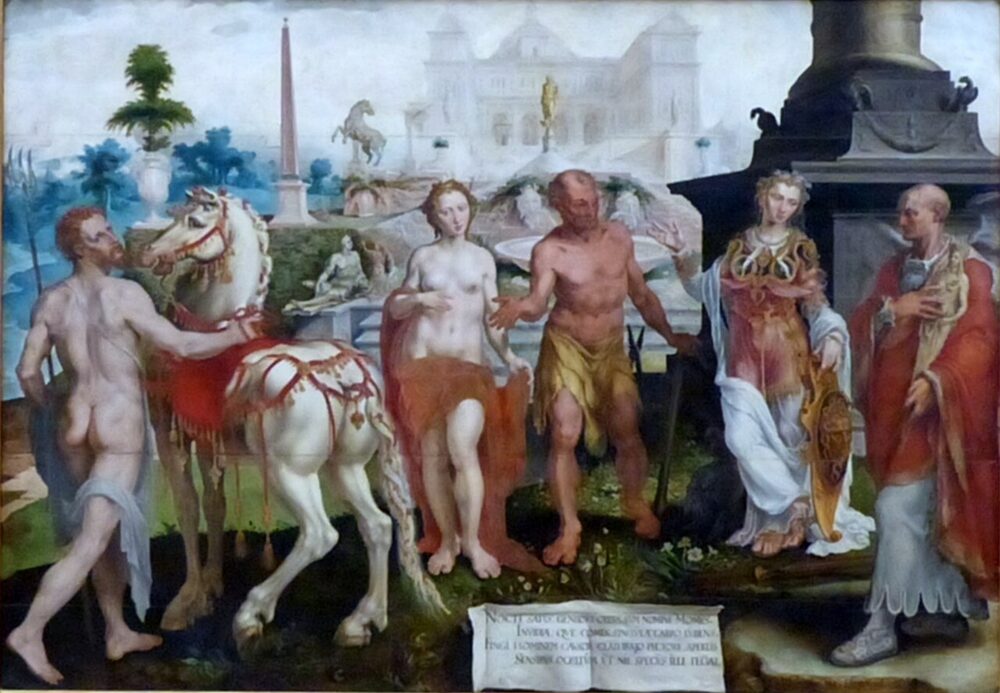
Mōmos
First Appearance
Momus steps into Greek poetry in Hesiod's catalogue of the children of Night. There murky Nyx, lying with no one, bears a brood of dark powers — Doom and Fate and Death, Sleep and the tribe of Dreams — and among them "hateful Blame" (stygerón te Mómon) and, beside him, painful Woe (Oïzýs) (Hesiod, Theogony 211–214). He is born, that is, not as a mischief among many but as one of the primal abstractions the Greeks felt moving through the world: the very spirit of reproach, Night's child, kin to Misery and to Death.
— Hesiod, Theogony 214
Who They Are
Momus (MOH-mus) is the god of blame, mockery, and censure — the carping fault-finder of the Greek imagination, the spirit of the sneer and the reproach made a person. His name is simply the common Greek word mōmos, "blame" or "reproach," and that is the whole of what he is: not a god with worshippers or a story of his own loves and quarrels, but the personification of the impulse to find fault, to pick holes, to praise nothing and criticize everything. The Greeks counted him a child of Nyx, Night, born of her alone without a father, and set him among her dark brood beside Woe and Death (Hesiod, Theogony 214).
He is best remembered as the god who found fault even with the works of the gods. In the fable tradition that grew up around him, Momus is called in to judge the finest things the immortals could make and can praise none of them — faulting the bull because its horns sit above its eyes so it cannot see where it strikes, faulting the house because it has no wheels to roll away from a bad neighbour, and faulting the maker of man for giving the human breast no little window through which his hidden thoughts might be seen. So sour and tireless was his carping that the tradition has him driven off Olympus altogether, the one god the other gods could not endure.
Yet the Greeks also gave him a strange dignity. A dark tradition made his counsel the hidden spring of the Trojan War — that it was on Momus's advice (or Earth's) that Zeus set in motion the great war to relieve the overburdened earth. And in the hands of the satirist Lucian, centuries later, Momus became the one honest voice in heaven, the frank critic who says out loud what the other gods would rather not hear. From him descends the whole after-figure of the "momus," the carping critic — the patron, we might say, of everyone who has ever found the flaw in a perfect thing.
Mythology
Child of Night
Momus belongs to the oldest stratum of Greek divine genealogy — the catalogue of the children of Nyx (Night) in Hesiod's Theogony. There Night, "though she lay with none," brings forth a brood of grim powers out of herself alone: Doom and black Fate and Death, Sleep and the whole tribe of Dreams, the Hesperides, the Fates and the Keres, Nemesis, Deceit and Friendship and hateful Old Age — and, named together, "hateful Blame (Mómos) and painful Woe (Oïzýs)" (Hesiod, Theogony 211–214). His place in that list tells us what he is. He is not a story but a force: one of the dark abstractions the Greeks felt at work in the world, born of Night and kin to Misery and to Death. He has no father, no cult, and almost no narrative of his own — he is pure personified reproach, the spirit of blame given a name and a parentage.
The fault-finder of the gods
Momus's fame rests on a single trait carried through the fable tradition: he could find fault with anything, even the masterworks of the gods. The oldest and best-known form of the story (preserved among Aesop's Fables) sets him as the judge of a contest of making. In one telling, Zeus, Prometheus, and Athena each fashion a thing — a bull, a man, and a house — and call in Momus to appraise them, confident he will have to praise such perfect works. Instead he blames every one.
He faults the bull because its horns are set above its eyes: the beast cannot see where it aims its charge, and should have had its eyes down on the horns (or the horns down by the eyes) so that it could watch what it gored. He faults the house because it was built with no wheels beneath it — so that if a bad neighbour should move in next door, the owner cannot simply roll his house away to a better street. And he faults the maker of man most of all, because he set no little door or window in the human breast: had there been one, a man could open it and all would see his heart, and no one could hide a false or wicked thought behind an honest face. In the end Momus praises nothing, and Zeus — the story's point — drives him out of heaven for his inability to see any good in anything. A related Aesopic fable has him sent to judge the beauty of Aphrodite herself and, unable to fault her form, carping instead at the creak of her sandal — so determined is he to find a flaw that, where none exists, he invents one.
The counsel that began the Trojan War
A far darker tradition gave Momus a hand in the greatest catastrophe of Greek myth. The lost epic the Cypria opened with a plan to relieve the earth of the weight of too many mortals, and the ancient commentators who preserve its argument (the scholia to Homer, Iliad 1.5) report that the war was set in motion "according to the counsel of Momus" (katà tḕn Mṓmou boulḗn). In this account the all-nurturing Earth, groaning under the multitude of men, appealed to Zeus to lighten her; and Zeus resolved to do it by war. The advice by which it was accomplished is credited in these sources to Momus: that Zeus should give the sea-goddess Thetis in marriage to a mortal man (from which union would come the warrior Achilles), and beget a daughter of surpassing beauty (Helen), so that strife over her should draw Greeks and Trojans alike to destroy one another on the plain of Troy. Some tellers assign the plea to Earth (Gaia) and the plan to the "will of Zeus" of which the Cypria and the Iliad speak; but the strand that names Momus makes the god of blame the hidden counsellor behind the war — the one whose cold advice turned the overcrowding of the world into the slaughter of a generation.
Driven off Olympus
Running through all of this is the tradition that the gods themselves could not bear Momus. In the fable of the contest he is cast out of heaven for finding fault with the gods' own handiwork; more broadly he became the proverbial figure of the god too disagreeable to keep, so relentlessly critical that even the immortals banished him from their company. The expulsion is less an event than a judgement the Greeks passed on the thing he stands for: pure, tireless, joyless fault-finding is unendurable even among the gods, and the one power that will praise nothing earns a place nowhere — not even on Olympus, and least of all there.
The satirist's patron
Momus had a long and lively afterlife as the god of frank and mocking speech. The satirist Lucian of Samosata, writing in Greek in the second century AD, made him a recurring character and something close to a mouthpiece: in dialogues such as the Assembly of the Gods (Deorum Concilium) and Zeus the Tragedian (Juppiter tragoedus), Momus is the one Olympian who speaks the uncomfortable truth aloud — exposing the gods' hypocrisies, deflating their pretensions, saying plainly what divine decorum would keep hidden. In Lucian's hands the carper of the fables becomes the honest critic, and his blame becomes a kind of candour. From this descends the whole later figure of the "momus": the name passed into Greek and then into European usage as a byword for the carping critic, the one who finds the flaw in every work, and Momus became the patron under whose sign satirists and fault-finders of every age have written.
Worship — Ancient
A personification, not a god of the altar
Momus had no cult. He was never, so far as the record shows, given a temple, a priesthood, a festival, or an altar anywhere in the Greek world, and no city claimed him as patron or named a day for him. This is exactly what we expect of a personified abstraction of his kind: like his brothers and sisters in Hesiod's catalogue of the children of Night — Woe, Deceit, Old Age, the Dreams — he was a power the Greeks named and reckoned with in poetry and thought rather than approached with offerings. To "worship" Blame would have made little sense; one does not sacrifice to reproach itself. His life was in the word and in the story.
His home in fable, drama, and satire
Where Momus truly lived was in literature. He belonged above all to the fable (the Aesopic tradition that made him the fault-finder of the gods), and the comic poets and satirists took him up from there. The Athenians knew a lost satyr-play or comedy about him, and the tragedian Sophocles is credited with a (now lost) Momos; the figure clearly offered the stage a ready-made embodiment of the heckler and the scold. It was this literary Momus, not any cult-god, that Lucian inherited and made famous — so that the god of blame survived the whole of antiquity not as a receiver of prayers but as a character, a mask the poets could put on whenever they wanted a voice to say the unsayable.
Worship — Modern
The patron of critics
Momus survives today almost entirely as a figure of speech and of letters rather than of devotion. His name became, and remains, a byword: a "momus" is a carping critic, a habitual fault-finder, the person at the back of the room who can admire nothing. In this sense he quietly presides over the whole enterprise of criticism — over the reviewer, the satirist, the sceptic, and everyone who insists on naming the flaw in the admired thing. The Renaissance made much of him: Leon Battista Alberti wrote a biting Latin satire, Momus, that turned the god of blame into a vehicle for mocking princes and philosophers, and the name recurs ever after as the sign under which satire is written.
A spirit to reckon with, not to flatter
For a modern reader drawn to the old personifications, Momus is less a god to honour than a truth to hold in view. He stands for the double edge of criticism itself — the fable's warning that the fault-finder who can praise nothing makes himself unbearable even to the gods, and Lucian's answering insight that a world with no Momus in it, no frank voice to say what others will not, is a world of comfortable lies. He is the reminder that blame can be mere sourness or it can be honesty, and that the difference lies not in the sharpness of the tongue but in whether it serves the truth. To "keep" Momus, in the only sense now available, is to keep a critical eye — and to watch that it does not curdle into the joyless carping for which the gods cast him out.
Epithets & Cult Titles
- ho memphómenos (ὁ μεμφόμενος) — The blamer, the one who finds fault — mōmos and the verb mémphesthai ('to blame, to reproach') name his whole nature: to carp, to censure, to pick holes in what others have made
- momoskopos (μωμοσκόπος) — The fault-inspector — a word used of one who scrutinizes a thing only to find what is wrong with it; it fits the god who looked at the finest works of the immortals and saw in each only the flaw
- the carper — His standing name in the later tradition — the one who will praise nothing and blame everything; from his name the Greeks and the ages after them drew the figure of the 'momus,' the sour critic who faults all that he is shown
Sources & Variants
- Hesiod, Theogony 211–214 (Nyx bears Momos, 'Blame,' together with Oizys, 'Woe,' among the children of Night)
- Aesop's Fables, 'Zeus, Prometheus, Athena and Momus' (Perry 100; cf. Babrius 59) — Momus faults the bull's horns set above its eyes, the house built without wheels, and the man made with no window in his breast, and is driven from heaven
- Aesop's Fables, 'Momus and Aphrodite' — unable to fault the goddess's beauty, Momus carps at the creak of her sandal
- Scholia to Homer, Iliad 1.5, preserving the argument of the Cypria (the earth, overburdened with men, is relieved by the Trojan War set in motion 'according to the counsel of Momus' — the marriage of Thetis to a mortal and the birth of Helen)
- Cypria, fragment 1 (West) (the plan of Zeus to lighten the all-nurturing earth by war)
- Lucian, Assembly of the Gods (Deorum Concilium) and Zeus the Tragedian (Juppiter tragoedus) (Momus as the frank, mocking critic of the gods) — later Greek, 2nd c. AD
- Sophocles, Momos (lost play, title and fragments; the god of blame on the Athenian stage)
- Leon Battista Alberti, Momus (c. 1450) — Renaissance Latin satire using the god as a figure for the carping critic; noted here as later reception, not an ancient source
Gallery